Introduction
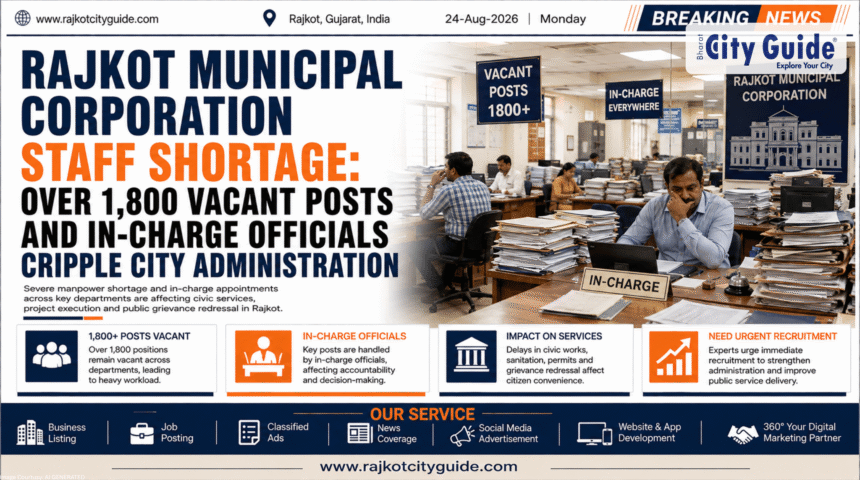
Urban local governance relies heavily on a robust administrative machinery to deliver daily essential services, manage city infrastructure, and enforce regulatory standards. In Rajkot, one of Gujarat’s fastest-growing industrial and commercial hubs, this vital municipal framework is facing a severe operational crisis. The Rajkot Municipal Corporation Staff Shortage has reached alarming levels, with 1,843 positions across various cadres remaining unfilled. This massive vacancy pool includes 50 high-level Class-1 and Class-2 officer posts, creating a administrative vacuum at the top executive tier of urban governance.
- Introduction
- What is Rajkot Municipal Corporation Staff Shortage?
- Why This News is Important
- Background Information
- Key Highlights
- Detailed Explanation of the Event
- Departmental Breakdown of Vacancies and Impact
- How It Impacts People
- Expert Insights and Industry Perspective
- Challenges and Limitations
- Future Outlook
- Frequently Asked Questions (FAQs)
- Conclusion
Even more troubling for civic administration is the heavy reliance on temporary arrangements. As many as 19 critical key positions within the corporation are currently operating without permanent, dedicated officers, running entirely on an “in-charge” (prabhari) basis. From city planning and civil engineering to public health, sanitation, and water supply supervision, key administrative portfolios are being managed by personnel forced to juggle multiple roles simultaneously.
This shortage directly affects public service delivery across Rajkot’s 18 administrative wards. Citizens visiting municipal zone offices face extended processing delays for routine tasks like building plan approvals, property tax assessments, birth and death certificate issuance, and trade license processing. As public infrastructure expands to meet the demands of a growing population, the lack of permanent municipal staff threatens to compromise urban development and daily civic operations.
                  ┌──────────────────────────────────────────────┐
                  │   RAJKOT MUNICIPAL CORPORATION STAFF STATS   │
                  │        Overview of Operational Deficit       │
                  └──────────────────────┬───────────────────────┘
                                         │
        ┌────────────────────────────────┼────────────────────────────────┐
        ▼                                ▼                                ▼
┌────────────────────────┐      ┌────────────────────────┐      ┌────────────────────────┐
│  TOTAL VACANT POSTS    │      │ SENIOR LEADERSHIP GAP  │      │ TEMPORARY GOVERNANCE   │
│ • 1,843 Open Positions │      │ • 50 Class-1 & Class-2 │      │ • 19 Key Posts Run by  │
│ • Across Class 1 to 4  │──────►   Leadership Positions │──────►   In-Charge Officials  │
│ • Severe Frontline Deficit    │ • Policy Bottlenecks   │      │ • Workload Inflation   │
└────────────────────────┘      └────────────────────────┘      └────────────────────────┘
What is Rajkot Municipal Corporation Staff Shortage?
The Rajkot Municipal Corporation Staff Shortage describes the systematic deficit between the sanctioned workforce strength of the Rajkot Municipal Corporation (RMC) and the actual personnel currently deployed on the ground. Over years of city expansion—incorporating new urban fringe areas, expanding ward boundaries, and launching smart city infrastructure initiatives—the municipality’s official workload has expanded rapidly. However, personnel recruitment, promotional cycles, and administrative sanctioning have failed to keep pace.
This vacancy gap spans all administrative tiers within the municipal framework:
- Class-1 Executive Officers: Top decision-makers responsible for departmental strategy, budget allocations, major infrastructure tenders, and city policy formulation.
- Class-2 Mid-Level Managers: Senior engineers, town planners, health officers, and deputy assessors who supervise field execution and approve technical permits.
- Class-3 Operational Staff: Clerks, junior engineers, revenue inspectors, sanitary inspectors, and computer operators who manage daily public desk transactions.
- Class-4 Support Personnel: Field laborers, ward sanitation staff, valve operators, and maintenance workers essential for direct physical services.
Why This News is Important
The scale of vacancies within Rajkot Municipal Corporation (RMC) is not merely an internal HR issue; it directly impacts urban management and civic life across the city:
- Slow Decision-Making: Key administrative posts operated by “in-charge” officers lead to delayed file clearances, stalled infrastructure tenders, and backlogged policy decisions.
- Compromised Field Quality: Without permanent supervisory staff in engineering, drainage, and road construction departments, field quality control for major public works suffers.
- Burnout Among Existing Personnel: Officers holding dual or triple charge face severe work pressure, leading to administrative fatigue and lower efficiency.
- Public Friction at Kiosks: Citizens experience repeated office visits, delayed approvals, and slower grievance redressal at central and zonal RMC offices.
Background Information
Over the past decade, Rajkot has experienced significant economic growth, expanding its geographic limits and population density. The inclusion of surrounding village panchayats into the RMC jurisdiction significantly increased the civic body’s scope of work. Substantial investments in urban infrastructure—including flyovers, BRTS corridors, underground drainage networks, solid waste management plants, and water distribution grids—demanded specialized technical and administrative oversight.
                [ CAUSES OF MUNICIPAL WORKFORCE EROSION ]
                                    │
  ┌─────────────────────────────────┼─────────────────────────────────┐
  ▼                                 ▼                                 ▼
[Natural Retirements]           [Delayed Sanctions]             [Urban Limit Expansion]
 • Continuous annual turn-off   • Lengthy approval pathways     • Added geographic wards
 • Lack of succession planning  • Pending state cadre tests     • Increased population density
 • Loss of institutional knowledge • Budgetary recruitment pauses • Skyrocketing ticket volume
However, municipal workforce sanctioned limits were not scaled proportionally, while natural retirements continued without immediate replacement recruitment drives. Institutional delays in state-level recruitment exams, administrative procedures for cadre approvals, and budgetary restrictions further widened the staff deficit, culminating in the current situation where nearly 1,850 positions remain open.
Key Highlights
- 1,843 Total Vacant Posts: A major workforce deficit across Class-1, Class-2, Class-3, and Class-4 operational cadres in the RMC.
- 50 Critical Senior Vacancies: Half a century of top executive posts (Class-1 and Class-2) lack permanent officers.
- 19 Key Positions Running on In-Charge Basis: Vital departments are managed by secondary officers handling dual responsibilities.
- Departmental Bottlenecks: Engineering, town planning, health, drainage, tax assessment, and solid waste management are among the most severely affected branches.
- Disrupted Public Services: Delays reported in trade licensing, building plan permissions, tax reassessment processing, and grievance resolution.
- Urban Growth Mismatch: City boundaries and public infrastructure have expanded rapidly, while municipal staffing has steadily contracted.
Detailed Explanation of the Event
The operational reality of the Rajkot Municipal Corporation Staff Shortage creates structural complications across the municipal machinery.
                    [ ADMINISTRATIVE BOTTLENECK CYCLE ]
                                     │
  Class-1/2 Senior Vacancies ──► 19 Key Posts Given to "In-Charge" Officers
                                                                 │
  Public Friction & Service Delays ◄── File Backlogs & Delayed Clearances ┘
1. The Senior Leadership Deficit (Class-1 and Class-2)
At the leadership level, 50 Class-1 and Class-2 posts are currently unfilled. These roles require qualified technical specialists, certified engineers, town planning officers, and senior public health officials. When these positions remain open, policy implementation stalls. Important files must route through a limited number of senior executives, creating severe bottlenecks for municipal approvals and major project tenders.
2. The “In-Charge” Governance Model
To prevent administrative collapse, the civic body has placed 19 key positions under “in-charge” (prabhari) arrangements. Under this structure, an officer holding a permanent post in one department (e.g., Water Works) is given the secondary responsibility of managing an entirely separate department (e.g., Town Planning or Solid Waste Management).
Because these officers must divide their working hours and focus between two or three demanding posts, decision-making naturally slows down, routine site visits are curtailed, and long-term planning gives way to basic day-to-day firefighting.
3. Frontline Operational Gaps (Class-3 and Class-4)
Beyond the headline executive vacancies, the bulk of the 1,843 open positions lies within Class-3 and Class-4 cadres. The lack of adequate junior engineers, sanitary inspectors, field supervisors, and clerical staff directly degrades basic municipal services. Ward-level sanitation inspections, drainage clearance checks, water pipe leak repairs, and public counter processing operate far below optimal capacity.
Departmental Breakdown of Vacancies and Impact
The staff shortage impacts several vital branches within the Rajkot Municipal Corporation:
| Department / Sector | Core Vacancy Nature | Operational Impact on Citizens | Administrative Consequence |
| Town Planning & Building | Senior Planners & Draftsmen | Delays in building plan approvals & occupancy certificates. | Stalled real estate projects & unauthorized construction risks. |
| Engineering & Drainage | Executive & Deputy Engineers | Slower road repair cycles, bridge maintenance, & drainage clears. | Infrastructure project overruns & reduced work quality checks. |
| Public Health & Sanitation | Health Officers & Sanitary Inspectors | Irregular garbage collection monitoring & vector control gaps. | Seasonal disease vulnerability & sanitation backlogs. |
| Revenue & Tax Department | Tax Inspectors & Clerical Cadres | Longer wait times for property tax assessments & NOCs. | Revenue collection delays & citizen queue congestion. |
| Water Supply & Works | Maintenance Technicians & Operators | Delayed response to pipe bursts & irregular supply monitoring. | Water wastage & inconsistent daily supply schedules. |
How It Impacts People
+-----------------------------------------------------------------------+
|                    IMPACT ON RAJKOT RESIDENTS & ECONOMY               |
+-----------------------------------+-----------------------------------+
|               GENERAL CITIZENS    |         PROPERTY DEVELOPERS       |
|  - Extended queue times at hubs   |  - Delayed building permits       |
|  - Slower complaint redressal     |  - Extended project holding costs |
|  - Inconsistent basic services    |  - Stalled commercial layouts     |
+-----------------------------------+-----------------------------------+
|               MUNICIPAL EMPLOYEES |         LOCAL BUSINESSES          |
|  - Excessive workload fatigue     |  - Delayed trade license issuance |
|  - Dual responsibility strain     |  - Fire safety certification gaps |
|  - Higher operational stress      |  - Slower municipal payments      |
+-----------------------------------+-----------------------------------+
For Common Citizens and Residents
Everyday civic life feels the strain of the workforce deficit. When residents visit RMC civic centers (Civic Center Hubs) to update property records, request water connections, or clear municipal dues, counter wait times are significantly extended due to shortage of clerical staff. Simple complaints filed through civic redressal apps regarding streetlights, drainage blockages, or road repairs often remain open longer because field inspection teams are understaffed.
For Real Estate Developers and Business Owners
The local business community and real estate sector face tangible economic consequences. Delays in obtaining Town Planning Scheme (TPS) clearances, layout permissions, and final completion certificates increase project holding costs for developers. Small business owners face similar procedural friction when seeking trade licenses, food safety clearances, or fire safety approvals.
For Existing Municipal Staff
For the current RMC workforce, the severe personnel deficit creates high operational pressure. Officers tasked with dual roles routinely work extended hours to manage incoming files across multiple departments. This sustained workload increases administrative stress and leaves minimal capacity for proactive urban planning or innovation.
Expert Insights and Industry Perspective
Governance experts and urban administration specialists emphasize that relying heavily on temporary or in-charge leadership dilutes administrative accountability.
                    [ PUBLIC GOVERNANCE FEEDBACK LOOP ]
                                     │
  ┌──────────────────────────────────┴──────────────────────────────────┐
  ▼                                                                     ▼
[Systemic Personnel Deficit]                      [Accountability & Execution Gaps]
 • Vacancies persist without recruitment           • In-charge officers lack full focus
 • Institutional knowledge erodes                  • Long-term urban planning suffers
 • Frontline supervision shrinks                   • Service quality becomes reactive
Public policy analysts point out that municipal governance requires dedicated, domain-specific leadership. An engineer managing both water supply and solid waste disposal can rarely dedicate necessary focus to strategic planning for either sector. Experts recommend that state authorities streamline the recruitment process through Gujarat Public Service Commission (GPSC) channels and municipal recruitment boards to ensure continuous replenishment of retiring staff.
Challenges and Limitations
Resolving the staffing crisis in the Rajkot Municipal Corporation presents several administrative and fiscal hurdles:
- Lengthy Recruitment Pathways: Conducting public competitive exams, interviewing candidates, verifying credentials, and completing appointments typically takes 12 to 18 months.
- State-Level Sanctions: Adding new sanctioned posts or altering cadre structures requires approval from the Urban Development Department of the State Government.
- Financial Ratios: Municipalities must balance administrative salary expenditure against capital spending budgets for city development projects.
- Retention of Skilled Professionals: Attracting and retaining specialized civil engineers, software experts, and urban planners within government pay scales remains challenging amidst private sector competition.
Future Outlook
Addressing the staffing crisis requires clear, sustained administrative action. In the coming months, civic leadership and elected representatives are expected to push for expedited recruitment drives and request state approval to fill core Class-1 and Class-2 vacancies.
If the recruitment process is fast-tracked, temporary relief can be provided through contract-based technical hires and direct cadre deputations from other state departments. However, establishing long-term administrative stability in Rajkot will require a permanent, structured recruitment strategy that expands municipal workforce capacity alongside the city’s physical growth.
Frequently Asked Questions (FAQs)
1. What is the total number of vacant posts in Rajkot Municipal Corporation?
There are currently 1,843 vacant posts across Class-1, Class-2, Class-3, and Class-4 cadres in the Rajkot Municipal Corporation.
2. How many senior leadership posts are lying vacant in RMC?
50 key Class-1 and Class-2 senior administrative and technical officer positions are vacant within the corporation.
3. What does running a municipal post on an “in-charge” basis mean?
It means a permanent officer from one department is assigned the temporary secondary duty of managing another department that lacks a dedicated officer.
4. How many key departments in RMC are currently run by in-charge officers?
Currently, 19 key positions and administrative portfolios within RMC are operating under temporary in-charge arrangements.
5. How does the staff shortage affect common citizens in Rajkot?
Citizens experience longer wait times at civic centers, delayed processing of building plans and trade licenses, and slower resolution of daily municipal complaints regarding drainage, water, and roads.
6. Which major municipal departments are most affected by vacancies?
The shortage heavily impacts Town Planning, Civil Engineering, Public Health and Sanitation, Revenue Tax Assessment, and Drainage and Water Works.
7. What steps are required to fill these vacant municipal posts?
Filling these positions requires recruitment drives organized through municipal recruitment boards and state channels like the GPSC, alongside formal cadre approvals from Gujarat’s Urban Development Department.
Conclusion
The Rajkot Municipal Corporation Staff Shortage presents a critical administrative challenge for one of Gujarat’s major urban centers. With 1,843 positions vacant and 19 crucial posts relying on in-charge management, the civic body’s capacity to deliver efficient public services, maintain infrastructure, and process development approvals is under severe strain. Expediting recruitment processes, filling senior leadership vacancies, and modernizing municipal human resource management will be essential to restoring administrative efficiency and supporting Rajkot’s continued urban growth.