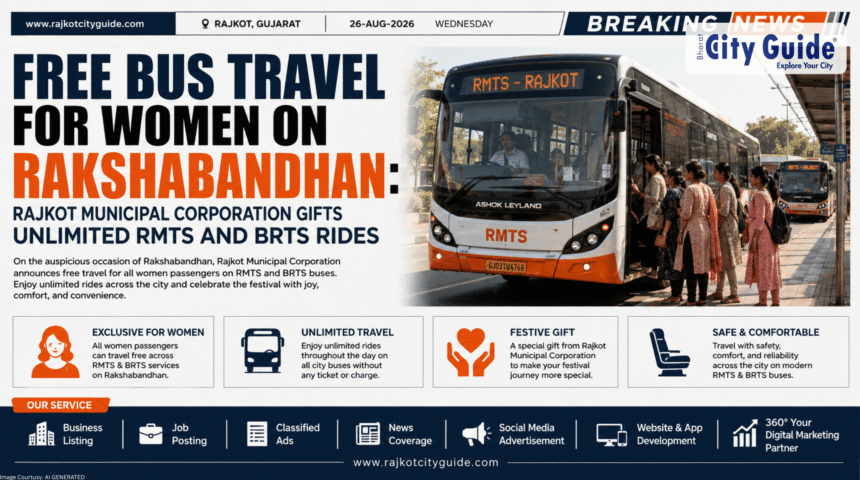
d affordable. In a significant festive gesture, the Rajkot Municipal Corporation (RMC) has announced a special public transport initiative offering Free Bus Travel For Women On Rakshabandhan across its entire urban transit network.
- What is Free Bus Travel For Women On Rakshabandhan?
- Why This News is Important
- Background Information
- Key Highlights
- Detailed Explanation of the Event
- Benefits, Features, and Importance
- How It Impacts People
- Expert Insights and Industry Perspective
- Challenges and Limitations
- Future Outlook
- Frequently Asked Questions (FAQs)
- Conclusion
Under this municipal welfare scheme, female passengers of all age groups can travel completely free of charge on all Rajkot Mass Transport Service (RMTS) city buses as well as the Bus Rapid Transit System (BRTS) corridor throughout the festival day. The urban body has removed all trip restrictions, allowing women to commute as many times as needed across any route in the city without purchasing a ticket.
This initiative addresses peak holiday traffic in Rajkot, where thousands of women navigate crowded streets to visit siblings, relatives, and festive markets. By removing fare barriers on city buses, the municipality reduces personal vehicle congestion on major roads like 150 Feet Ring Road, Yagnik Road, and Kalawad Road, while offering a safe, budget-friendly transit alternative for families across the urban center.
                  ┌──────────────────────────────────────────────┐
                  │   RMC RAKSHABANDHAN SPECIAL BUS INITIATIVE   │
                  │       Citywide Free Public Transit Scheme    │
                  └──────────────────────┬───────────────────────┘
                                         │
        ┌────────────────────────────────┼────────────────────────────────┐
        ▼                                ▼                                ▼
┌────────────────────────┐      ┌────────────────────────┐      ┌────────────────────────┐
│  COVERED TRANSIT MODES │      │   ELIGIBILITY & SCOPE  │      │   TRAFFIC & SOCIO IMPACT │
│ • RMTS City Buses      │      │ • All Female Riders    │      │ • Zero Fare Expenses   │
│ • 150 Ft Ring Rd BRTS  │──────► • Unlimited Daily Trips│──────► • Reduced Road Jams    │
│ • All Ward Feeder Lines│      │ • All Urban Bus Routes │      │ • Safe Festive Travel  │
└────────────────────────┘      └────────────────────────┘      └────────────────────────┘
What is Free Bus Travel For Women On Rakshabandhan?
The policy of Free Bus Travel For Women On Rakshabandhan is a festive fare-waiver initiative rolled out by the Rajkot Municipal Corporation (RMC) and operated through Rajkot Rajpath Limited (RRL). On the day of Rakshabandhan, female commuters traveling within municipal limits are exempt from paying standard passenger fares across all city transit routes.
Key components of the program include:
- Zero-Cost Tickets: Women board any operational RMTS or BRTS bus without purchasing standard stage tickets or daily passes.
- Unlimited Daily Mobility: Riders can take multiple trips throughout the day to reach various neighborhoods, market areas, and transit hubs without restrictions.
- Network-Wide Coverage: The waiver applies to both radial RMTS routes connecting outlying residential areas and high-frequency BRTS corridors along major thoroughfares.
- Universal Age Inclusion: Young girls, students, working women, and senior citizens automatically qualify for the fare exemption.
Why This News is Important
Providing free public transit during major cultural festivals creates measurable social, economic, and operational benefits across the city:
- Economic Relief for Families: Festival travel expenses add up quickly for households visiting multiple locations. Waiving fares provides direct financial savings.
- Easing Festival Road Congestion: Rakshabandhan generates peak traffic across urban centers. Encouraging bus travel helps reduce gridlock caused by private two-wheelers and auto-rickshaws.
- Ensuring Safe Mobility: Public buses offer a safe, reliable mode of transportation for women traveling alone or with young children during high-footfall festive days.
- Promoting Mass Transit: Experiencing free, comfortable public transit encourages residents who usually rely on private vehicles to consider buses for daily commutes.
Background Information
Over the past decade, urban local bodies across Gujarat—including Surat, Ahmedabad, and Rajkot—have periodically introduced special transport schemes during major cultural festivals. In Rajkot, urban mobility is managed by Rajkot Rajpath Limited (RRL), a special purpose vehicle established by the Rajkot Municipal Corporation. The RRL handles both the traditional Rajkot Mass Transport Service (RMTS) city bus fleet and the dedicated Bus Rapid Transit System (BRTS) running along the 150 Feet Ring Road corridor.
                [ PUBLIC TRANSIT CAPACITY IN RAJKOT ]
                                   │
  ┌────────────────────────────────┴────────────────────────────────┐
  ▼                                                                 ▼
[RMTS City Bus Fleet]                                    [BRTS Blue Line Corridor]
 • Connects interior wards & suburbs                     • High-speed dedicated lane
 • Feeder lines to Trikon Baug central hub               • Runs along 150 Feet Ring Road
 • High coverage across residential zones                • High passenger carrying capacity
Historically, festive travel creates major traffic spikes around central commercial hubs like Trikon Baug, Dharmendra Road, Yagnik Road, and Gundavadi. To prevent severe traffic bottlenecks and support citizen mobility, the RMC standing committee periodically approves full fare waivers for female passengers on Rakshabandhan.
Key Highlights
- 100% Fare Waiver: Complete ticket exemption for all women and girls traveling on Rakshabandhan.
- Unlimited Boarding: Female passengers can take unlimited trips throughout the day without route restrictions.
- Dual Network Coverage: Applicable across all RMTS city buses and the 150 Feet Ring Road BRTS bus corridor.
- Extra Fleet Deployment: RMC and Rajkot Rajpath Ltd. schedule supplementary trips on high-demand routes to handle passenger surges.
- No Prior Pass Required: Women do not need prior registration or specialized smart cards; direct boarding is permitted.
- Safety Supervision: Dedicated administrative control rooms and staff manage passenger flow at major stops like Trikon Baug.
Detailed Explanation of the Event
The implementation of Free Bus Travel For Women On Rakshabandhan relies on operational planning by the Rajkot Municipal Corporation (RMC) and Rajkot Rajpath Ltd.
                     [ FESTIVE TRANSIT OPERATION WORKFLOW ]
                                       │
  RMC Policy Announcement ──► Transit Control Room Fleet Optimization
                                            │
  Zero-Fare Passenger Boarding ◄── Driver/Conductor Directive Issuance ──────┘
1. Scope and Route Coverage
The fare waiver applies across the entire RMC municipal territory. This includes all active RMTS city bus routes that start from major transit terminals like Trikon Baug, Central Bus Station (ST Stand), Raiya Road, Kotech Chowk, Mavdi, and Aji Dam. Additionally, female commuters traveling on the BRTS blue line corridor—stretching across the 150 Feet Ring Road from Madhapar Chokdi to Gondal Road Chokdi—can enter stations and board buses without buying tokens or swiping smart cards.
2. Operational Logistics and Fleet Management
To handle the higher volume of festive commuters, Rajkot Rajpath Ltd. optimizes bus schedules. Operational steps include:
- Frequency Adjustments: Reducing headway times on high-demand routes connecting dense residential neighborhoods to commercial centers.
- Conductor Directives: Issuing clear guidelines to bus conductors and BRTS turnstile operators to allow seamless entry for female passengers without issuing paid receipts.
- Depot Monitoring: Keeping spare buses at main depots to deploy quickly if crowd levels spike at major junctions.
3. Safety and Crowd Control
Given the surge in passengers, safety measures are implemented across major bus stops. Monitoring teams track passenger boarding at high-density stops like Trikon Baug, Indira Circle, Nana Mava Chowk, and Kalawad Road Chowk to prevent overcrowding and maintain orderly boarding.
Benefits, Features, and Importance
The following table summarizes the key operational features of the Rakshabandhan transit scheme:
| Parameter / Operational Aspect | Regular Public Transit Operations | Rakshabandhan Special Policy | Strategic Community Benefit |
| Ticket Fare for Women | Standard distance fares | ₹0 (100% Free) | Direct monetary savings for households. |
| Ride Restrictions | Single-journey paid ticket | Unlimited daily trips | Complete mobility freedom across the city. |
| RMTS Coverage | Standard paid ticket/pass | Full free access | Connects suburban & interior residential wards. |
| BRTS Corridor Access | Standard token/smartcard | Free turnstile access | Rapid cross-city travel along Ring Road. |
| Access Requirements | Cash fare / Smart Pass | Direct boarding | Eliminates ticket counter wait times. |
How It Impacts People
+-----------------------------------------------------------------------+
|                    COMMUNITY IMPACT OF FREE FESTIVE TRANSIT           |
+-----------------------------------+-----------------------------------+
|               FEMALE COMMUTERS    |         CITY TRAFFIC SYSTEM       |
|  - Savings on travel costs        |  - Fewer private vehicles on road |
|  - Multi-stop visit flexibility   |  - Reduced junction bottlenecks   |
|  - Safe, reliable transport       |  - Lower festive carbon footprint |
+-----------------------------------+-----------------------------------+
|               SENIOR CITIZENS     |         LOCAL BUSINESSES          |
|  - Easy travel to relatives       |  - Higher footfall in markets     |
|  - Reduced travel anxiety         |  - Increased sales for retailers  |
|  - Comfortable, assisted rides    |  - Smooth access to commercial hubs|
+-----------------------------------+-----------------------------------+
For Women and Families
The primary beneficiaries are women visiting brothers and family members across Rajkot. Whether a commuter needs to take two trips or six throughout the day, removing bus fares eliminates travel costs during an otherwise expensive holiday season.
For City Traffic Management
Festival days typically bring severe traffic jams to Rajkot’s narrow central streets and major arterial roads. By making municipal buses free for women, a significant portion of festive commuters shifts from two-wheelers and auto-rickshaws to public transit. This modal shift keeps key intersections clearer and reduces traffic congestion across the city.
For Local Retailers and Market Hubs
Retail hubs near major transit nodes—such as Gundavadi, Dharmendra Road, Yagnik Road, and Crystal Mall—see increased footfall when public transit is free and accessible. Easy, cost-free transportation encourages residents to visit markets for last-minute shopping, supporting local shopkeepers and street vendors.
Expert Insights and Industry Perspective
Urban transport planners view targeted fare-waiver schemes during major festivals as an effective strategy for managing urban traffic and building long-term ridership.
                  [ FESTIVE URBAN MOBILITY FEEDBACK LOOP ]
                                     │
  ┌──────────────────────────────────┴──────────────────────────────────┐
  ▼                                                                     ▼
[Targeted Fare Exemption]                          [Urban Mobility Benefits]
 • Eliminates cost barrier on holidays              • Shifts riders from private vehicles
 • Drives trial use of public transit               • Eases peak holiday road congestion
 • Demonstrates network reliability                 • Builds long-term transit adoption
Transport experts point out that temporary fare exemptions serve as a practical trial opportunity for public transit systems. When residents who normally drive two-wheelers experience the convenience of dedicated BRTS lanes or air-conditioned city buses during a busy holiday, they are more likely to consider using public transit for daily work or study commutes.
Challenges and Limitations
While the initiative offers clear social benefits, managing peak holiday transit operations comes with practical challenges:
- Managing Peak Overcrowding: High ridership on popular routes can cause overcrowded buses, requiring extra fleet management to prevent boarding delays.
- Schedule Adherence in Traffic: RMTS buses operating on shared roads still face congestion at un-signalized intersections during peak holiday hours.
- Municipal Revenue Absorption: Waiving fares requires the municipal corporation to absorb the day’s operational costs and subsidize fuel and crew expenses.
Future Outlook
The success of festive transit initiatives has sparked discussions around expanding fare-concession frameworks in Gujarat’s major cities. Following successful Rakshabandhan implementations, urban local bodies are exploring similar incentives for other major holidays like Bhai Dooj and International Women’s Day.
Additionally, progressive transit policies—such as discounted annual passes for female students and working professionals—are gaining traction in urban transport planning. As Rajkot expands its electric bus fleet and extends BRTS feeder corridors, integrating gender-sensitive transit policies will remain a key focus for local city planners.
Frequently Asked Questions (FAQs)
1. Who is eligible for free bus travel in Rajkot on Rakshabandhan?
All female passengers, regardless of age or residential address, are eligible for 100% free bus travel on Rakshabandhan.
2. Which bus services are included under this free scheme?
The scheme covers the entire Rajkot Mass Transport Service (RMTS) city bus fleet as well as the Bus Rapid Transit System (BRTS) corridor along the 150 Feet Ring Road.
3. Is there a limit on how many times a woman can travel for free during the day?
No. There are no trip limits. Eligible riders can board buses as many times as needed throughout the day.
4. Do women need to show an ID card or carry a special pass to get free tickets?
No prior pass or registration is required. Women can board RMTS buses and enter BRTS stations directly without paying fares.
5. What are the operating hours for the free travel scheme on Rakshabandhan?
Free travel is available throughout the standard operating hours of the RMTS and BRTS networks on Rakshabandhan day.
6. Are male children traveling with their mothers allowed free travel?
Young children (typically under 5 years of age) travel free under standard transit rules. Standard ticketing rules apply for male passengers above the free-age threshold.
7. How does this scheme help manage city traffic on Rakshabandhan?
By encouraging women and families to take public transit, the scheme reduces the number of private two-wheelers and auto-rickshaws on the road, lessening traffic gridlock near major markets.
Conclusion
The provision of Free Bus Travel For Women On Rakshabandhan by the Rajkot Municipal Corporation is a practical, community-focused initiative that highlights how public transit can support cultural celebrations. By offering unlimited, zero-cost access across both RMTS and BRTS routes, the city ensures that women can visit loved ones safely, conveniently, and affordably. Beyond direct financial savings for families, the scheme helps ease holiday road congestion and promotes long-term adoption of public transportation across Rajkot.