Introduction
As the world shifts aggressively toward cleaner, non-fossil fuel alternatives, nuclear power has re-emerged at the center of global energy transition strategies. Amid this geopolitical shift, India is carving out a uniquely autonomous path. At an international academic conference hosted at Saurashtra University in Rajkot, Gujarat, pioneering Indian nuclear scientist and former Chairman of the Atomic Energy Commission, Dr. Anil Kakodkar, delivered a powerful assessment: through the strategic deployment of its massive domestic reserves, Thorium Nuclear Energy in India will establish the nation as an undisputed global leader in the atomic sector.
- Introduction
- What is Thorium Nuclear Energy in India?
- Why This News is Important
- Background Information
- Key Highlights from the Conference
- Detailed Explanation of the Event
- Benefits and Superiority of Thorium Nuclear Energy
- How It Impacts People
- Challenges and Technical Hurdles
- Future Outlook
- Frequently Asked Questions (FAQs)
- Conclusion
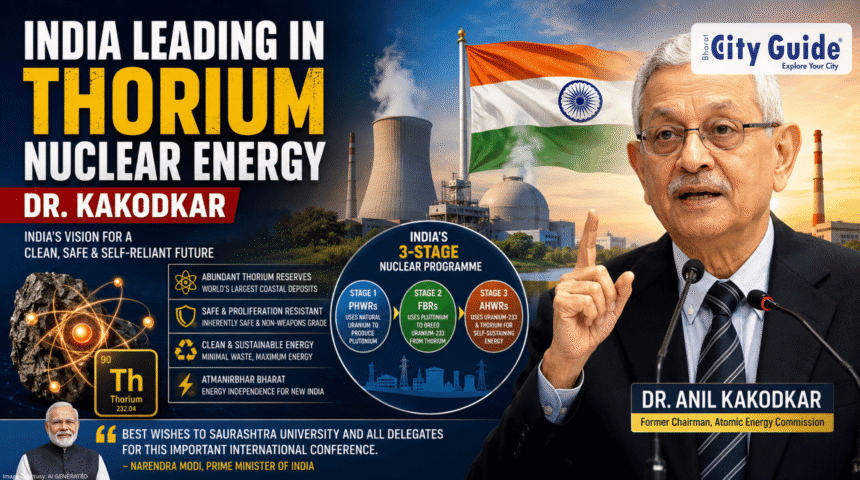
The high-level scientific event gained further momentum with an official message of support from Prime Minister Narendra Modi. The Prime Minister extended his best wishes to Saurashtra University and the global scientific delegates assembled at the summit. This direct prime ministerial acknowledgment underscores the deep national importance of the discussions, linking advanced atomic research with India’s broader macroeconomic goal of achieving comprehensive energy independence (Aatmanirbhar Bharat).
For decades, international nuclear discussions have been dominated by countries holding rich reserves of Uranium. However, India’s geographical reality is vastly different: it possesses constrained deposits of high-grade Uranium but boasts the world’s most extensive, premium coastal reserves of monazite sand—the primary mineral source of Thorium. Dr. Kakodkar’s remarks emphasize that transitioning to a Thorium-centered energy model is not just an alternative path, but an essential strategic pivot. This article details the historic Saurashtra University conference, breaks down the science of the three-stage nuclear expansion, and explores how Thorium will secure India’s long-term socioeconomic and environmental future.
What is Thorium Nuclear Energy in India?
Thorium Nuclear Energy in India refers to the long-term, multi-stage strategy devised by India’s atomic pioneers—most notably Dr. Homi J. Bhabha—to utilize Thorium-232 (232Th) as the primary fuel source for generating clean, baseload electricity. Unlike Uranium-235 (235U), which is “fissile” and can sustain a nuclear fission chain reaction on its own, Thorium is “fertile.” This means it cannot split directly to produce energy; instead, it must first absorb a neutron inside a nuclear reactor to convert into a highly fissile isotope of Uranium, specifically Uranium-233 (233U).
Because of this unique nuclear chemistry, exploiting Thorium requires a sophisticated, sequential approach known as India’s Three-Stage Nuclear Power Programme:
In the final phase, the Advanced Heavy Water Reactor (AHWR) utilizes a blended core of Uranium-233 and Thorium. As the reactor runs, it continuously transmutes raw Thorium into fresh Uranium-233 at a rate equal to or greater than what it consumes. This creates an incredibly efficient, nearly endless cycle of sovereign clean energy.
Why This News is Important
This latest declaration from the Saurashtra University conference carries immense weight on both domestic and global stages. Globally, it sends a clear signal that India is rapidly moving closer to operationalizing the final, holy grail stage of its indigenous nuclear cycle. While many developed countries slowed down their nuclear innovation programs post-Fukushima, India has consistently accelerated its research, positioning itself as a primary center for advanced heavy-water and fast-breeder engineering.
Domestically, the news highlights a vital shift: cutting-edge scientific discourse is moving beyond elite national laboratories into regional academic institutions like Saurashtra University. By creating an open forum for dialogue between veteran policymakers like Dr. Kakodkar and young university researchers, India is actively building the intellectual capital needed to sustain its high-tech industries. Prime Minister Modi’s direct letter of encouragement reinforces this synergy, showing a unified national push to merge academic excellence with critical energy policy.
Background Information
India’s push for Thorium technology was originally born out of geopolitical necessity. Following India’s peaceful nuclear explosion experiment at Pokhran in 1974, major global powers imposed strict technology and material embargoes through the Nuclear Suppliers Group (NSG). Denied access to global Uranium markets for decades, Indian scientists at the Bhabha Atomic Research Centre (BARC) were forced to innovate independently.
Dr. Anil Kakodkar was a key architect during this challenging period of isolation. He led the design and engineering of the 100-megawatt Dhruva research reactor and spent his tenure as DAE Chairman perfecting the thermal-hydraulic blueprints for the Advanced Heavy Water Reactor (AHWR).
The geopolitical landscape shifted with the signing of the Indo-US Civil Nuclear Deal and the subsequent NSG waiver, which finally allowed India to import foreign Uranium to power its early-generation Pressurized Heavy Water Reactors (PHWRs). However, as Dr. Kakodkar recently pointed out, relying permanently on imported Uranium leaves a nation vulnerable to shifting foreign policies and market price spikes. India holds roughly 25% of the global supply of Thorium, with over 1,000,000 tonnes bound within the monazite sands of the coastal stretches of Kerala, Tamil Nadu, and Odisha. Consequently, achieving ultimate energy sovereignty has always depended entirely on unlocking this massive Thorium potential.
Key Highlights from the Conference
- Global Dominance: Dr. Anil Kakodkar stated that mastering the Thorium fuel cycle will put India at the absolute forefront of global nuclear energy capability.
- PM Modi’s Support: Prime Minister Narendra Modi issued an official message of encouragement, praising Saurashtra University for organizing the international scientific summit.
- Self-Reliance Focus: The conference emphasized transitioning away from imported Uranium by utilizing India’s massive, indigenous coastal Thorium reserves.
- Academic Synergy: The event successfully bridged national scientific policy with university-level education, encouraging a new generation of Gujarati students to enter nuclear sciences.
- Safety & Sustainability: Technical presentations highlighted that Thorium-fueled systems inherently offer superior passive safety profiles and leave behind a significantly smaller long-term radioactive waste footprint compared to traditional reactors.
Detailed Explanation of the Event
The International Scientific Conference at Saurashtra University brought together an elite group of physicists, nuclear engineers, policy analysts, and international delegates. The overarching theme focused on exploring sustainable energy alternatives to help India achieve its aggressive climate mandate of hitting Net-Zero carbon emissions by 2070, while supporting its fast-accelerating industrial growth.
Taking the podium, Dr. Kakodkar explained that while the initial stages of India’s nuclear road map relied heavily on natural and enriched Uranium, the ultimate goal has always been Thorium. He detailed how India’s current fleet of 220 MWe and 700 MWe Pressurized Heavy Water Reactors (PHWRs) are performing exceptionally well, providing the vital foundational material needed to fuel the second stage: Fast Breeder Reactors (FBRs).
The ongoing commissioning and trial phases of the 500 MWe Prototype Fast Breeder Reactor (PFBR) at Kalpakkam represent the crucial operational bridge. Once these breeder reactors begin operating on a commercial scale, they will use a blanket of Thorium to generate large amounts of Uranium-233. Dr. Kakodkar expressed immense confidence that the technical challenges surrounding Thorium processing, remote fuel fabrication, and handling the intense gamma radiation of byproducts have been systematically solved by Indian scientists, paving the way for full-scale global leadership.
Benefits and Superiority of Thorium Nuclear Energy
The widespread adoption of Thorium over conventional Uranium provides several profound advantages:
1. Superior Proliferation Resistance
A major concern with traditional Uranium-driven nuclear power is the risk of weaponization, as enrichment facilities can potentially produce weapons-grade uranium or plutonium. Thorium cycles are inherently resistant to this. The transformation of Thorium into Uranium-233 always creates a trace byproduct isotope, Uranium-232 (232U), which emits intense, high-energy gamma radiation. This makes the fuel highly dangerous and technically impossible to handle or divert for illicit weapons manufacturing without immediate detection.
2. High Element Abundance and Fuel Efficiency
Thorium is roughly three to four times more abundant in the earth’s crust than Uranium. Furthermore, inside a properly optimized reactor core, nearly all mined Thorium can be utilized as fuel, compared to traditional reactors which only burn a tiny fraction (less than 1%) of natural Uranium. This means a single ton of Thorium can generate an equivalent amount of electricity to hundreds of tons of conventional Uranium.
3. Excellent Passive Safety Systems
Thorium-fueled reactors, like India’s proposed AHWR, incorporate advanced passive safety mechanisms. In the event of a sudden power surge or a total loss of external electrical power, the reactor core relies on natural physical laws—such as gravity-driven cooling water pools and natural siphon circulation—to cool itself down automatically without needing human intervention or emergency diesel generators.
4. Greatly Reduced Radioactive Waste Footprint
The long-term storage of nuclear waste is a global challenge. Thorium reactors produce significantly fewer long-lived transuranic actinides (highly toxic radioactive elements that persist for tens of thousands of years). The bulk of Thorium waste decays down to safe radiation levels within a few hundred years, drastically simplifying long-term geologic repository management.
How It Impacts People
The progress of Thorium Nuclear Energy in India will directly transform everyday life across the nation:
- For Everyday Citizens and Consumers: Nuclear power provides reliable, uninterrupted base-load electricity that does not fluctuate with the weather, unlike solar or wind power. Widespread nuclear adoption ensures clean power grids, more stable electricity tariffs, and a massive drop in hazardous urban air pollution.
- For University Students and Researchers: The spotlight on Saurashtra University shows that regional academic ecosystems are becoming major hubs for high-tech research opportunities. Students gain direct access to well-funded fellowships, advanced laboratories, and career paths within the Department of Atomic Energy (DAE) and the Nuclear Power Corporation of India Limited (NPCIL).
- For Industrial and Economic Progress: A self-sustaining atomic grid protects Indian industries from global fossil fuel price volatility, keeping local manufacturing competitive on the global stage.
Challenges and Technical Hurdles
Despite the brilliant potential outlined by Dr. Kakodkar, transitioning to a full Thorium economy comes with real challenges:
- High Melting Point Logistics: Thorium dioxide (ThO2) has an exceptionally high melting point (around 3,300∘C). This requires specialized, highly expensive manufacturing facilities to shape the material into reactor fuel rods.
- Delayed Commercialization Timelines: Building and testing fast-breeder technology takes a long time. The secondary breeding phase must run for several decades to generate enough Uranium-233 inventory to fully launch the third stage on a national scale.
- Public Perception Barriers: Despite its excellent safety profile, any nuclear expansion must overcome public anxiety regarding radiation safety and waste management through transparent, community-focused education.
Future Outlook
The coming decade will be a defining chapter for India’s atomic energy sector. As commercial fast-breeder designs are standardized and the initial test beds for Advanced Heavy Water Reactors go live, India will gradually transition from a country that imports nuclear components to a leading exporter of proliferation-resistant, thorium-capable reactor technology to developing nations worldwide. Guided by the clear-eyed vision of veterans like Dr. Kakodkar and backed by strong political support from the highest levels of government, India’s journey toward becoming a sovereign, clean-energy superpower is well underway.
Frequently Asked Questions (FAQs)
1. Why does Dr. Anil Kakodkar believe Thorium will make India a global nuclear leader?
India holds the world’s largest reserves of Thorium. By successfully developing indigenous technologies to convert this Thorium into usable atomic fuel, India can bypass global Uranium cartels, achieve total energy independence, and export advanced, safe reactor designs worldwide.
2. What was the significance of the conference at Saurashtra University?
The international conference brought together elite global and national scientists to discuss clean energy solutions, highlighted by an official message of support and best wishes from Prime Minister Narendra Modi.
3. Can Thorium be used directly as fuel in a nuclear reactor?
No. Thorium is a “fertile” material, meaning it cannot split on its own to generate power. It must first be placed inside a reactor where it absorbs neutrons and converts into Uranium-233, which is a highly effective, fissile nuclear fuel.
4. What are the three stages of India’s nuclear power programme?
- Stage 1: Pressurized Heavy Water Reactors (PHWRs) using natural Uranium to produce Plutonium.
- Stage 2: Fast Breeder Reactors (FBRs) using Plutonium to turn Thorium into Uranium-233.
- Stage 3: Advanced Heavy Water Reactors (AHWRs) running on a self-sustaining Uranium-233 and Thorium cycle.
5. Is Thorium safer than conventional Uranium?
Yes. Thorium-fueled reactors produce less long-term radioactive waste, operate with excellent passive safety systems that prevent meltdowns naturally, and produce trace byproducts that prevent the fuel from being secretly diverted for weapons manufacturing.
6. Where are India’s major Thorium deposits found?
The bulk of India’s Thorium is found within monazite sand deposits concentrated along the coastal beaches of Kerala, Tamil Nadu, Andhra Pradesh, and Odisha.
Conclusion
The inspiring insights shared by Dr. Sequential Kakodkar at the Saurashtra University international conference illuminate a bright path forward for the nation’s grid infrastructure. Developing Thorium Nuclear Energy in India is far more than a specialized scientific pursuit; it is the ultimate key to unlocking permanent energy independence and protecting the country from global resource conflicts. Backed by strong support from Prime Minister Narendra Modi and built on decades of brilliant, independent research by BARC and DAE scientists, India is steadily turning its vast coastal sands into a clean, safe, and inexhaustible power source. By mastering the complex physics of the Thorium fuel cycle, India is firmly on track to lead the global community toward a sustainable, carbon-free future.