Introduction
As one of the fastest-growing urban hubs in Gujarat’s Saurashtra region, Rajkot continues to experience a rapid surge in industrial activity, population expansion, and civic infrastructure demands. To keep pace with this accelerating urban footprint, the local municipal body regularly convenes administrative sessions to review, approve, and implement critical public works projects. The recent Rajkot Standing Committee Meeting represents a key administrative milestone in this ongoing effort, bringing several major infrastructure, environmental, and municipal development proposals before civic leaders for official evaluation and financial clearance.
- Introduction
- What is Rajkot Standing Committee Meeting?
- Why This News is Important
- Background Information
- Key Highlights
- Detailed Explanation of the Event
- Benefits, Features, and Importance
- How It Impacts People
- Expert Insights and Industry Perspective
- Challenges and Limitations
- Future Outlook
- Frequently Asked Questions (FAQs)
- Conclusion
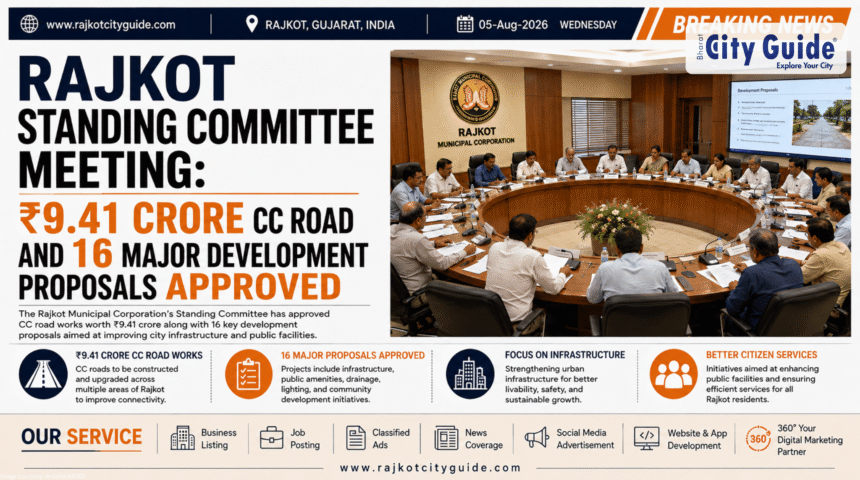
In this landmark executive session, municipal leaders discussed and approved a total of 16 comprehensive development proposals designed to modernize city facilities and enhance public services. Highlighting the meeting agenda is a major road construction project: a 1-kilometer cement concrete (CC) road carrying an estimated construction cost of ₹9.41 crore. Formulated following specific structural guidance and urban planning advice from Chief Minister Bhupendra Patel, this high-durability road project aims to provide long-term resilience against monsoon damage and heavy traffic wear in a key transit corridor.
Beyond road modernization, the standing committee addressed key environmental initiatives, public safety upgrades, urban beautification, and municipal administrative workflows. By converting high-traffic asphalt streets into heavy-duty concrete structures and expanding urban forestry through dedicated tree plantation drives, the civic body is building an infrastructure ecosystem capable of supporting Rajkot’s economic trajectory over the coming decades.
What is Rajkot Standing Committee Meeting?
The Rajkot Standing Committee Meeting is the primary executive and financial decision-making forum within the Rajkot Municipal Corporation (RMC). While the general body of elected municipal councillors provides broad legislative oversight, the Standing Committee serves as the practical executive arm that reviews financial estimates, awards public works contracts, authorizes capital expenditures, and approves urban development policies.
Composed of senior municipal leaders and chaired by the Standing Committee Chairman, this executive body acts as a financial gatekeeper and operational engine for city governance. Every major project proposed by the Municipal Commissioner or various civic engineering departments—ranging from water supply pipelines and drainage networks to street lighting, public parks, and road paving—must pass through this committee for formal scrutiny, budget allocation, and sanction.
Sessions of the standing committee are held at regular intervals at the RMC headquarters. During these meetings, committee members evaluate engineering feasibility reports, cost estimates submitted by private contractors, environmental compliance parameters, and project completion timelines. Approval by the standing committee enables administrative departments to issue formal work orders, deploy municipal funds, and commence physical execution on the ground.
Why This News is Important
Urban centers require continuous capital investment to prevent infrastructure decay, reduce traffic congestion, and maintain public health standards. The decisions finalized during this recent committee session carry significant importance for multiple civic stakeholders across Rajkot:
1. Transition to Climate-Resilient Urban Roads
Traditional asphalt (bitumen) roads frequently deteriorate during heavy monsoon rains, leading to potholes, traffic delays, and high annual repair costs. Spending ₹9.41 crore on a 1-kilometer concrete road introduces high-strength engineering standards capable of withstanding heavy vehicle loads and intense seasonal downpours without structural failure.
2. High-Level Administrative Coordination
The direct incorporation of state leadership guidance—specifically advice from Chief Minister Bhupendra Patel—underscores alignment between local municipal priorities and state-level urban development visions. This cooperation speeds up project approvals and financial clearances.
3. Balanced Approach to Urban Growth
With 16 distinct proposals on the agenda, the standing committee session balanced heavy engineering projects with green environmental drives, public sanitation measures, and community welfare initiatives, fostering holistic urban expansion.
4. Efficient Municipal Resource Management
Systematic committee review ensures that public tax revenue is allocated through transparent bidding, rigorous cost evaluations, and structured project timelines, minimizing cost overruns and operational delays.
Background Information
Over the past decade, Rajkot has transformed from a regional trading town into a major industrial and commercial engine, heavily driven by auto-component manufacturing, casting foundries, jewelry production, and real estate expansion. The expansion of city limits, along with the integration of surrounding suburban villages into the RMC boundary, has placed unprecedented demands on local infrastructure networks.
+-------------------------------------------------------------------------+
|                  RAJKOT URBAN EXPANSION CHALLENGES                      |
+-------------------------------------------------------------------------+
                                     |
    +--------------------------------+--------------------------------+
    |                                |                                |
    v                                v                                v
+------------------------+  +------------------------+  +------------------------+
| High Traffic Volume    |  | Seasonal Waterlogging  |  | Infrastructure Aging   |
| Heavy commercial trucks|  | Monsoon road erosion   |  | Bitumen roads needing  |
| and urban commuters    |  | on low-lying arterial  |  | annual resurfacing     |
| straining arterial lanes| | transit corridors      |  | and frequent patching  |
+------------------------+  +------------------------+  +------------------------+
Asphalt roads in heavy-traffic industrial corridors and busy commercial zones often require annual resurfacing due to seasonal waterlogging and continuous wear from heavy freight vehicles. Recognizing the financial inefficiency of repeated asphalt patching, urban planners across Gujarat have shifted toward Cement Concrete (CC) road design for high-load corridors. Although CC roads require higher upfront capital investment, they offer a service life of 20 to 30 years with minimal maintenance, yielding significant long-term savings for civic bodies.
Concurrently, rapidly expanding concrete infrastructure can create urban heat island effects and decrease green cover. To balance these physical civil works, municipal urban planning policies mandate integrating extensive tree plantation drives, park developments, and green belt preservation into standard city administration workflows.
Key Highlights
The primary outcomes and decisions from the executive municipal meeting include:
- Approval of 16 Key Proposals: The committee reviewed and acted upon 16 major municipal work proposals covering infrastructure, civic amenities, and urban forestry.
- ₹9.41 Crore CC Road Allocation: Sanctioned the construction of a 1-kilometer long, heavy-duty Cement Concrete (CC) road engineered to handle high traffic loads.
- Alignment with State Guidance: Project specifications incorporate urban infrastructure guidelines recommended by Chief Minister Bhupendra Patel.
- Urban Forestry and Plantation Drives: Approved targeted greening initiatives to increase city tree cover along road dividers, public parks, and vacant civic plots.
- Drainage and Utility Integration: Paving plans include underground utility channels and storm-water drainage integration to prevent surface water accumulation.
- Enhancements to Public Services: Additional proposals focus on upgrading street lighting, municipal water distribution, and neighborhood sanitation systems.
Detailed Explanation of the Event
The recent agenda of the Rajkot Standing Committee Meeting highlights a deliberate effort by the municipal administration to combine durable civil engineering with environmental stewardship.
+-----------------------------------------------------------------------+
|                STANDING COMMITTEE DECISION FLOWCHART                  |
+-----------------------------------------------------------------------+
                                    |
                                    v
+-----------------------------------------------------------------------+
|             STANDING COMMITTEE SCALING & FINANCIAL APPROVAL           |
+-----------------------------------------------------------------------+
        |                                   |                   |
        v                                   v                   v
+-----------------------+   +-----------------------+   +-----------------------+
|  ₹9.41 Cr CC Road     |   |   Urban Greening      |   |  14 Other Civic       |
| - 1 km heavy-duty     |   | - Tree plantations    |   |   Proposals           |
| - Long-term durability|   | - Green belt covers   |   | - Drainage & Lighting |
| - High traffic load   |   | - Park maintenance    |   | - Water supply systems|
+-----------------------+   +-----------------------+   +-----------------------+
The ₹9.41 Crore Cement Concrete (CC) Road Project
The primary highlight of the meeting was the formal approval of a ₹9.41 crore budget allocation for a 1-kilometer concrete road section. While a cost of nearly ₹9.41 crore per kilometer represents a significant investment, the technical scope accounts for more than simple surface paving:
- Sub-Base and Structural Engineering: Deep excavation, heavy sub-grade stabilization, and reinforced concrete slab laying designed to bear heavy freight and transit vehicles.
- Integrated Stormwater Drainage: Parallel underground drainage channels to divert rainwater away from the road surface, eliminating standing water—the primary cause of road deterioration.
- Utility Corridors: Pre-installed utility ducts for water pipes, electrical cables, and telecommunication lines, preventing future trenching that destroys road surfaces.
- Pedestrian Footpaths and Safety Barriers: Paved walkways, street lighting infrastructure, and clear road markings to ensure pedestrian safety alongside motor traffic.
Environmental Plantation and Beautification Drives
Alongside civil engineering allocations, the standing committee prioritized environmental health by approving comprehensive tree plantation drives. These initiatives aim to plant native, drought-resistant tree species along major road margins, central dividers, and municipal reserves, helping lower urban temperatures, absorb carbon emissions, and enhance visual aesthetics across transit corridors.
Comprehensive Civic Works Review
The remaining 14 proposals approved during the session cover a broad spectrum of municipal operations, including upgrading municipal water pipelines, modernizing street lighting with energy-efficient LED systems, expanding public health facilities, and refining municipal solid waste management workflows.
Benefits, Features, and Importance
The executive approvals granted during the committee session provide short-term operational improvements and long-term strategic benefits for Rajkot:
+-----------------------------------------------------------------------+
|                    SUMMARY OF COMMUNITY BENEFITS                      |
+-----------------------------------------------------------------------+
|  1. LONG-TERM DURABILITY | CC roads last 20+ years without potholes   |
|  2. MONSOON RESILIENCE   | Integrated drainage stops waterlogging     |
|  3. FINANCIAL EFFICIENCY | Saves municipal funds on annual road repairs|
|  4. ECOLOGICAL BALANCE   | Tree drives counter urban heat accumulation|
|  5. SMOOTHER TRAFFIC     | Eliminates bottlenecks caused by road wear  |
+-----------------------------------------------------------------------+
Key Technical Advantages
- Extended Service Life: CC roads last substantially longer than asphalt alternatives, remaining structural intact for decades under heavy traffic conditions.
- Monsoon Resilience: Rigid concrete surfaces resist rain damage, oil spills, and water pooling, ensuring uninterrupted vehicle movement during heavy monsoon downpours.
- Lower Lifecycle Costs: Higher initial capital expenditures are offset by near-zero surface maintenance requirements over the road’s operating lifespan.
- Enhanced Environmental Resilience: Dedicated urban greening balances civil construction, absorbing emissions and providing shade along major commuter lines.
- Improved Fuel Efficiency: Smooth, un-rutted concrete roadways lower rolling resistance for transit vehicles, reducing fuel consumption and emissions.
How It Impacts People
The implementation of these committee-approved projects directly affects multiple groups of city residents and stakeholders:
Daily Commuters and Motorists
For commuters, replacing degraded asphalt with a smooth, heavy-duty concrete road eliminates pot-hole hazards, protects vehicles from mechanical wear, reduces travel times, and lowers the risk of monsoon traffic jams.
Local Business Owners and Logistics Operators
Reliable transport corridors enable commercial transport operators and local businesses to move raw materials and finished goods efficiently. Smooth roads minimize transit delays and prevent vehicle damage for logistics providers operating in nearby industrial clusters.
Neighborhood Residents
Families living near newly paved and greened corridors benefit from reduced road noise, lower dust pollution, better stormwater drainage during heavy rains, and improved neighborhood aesthetics from roadside tree drives.
Taxpayers and Civic Community
By investing in long-lasting concrete infrastructure, the RMC reduces the need for repeated annual road repairs, allowing municipal tax dollars to be redirected toward healthcare, education, and public parks.
Expert Insights and Industry Perspective
Civil engineers, urban planners, and municipal finance specialists consistently advocate for long-term lifecycle planning in municipal infrastructure.
                       +-------------------------+
                       |    THREE PILLARS OF     |
                       | MODERN URBAN PAVEMENTS  |
                       +-------------------------+
                                    |
          +-------------------------+-------------------------+
          |                         |                         |
          v                         v                         v
+-------------------+     +-------------------+     +-------------------+
| Structural Load   |     | Drainage First    |     | Utility Ducts     |
| High-grade concrete|    | Diverting surface |     | Dedicated spaces  |
| for heavy freight |     | water to preserve |     | to avoid future   |
| vehicle support   |     | pavement sub-base |     | road cutting      |
+-------------------+     +-------------------+     +-------------------+
Key principles highlighted by urban engineering experts include:
- Prioritizing Lifecycle Value over Initial Cost: While asphalt roads offer lower initial construction costs, concrete pavements deliver significantly greater long-term value in regions prone to heavy monsoon rains and high traffic loads.
- Integrated Sub-Surface Infrastructure: Modern road engineering requires building drainage and utility corridors alongside road surfaces. Constructing pavements without proper drainage leads to premature structural failure, regardless of the paving material used.
- Balancing Concrete with Canopy Cover: Urban planners stress that extensive paving must be paired with aggressive urban forestry programs to prevent rising localized temperatures and maintain urban environmental balance.
Challenges and Limitations
While the approved proposals bring clear long-term benefits, executing high-budget urban infrastructure projects introduces notable operational challenges:
- Short-Term Traffic Disruption: Constructing concrete roads requires complete section closures for extended curing periods (often 21 to 28 days), requiring temporary traffic detours and causing localized congestion.
- Managing High Capital Costs: Allocating ₹9.41 crore for a 1-kilometer road section absorbs significant capital resources, requiring strict financial management across other municipal departments.
- Inter-Departmental Utility Coordination: Preventing future road damage requires gas, water, electricity, and telecom utilities to complete underground installations before concrete pouring begins.
- Plantation Survival Rates: Ensuring high survival rates for newly planted trees amidst ongoing urban traffic and seasonal climate variations requires sustained watering and protective fencing.
Future Outlook
Looking ahead, the decisions made at this standing committee session reflect a broader evolution in how Rajkot manages urban infrastructure and civic expansion:
- Standardization of Concrete Corridors: As high-traffic asphalt streets reach the end of their design lives, the RMC is likely to transition additional key transit lines to cement concrete construction.
- Smart Infrastructure Integration: Future road projects will increasingly incorporate smart traffic monitoring sensors, automated street lighting systems, and rain-water harvesting channels within the pavement structure.
- Data-Driven Green Mapping: Civic bodies are moving toward GIS mapping to track tree plantation drives, monitor sapling growth rates, and identify areas lacking sufficient green cover.
- Accelerated Project Timelines: With direct state-level guidance and streamlined committee approvals, municipal work orders are expected to transition faster from approval to physical execution.
Frequently Asked Questions (FAQs)
Q1: What was the main financial allocation approved during the Rajkot Standing Committee Meeting?
A: The standing committee approved a ₹9.41 crore allocation to construct a 1-kilometer long, heavy-duty Cement Concrete (CC) road designed for long-term durability.
Q2: How many total proposals were approved during this standing committee session?
A: A total of 16 different civic proposals covering infrastructure, public works, tree plantations, and municipal management were considered and approved.
Q3: Why is a Cement Concrete (CC) road preferred over traditional asphalt paving?
A: CC roads offer far greater structural durability, resist waterlogging damage during monsoons, require minimal maintenance, and last 20 to 30 years—making them ideal for heavy traffic corridors.
Q4: Whose administrative guidance was incorporated into the CC road project planning?
A: The project planning and structural specifications incorporated advice and urban development guidelines provided by Chief Minister Bhupendra Patel.
Q5: What environmental measures were approved during the meeting?
A: The committee approved dedicated tree plantation drives along road margins, central dividers, and civic spaces to expand city green cover and balance concrete construction.
Q6: How does the higher cost of CC roads benefit city taxpayers over time?
A: Although CC roads require higher upfront expenditure, their 20 to 30 year lifespan eliminates the need for expensive annual asphalt patching and resurfacing, saving civic funds over time.
Q7: Will utility pipelines be placed under the new road?
A: Modern CC road engineering standards include dedicated underground utility channels along the roadway, allowing future pipeline or cable work without breaking the concrete surface.
Q8: When will physical construction work on these approved proposals begin?
A: Following standing committee financial sanction, the RMC engineering departments issue formal work orders, clear site access, and initiate field construction according to project schedules.
Conclusion
The recent Rajkot Standing Committee Meeting represents a decisive step forward in modernizing the city’s civic infrastructure and enhancing long-term urban quality of life. By committing ₹9.41 crore to a 1-kilometer cement concrete road project, municipal leaders are prioritizing climate-resilient, low-maintenance transport engineering over temporary fixes.
Combined with tree plantation drives and 15 additional civic improvement proposals, these executive approvals demonstrate a balanced approach to urban growth. As physical execution begins across the city, residents can look forward to smoother transit, reduced monsoon road damage, better public amenities, and a greener urban environment—positioning Rajkot to handle its rapid growth effectively.