Introduction
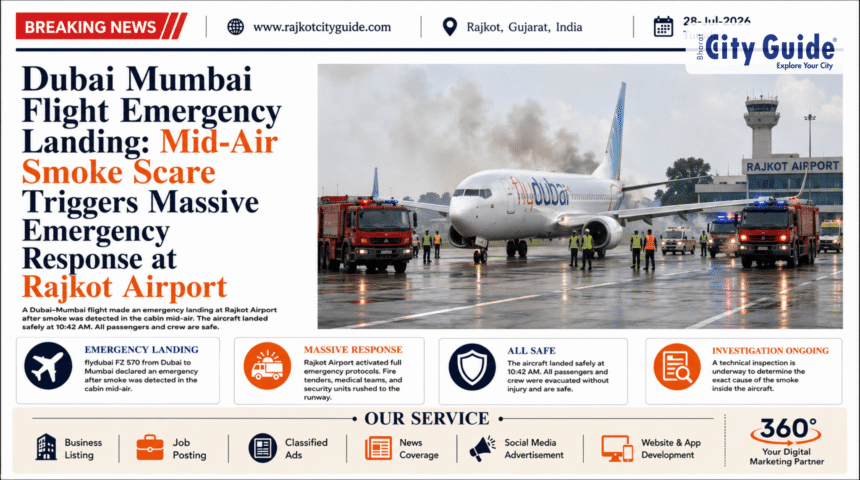
A standard commercial journey turned into a high-stakes race against time when a mid-air emergency sent shockwaves through the Indian aviation sector. An IndiGo Airbus A321 aircraft, operating flight 6E 1452 from Dubai International Airport to Chhatrapati Shivaji Maharaj International Airport in Mumbai, was forced to execute an immediate, unscheduled diversion. While cruising over the Gujarat airspace, the cockpit crew detected a serious technical issue: an ominous smoke warning emanating directly from the aircraft’s cargo hold area.
- Introduction
- What is a Dubai Mumbai Flight Emergency Landing?
- Why This News is Important
- Background Information
- Key Highlights
- Detailed Explanation of the Event
- Technical Features of Aviation Safety Systems
- How It Impacts People
- Expert Insights and Industry Perspective
- Challenges and Limitations
- Future Outlook
- Frequently Asked Questions (FAQs)
- Conclusion
Recognizing the potential severity of an uncontrolled fire or smoke development at high altitude, the pilot in command swiftly declared a “Mayday” status to Air Traffic Control (ATC). This critical distress call set off an unprecedented, multi-department emergency response on the ground. The flight was immediately routed to the newly operational Rajkot International Airport (also known as Hirasar Airport).
As the aircraft descended, a total of 194 lives hung in the balance, creating a palpable state of tension both inside the cabin and across regional administrative centers. The subsequent events showcased a flawless masterclass in aviation crisis management, disaster preparedness, and inter-agency coordination. This comprehensive blog article analyzes the minute-by-minute details of the incident, the swift execution of safety protocols, and the overarching lessons for international aviation safety standards.
What is a Dubai Mumbai Flight Emergency Landing?
A Dubai Mumbai flight emergency landing refers to a critical event where an aircraft scheduled to fly between Dubai (one of the world’s busiest international transport hubs) and Mumbai (India’s primary commercial aviation gateway) is forced to land immediately due to unforeseen, hazardous circumstances. These landings bypass the designated destination in favor of the nearest airport capable of safely handling the aircraft type.
In commercial aviation, an emergency landing is classified into distinct categories depending on the severity of the threat:
- Precautionary Landing: Conducted when further flight is deemed unwise due to minor technical glitches, weather constraints, or non-life-threatening system irregularities.
- Forced Landing: Executed when an aircraft is unable to sustain flight, such as during a complete dual-engine failure.
- Emergency Landing (Distress / Mayday): Declared when an immediate, severe hazard—such as structural damage, cabin depressurization, or mid-air smoke and fire—threatens the physical integrity of the aircraft and the lives of those on board.
The event involving flight 6E 1452 falls squarely into the third category. The detection of smoke in an isolated, pressurized compartment like a cargo hold represents one of the most perilous scenarios in modern aviation, making an immediate landing paramount to passenger survival.
Why This News is Important
This incident is of paramount importance for several critical reasons:
- Validation of Regional Aviation Infrastructure: The diversion put the freshly constructed Rajkot International Airport (Hirasar) through its ultimate real-world test. The successful handling of a large Airbus A321 under emergency conditions proves the tactical utility of regional international airfields.
- Benchmark for Disaster Response: The mobilization of 70 standby ambulances and the rapid placement of all local medical facilities on red alert sets a definitive baseline for municipal emergency responses across India.
- Aviation Safety Analytics: Air safety regulators, including the Directorate General of Civil Aviation (DGCA), closely scrutinize occurrences involving smoke alerts to evaluate if underlying technical issues point toward systemic fleet or maintenance component flaws.
Background Information
The flight route connecting the United Arab Emirates to Western India is among the most congested international air corridors globally. Thousands of business professionals, tourists, and migrant workers travel this path daily. The aircraft involved in this specific scare was an Airbus A321, a stretched, highly efficient twin-engine jet widely deployed by IndiGo for high-density short-to-medium-haul international sectors.
Rajkot International Airport at Hirasar, situated in the Saurashtra region of Gujarat, was designed to handle large wide-body and narrow-body aircraft, relieving congestion from older domestic airfields. Though its international passenger terminal is technically prepared, it had not yet instituted a regular schedule of daily international commercial arrivals. Thus, the sudden arrival of 194 international travelers from Dubai tested not only the airfield’s physical runways but also its customs, immigration, and security frameworks under short-notice conditions.
Key Highlights
- Flight Details: IndiGo Flight 6E 1452 (Airbus A321) traveling from Dubai (DXB) to Mumbai (BOM).
- Total Persons Onboard: 194 individuals, comprising passengers and flight crew.
- Primary Cause: System triggers indicating smoke inside the aircraft’s cargo hold area.
- Distress Call Issued: The cockpit crew communicated a “Mayday” distress signal to Air Traffic Control to prioritize their landing sequence.
- Emergency Declaration Time: Full emergency status officially activated at Rajkot Airport at 2:45 PM.
- Safe Touchdown: The aircraft landed safely on the Rajkot runway at 3:27 PM.
- Ground Support Mobilization: Administrative dispatch of 70 ambulances alongside multiple fire tenders and police units to the tarmac.
- Casualties: Zero injuries; all 194 occupants evacuated securely.
Detailed Explanation of the Event
The Mid-Air Alarm
On the afternoon of the flight, IndiGo 6E 1452 was charting its regular path over India’s western airspace. At approximately 2:45 PM, automated optical or ionization sensors inside the lower cargo deck registered an atmospheric change, activating a master warning light on the pilots’ main instrument panel. In an aviation context, cargo hold smoke warnings require immediate, uncompromising execution of safety checklists. While cabin crew checked passenger areas, the flight crew activated built-in fire suppression systems designed to flood the cargo compartment with Halon gas.
The Mayday Call and Diversion Strategy
Recognizing that onboard suppression is a temporary dampener rather than a permanent fix, the pilot initiated a radio transmission utilizing the universal distress prefix “Mayday, Mayday, Mayday.” This broadcast instantly cleared all other traffic from the regional radio frequencies. Air Traffic Control evaluated the plane’s exact GPS coordinates over Gujarat and determined that Rajkot International Airport presented the most logical, immediate diversion point equipped with a runway long enough to safely receive a heavy Airbus A321.
The Ground Mobilization at Hirasar
Once ATC confirmed the emergency diversion route, the local state administration swung into action. Rajkot District Collector Om Prakash and the city’s Police Commissioner took personal charge of the emergency operations center. Operating on the worst-case assumption of a major post-landing fire or hull breach, the district administration contacted every public hospital, government medical college, and major private trauma clinic in the region.
Within minutes, a fleet of 70 fully staffed ambulances rushed from various points in Rajkot to line up alongside the airport’s perimeter fence. Multiple heavy-duty airfield crash fire tenders took positions along the taxiways, their foam cannons aimed and ready to neutralize sparks upon the plane’s impact.
Time (PM)    Event Chronology
------------------------------------------------------------
02:45 PM     Smoke detected in cargo hold; Mayday declared
02:50 PM     Ground administration dispatches 70 ambulances
03:15 PM     Local hospitals placed on high alert
03:27 PM     Safe touchdown at Rajkot International Airport
03:40 PM     Successful evacuation of all 194 occupants
The Touchdown and Evacuation Phase
Inside the cabin, passengers experienced moments of severe anxiety as the plane rapidly descended toward the Saurashtra plains. At 3:27 PM, the pilot guided the Airbus A321 down onto the tarmac. The landing was smooth, and the aircraft rolled out to a complete stop surrounded by flashing red lights of rescue vehicles.
Airport Director Diganta Borah directed ground crews to quickly guide the passengers out of the aircraft and transfer them directly into the secure international terminal arrival hall. Technical inspection teams subsequently confirmed that while smoke indicators had triggered the alert, there was no active, open fire consuming the airframe, preventing an escalation into a tragedy.
Technical Features of Aviation Safety Systems
Modern passenger aircraft utilize sophisticated systems to handle onboard emergencies:
1. Cargo Compartment Fire Suppression
Cargo holds are built as sealed, airtight environments designed to starve potential fires of oxygen. They feature automated dual-bottle fire extinguishing systems. The first bottle discharges quickly to knock down flames, while the second metes out gas slowly over several hours to keep the space inert while the flight diverts.
2. Primary Flight Display Alert Priority
Cockpit alerts use strict prioritization logic. Smoke or fire alerts are categorized as Level 3 warnings, triggering red flashing lights and continuous acoustic chimes that override less critical diagnostic messages, demanding the pilot’s immediate action.
How It Impacts People
Impacts on Air Travelers
For the global traveler, incidents like this emphasize the vital importance of strictly observing airline baggage guidelines. Passengers often fail to realize that prohibited items—such as loose lithium-ion cells, damaged power banks, or certain e-cigarettes packed inside checked luggage—can overheat and trigger cargo hold smoke alarms.
Impacts on Regional Communities
For the citizens of Rajkot, the event highlighted the exceptional readiness of their municipal infrastructure. The rapid deployment of medical and law enforcement personnel reassured the public that the city can handle large-scale transport crises effectively.
Expert Insights and Industry Perspective
Aviation safety analysts emphasize that a crew’s quick decision to execute an emergency landing should be viewed as a sign of operational strength rather than a failure. Historically, some of the worst accidents occurred because pilots delayed diversions to try to troubleshoot complex warnings mid-flight.
Industry experts note that treating a smoke alert with maximum urgency—including issuing a Mayday call and heading to the nearest runway—reflects excellent crew resource management and adherence to international safety protocols.
Challenges and Limitations
The incident also highlighted the logistical difficulties of handling international diversions at newer regional airports. Because Hirasar Airport does not handle regular international arrivals, it lacked round-the-clock customs and immigration staff.
As a result, the 194 passengers had to remain inside the international terminal’s transit lounge for their security clearance. Managing an unexpected influx of international travelers requires flexible, on-call mobilization of border control personnel to balance national security with passenger comfort during an emergency.
Future Outlook
Following standard international aviation protocol, the incident will undergo an in-depth review by the Aircraft Accident Investigation Bureau (AAIB) along with technical experts from IndiGo. Technicians will examine the cargo sensors to determine if the alert stemmed from a malfunctioning sensor or an actual item that began smoking inside a passenger’s checked bag.
The findings will be shared globally to help improve sensor designs and minimize false alarms while maintaining high safety standards. Furthermore, the seamless coordination between the regional administration, medical services, and air traffic control will serve as a model case study for domestic airport emergency drills across India.
Frequently Asked Questions (FAQs)
What triggered the Dubai Mumbai Flight Emergency Landing?
The emergency landing was triggered when automated cockpit sensors detected smoke within the aircraft’s cargo hold area while flying over Gujarat airspace.
How many people were on board the diverted IndiGo flight?
There were a total of 194 people on board, including both the flight crew and passengers, all of whom disembarked safely.
Why were 70 ambulances deployed at Rajkot Airport?
As a strict precautionary measure under “Full Emergency” protocols, the local district administration deployed 70 ambulances to handle any potential casualties if the situation escalated during landing.
What is the meaning of a ‘Mayday’ call in aviation?
A “Mayday” call is a declaration used by pilots to signify a life-threatening distress situation. It gives the aircraft ultimate priority over all other air traffic and alerts ground rescue teams to prepare for immediate action.
Were there any injuries during the emergency landing at Rajkot?
No, there were no injuries reported. All 194 passengers and crew members were evacuated safely and moved to the terminal building without incident.
Where did the passengers go after landing at Rajkot International Airport?
The passengers were accommodated in the arrival hall of the international terminal while IndiGo dispatched an alternate aircraft from Mumbai to complete their journey.
Conclusion
The mid-air scare involving IndiGo flight 6E 1452 underscored the unpredictable nature of commercial aviation and the crucial role of strict safety protocols. The successful execution of the Dubai Mumbai Flight Emergency Landing at Rajkot International Airport stands as a testament to the exemplary skills of the flight crew and the rapid responsiveness of Gujarat’s emergency services. By declaring a Mayday call early and mobilizing 70 standby ambulances, authorities ensured that a potentially catastrophic smoke warning concluded as a safe, controlled operation. This event reinforces global confidence in India’s aviation infrastructure and highlights the vital importance of maintaining absolute readiness across all regional transportation hubs.