Introduction
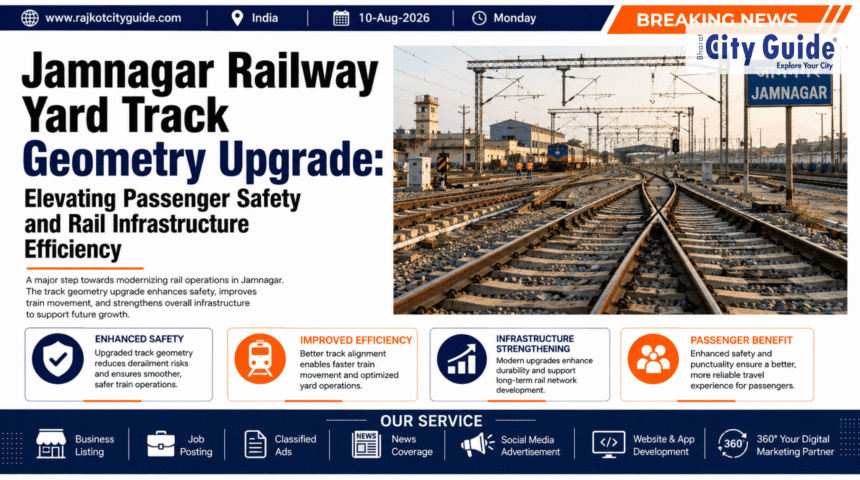
Indian Railways, widely acknowledged as the lifeline of the nation, continuously strives to enhance operational efficiency and passenger safety across its massive rail network. In a significant operational breakthrough within Western Railway’s Rajkot Division, the execution of the Jamnagar Railway Yard Track Geometry Upgrade has successfully eliminated critical track defects and significantly reduced derailment and accident risks. Railway yards serve as complex operational hubs where passenger trains, freight rakes, and shunting engines constantly maneuver through intricate networks of points, crossings, and curves. Over time, heavy dynamic loads, environmental factors, and continuous traffic can cause subtle alignment shifts, gauge variations, and profile distortions known as track geometry defects.
- Introduction
- What is Jamnagar Railway Yard Track Geometry Upgrade?
- Why This News is Important
- Background Information
- Key Highlights
- Detailed Explanation of the Event
- Technical Specifications and Operational Impact
- Benefits, Features, and Importance
- How It Impacts People
- Expert Insights and Industry Perspective
- Challenges and Limitations
- Future Outlook
- Frequently Asked Questions (FAQs)
- Conclusion
The prompt identification and precise correction of these geometric distortions at the Jamnagar Yard reflect the high level of vigilance and technical expertise maintained by the engineering staff of the Rajkot Division. To recognize this exceptional dedication toward operational safety, the division honored five railway employees with special awards for their alertness, timely intervention, and high-quality maintenance work. This successful intervention not only safeguards thousands of daily passengers traveling through the Western Railway zone but also ensures smooth freight movements supporting the vital industrial belt of Saurashtra. This comprehensive article provides an in-depth analysis of the Jamnagar Railway Yard Track Geometry Upgrade, examining its technical components, background context, societal benefits, employee recognition, and long-term implications for Indian Railways.
What is Jamnagar Railway Yard Track Geometry Upgrade?
The Jamnagar Railway Yard Track Geometry Upgrade refers to a specialized, high-precision engineering intervention performed on the railway tracks, turnouts, points, and crossings within the Jamnagar station yard under the Rajkot Railway Division. Track geometry encompasses the three-dimensional spatial configuration and alignment parameters of railway tracks. Maintaining precise geometry is essential to ensure that steel wheels run smoothly on steel rails without excessive friction, hunting oscillation, or derailment hazards.
+-------------------------------------------------------------------------+
|                  KEY TRACK GEOMETRY PARAMETERS OVERHAULED               |
+-------------------------------------------------------------------------+
| 1. GAUGE ALIGNMENT  | Distance between inner heads of running rails     |
| 2. CROSS LEVEL      | Height differential between parallel rail heads   |
| 3. TWIST           | Rate of change of cross-level over distance       |
| 4. CURVATURE       | Smoothness of horizontal arc radius               |
| 5. LONGITUDINAL    | Vertical profile along rail top surfaces          |
+-------------------------------------------------------------------------+
When heavy freight and passenger trains pass through a yard, tracks naturally experience physical stresses that alter these critical dimensions:
- Gauge Variations: Expansion or narrowing of the distance between running rails beyond permissible millimeter tolerances.
- Cross-Level Discrepancies: Uneven height levels between left and right rails causing lateral sway in rolling stock.
- Track Twist: Rapid changes in cross-levels over short distances, which can lift train wheel flanges over the rail head and lead to derailments.
- Curvature Realignment: Irregularities in horizontal curves that increase lateral flange forces during train movements.
The Jamnagar Railway Yard Track Geometry Upgrade involved comprehensive track inspections, deep screening, ballast tamping, alignment rectification using heavy track machines, manual fine-tuning of points and crossings, and tightening of rail fasteners. By restoring the track parameters to strict Indian Railways Permanent Way (P-Way) standards, the project successfully mitigated severe safety hazards and restored optimal track stability.
Why This News is Important
The successful completion of the Jamnagar Railway Yard Track Geometry Upgrade carries profound significance across several dimensions of railway management and public transportation:
- Prevention of Disastrous Accidents: Track geometry flaws are among the leading causes of yard derailments and low-speed train mishaps. Correcting these anomalies proactively prevents potential catastrophic accidents.
- Protection of Passenger Lives: Jamnagar is a major railway hub connecting Saurashtra to prominent destinations across India. Enhancing yard safety directly protects thousands of daily commuters and long-distance travelers.
- Boosting Freight Transit Efficiency: Jamnagar hosts major industrial establishments, including petroleum refineries, brass industries, and port facilities. Smooth yard operations prevent freight bottleneck delays and boost regional logistics.
- Recognition of Frontline Safety Personnel: Honoring five railway employees fosters a culture of safety, alertness, and professional pride across the workforce.
- Cost Savings for Indian Railways: Preventive track maintenance is significantly cheaper than dealing with the severe financial losses, equipment damage, and legal liabilities associated with train accidents.
Background Information
To fully understand the context of this achievement, it is necessary to examine the strategic role of Jamnagar Railway Yard within the Western Railway network and the broader framework of safety management in the Rajkot Division.
The Strategic Importance of Jamnagar Railway Station
Jamnagar Railway Station, located in Gujarat’s Saurashtra region, operates under the Rajkot Division of Western Railway. It sits along a crucial broad-gauge rail corridor connecting major ports like Sikka, Okha, and Rozi Pier with the rest of the national rail grid. Furthermore, Jamnagar accommodates heavy passenger traffic heading toward religious landmarks like Dwarka and Somnath, alongside intense freight movements serving giant industrial complexes.
Because Jamnagar Yard handles extensive train shunting, rake formation, engine reversals, and heavy freight transit daily, its tracks are subjected to extreme mechanical stresses. Turnouts and crossovers in yard layouts are especially vulnerable to wear and tear due to the frequent switching of train paths across points.
The Mechanics of Track Degradation
Over time, repeated wheel impacts, thermal expansion, moisture ingress into the ballast bed, and soil compaction alter the precise alignment of rails. If left undetected, minor geometric flaws escalate into critical structural defects. Indian Railways employs regular inspection protocols using Track Recording Cars (TRC), Oscillograph Cars, and manual inspections by Track Maintainers (Gangmen) and Keymen to catch these issues early.
During routine and specialized inspections at Jamnagar Yard, engineering teams identified geometric irregularities that required immediate rectification. Recognizing the potential hazard to train operations, the engineering department mobilized specialized crews and equipment to carry out comprehensive geometry corrections.
Key Highlights
Here are the central highlights of the Jamnagar Railway Yard Track Geometry Upgrade and safety recognition event:
- Key Project: Comprehensive track geometry upgrade and alignment correction at Jamnagar Railway Yard.
- Administrative Unit: Rajkot Division, Western Railway Zone.
- Core Engineering Objective: Rectification of gauge errors, cross-level variations, track twist, and point alignment to eliminate derailment risks.
- Employee Recognition: 5 railway staff members were officially honored for exceptional vigilance, timely reporting, and high-quality maintenance work.
- Primary Beneficiaries: Thousands of daily passenger train commuters and major freight logistics operations in Saurashtra.
- Operational Impact: Enhanced train stability, reduced mechanical wear on rolling stock, faster yard transit times, and improved overall safety standards.
Detailed Explanation of the Event
The execution of the Jamnagar Railway Yard Track Geometry Upgrade was a coordinated effort involving meticulous planning, advanced machinery, and dedicated manual track work.
+-------------------------------------------------------------------------+
|                  WORKFLOW OF TRACK GEOMETRY RECTIFICATION               |
+-------------------------------------------------------------------------+
| STEP 1: Detailed Inspection & Identification of Geometric Faults        |
| STEP 2: Deployment of Heavy Tamping & Track Aligning Machines           |
| STEP 3: Ballast Deep Screening, Packing, and Shoulder Formation         |
| STEP 4: Precision Manual Overhauling of Turnouts, Switches & Fasteners |
| STEP 5: Final Validation Run & Quality Audit by Senior Divisional Off.  |
+-------------------------------------------------------------------------+
Engineering Execution in the Yard
- Inspection and Data Collection: Engineering inspectors measured track parameters across critical yard lines, switches, and crossovers using precision gauges and digital measuring devices.
- Track Machine Deployment: Heavy-duty track machines, including Hydraulic Heavy-Duty Tamping Machines and Track Relaying Trains, were brought in to lift, pack, and align the rail structure automatically.
- Ballast Bed Stabilization: Fresh stone ballast was distributed and packed beneath sleepers to ensure uniform load distribution and proper track drainage.
- Fine-Tuning Turnouts: Points and crossings—the most delicate elements of yard geometry—were overhauled by replacing worn-out fittings, adjusting switch rails, and ensuring exact clearance distances.
Honoring Outstanding Safety Contributions
A dedicated ceremony was organized by the Rajkot Division administration to recognize the pivotal role played by frontline staff. Five dedicated employees received awards and certificates of appreciation for their exemplary performance:
- Alertness and Diligence: These staff members identified subtle track defects before they could affect train movements.
- Prompt Execution: They worked under challenging field conditions to execute track geometry corrections without interrupting regular train schedules unnecessarily.
- Inspirational Leadership: Their proactive approach serves as a benchmark for safety awareness across all departments in the Rajkot Division.
Technical Specifications and Operational Impact
The table below outlines the core operational and technical facets of the Jamnagar Yard upgrade:
| Parameter | Project & Operational Specification |
| Location | Jamnagar Railway Yard, Gujarat |
| Division / Zone | Rajkot Division / Western Railway |
| Key Focus Area | Track Geometry Alignment, Gauge Correction & Turnout Maintenance |
| Machinery Used | Hydraulic Tamping Machines, Track Aligning Units, Digital Gauges |
| Employees Honored | 5 Staff Members (Recognized for outstanding safety vigilance) |
| Target Risk Eliminated | Low-speed yard derailments, flange climbing, track twist hazards |
| Impact on Commuters | Smoother passenger travel, reduced delays, enhanced ride comfort |
| Impact on Freight | Safer and faster movement of petroleum, industrial, and port cargo |
Benefits, Features, and Importance
The execution of the Jamnagar Railway Yard Track Geometry Upgrade delivers numerous technical, social, and economic advantages:
1. Eliminating Derailment Risks
The primary benefit of track geometry restoration is the prevention of derailments. By maintaining strict millimeter-level tolerances in gauge and cross-levels, train wheels remain securely guided along rail heads, virtually eliminating the risk of flange climbing or derailments during switching operations.
2. Smooth Ride Quality and Passenger Comfort
When tracks suffer from geometric distortions, train coaches experience severe lateral swaying, jerks, and vertical oscillations. Rectifying track alignment ensures that passenger trains passing through or departing from Jamnagar Yard experience a remarkably smooth, comfortable ride.
3. Reduced Wear and Tear on Rolling Stock
Track irregularities inflict heavy dynamic impact forces on locomotive wheels, bogie suspension systems, and coach couplers. Smooth track geometry drastically reduces mechanical wear and tear on both rails and rolling stock, extending the service life of railway assets and cutting maintenance expenses.
4. Boosted Operational Speed and Reduced Delays
Defective track sections require “Caution Orders” that force train drivers to slow down to crawling speeds (e.g., 10 km/h or 15 km/h). Upgrading yard geometry allows the railway administration to relax or eliminate speed restrictions, ensuring on-time train performance across the Rajkot Division.
How It Impacts People
The positive outcomes of this safety project extend across multiple groups of stakeholders in the regional transportation ecosystem:
For Railway Passengers and Tourists
- Maximum Safety Assurance: Passengers traveling to and from Jamnagar, Rajkot, Dwarka, and Mumbai can travel with complete peace of mind knowing that track infrastructure meets the highest safety standards.
- Punctuality Improvements: Reduced speed restrictions in the yard mean fewer delays for incoming and outgoing passenger trains.
For Railway Staff and Field Workers
- Workplace Safety Culture: Highlighting and rewarding the diligence of five staff members boosts team morale and reinforces a collective commitment to safety across all cadres.
- Operational Efficiency: Maintenance crews can work with greater confidence when system defects are tackled systematically rather than through emergency fixes.
For Industrial and Freight Stakeholders
- Reliable Logistics Supply Chains: Jamnagar’s industrial sector relies heavily on Indian Railways for moving raw materials and finished goods. Safe yard operations prevent supply chain disruptions and cargo damage.
Expert Insights and Industry Perspective
Railway safety experts and civil engineers consistently emphasize that yard infrastructure requires even greater maintenance attention than open line main tracks due to the complexity of turnouts and heavy shunting stresses.
The Critical Role of Proactive Track Maintenance
Infrastructure experts note that shifting from reactive repair (fixing track after an incident) to proactive preventive maintenance (correcting geometry continuously) is the cornerstone of modern railway safety management. The Rajkot Division’s swift action at Jamnagar Yard reflects international best practices in track asset management.
Human Factors in Railway Safety
While high-tech track machines handle heavy tamping and alignment, human alertness remains indispensable. Engineering consultants praise Indian Railways for continuing to honor frontline workers, noting that observant track staff provide the vital human layer of defense against infrastructure failures.
Challenges and Limitations
Executing complex engineering upgrades in a busy operational railway yard involves distinct operational constraints:
- Working in Active Yard Conditions: Engineers must carry out track work during tight “traffic blocks”—short time windows when train movements are suspended—to minimize disruptions to scheduled passenger trains.
- Managing Extreme Weather Conditions: High ambient temperatures in Saurashtra cause steel rails to expand significantly, making precise track alignment challenging during summer peak hours.
- Maintenance Sustainability: Track geometry naturally degrades over time due to continuous heavy axle traffic, requiring ongoing monitoring and periodic re-tamping rather than a single one-off effort.
Future Outlook
Looking ahead, Western Railway’s Rajkot Division continues to modernize its safety and infrastructure frameworks through several futuristic initiatives:
- Automated Inspection Systems: Increasing integration of Track Recording Cars equipped with laser-based measuring sensors and AI-driven defect detection to monitor yard geometry continuously.
- Mechanized Track Maintenance: Expanded deployment of high-speed tamping machines and ballast cleaning machines across all major yards in Saurashtra.
- Continuous Employee Incentive Programs: Regular recognition events to honor vigilant staff members across all railway stations under the Rajkot Division, embedding safety excellence as a core institutional value.
Frequently Asked Questions (FAQs)
Q1: What is the Jamnagar Railway Yard Track Geometry Upgrade?
A: It is a comprehensive engineering maintenance project undertaken in Jamnagar Yard under the Rajkot Division to correct track alignment, gauge dimensions, cross-levels, and turnout structures to ensure maximum train safety.
Q2: Why is track geometry important for railway safety?
A: Proper track geometry ensures that train wheels ride smoothly along rails without excessive friction or vertical/horizontal oscillations, preventing severe hazards like wheel climbing and derailments.
Q3: Why were 5 employees honored by the Rajkot Division?
A: Five railway staff members were officially honored for their exceptional alertness, timely detection of track defects, and high-performance maintenance work that ensured safe train operations.
Q4: How does this upgrade benefit daily railway passengers?
A: It eliminates safety risks, reduces train jerks and sways for a smoother travel experience, and prevents journey delays caused by speed restrictions at defective track sections.
Q5: Which railway division executed this safety project?
A: The project was executed by the engineering wing of the Rajkot Division within the Western Railway zone of Indian Railways.
Q6: How does track geometry degrade over time?
A: Repeated passage of heavy passenger and freight trains, coupled with weather variations and natural soil movement, gradually compresses ballast and shifts steel rails out of their original alignments.
Q7: What tools and machines are used in track geometry upgrades?
A: Engineering teams utilize heavy hydraulic tamping machines, track aligners, electronic track gauges, digital measuring instruments, and manual overhauling tools.
Conclusion
The execution of the Jamnagar Railway Yard Track Geometry Upgrade stands as a shining example of proactive safety management, engineering precision, and employee recognition within Indian Railways’ Rajkot Division. By identifying and rectifying critical track geometric flaws in the busy Jamnagar Yard, railway engineers have successfully safeguarded vital rail corridors connecting Saurashtra to the rest of the nation.
Beyond the technical achievement of restoring track alignments and turnout stability, the decision to honor five frontline employees reinforces a culture of vigilance, dedication, and professional pride across the railway workforce. As Western Railway continues to invest in modernizing its track infrastructure, projects like the Jamnagar Railway Yard Track Geometry Upgrade ensure that passenger journeys remain safe, efficient, and reliable for millions of travelers every single day.