Introduction
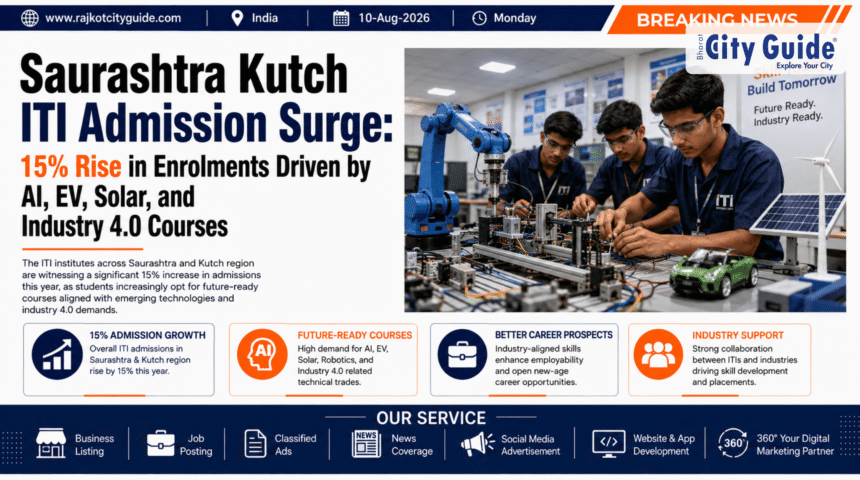
In a transformative shift for vocational education across Western Gujarat, the regional technical education ecosystem is witnessing an unprecedented wave of youth engagement. According to recent administrative data released by the Directorate of Employment and Training (DET) Gujarat, a remarkable Saurashtra Kutch ITI Admission Surge has been recorded across 148 Industrial Training Institutes (ITIs) functioning in the region. Total student enrolments have surged by a substantial 15% compared to previous academic cycles.
- Introduction
- What is Saurashtra Kutch ITI Admission Surge?
- Why This News is Important
- Background Information
- Key Highlights
- Detailed Explanation of the Event
- Course Comparison: Traditional vs. Industry 4.0 Trades
- Benefits, Features, and Importance
- How It Impacts People
- Expert Insights and Industry Perspective
- Challenges and Limitations
- Future Outlook
- Frequently Asked Questions (FAQs)
- Conclusion
This dramatic uptick in admissions is far more than a routine seasonal fluctuation. It signifies a profound paradigm shift in how youth and parents perceive technical and vocational education. Traditionally viewed as fallback options for manual trades like fitting, turning, and basic electrical wiring, modern ITIs across Saurashtra and Kutch have systematically upgraded their course offerings. Today’s vocational applicants are eagerly lining up to secure seats in cutting-edge, Industry 4.0-aligned disciplines including Artificial Intelligence (AI) Applications, Solar PV Installation & Maintenance, Green Hydrogen Technology, Electric Vehicle (EV) Servicing, and 3D Printing / Additive Manufacturing.
As Gujarat solidifies its standing as an industrial power block, renewable energy hub, and manufacturing corridor, local industries urgently require skilled technicians equipped with modern digital and green domain expertise. This surge in admissions highlights how timely curriculum modernization, public-private industry partnerships, and state-backed skill development drives can successfully bridge the gap between traditional education and high-demand industry careers.
What is Saurashtra Kutch ITI Admission Surge?
The Saurashtra Kutch ITI Admission Surge refers to the substantial 15% year-on-year increase in student registrations and seat acceptances recorded across the 148 government and self-financed Industrial Training Institutes operating throughout the Saurashtra and Kutch administrative divisions of Gujarat.
Geographically spanning key industrial districts—including Rajkot, Jamnagar, Bhavnagar, Junagadh, Amreli, Morbi, Porbandar, Devbhumi Dwarka, Surendranagar, Gir Somnath, and the expansive Kutch region—these 148 ITIs form the backbone of middle-tier technical skill development in Western India.
The defining characteristic of this admission boom lies in the shifting preferences of incoming students. While conventional engineering trades such as Electrician, Fitter, Turner, Motor Vehicle Mechanic, and Welder continue to maintain steady demand, the exponential growth in applications is overwhelmingly driven by next-generation technical programs:
- Artificial Intelligence & Data Entry Operations: Training in AI tools, basic machine learning workflows, automated data processing, and smart factory data collection.
- Solar Technician (Renewable Energy): Comprehensive instruction on solar photovoltaic panel assembly, grid inverter wiring, rooftop mounting, and maintenance.
- Electric Vehicle (EV) Technology: Specialized training covering lithium-ion battery management systems (BMS), electric motor diagnostics, power electronics, and EV charging station infrastructure.
- 3D Printing & Additive Manufacturing: Hands-on experience with CAD modelling, rapid prototyping, digital filament extrusion, and precision industrial 3D printing.
- Green Hydrogen & Clean Energy Concepts: Foundational skill modules introducing green hydrogen production equipment, storage protocols, and industrial clean fuel handling.
Why This News is Important
The record-breaking Saurashtra Kutch ITI Admission Surge holds immense strategic importance for students, industrial employers, educational policymakers, and economic planners across Gujarat for several reasons:
- Addressing Regional Skill Mismatches: Heavy manufacturing clusters in Rajkot, ceramic industries in Morbi, brass parts units in Jamnagar, and massive green energy zones in Kutch have long struggled with a shortage of techno-commercially trained local youth. High ITI enrolments ensure a steady pipeline of job-ready talent.
- Empowering Non-Urban Youth: ITIs provide affordable, accessible, and quick employment pathways for students from rural and semi-urban backgrounds who prefer fast-track skill acquisition over lengthy four-year academic degrees.
- Aligning Education with National Clean Energy Goals: India’s ambitious target of achieving 500 GW of non-fossil energy capacity by 2030 requires hundreds of thousands of solar, wind, and EV technicians. The surge in clean-tech trade admissions directly supports these national green transition mandates.
- Boosting Female Participation in Technical Trades: Modern digital and laboratory-based courses like 3D Printing, AI Applications, and Smart Electronics are attracting a record number of female applicants, promoting gender diversity in technical industries.
Background Information
To fully appreciate the factors driving the Saurashtra Kutch ITI Admission Surge, it is essential to examine the industrial evolution of the region and the state government’s proactive curriculum modernization initiatives.
The Changing Industrial Landscape of Saurashtra and Kutch
Saurashtra and Kutch represent one of India’s most dynamic industrial hubs. Rajkot is globally recognized for engineering goods, auto components, diesel engines, and machine tools. Morbi manufactures a significant portion of the world’s ceramic tiles and sanitaryware. Jamnagar hosts petroleum refining mega-complexes and brass forging clusters, while Kutch has transformed into a global powerhouse for ports, logistics, wind-solar hybrid parks, and green hydrogen projects.
+-----------------------------------------------------------------------+
|              SAURASHTRA-KUTCH INDUSTRIAL & SKILL MAP                  |
+-----------------------------------------------------------------------+
| REGION        | DOMINANT INDUSTRIES         | DEMANDED ITI SKILLS    |
+---------------+-----------------------------+-------------------------+
| Rajkot        | Auto Components, CNC Tools  | EV Tech, 3D Printing    |
| Morbi         | Ceramics, Machinery         | Automation, Electronics |
| Jamnagar      | Brassware, Petrochemicals   | Instrumentation, Safety |
| Kutch         | Solar-Wind Parks, Hydrogen  | Solar PV, Clean Energy  |
| Bhavnagar     | Ship Recycling, Engineering | Welding, Heavy Fitting  |
+-----------------------------------------------------------------------+
As these industries rapidly transitioned toward automated production lines, CNC machinery, robotics, and clean energy practices, traditional trade certificates alone were no longer sufficient. Local manufacturers began demanding workers equipped with contemporary technical skills.
Government Initiatives and Course Modernization
Recognizing this structural shift, the Department of Technical Education and DET Gujarat initiated a systematic revamp of ITI infrastructure. Under state-backed skill development schemes and public-private partnership (PPP) models with leading industrial conglomerates, hundreds of ITI workshops were upgraded with modern equipment:
- State-of-the-Art Labs: Installation of 3D printers, solar test benches, EV cut-section working models, and computer labs running AI-enabled software.
- Dual System of Training (DST): Partnering directly with local factories so students spend part of their program training directly on actual shop floors.
- Short-Term Modular Up-skilling: Introduction of short, specialized certificate modules that allow existing trade students to acquire additional certifications in solar or EV mechanics.
Key Highlights
The key details and statistical metrics surrounding the Saurashtra Kutch ITI Admission Surge include:
- 15% Increase in Total Enrolments: Overall admission numbers across 148 regional ITIs expanded by 15% compared to the previous academic session.
- Coverage Across 148 Institutes: Applies to both government-run and private/self-financed ITIs located across all 11 districts of Saurashtra and Kutch.
- Top Demand Trades: Electric Vehicle (EV) Technician, Solar PV Installer, 3D Printing Specialist, Artificial Intelligence & Data Operations, and Green Hydrogen Basics.
- High Placement Record: Rising corporate campus recruitment drives boasting up to 80–90% job placement rates for graduates of modernized trades.
- Affordable Fee Structure: Low tuition fees combined with state scholarship support make high-tech education accessible to economically weaker sections.
Detailed Explanation of the Event
The recent admission metrics released by educational authorities confirm that the Saurashtra Kutch ITI Admission Surge was observed across multiple merit rounds. Online registration portals managed by DET Gujarat experienced high web traffic as thousands of Class 10 and Class 12 graduates submitted applications for technical trade seats.
+-----------------------------------------------------------------------+
|                    STUDENT ADMISSION WORKFLOW PATHWAYS                 |
+-----------------------------------------------------------------------+
| 1. ONLINE APPLICATION  | Registration on DET Gujarat admission portal  |
| 2. MERIT LISTING       | State-wide ranking based on qualifying marks  |
| 3. CHOICE FILLING      | Priority selection of preferred trade & ITI  |
| 4. SEAT ALLOTMENT      | Multi-round seat distribution & fee payment   |
| 5. INDUSTRY ORIENTATION| On-boarding into modern workshop-lab modules  |
+-----------------------------------------------------------------------+
Breakdown of Trending Vocational Disciplines
1. Electric Vehicle (EV) Technician
With India’s electric two-wheeler and four-wheeler market expanding rapidly, traditional automotive repair mechanics are facing technology obsolescence. The dedicated EV Technician course teaches students high-voltage electrical safety, battery chemistry, motor controller programming, and regenerative braking diagnostics. Automotive clusters around Rajkot and Sanand actively recruit these specialized graduates.
2. Solar PV Installer and Maintenance Technician
Given Kutch’s massive renewable energy plants and the state-wide adoption of rooftop solar systems under government subsidy programs, certified solar technicians enjoy immediate local employment opportunities. Students master site assessment, solar panel tilt alignment, inverter synchronization, and battery storage wiring.
3. 3D Printing and Additive Manufacturing
In industrial foundry and machine-tool hubs like Rajkot and Bhavnagar, prototyping custom metal and polymer parts using traditional milling takes days. ITI trainees equipped with 3D printing and CAD design skills enable small and medium enterprises (SMEs) to design, print, and test prototype components within hours.
4. Artificial Intelligence & Data Operations
Modern smart factories utilize IoT sensors and AI software to track machine health, monitor output quality, and manage supply chains. The AI-focused ITI curriculum introduces students to basic data annotation, automated quality checking protocols, and digital record-keeping tools.
Course Comparison: Traditional vs. Industry 4.0 Trades
The following comparison matrix highlights key differences between legacy vocational courses and the newly introduced Industry 4.0 programs driving the current admission surge:
| Parameter | Legacy ITI Trades (e.g., Fitter, Welder) | Modern Industry 4.0 Trades (e.g., EV, Solar, AI, 3D Printing) |
| Core Focus | Mechanical fabrication, manual machining, basic wiring | Digital design, power electronics, green energy, automation |
| Primary Work Environment | Traditional factory shop floors, foundries, repair garages | Smart factories, renewable energy sites, digital labs, EV service centers |
| Key Tools Used | Lathe machines, welding torches, manual calipers | 3D printers, EV diagnostic scanners, solar analyzers, CAD software |
| Employment Sectors | Structural fabrication, conventional auto repair, basic masonry | Renewable power plants, EV original equipment manufacturers (OEMs), tech startups |
| Initial Starting Salary Range | ₹12,000 – ₹18,000 per month | ₹18,000 – ₹28,000+ per month |
| Career Growth Velocity | Steady, experience-based progression | Rapid expansion driven by high regional skill demand |
Benefits, Features, and Importance
The Saurashtra Kutch ITI Admission Surge yields far-reaching economic and social dividends across Western Gujarat:
1. Rapid Employability and Job Security
Unlike traditional four-year degree programs that often leave graduates struggling with theoretical knowledge but lacking practical capabilities, ITI courses emphasize 70% practical, hands-on workshop training. Graduates transition into active industrial roles immediately upon course completion.
2. Supporting Regional Industrial Competitiveness
Local industrial units in Rajkot, Morbi, and Jamnagar can modernize their factory floors far more confidently knowing that local ITIs are producing workers capable of operating automated machinery, CNC equipment, and digital quality-assurance systems.
3. Fostering Grassroots Micro-Entrepreneurship
Courses like Solar Technician and EV Servicing empower young graduates to establish their own independent service ventures, solar installation startups, or specialized repair workshops, transforming job seekers into local job creators.
4. Inclusion of Rural and Diverse Youth
With 148 ITIs distributed across rural talukas and urban centers, students do not need to migrate to distant metro cities to acquire high-value technical skills. Affordable fees ensure that financial constraints do not block access to technical education.
How It Impacts People
The positive ripple effects of this admission surge influence various sections of society across the region:
For Students and Young Job Seekers
- Shorter Learning Cycles: Students complete 1-year or 2-year certification programs and begin earning income much earlier than university peers.
- Exposure to Future-Proof Industries: Gaining hands-on expertise in solar energy or electric mobility protects workers against future technological automation.
For Parents and Families
- Low Cost, High Return on Investment: Low admission fees paired with government scholarship support drastically reduce the financial burden on middle-class and rural families.
- Financial Stability: Early employment helps families achieve steady household financial security.
For Industrial Employers and Factory Owners
- Reduced On-the-Job Training Costs: Hiring ITI graduates trained under the Dual System of Training (DST) significantly reduces the time and expense required to train new recruits.
- Higher Production Quality: Skilled technicians produce fewer manufacturing defects and maintain higher workplace safety standards.
Expert Insights and Industry Perspective
Skill development experts and regional industrial leaders view the surge in ITI admissions as a crucial milestone in Gujarat’s economic development journey.
Bridging the “Technician Gap” in Indian Manufacturing
Industrial economists frequently note that while India produces hundreds of thousands of engineering graduates every year, manufacturing units suffer from a severe shortage of well-trained operational technicians. High-quality ITI training solves this “technician gap” by producing hands-on professionals who directly manage machine operations, maintenance, and quality control.
Public-Private Partnerships Driving Curriculum Relevance
Education consultants praise DET Gujarat’s collaborative strategy of inviting major industrial players to co-design ITI course modules, sponsor laboratory equipment, and offer direct apprenticeship programs. This direct feedback loop ensures that course syllabi stay updated with changing technological trends.
Challenges and Limitations
Despite the overwhelming success of the Saurashtra Kutch ITI Admission Surge, educational authorities must address key operational challenges to maintain long-term training quality:
- Instructor Up-skilling and Recruitment: Technology in fields like AI, EV systems, and Green Hydrogen evolves rapidly. Training and retaining qualified instructional staff who possess up-to-date industry experience remains an ongoing requirement.
- Capital Expenditure for Lab Equipment: High-end 3D printers, advanced EV testing rigs, and solar diagnostic units require continuous capital funding for maintenance, software licensing, and hardware upgrades.
- Equitable Rural Infrastructure: Ensuring that remote taluka-level ITIs receive the same high-speed internet connectivity, digital equipment, and corporate exposure as urban ITIs in Rajkot or Jamnagar is essential to avoid regional disparities.
Future Outlook
Looking ahead, the momentum generated by the Saurashtra Kutch ITI Admission Surge sets the stage for further expansion of vocational education in Gujarat:
- Expansion of Green Energy Centers of Excellence: RMC and DET Gujarat plan to establish dedicated specialized centers focusing on offshore wind energy maintenance, battery recycling, and green hydrogen storage technology across Kutch and coastal Saurashtra.
- Deeper AI and Robotics Integration: Future course upgrades will introduce basic cobot (collaborative robot) programming, drone maintenance, and industrial IoT troubleshooting across more ITI campuses.
- International Skill Certification Alignment: Efforts are underway to align select ITI trade curricula with international vocational standards, opening up overseas employment opportunities for skilled Gujarati technicians in the Middle East, Europe, and Southeast Asia.
Frequently Asked Questions (FAQs)
Q1: What is the main reason behind the Saurashtra Kutch ITI Admission Surge?
A: The 15% surge in admissions across 148 ITIs is primarily driven by the introduction of popular Industry 4.0 trades—such as AI Applications, EV Technology, Solar Technician, 3D Printing, and Green Hydrogen concepts—which offer high employability and competitive starting salaries.
Q2: How many ITIs are included in this regional admission report?
A: A total of 148 government and self-financed Industrial Training Institutes spread across all 11 districts of the Saurashtra and Kutch regions are covered.
Q3: What eligibility criteria are required to apply for these modern ITI courses?
A: Most 1-year and 2-year technical ITI trade courses require candidates to have successfully passed Class 10 or Class 12 from a recognized education board.
Q4: Which specific trade courses are experiencing the highest student demand?
A: The highest demand has been recorded in Electric Vehicle (EV) Servicing, Solar PV Installation, 3D Printing / Additive Manufacturing, and AI & Data Operations.
Q5: How do modern ITI courses benefit regional industries in Rajkot and Kutch?
A: They provide local engineering, ceramic, auto-component, and clean energy companies with job-ready technicians trained on modern equipment, reducing factory training costs and improving production efficiency.
Q6: Do ITI students receive hands-on industry training during their studies?
A: Yes. Under schemes like the Dual System of Training (DST), students spend significant time training directly inside operational factories and industrial workshops alongside their classroom studies.
Q7: Are there scholarship programs available for students joining ITIs in Gujarat?
A: Yes. The Gujarat government offers various scholarship initiatives, fee waivers, and stipend programs for eligible students from economically weaker and reserved categories.
Conclusion
The Saurashtra Kutch ITI Admission Surge marks a defining milestone in the modernization of vocational education across Western India. A 15% increase in enrolments across 148 ITIs demonstrates that Gujarat’s youth are actively recognizing the immense career potential offered by technical trades aligned with Industry 4.0 and green energy transition goals.
By shifting focus toward high-demand disciplines such as Artificial Intelligence, Electric Vehicle mechanics, Solar energy technology, 3D printing, and Green Hydrogen systems, technical education authorities are successfully bridging the traditional divide between classroom training and industrial needs. As these skilled graduates pass out of ITI workshops and enter the regional workforce, they will not only achieve financial independence but also serve as the primary engine driving Saurashtra and Kutch toward a technological and sustainable industrial future.