Introduction
Educational assessment frameworks across India are undergoing a structural evolution, shifting away from high-stakes, rote-memorization examinations toward continuous, multidimensional learning evaluations. Aligning with the foundational directives of the National Education Policy (NEP) 2020, state educational departments are overhauling conventional testing systems to measure real understanding, cognitive progression, behavioral traits, and practical skills.
- Introduction
- What is Rajkot School New Evaluation Method?
- Why This News is Important
- Background Information
- Key Highlights
- Detailed Explanation of the Event
- Benefits and Importance of the Reform
- How It Impacts People
- Expert Insights and Industry Perspective
- Challenges and Limitations
- Future Outlook
- Frequently Asked Questions (FAQs)
- Conclusion
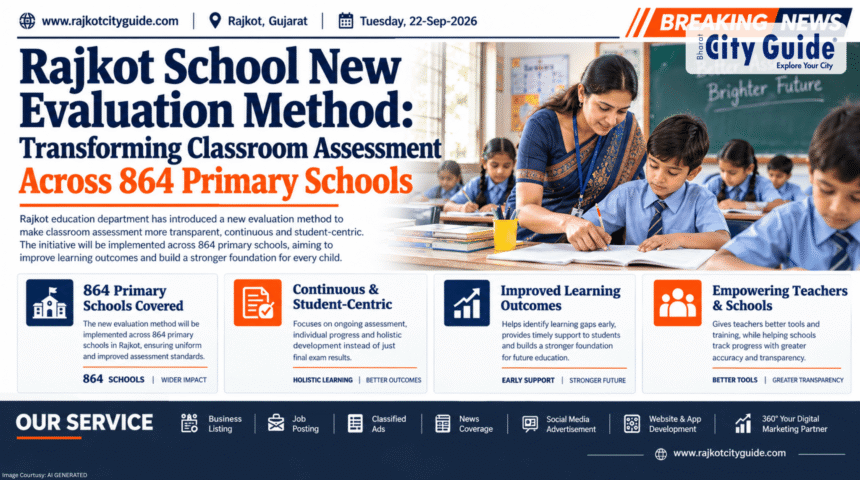
In a major regional educational reform in Gujarat, local education authorities have rolled out the Rajkot School New Evaluation Method across 864 primary schools. This strategic shift transforms how young learners from Class 1 through Class 8 are monitored, graded, and supported throughout their foundational academic years.
By replacing rigid end-of-term scorecards with a dynamic, 360-degree holistic assessment structure, the initiative seeks to eliminate examination-induced stress while delivering actionable learning insights to educators, parents, and school administrators.
This update carries immense relevance for parents, school administrators, primary educators, and policy observers. It signals a fundamental departure from passive marks-based reporting, creating an environment where a child’s creativity, sportsmanship, peer collaboration, and conceptual clarity are valued alongside formal classroom subjects.
What is Rajkot School New Evaluation Method?
The Rajkot School New Evaluation Method is a standardized, multidimensional assessment framework implemented across government and grant-in-aid primary schools in the Rajkot district. Developed under the broad umbrella of the Gujarat State Quality Accreditation Council (GSQAC) and state educational research wings, this system replaces traditional single-dimensional marksheets with a Holistic Progress Card (HPC).
Rather than relying solely on written mid-term and annual exams, the new model evaluates students across three core educational domains:
- Cognitive Domain: Core subject comprehension, critical thinking, problem-solving abilities, and daily classroom interaction.
- Affective Domain: Emotional intelligence, social behavior, values, teamwork, discipline, and peer-to-peer relationship building.
- Psychomotor Domain: Physical education, artistic expression, motor skills, hand-eye coordination, and co-curricular engagement.
+--------------------------------------------------------------------------+
|            STRUCTURE OF THE NEW 360-DEGREE EVALUATION FRAMEWORK           |
+--------------------------------------------------------------------------+
                                     |
    +--------------------------------+--------------------------------+
    |                                |                                |
    v                                v                                v
[ TEACHER ASSESSMENT ]       [ SELF & PEER EVALUATION ]       [ PARENTAL FEEDBACK ]
- Academic mastery           - Self-reflection worksheets     - Home study habits
- Classroom engagement       - Teamwork observation           - Personal interests
- Observational logging      - Mutual grading activities      - Behavioral traits
Why This News is Important
The implementation of this assessment model across 864 primary schools in Rajkot marks a decisive operational transition in primary school administration.
1. Shift Away from Rote Learning
For decades, primary education faced criticism for pushing children to memorize textbooks for single annual exams. The new method prioritizes continuous evaluation, tracking a student’s weekly progress rather than judging their intelligence on a single test day.
2. Standardized Quality Control
Applying a unified evaluation mechanism across all 864 designated schools ensures educational parity between urban centers and rural primary clusters in the Rajkot district.
3. Active Stakeholder Inclusion
The new framework requires parents and peers to provide structured feedback, breaking the traditional barrier where assessment was strictly a one-way transaction between teacher and student.
Background Information
Over the past decade, Gujarat’s primary education system relied on periodic initiatives like Gunotsav and weekly Periodic Assessment Tests (PAT) to measure basic learning outcomes in Gujarati, Mathematics, and Science. While PAT provided structured data for teachers, classroom learning remained focused heavily on written examination booklets.
[ Traditional Mark-Based Testing (Annual/Mid-Term Exams) ]
                           |
                           v
[ Weekly Periodic Assessment Tests (PAT) & Gunotsav Quality Audits ]
                           |
                           v
[ NEP-Aligned 360-Degree Holistic Evaluation across 864 Rajkot Schools ]
Following recommendations from expert educational committees and the launch of the School Quality Assessment and Assurance Framework (SQAAF), state authorities prioritized a comprehensive overhaul. The rollout in 864 schools across Rajkot acts as a focal regional implementation, setting a benchmark for full-scale adoption across Gujarat’s primary educational network.
Key Highlights
- Wide Institutional Reach: Implemented across 864 government and municipal primary schools in Rajkot district.
- Coverage: Applies to primary students from Class 1 through Class 8.
- 360-Degree Holistic Progress Card (HPC): Replaces legacy marksheets with descriptive assessment rubrics.
- Multi-Source Feedback: Integrates evaluations from class teachers, peer groups, parents, and student self-assessments.
- Domain-Balanced Scoring: Evaluates academic understanding, co-curricular skills, physical health, social adaptability, and moral values.
- Teacher Empowerment: Includes district-wide training sessions to help primary school teachers adopt qualitative rubrics instead of numerical grading.
Detailed Explanation of the Event
1. Overhauling the Assessment Structure
Under the Rajkot School New Evaluation Method, traditional end-of-term numerical scorecards are transformed into detailed descriptive profiles. For students in early primary grades (Classes 1 to 3), formal written exams are minimized in favor of observational logging, activity-based tasks, oral storytelling, and basic problem-solving exercises.
+--------------------------------------------------------------------------+
|                  COMPARISON: LEGACY VS. NEW EVALUATION SYSTEM           |
+--------------------------------------------------------------------------+
| Evaluation Attribute | Legacy Assessment System   | New Assessment Method        |
+----------------------+--------------------------+------------------------------+
| Core Focus           | Marks & Final Percentage | Holistic Skill Growth        |
| Primary Metric       | Written Semester Exams   | Continuous Observation (HPC) |
| Assessor             | Teacher Only             | Teacher, Peer, Parent, Self  |
| Learning Style       | Rote Memorization        | Conceptual Application       |
| Feedback Frequency   | Biannual / Annual        | Continuous & Monthly Logging |
+----------------------+--------------------------+------------------------------+
As students progress to upper primary levels (Classes 4 to 8), assessments balance subject knowledge with real-world applications. Periodic assessment data is integrated into the student’s digital profile on state educational portals, allowing administrative teams to track learning gaps in real time.
2. Multi-Stakeholder Participation Model
A core element of this reform is distributing assessment responsibilities across four distinct contributors:
- Classroom Teacher Evaluation: Focuses on subject mastery, classroom participation, task completion, and analytical thinking.
- Peer Evaluation: Conducted through group activities where students assess classmates on teamwork, sharing, leadership, and communication.
- Parental Feedback: Captures home learning habits, emotional well-being, personal hobbies, screen time, and behavioral changes at home.
- Student Self-Assessment: Encourages young learners to identify their own strengths, interests, and areas where they need help.
Benefits and Importance of the Reform
The rollout across 864 primary institutions brings important improvements to the regional educational framework:
1. Reduction of Academic Anxiety
By removing sole reliance on high-stakes examination days, students experience less fear around tests. Learning becomes a continuous journey rather than a stressful event.
2. Early Identification of Learning Gaps
Because teachers log student progress continuously, learning difficulties in foundational reading or basic mathematics can be caught and addressed early in the term.
3. Balanced Skill Development
Students who excel in arts, athletics, group leadership, or creative problem-solving receive formal recognition on their official progress records, encouraging balanced growth beyond purely academic scores.
How It Impacts People
| Stakeholder Group | Direct Impact & Practical Outcome |
| Primary School Students | Experience lower exam-related stress and gain recognition for talents in sports, arts, leadership, and teamwork. |
| Parents & Guardians | Receive detailed insights into their child’s holistic development rather than just a two-digit examination score. |
| Teachers & Educators | Gain clear diagnostic tools to identify individual student learning needs, though administrative logging increases. |
| School Administrators | Can analyze institutional performance across all 864 schools using standardized data metrics. |
Expert Insights and Industry Perspective
Educational experts and child psychologists have long advocated for moving away from single-event examinations in primary education.
“Primary education forms the foundation of lifelong learning. When evaluation focuses purely on memorizing answers for a written test, children lose their natural curiosity. The shift toward a 360-degree assessment across 864 schools in Rajkot ensures that emotional maturity, social interaction, and creative thinking are valued alongside textbook knowledge.”
Senior education officers also emphasize that training primary educators to use qualitative assessment rubrics effectively remains the most important factor in making this initiative a success.
Challenges and Limitations
While the system offers clear benefits, successful execution across 864 schools requires overcoming practical challenges:
- Teacher Training Demands: Shifting from simple numerical grading to qualitative rubric evaluations requires ongoing professional development for primary school teachers.
- Administrative Workload: Continuous observation and logging across large class sizes can increase paperwork and data-entry responsibilities for faculty members.
- Parental Awareness Gaps: Educating parents—especially in semi-urban and rural clusters—on how to interpret the Holistic Progress Card requires regular parent-teacher orientation sessions.
Future Outlook
The rollout across 864 schools in Rajkot is an important step in Gujarat’s broader primary education reform plan. Over the coming academic sessions, several key developments are expected:
- Statewide System Expansion: Successful results in Rajkot will serve as an operational model for expanding the 360-degree assessment framework to other districts across Gujarat.
- Digital Integration: Evaluation data will connect directly with centralized state educational tracking portals, providing real-time analytics to district education officers.
- Advanced Rubrics for Secondary Schools: Feedback from this primary school rollout will help refine upcoming evaluation updates for secondary and higher secondary grades.
Frequently Asked Questions (FAQs)
1. What is the Rajkot School New Evaluation Method?
It is a 360-degree holistic assessment framework introduced across primary schools in Rajkot, evaluating students on academics, behavior, sports, creative skills, and social development instead of relying solely on written exams.
2. How many schools in Rajkot are covered under this new system?
The initiative applies to 864 primary schools in the Rajkot district.
3. Which student age groups or classes fall under this evaluation model?
The new evaluation framework covers primary school students from Class 1 through Class 8.
4. What is a Holistic Progress Card (HPC)?
A Holistic Progress Card is an all-around reporting format that records a child’s academic understanding, physical motor skills, social values, self-reflections, and peer interactions.
5. Are parents involved in evaluating the student under this new method?
Yes, parents provide structured feedback regarding the child’s home learning habits, personal interests, emotional state, and behavioral routines.
6. Will traditional written exams be completely abolished?
Written assessments are not eliminated entirely; instead, their weight is balanced alongside oral tests, practical projects, peer evaluations, and continuous classroom observation.
Conclusion
The introduction of the Rajkot School New Evaluation Method across 864 primary schools marks a major step forward for elementary education in Gujarat. By shifting the focus from exam-centric pressure to a balanced 360-degree assessment model, the reform creates an environment where students are evaluated on their overall growth, creativity, and practical skills. As teachers, parents, and administrators adapt to this holistic framework, Rajkot’s primary schools are well-positioned to set a strong benchmark for modern, child-centric education across the state.