Introduction
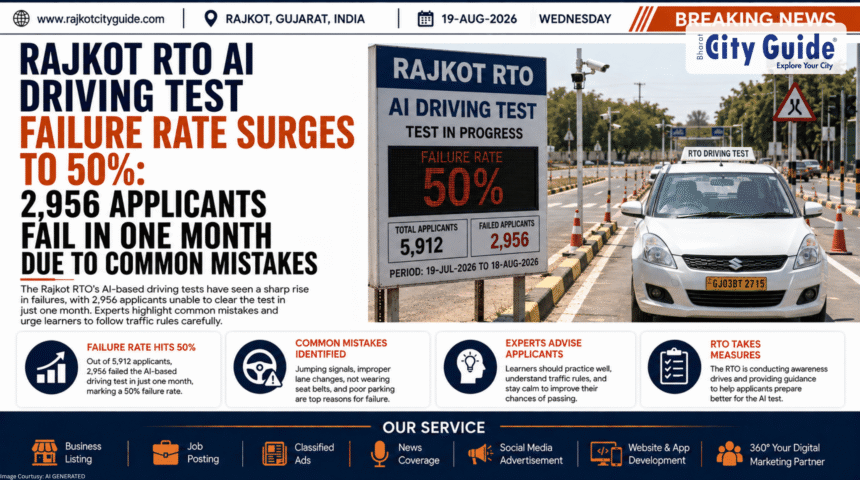
Securing a permanent driving license in Gujarat has undergone a revolutionary shift, but the transition has brought an unexpected reality check for thousands of motor vehicle drivers. The introduction of artificial intelligence-powered computer vision and multi-camera automated testing tracks at Regional Transport Offices across the state was designed to modernize license issuance. However, recent data highlights a dramatic trend: the Rajkot RTO AI Driving Test Failure Rate has soared to approximately 50% within just a single month of its deployment. Out of thousands of eager applicants appearing for two-wheeler and four-wheeler driving evaluations, a staggering 2,956 drivers failed to clear the automated tracks.
- Introduction
- What is Rajkot RTO AI Driving Test Failure Rate?
- Why This News is Important
- Background Information
- Key Highlights
- Detailed Explanation of the Event
- Common Errors Causing Candidate Failures
- Benefits, Features, and Importance
- How It Impacts People
- Expert Insights and Industry Perspective
- Challenges and Limitations
- Future Outlook
- Frequently Asked Questions (FAQs)
- Conclusion
This massive surge in candidate rejections is turning heads across Gujarat. What was previously evaluated under human supervision with a margin for minor manual oversights is now monitored by an unyielding, high-precision network of high-definition AI cameras, optical sensors, and real-time spatial algorithms. From touching border lines during parallel parking to failing to halt precisely at stop lines, minor driving oversights that applicants often dismiss are triggering instant automated rejections.
Understanding the factors driving the high Rajkot RTO AI Driving Test Failure Rate is critical for any driving license applicant. This article provides a comprehensive, data-driven analysis of the new AI testing system, examines why candidate rejections have spiked, identifies the most common driving errors committed on the track, and offers actionable strategies to help drivers clear the test on their very first attempt.
What is Rajkot RTO AI Driving Test Failure Rate?
The Rajkot RTO AI Driving Test Failure Rate refers to the statistical percentage of driving license applicants who fail their practical driving test on the newly deployed Automated Driving Test Tracks (ADTT) managed by the Rajkot Regional Transport Office.
                       ┌──────────────────────────────────────────────┐
                       │    RAJKOT RTO AI DRIVING TEST SYSTEM         │
                       │ 16+ HD Cameras | Sensor Mesh | AI Analytics  │
                       └──────────────────────┬───────────────────────┘
                                              │
         ┌────────────────────────────────────┴────────────────────────────────────┐
         ▼                                                                         ▼
┌─────────────────────────┐                                              ┌─────────────────────────┐
│     TWO-WHEELER TRACK    │                                              │    FOUR-WHEELER TRACK    │
│ • Serpentine / Figure-8 │                                              │ • Reverse S & Parallel  │
│ • 60-Second Time Limit  │                                              │ • Gradient & Up-Hill    │
└────────────┬────────────┘                                              └────────────┬────────────┘
             │                                                                        │
             └───────────────────────────────────┬────────────────────────────────────┘
                                                 ▼
                              ┌─────────────────────────────────────┐
                              │  50% AVERAGE FAILURE RATE (1 MONTH) │
                              │    2,956 Applicants Rejected        │
                              └─────────────────────────────────────┘
Unlike legacy manual testing tracks—where an RTO inspector visually monitored vehicle movements—the AI-driven system relies on 16 or more high-definition cameras, radio-frequency identification (RFID) tags, pressure sensors, and automated timing software. The system assesses spatial accuracy, vehicle control, timing constraints, and rule compliance with zero human intervention. When candidates exceed designated time limits or touch boundary poles, the algorithm automatically logs a failure without any possibility of manual score editing.
Why This News is Important
The sharp rise in driving test rejections at the Rajkot RTO carries major implications for public safety, civic administration, and motor vehicle regulation across Gujarat:
- Eradication of Corruption and Middlemen: Fully automated evaluation eliminates visual bias, favoritism, and unauthorized interference, ensuring that only skilled drivers earn a license.
- Enhanced Road Safety Standards: By enforcing strict technical evaluation standards, the state ensures that drivers entering public highways possess verified vehicle control skills.
- Growing Re-Test Backlogs: A 50% rejection rate doubles the demand for re-test slots, resulting in longer waiting periods for citizens applying for permanent driving licenses.
- Shift Toward Professional Driving Education: The strictness of AI evaluations is forcing applicants to move away from informal, unorganized learning and enroll in accredited motor driving schools.
Background Information
Over the past decade, the Gujarat Transport Department has systematically digitized its motor vehicle administration services. While online slot booking and digitized learner license exams simplified initial procedures, practical driving tests continued to present operational bottlenecks.
                  [ EVOLUTION OF GUJARAT RTO DRIVING TESTS ]
                                       │
  ┌────────────────────────────────────┼────────────────────────────────────┐
  ▼                                    ▼                                    ▼
[Legacy Manual Testing]      [Basic Sensor ADTT Tracks]          [AI & Computer Vision ADTT]
 • Inspector visual check     • Boundary sensor poles             • 16+ HD camera surveillance
 • High subjectivity          • Unmaintained sensor issues        • Zero human intervention
 • Inconsistent pass rates    • Manual override gaps              • Automated time & spatial logging
Initially, automated test tracks utilized ground-level sensor poles to detect perimeter breaches. However, operational audits revealed that physical sensors were prone to wear and tear from weather and vehicle collisions. To solve these hardware limitations and standardize evaluation statewide, the Gujarat Transport Department partnered with tech vendors to upgrade tracks across 39 RTOs—including Rajkot, Ahmedabad, Surat, and Vadodara—with advanced AI video analytics.
When the AI system went live at the Rajkot RTO, applicants accustomed to lenient manual standards encountered an uncompromising digital inspector. The immediate result was a steep rise in test rejections, with 2,956 applicants failing within the first 30 days of operation.
Key Highlights
- 50% Failure Rate: Half of all driving license applicants at the Rajkot RTO failed their practical driving test during the first month of AI implementation.
- 2,956 Rejections Logged: Nearly three thousand drivers failed their two-wheeler and four-wheeler skill tests on the automated track.
- 100% Unbiased Evaluation: Evaluated entirely by AI video analytics and camera arrays without human inspector discretion.
- Strict Stage Time Limits: Every maneuver (Reverse S, Figure-8, Parallel Parking, and Gradient) carries non-negotiable completion time limits.
- Dominant Causes of Failure: Parallel parking boundary touches, vehicle rollback on gradients, line-crossing in serpentine tracks, and signal line violations.
Detailed Explanation of the Event
The implementation of artificial intelligence at the Rajkot RTO track has transformed the driving test from a routine administrative hurdle into a rigorous test of driving skill.
                         [ AI EVALUATION WORKFLOW ]
                                     │
  RFID Vehicle Tracking ──► Stage Entrance Camera ──► Real-Time AI Skill Analysis
                                                                  │
  Automated Result Generation ◄── Zero Inspector Discretion ◄─────┘
1. How the AI Track Operates
When an applicant drives onto the test track, an RFID tag attached to the vehicle pairs with overhead AI cameras. As the driver navigates through designated maneuvers, computer vision software tracks the exact boundaries of the tires relative to track markings.
If a tire touches a kerb, crosses a solid white boundary, or fails to stop before a designated stop line, the camera feed detects the infraction within milliseconds, sending a fail signal to the central server.
2. Four-Wheeler Evaluation Stages and Time Limits
Four-wheeler applicants must successfully navigate four complex stages:
- Reverse ‘S’ Track: Testing tight spatial awareness and mirror coordination within 150 seconds.
- Eight (‘8’) Track: Evaluating continuous steering control and turning radii within 90 seconds.
- Parallel Parking: Requiring candidates to park in a tight bay without touching kerbs or poles within 130 seconds.
- Gradient (Incline) Test: Testing hill-start clutch/brake control without rolling backward more than a few inches within 120 seconds.
3. Two-Wheeler Evaluation Stages
Two-wheeler candidates face a serpentine (zigzag) track and a narrow ‘8’ layout designed to test balance, throttle modulation, and indicator use within a strict 60-second window. Foot-touches to the ground or crossing track borders lead to an immediate failure mark.
Common Errors Causing Candidate Failures
A detailed breakdown of the 2,956 failed tests reveals recurring mistakes made by applicants on the AI track:
| Test Stage | Common Driving Mistake | AI Detection Trigger |
| Parallel Parking | Misjudging vehicle corners while reversing into the bay. | HD cameras record tire or bumper crossing yellow boundary lines. |
| Gradient / Up-Hill | Poor clutch-brake coordination causing vehicle rollback. | Motion-tracking sensors register backward movement exceeding threshold. |
| Serpentine / Figure-8 | Entering curves at excessive speed or losing balance. | Camera analytics detect tire crossing track margin or foot touched ground. |
| Traffic Signals | Overshooting the stop line or failing to pause at red markers. | Optical sensors flag vehicle front bumper past solid stop line. |
| Stage Timeouts | Hesitating or making excessive micro-adjustments. | System timer automatically terminates test upon reaching limit. |
Benefits, Features, and Importance
While the high failure rate has surprised many applicants, the long-term benefits of AI-automated testing tracks are significant:
- Absolute Objectivity: Eliminates personal bias, subjective inspector judgements, and corruption.
- Standardized Driver Competency: Ensures every licensed driver on public roads meets a verified threshold of vehicle control.
- Transparent Appeal Mechanism: Applicants can review digitized video recordings of their test to see exactly where and why they failed.
- Accurate Data Collection: Helps transport authorities identify widespread driving deficiencies and refine driver training curriculums.
How It Impacts People
+-----------------------------------------------------------------------+
|                    IMPACT OF AI DRIVING TEST SYSTEM                   |
+-----------------------------------+-----------------------------------+
|            LICENSE APPLICANTS     |           GENERAL COMMUTERS       |
|  - Must practice systematically   |  - Safer public roads             |
|  - Need better spatial awareness  |  - Fewer untrained drivers        |
|  - Experience longer wait slots   |  - Reduced accident risks         |
+-----------------------------------+-----------------------------------+
|          DRIVING SCHOOLS          |         RTO ADMINISTRATION        |
|  - Need upgraded practice tracks  |  - 100% automated record-keeping  |
|  - Increased demand for training  |  - Zero manual intervention       |
+-----------------------------------+-----------------------------------+
For License Applicants
Applicants can no longer rely on superficial driving skills or informal practice in open grounds. Passing the test now requires disciplined preparation, familiarity with track dimensions, precise mirror usage, and calm clutch-throttle control under timed conditions.
For Motor Driving Schools
Driving schools across Rajkot are upgrading their practice facilities. Many are constructing replica AI tracks featuring exact lane dimensions, parallel parking bays, and gradient ramps to prepare students effectively before their official test.
For General Road Users
For the general public, strict licensing evaluation directly translates to safer roads. Ensuring that only capable drivers receive licenses helps reduce urban traffic accidents, erratic lane changes, and dangerous parking maneuvers.
Expert Insights and Industry Perspective
Road safety experts and automobile instructors view the AI driving test track as a long-overdue technological upgrade. Modern traffic conditions require precise vehicle control, split-second decision making, and strict adherence to traffic rules.
                      [ MODERN ROAD SAFETY FRAMEWORK ]
                                     │
  ┌──────────────────────────────────┴──────────────────────────────────┐
  ▼                                                                     ▼
[Informal Practice Deficiencies]                      [AI Track Competency Mandate]
 • Guesswork parking judgment                          • Precise spatial awareness
 • Inconsistent hill-start control                     • Strict clutch-brake coordination
 • Ignoring traffic line markings                      • Absolute stop-line compliance
Automotive experts emphasize that candidate rejections stem primarily from lack of structured preparation rather than system flaws. Most applicants fail because they do not review the mandatory instructional videos displayed in RTO waiting halls or practice spatial parking maneuvers prior to taking the test. Experts recommend that applicants study the official track geometry and utilize motorized driving school simulation tracks before booking their test slots.
Challenges and Limitations
Despite its systemic advantages, the implementation of AI test tracks faces practical challenges:
- Public Frustration and Backlogs: High rejection rates increase re-test applications, extending wait times for fresh appointment slots to several weeks.
- Lack of Standardized Practice Infrastructure: Many novice drivers lack access to public practice tracks built to exact RTO dimensions.
- Calibrating System Thresholds: Finding the right balance between strict safety standards and realistic driving conditions remains an ongoing process for transport authorities.
Future Outlook
To manage growing applicant queues and lower rejection rates, the Transport Department is rolling out educational measures. RTO facilities are expanding pre-test briefing orientation halls, where applicants view detailed instructional videos outlining track rules, camera placements, and stage time limits.
Furthermore, state authorities are considering minor parameter adjustments across AI tracks statewide to smooth the transition for drivers while maintaining high road safety standards. As driving schools adapt their training programs to mirror AI track conditions, pass rates are expected to stabilize over time, ushering in a safer driving environment across Gujarat.
Frequently Asked Questions (FAQs)
1. Why is the Rajkot RTO AI driving test failure rate so high?
The failure rate sits at 50% because high-definition AI cameras and sensors detect minor driving errors—such as touching line borders, rolling back on gradients, or exceeding time limits—with zero human tolerance or manual override.
2. How many candidates failed the AI driving test in Rajkot during the past month?
According to recent RTO data, 2,956 driving license applicants failed their automated driving test during the first month of system deployment.
3. What are the most common reasons applicants fail the AI four-wheeler test?
The most common points of failure include touching boundary kerbs during parallel parking, vehicle rollback during the gradient (incline) test, crossing lines on the Reverse S track, and overshooting stop lines.
4. Can an RTO officer manually pass a candidate who fails the AI test?
No. The system is fully automated. Results are logged digitally by computer vision algorithms and sent directly to central servers without any manual intervention from RTO inspectors.
5. What are the time limits for four-wheeler test stages on the AI track?
Four-wheeler applicants must complete the Reverse S track within 150 seconds, the Figure-8 within 90 seconds, parallel parking within 130 seconds, and the gradient test within 120 seconds.
6. How soon can a failed applicant re-apply for the test?
Applicants who fail can re-book an appointment slot after seven days via the official Parivahan portal, subject to slot availability.
7. How can applicants improve their chances of passing the Rajkot RTO AI driving test?
Applicants should watch official RTO track tutorial videos, practice parallel parking and hill starts on designated practice tracks, memorize stage time limits, and ensure proper mirror alignment before entering the track.
Conclusion
The high Rajkot RTO AI Driving Test Failure Rate highlights a transformative era in Gujarat’s road transport administration. While a 50% failure rate and 2,956 rejections reflect initial challenges for applicants, the automated system ensures that driving licenses are awarded strictly on merit and technical competence. By shifting away from informal habits and embracing structured driving education, license applicants can master the required maneuvers, pass the AI evaluation confidently, and contribute to safer roads across the city.