Introduction
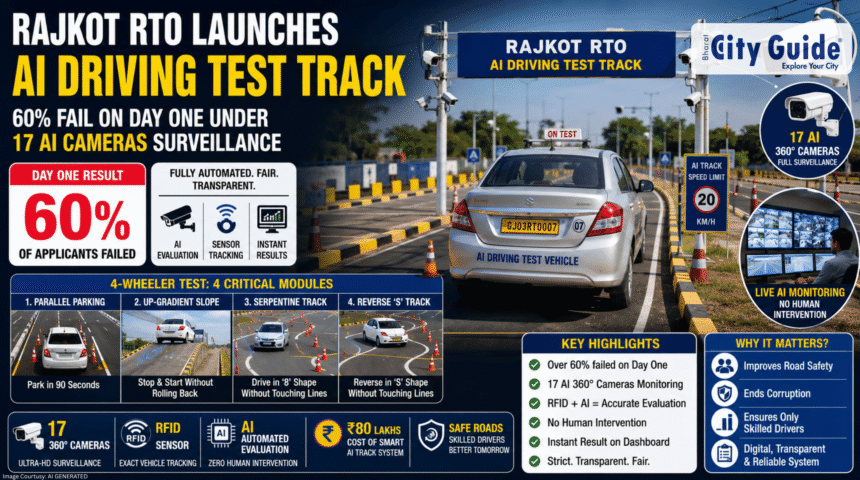
Securing a permanent driving licence in Gujarat has undergone a massive technological evolution. With the official announcement that the Rajkot RTO Launches AI Driving Test Track, the evaluation process has transitioned from human oversight into a fully automated digital ecosystem. The newly integrated, tech-driven driving track left applicants stunned on its very first day of deployment, recording an astonishing 60% failure rate among applicants. This sudden drop in passing statistics highlights the absolute zero-tolerance nature of artificial intelligence when assessing standard driving compliance.
- Introduction
- What is Rajkot RTO Launches AI Driving Test Track?
- Why This News is Important
- Background Information
- Key Highlights
- Detailed Explanation of the Event
- Benefits and Crucial Features
- How It Impacts People
- Expert Insights / Industry Perspective
- Challenges and Limitations
- Future Outlook
- Frequently Asked Questions (FAQs)
- Conclusion
Historically, passing a driving test at Regional Transport Offices relied heavily on manual inspection by regional motor vehicle inspectors. Minor errors could sometimes go unnoticed, or subjective leniency might play a role. However, as the Rajkot RTO Launches AI Driving Test Track, subjective parameters have been completely eliminated. The newly deployed smart track utilizes seventeen ultra-high-definition 360-degree cameras alongside high-precision Radio Frequency Identification (RFID) sensors. Every single gear change, curb touch, backward slip, and boundary violation is logged by central computer systems in real time.
This technological integration marks a critical step forward in the Ministry of Road Transport and Highways’ broader mandate to reduce road fatalities and ensure only skilled drivers navigate Indian roads. By automating evaluating mechanisms, the transport department aims to eradicate corruption, establish absolute transparency, and ensure that every license holder possesses sufficient on-road competence. For applicants in Rajkot, this means the era of casual test runs is officially over.
What is Rajkot RTO Launches AI Driving Test Track?
The development referred to as Rajkot RTO Launches AI Driving Test Track represents a comprehensive technological overhaul of the existing physical testing tracks at the Rajkot Regional Transport Office. Constructed at an estimated cost of approximately ₹80 lakhs, this advanced smart testing framework infuses algorithmic logic, edge computing, and sensor-based mechanics directly into the physical paving structures where two-wheeler and four-wheeler driving tests occur.
Instead of an inspector holding a clipboard at the side of the track, the entire area is governed by a unified Artificial Intelligence Automated Driving Test System (ADTT). The facility features concrete layout pathways arranged in precise operational geometries—such as the Serpentine ‘8’ track, Parallel Parking zones, Reverse ‘S’ patterns, and Up-gradient slope tracks. Embedded beneath and around these pathways are specialized sensors that track the metallic mass and exact movement path of the vehicle.
Furthermore, the vehicle tracking mechanism utilizes RFID tags applied directly to the test vehicle, communicating seamlessly with receptor towers situated around the perimeter. The artificial intelligence system cross-references the live telemetry feeds against a pre-programmed blueprint of an absolute perfect driving run. If a vehicle crosses a boundary line by even a fraction of an inch or fails to hold the brakes on an incline for the mandated duration, the AI immediately flags the error, aggregates the negative marks, and issues an instantaneous automated result.
Why This News is Important
The operationalization of this facility is a milestone for automated governance in Gujarat. Road safety remains a paramount concern across India, with statistics indicating that thousands of severe accidents occur due to improper driving mechanics, poor lane discipline, and lack of parking spatial awareness. By raising the benchmark for securing a driving permit, the RTO ensures that untrained individuals cannot access public roads.
The 60% failure rate recorded on the opening day proves that the existing skill level of average vehicle users requires significant elevation. The automated system ensures that those who cannot execute standard operations like reverse parallel parking or hill-starts are filtered out immediately. It forces commercial and private motor driving schools to completely revamp their training curricula, pushing them to emphasize exact technical compliance over superficial driving patterns.
Additionally, this structural shift entirely eradicates structural vulnerabilities related to corruption or third-party mediation. Since the AI algorithm processes data in a secure, central system, no external agent can manipulate the outcomes. The digital log serves as an unalterable legal archive of the applicant’s driving trial, making the entire procedure completely transparent and objective.
Background Information
Automated driving tracks are not entirely brand new to the state of Gujarat, but their integration with comprehensive, real-time AI computer vision represents the modern frontier of transport administration. Over the past decade, the state capital and major hubs like Ahmedabad, Surat, and Vadodara have gradually experimented with basic sensor setups. However, older automated versions were frequently plagued by persistent technical snags, server disconnects, and outdated camera systems.
In Rajkot specifically, reports from recent years highlighted that the older driving test tracks suffered from significant downtime. Equipment installed over a decade ago lacked modern component support, resulting in lengthy maintenance delays that inflated waiting list timelines for applicants. At various intervals, thousands of applicants faced test reschedules because legacy RFID sensors failed to sync properly with local computers.
Recognizing these persistent infrastructural gaps, the Commissioner of Transport authorized a complete modernization phase. The implementation of the latest AI system at the Rajkot Regional Transport Office (RTO) is a direct response to the need for durable, high-speed, and infallible civic infrastructure. This upgraded installation addresses past technological lags by leveraging 360-degree high-definition camera arrays capable of functioning under intense sunlight, dusty conditions, and low-light environments, setting a new operational benchmark for regional transport offices statewide.
Key Highlights
- High Failure Rate: Over 60% of all applicants failed to pass their practical driving evaluation on the inaugural day of the AI track’s operation.
- Intense Surveillance: The smart track is embedded with 17 state-of-the-art 360-degree rotating cameras monitoring every possible vehicle angle.
- Sensor Integration: Advanced RFID sensors work concurrently with computer vision to track exact vehicle paths down to the millimeter.
- Zero Human Intervention: The evaluation, marking, and final pass/fail generation are executed autonomously by central software logic.
- Significant Investment: The state-of-the-art AI tracking facility was upgraded and deployed at a cost of approximately ₹80 lakhs.
- Four Critical Phases: Four-wheeler drivers must successfully clear four complex modules: Parallel Parking, Up-gradient Slope, Serpentine Track, and Reverse ‘S’ paths.
Detailed Explanation of the Event
The launch day at the Rajkot RTO saw a packed house of hopeful license applicants, many of whom were unaware of the strict operational precision of the newly deployed system. As the morning testing block commenced, vehicles were equipped with localized tracking devices and directed onto the modernized pathways. Within hours, the automated dashboard displayed a stark reality: the majority of drivers were failing sections they previously assumed were straightforward.
The testing process is categorized strictly by vehicle class, each bound by specialized layout logic:
The Two-Wheeler Test Matrix
For two-wheeler applicants, the test primarily focuses on balance, steering rhythm, and mandatory safety gear. The AI tracks whether the rider keeps both feet continuously on the foot pegs while traversing a sharp, winding serpentine ‘8’ track. The 17-camera grid checks if the applicant is wearing a securely fastened helmet before the vehicle tires cross the starting line. Touching a foot to the ground or scraping the outer boundary lines immediately triggers a system penalty.
The Four-Wheeler Comprehensive Modules
For Light Motor Vehicles (LMVs), the testing procedure consists of four distinct, mandatory phases that must be cleared sequentially within specified time limits:
- The Serpentine Track: Drivers must maneuver through an S-shaped curving path forward without hitting any side cones or stepping off the paved margins.
- Parallel Parking: The candidate must reverse parallel park the vehicle completely into a designated tight rectangular slot within 90 seconds. The cameras analyze the alignment relative to the curb.
- The Up-Gradient Slope: The car must be driven up a steep incline and brought to a complete halt. The driver must then move forward from the stationary position without letting the car roll backward by even a few inches.
- The Reverse ‘S’ Module: This final element requires the driver to back the car through a long, winding S-shaped corridor using mirrors and spatial judgment without touching the boundaries.
On the initial day, the majority of the failures occurred during the parallel parking and up-gradient slope modules. Drivers regularly allowed their vehicles to roll back on the incline or misjudged the tight angles of the parking slot, which the AI detected instantly, rendering a failing grade.
Benefits and Crucial Features
| Feature Component | Technical Specification | Direct Safety Benefit |
| 360-Degree Camera Array | 17 Ultra-HD Smart Cameras | Eliminates visual blind spots during testing |
| RFID Tracking | Real-time Radio Frequency Identity | Accurately registers entry, exit, and exact time logs |
| Automated Marking Logic | Algorithmic Evaluation | Ensures completely unbiased, transparent testing |
| Instant Result Delivery | Cloud-synced Dashboard | Drastically minimizes waiting list backlogs |
The implementation offers an array of institutional benefits. First and foremost is the absolute standardization of evaluation rules. Under the new protocol, every single citizen—regardless of status—undergoes identical scrutinization.
Furthermore, the operational speed of the track has improved. Because the system calculates performance metrics instantaneously, the time spent waiting for an inspector to manually write up a scorecard is saved. Results are updated immediately on the digital transport portal, enabling individuals to schedule a re-test or print their passing certifications faster than before.
How It Impacts People
Impact on Common Citizens and Applicants
For the general public in Rajkot, this development requires a significant shift in preparation. Applicants can no longer treat the practical test as a minor formality. They must now invest serious time into practicing exact maneuvers, learning how to handle clutch control on hills, and master reverse mirror alignments. While this creates initial friction and higher failure rates, it ultimately protects these very citizens by ensuring they are competent before joining chaotic city traffic.
Impact on Motor Driving Schools
Commercial driving instructors are facing immediate pressure to overhaul their training methods. Traditional driving schools that merely taught basic gear shifts on open roads must now construct replica tracks with similar dimensions to the RTO’s ‘8’ and ‘S’ patterns. Driving schools must train students to park within strict boundaries and pass the test on their technical merits.
Expert Insights / Industry Perspective
Traffic management consultants and automotive safety experts universally welcome the shift toward automated testing tracks. Historically, transport research indicates a direct correlation between rigorous licensing exams and lowered urban accident rates. Experts note that when a human agent is removed from the immediate testing loop, it forces the entire driving population to respect the rulebook.
Engineers within the smart infrastructure space state that AI-driven vision systems are highly effective at detecting structural errors that human eyes miss—such as slight vehicle rollbacks on slopes or minor tire line touches. The long-term perspective shared by urban planners is that as more cities deploy these automated tracks, the overall driving culture of the country will naturally evolve toward better lane discipline and safer road habits.
Challenges and Limitations
Despite its immense benefits, the rollout of such an advanced system comes with inherent challenges. The most immediate issue is the widespread anxiety and frustration among applicants who fail on their first attempt, leading to a surge in re-test applications that can strain scheduling systems.
Technical maintenance remains another area of focus. Because the system relies on an interconnected grid of 17 digital cameras, edge sensors, and cloud servers, even a minor hardware glitch or network failure can bring the entire testing process to a halt. The Rajkot RTO must establish dedicated technical support teams to ensure maximum hardware uptime and prevent the system from suffering the lengthy operational outages seen in older automated tracks.
Future Outlook
Looking ahead, the successful deployment of the AI track at Rajkot serves as a operational blueprint for the rest of Gujarat and other states. The Ministry of Transport plans to eventually phase out manual testing tracks entirely across all Tier-2 and Tier-3 cities.
We can also expect future software updates to integrate even more advanced telemetry features. Future iterations may include internal cabin sensors to track whether the driver checks their rearview mirrors before reversing, or whether they use proper hand placement on the steering wheel. As AI technology continues to mature, securing a driving license will remain a true testament to genuine driving proficiency.
Frequently Asked Questions (FAQs)
1. Why did the failure rate reach 60% when the Rajkot RTO Launches AI Driving Test Track?
The failure rate spiked because the AI system uses 17 high-definition cameras and sensors that catch minor errors—like line touches or rolling back on slopes—that human inspectors might miss.
2. Can an applicant appeal a fail result generated by the AI system?
The results generated by the system are highly accurate and based on concrete sensor data. However, since the entire run is recorded digitally, the video log can be reviewed by senior RTO authorities if a technical error is suspected.
3. What are the key modules for the four-wheeler driving test?
Four-wheeler applicants must clear four mandatory segments: the Serpentine ‘8’ forward track, precise Parallel Parking within 90 seconds, an Up-gradient slope start without rolling back, and a Reverse ‘S’ corridor maneuver.
4. Is wearing a helmet compulsory during the two-wheeler AI test?
Yes. The camera network uses computer vision to check for proper safety gear. Failing to wear a securely fastened helmet before starting the track will result in an immediate penalty.
5. How much did it cost to upgrade the Rajkot RTO driving track?
The complete technological overhaul and installation of the smart AI system cost approximately ₹80 lakhs to ensure high-precision testing.
6. What happens if I fail the automated driving test?
If you fail the automated test, you will need to log into the Sarathi transport portal, pay the applicable re-test fee, and book a new appointment slot to take the test again.
Conclusion
The announcement that the Rajkot RTO Launches AI Driving Test Track marks a major milestone in upgrading road safety and digital governance in Gujarat. The initial 60% failure rate underscores the precision and strict standards of the automated system, proving that human leniency has been replaced by consistent, objective technology. While this transition requires a higher level of preparation from applicants, it ensures that only truly skilled and safe drivers receive a permanent license, creating a more secure driving environment for everyone on the road.