Introduction
The annual monsoon season brings life-giving rain to the semi-arid region of Saurashtra, but it also presents a severe challenge to urban infrastructure. Heavy downpours often cause major damage to asphalt surfaces, turning city streets into rough, uneven paths. Following recent severe weather alerts and heavy rains in Gujarat, the city of Rajkot faced significant road erosion. Potholes emerged across major corridors, inner-city junctions, and neighborhood streets, creating safety hazards and disrupting daily traffic.
- Introduction
- What is the Road Repair Campaign?
- Why This News is Important
- Background Information and Monsoon Infrastructure Challenges
- Key Highlights of the Campaign
- Detailed Explanation of the Repair Operations
- Benefits and Features of the Initiative
- How It Impacts the Community
- Expert Insights on Urban Road Resilience
- Challenges and Technical Limitations
- Future Outlook
- Frequently Asked Questions (FAQs)
- Conclusion
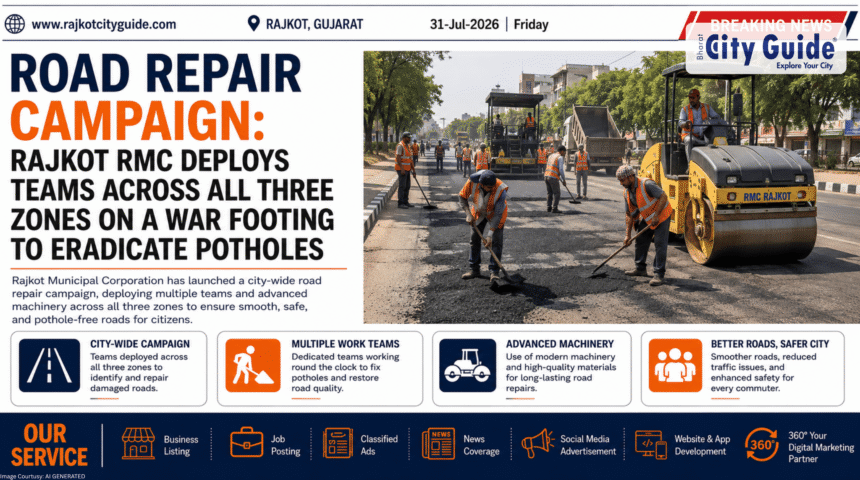
Responding to these challenges, the Rajkot Municipal Corporation (RMC) has taken direct action. The civic body launched a comprehensive Road Repair Campaign deployed on a war footing. Recognizing that broken roads slow down transit times, damage vehicles, and increase accident risks, the municipal administration has mobilized dedicated repair teams across all three of its administrative zones: East, West, and Central.
This infrastructure initiative goes beyond simple patchwork. It represents a highly coordinated, time-bound deployment of personnel, specialized vehicles, and modern materials designed to restore safe driving conditions quickly. By using advanced cold-mix technologies and fast-setting asphalt compounds, the RMC aims to make the city’s roads entirely pothole-free. This article covers the details of this extensive repair effort, examining its operational strategies, technological choices, community impacts, and long-term plans for building resilient urban infrastructure.
What is the Road Repair Campaign?
The Road Repair Campaign is an intensive, high-priority infrastructure maintenance initiative launched by the Rajkot Municipal Corporation. Its primary goal is the rapid repair and resurfacing of roads damaged by seasonal rainfall. Instead of waiting for the monsoon to completely end, the city launched this campaign as an active, immediate response to rising public complaints and field assessments.
Operationally, the campaign breaks the city down into distinct zones, allowing municipal engineers to tackle repairs systematically. Each zone is assigned specialized teams equipped with asphalt mixers, steamrollers, and specialized repair materials. The campaign focuses on flattening dangerous potholes, repairing eroded road edges, and fixing uneven asphalt layers. By organizing these teams simultaneously across the city, the RMC ensures that both major commercial highways and smaller residential streets receive timely maintenance.
Why This News is Important
This news is highly important for the economic health and daily safety of Rajkot. Roads serve as the literal circulatory system of any growing urban economy. When potholes clutter major transit routes, the impacts are felt immediately across multiple sectors.
First, road safety is a critical priority. Potholes are a major cause of two-wheeler accidents, as riders frequently swerve suddenly to avoid deep craters, leading to collisions. By repairing these hazards on a war footing, the RMC directly reduces injuries and protects lives.
Second, the economic cost of delayed road maintenance is high. Persistent potholes cause significant wear and tear on suspension systems, tires, and vehicle alignments, forcing residents to spend more on repairs. Furthermore, slow-moving traffic caused by damaged roads increases fuel consumption and lengthens travel times for commercial goods. The rapid rollout of this campaign shows that the local government is prioritizing public safety and economic efficiency.
Background Information and Monsoon Infrastructure Challenges
To better understand the scale of this initiative, it helps to examine the unique challenges that monsoon weather poses to asphalt infrastructure. Standard city roads are primarily composed of bituminous macadam. While bitumen provides a smooth, flexible surface for driving, it is naturally vulnerable to prolonged exposure to water.
[Relentless Heavy Rainfall] ──► [Water Seeps Into Asphalt Cracks]
                                         │
                                         ▼
[Potholes Form & Expand]    ◄── [Heavy Traffic Crushes Weak Base]
When heavy rains hit the city, water accumulates in minor surface cracks. As heavy buses, trucks, and cars drive over these wet sections, they create high hydro-dynamic pressure that forces water deeper into the road’s sub-base layer. This process strips the bitumen binder away from the aggregate stone chips, weakening the structural foundation. Over time, the asphalt crumbles under the weight of daily traffic, creating potholes.
Rajkot’s recent weather has accelerated this process. The city experienced a series of severe deep depressions that brought intense, continuous rainfall over several days. Because the local storm drainage systems were working at maximum capacity, many roads experienced prolonged waterlogging. This sustained immersion weakened the asphalt across the East, West, and Central zones, making a widespread repair initiative absolutely necessary.
Key Highlights of the Campaign
- War-Footing Execution: The Rajkot Municipal Corporation (RMC) has categorized the repair initiative as a high-priority emergency campaign, working around the clock to fix broken surfaces.
- Three-Zone Deployment: Dedicated engineering teams have been deployed simultaneously across the East, West, and Central zones to ensure balanced city-wide coverage.
- High-Traffic Focus: Priority is given to major intersections, BRTS corridors, hospital routes, and high-density commercial markets.
- Advanced Material Use: Teams are utilizing specialized cold-mix asphalt and quick-setting chemical binders, allowing repairs to set properly even in damp conditions.
- Continuous Monitoring: Senior municipal engineers and ward officers are conducting regular field inspections to verify repair quality and ensure long-term durability.
Detailed Explanation of the Repair Operations
The Rajkot Municipal Corporation’s approach to this Road Repair Campaign is built around targeted execution and structured zoning. Rather than spreading resources too thin, the RMC divided its workforce into independent teams, each assigned to specific municipal wards within the three primary zones.
1. The Central Zone Operations
The Central Zone contains Rajkot’s historic core, featuring narrow streets, dense residential neighborhoods, and highly active commercial markets. Potholes here cause immediate traffic gridlock. The RMC teams in this zone operate primarily during late-night and early-morning hours to minimize disruption to shoppers and local businesses. These teams focus on clearing loose debris from potholes, drying out the base, and filling the space with dense asphalt mixtures before compacting it flush with the existing road surface.
2. The West Zone Operations
The West Zone represents Rajkot’s rapidly expanding modern half, characterized by wide avenues, high-rise residential complexes, and prominent educational institutions. Roads here carry fast-moving commuter traffic. Repair teams in this sector utilize heavy machinery, including mechanical rollers and motorized aggregate spreaders, to cover larger sections of damaged asphalt quickly. Special attention is paid to the main arterial roads connecting the city center to outlying residential suburbs.
3. The East Zone Operations
The East Zone features a mix of industrial estates, transport hubs, and worker housing. The roads in this zone regularly carry heavy-duty commercial trucks and industrial logistics vehicles. Because heavy vehicles put immense pressure on roads, the repair teams here apply thicker base layers and reinforced aggregate mixes to ensure the patchwork can withstand heavy industrial loads without crumbling.
Benefits and Features of the Initiative
The systematic rollout of this infrastructure campaign brings clear operational advantages:
All-Weather Asphalt Mixes
A major highlight of the campaign is the use of advanced cold-mix bitumen compounds. Traditional hot-mix asphalt requires completely dry surfaces and high temperatures to set properly, making it impractical during intermittent monsoon spells. Cold-mix asphalt can be applied directly to damp surfaces, allowing repair teams to patch holes efficiently between rain showers without waiting weeks for dry weather.
Improved Traffic Flow and Reduced Transit Times
As potholes are filled and smoothed over, traffic bottlenecks melt away. Vehicles can maintain steady, safe speeds without sudden braking or erratic swerving. This smoother flow optimizes the efficiency of public transit systems, including the local BRTS networks, ensuring commuters reach their destinations reliably.
Lower Vehicle Maintenance Costs
Smoother roads mean less wear and tear on private and public vehicles. By fixing deep craters, the RMC helps residents avoid costly tire blowouts, bent wheel rims, and broken suspension systems, saving the community significant money on vehicle upkeep.
How It Impacts the Community
Daily Commuters and Drivers
For the thousands of residents who navigate Rajkot on two-wheelers and auto-rickshaws, the campaign brings immediate safety benefits. Smoother roads make daily travel less stressful and significantly reduce the risk of skidding or losing control on uneven surfaces.
Business Owners and Logistics Providers
Local businesses depend on predictable delivery timelines. The repair of major commercial routes ensures that delivery trucks, supply vans, and couriers can move items through the city efficiently, avoiding delayed shipments caused by traffic gridlock or vehicle breakdowns.
Travelers and Public Transport Users
People traveling to Rajkot via state transport buses or regional trains enjoy a smoother final leg of their journey. As road quality improves around transport hubs, taxi and auto-rickshaw rides become faster, safer, and more comfortable.
Expert Insights on Urban Road Resilience
Civil engineers and urban planning experts emphasize that seasonal road maintenance is an essential part of modern city management. Infrastructure specialists note that while immediate patchwork campaigns are vital for public safety during the monsoon, they must be paired with smart engineering choices, such as building proper road cambers (slopes) and clearing roadside drains.
When a road has a slight slope, rainwater naturally flows off the asphalt and into the drainage system rather than pooling on the surface. Experts suggest that cities should increasingly move toward using concrete for high-traffic junctions and low-lying zones, as concrete is highly resistant to water damage and offers greater long-term durability compared to standard bitumen.
Challenges and Technical Limitations
Despite thorough planning, executing a large-scale repair campaign during the monsoon presents real challenges:
- Intermittent Rainfall: Sudden downpours can wash away freshly laid asphalt aggregate before it has fully cured, requiring teams to re-do sections.
- Heavy Traffic Pressure: Repairing high-density roads during the day is difficult due to constant traffic flow, which can disturb the new patches before they set completely.
- Underlying Drainage Issues: If a neighborhood suffers from poor drainage, repaired roads will continue to face water accumulation, which can cause new potholes to form over time.
Future Outlook
Looking ahead, the Rajkot Municipal Corporation plans to transition from temporary monsoon repairs to long-term resurfacing projects as the rainy season tapers off. The city is evaluating advanced road-mapping technologies, including using drone photography and mobile apps to track road conditions in real time.
By creating a digital inventory of road quality, the RMC can transition from a reactive maintenance style to a predictive model, identifying and reinforcing weak road sections before the next monsoon season arrives. Additionally, the city aims to increase the use of white-topping (overlaying asphalt with concrete) at major intersections to ensure long-term stability.
Frequently Asked Questions (FAQs)
1. What is the main goal of the Rajkot Road Repair Campaign?
The campaign aims to quickly repair, patch, and smooth over potholes and road damage caused by heavy monsoon rains across Rajkot’s East, West, and Central zones.
2. How is the RMC fixing roads while it is still raining intermittently?
Repair teams are using specialized cold-mix asphalt and quick-setting chemical binders designed to cure effectively even on damp road surfaces, bypassing the need for hot, dry weather.
3. Which areas of the city are being prioritized for repairs?
Priority is given to high-traffic locations, including main commercial corridors, BRTS transit paths, hospital entry routes, and major busy intersections.
4. How does fixing potholes help improve public safety?
Smooth roads eliminate the need for drivers to swerve suddenly, which drastically reduces the risk of collisions, vehicle damage, and two-wheeler skidding accidents.
5. What should citizens do if they spot a dangerous pothole in their neighborhood?
Residents can report damaged roads directly to the Rajkot Municipal Corporation via their official civic helpline number or through the city’s dedicated online grievance portal.
6. Are there long-term plans to prevent potholes from reforming?
Yes. Following the initial patchwork campaign, the RMC plans to undertake full road resurfacing, improve roadside drainage systems, and use durable concrete materials at water-prone intersections.
Conclusion
The launch of the Road Repair Campaign highlights the Rajkot Municipal Corporation’s proactive commitment to maintaining safe and reliable urban infrastructure. By deploying specialized repair teams on a war footing across the East, West, and Central zones, the city is systematically addressing the infrastructure damage caused by severe monsoon weather.
While seasonal rainfall presents continuous challenges to asphalt roads, the strategic use of modern cold-mix materials and targeted zoning ensures that the city remains safe and accessible. As these repair teams complete their work across Rajkot, the focus will naturally shift toward building long-term durability. Through smart engineering, clear drainage systems, and continuous maintenance, Rajkot is paving the way toward a safer, smoother, and more resilient urban future for all its residents.