Introduction
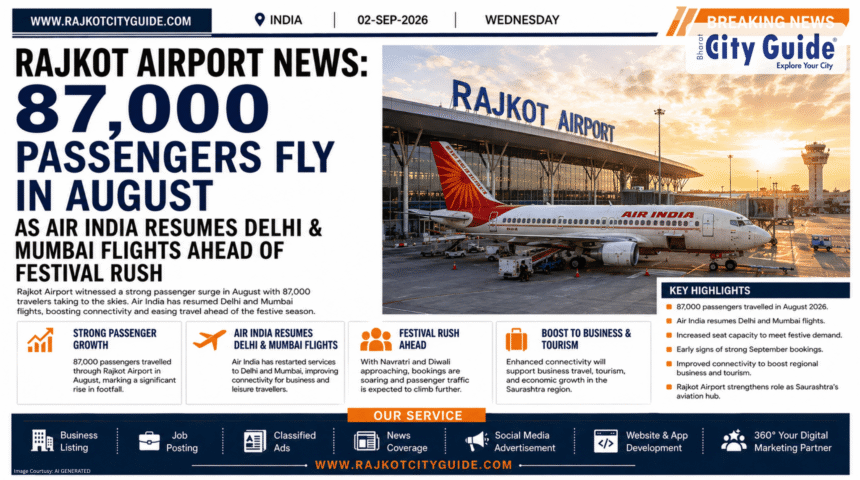
In a significant milestone for regional connectivity across Western India, the latest Rajkot Airport News highlights a massive surge in aviation activity across Saurashtra. During the month of August alone, Rajkot International Airport (located near Hirasar) recorded a staggering footfall of over 87,000 air passengers. This surge in travel volume underscores the growing reliance on air travel among business leaders, industry operators, non-resident Gujaratis (NRGs), and domestic tourists connecting through Rajkot.
- Introduction
- Why This News is Important
- Background Information
- Key Highlights
- What is Rajkot Airport News?
- Detailed Explanation of the Event
- Benefits, Features, and Importance
- How It Impacts People
- Expert Insights / Industry Perspective
- Challenges and Limitations
- Future Outlook
- Frequently Asked Questions (FAQs)
- Conclusion
Adding to the momentum, flag carrier Air India officially resumed its crucial direct flight operations linking Rajkot with major metros including New Delhi and Mumbai. The reinstatement of these key routes provides seamless travel options for passengers travelling for business, healthcare, education, and leisure. With major cultural events like Janmashtami and Diwali approaching, airport management and regional airlines are preparing for even higher passenger rushes over the coming months.
This detailed article breaks down the passenger footfall data recorded in August, examines the strategic importance of Air India’s resumed routes, explores the economic impact on Saurashtra’s commercial sectors, and outlines future infrastructure expectations at Rajkot International Airport.
Why This News is Important
The record passenger numbers and restored air links represent a major milestone for Saurashtra’s socio-economic ecosystem:
- Commercial & Industrial Connectivity: Rajkot serves as the manufacturing and engineering hub for Saurashtra’s extensive auto-parts, brass parts, machine tools, and jewelry industries. Fast connectivity to Delhi and Mumbai enables business owners to execute transactions and meet clients without travel friction.
- Support for Festive Travel: August and September mark the start of Gujarat’s vibrant festival calendar. Thousands of families and NRGs travel home during Janmashtami and Diwali, making reliable air routes essential.
- Boost to Regional Tourism: Improved air access streamlines travel to key pilgrimage and cultural heritage destinations across Saurashtra, including Somnath, Dwarka, Junagadh, and Gir National Park.
- Airport Utilization & Expansion: Crossing 87,000 monthly passengers validates the heavy capital investment in the greenfield Hirasar airport complex, paving the way for eventual international flights.
Background Information
The old Rajkot Airport, situated inside the city boundaries, operated on a limited 6,000-foot runway that could not be expanded due to urban encroachment. This restricted airline operations, forcing carriers to reduce payload capacity during hot summer months and limiting aircraft types to smaller turboprops or short-haul jets.
To solve these constraints, the greenfield Rajkot International Airport was built at Hirasar across 2,500+ acres with a 3,040-meter (nearly 10,000-foot) runway capable of accommodating larger aircraft like Airbus A320/A321 and Boeing 737 models seamlessly. Operational transfers were completed in late 2023.
While passenger movement grew rapidly post-launch, temporary schedule adjustments by airlines during mid-2024 caused brief interruptions on certain metro routes. The recent decision by Air India to restore high-frequency flights to Delhi and Mumbai marks a full operational recovery, driving August’s high passenger numbers.
Key Highlights
- 87,000+ Passengers in August: Rajkot International Airport achieved one of its highest monthly footfalls, handling over 87,000 passengers.
- Air India Flight Restoration: Full-service direct flights connecting Rajkot with New Delhi and Mumbai have officially resumed.
- Upcoming Festival Surge: Travel demand is projected to spike sharply through September, October, and November due to Janmashtami, Navratri, and Diwali holidays.
- Improved Metro Schedules: IndiGo and Air India now provide multiple daily connections to Mumbai and Delhi, alongside flights to Bengaluru.
- Push for International Routes: Local trade organizations like the Rajkot Chamber of Commerce and Industry (RCCI) are campaigning for direct flights to Dubai and Bangkok before the year ends.
What is Rajkot Airport News?
The term Rajkot Airport News covers official updates, operational statistics, airline schedule changes, and infrastructure developments related to Rajkot International Airport (IATA: HSR). Located at Hirasar along the Rajkot-Ahmedabad Highway, this modern greenfield facility replaced the old city airport to handle larger narrow-body and wide-body aircraft with enhanced passenger capacity.
Key Operational Metrics at Rajkot International Airport
- August Passenger Footfall: Over 87,000 passengers handled across arrival and departure terminals.
- Major Carriers: Air India and IndiGo operating key domestic schedules.
- Primary Metros Connected: Direct non-stop service to Delhi, Mumbai, and Bengaluru.
- Peak Infrastructure Capacity: Terminal designed to accommodate up to 2,800 peak-hour passengers.
Key elements tracked in the current aviation update include:
- Monthly Passenger Statistics: Comprehensive tracking of footfall numbers, flight movements, and terminal usage.
- Flight Restorations & Frequency Additions: Reintroduction of daily or multi-weekly direct connections to major hubs like Delhi and Mumbai by full-service carriers.
- Seasonal Rush Projections: Operational readiness for major festive travel periods such as Janmashtami, Navratri, and Diwali.
- International Operational Status: Ongoing campaigns by regional trade bodies to secure international customs and immigration approvals for direct Middle East and Southeast Asia routes.
Detailed Explanation of the Event
1. August Footfall Milestone
During August, passenger throughput at the new Hirasar terminal hit impressive levels. Analysis of airport movement data shows that over 87,000 inbound and outbound passengers passed through the facility. This growth is driven by business travel, student movements, and early festive bookings by families heading to Saurashtra.
                  [ RAJKOT AIRPORT AVIATION GROWTH ENGINE ]
                                     │
 ┌───────────────────────────────────┼───────────────────────────────────┐
 ▼                                   ▼                                   ▼
Modern Hirasar Infrastructure   Air India Metro Restorations     Upcoming Festival Rush
(10,000 ft Runway / 20 Check-in) (Delhi & Mumbai Non-Stop Links) (Janmashtami & Diwali Demand)
 └───────────────────────────────────┬───────────────────────────────────┘
                                     │
                                     ▼
             Over 87,000 Passengers Handled in August Single-Month Period
2. Air India Delhi and Mumbai Route Reinstatement
The resumption of Air India’s flights to Indira Gandhi International Airport (DEL) in Delhi and Chhatrapati Shivaji Maharaj International Airport (BOM) in Mumbai provides vital options for travelers. As a full-service carrier, Air India offers seamless baggage transfers, complimentary meals, and through-check-in for international connecting flights via its primary hubs in Delhi and Mumbai.
| Airline | Route Origin / Destination | Aircraft Type | Connectivity Benefit |
| Air India | Rajkot (HSR) ◄► Mumbai (BOM) | Airbus A320neo | Direct connection to India’s financial hub & international transfers. |
| Air India | Rajkot (HSR) ◄► New Delhi (DEL) | Airbus A320/A321 | Direct access to North India & international onward flights. |
| IndiGo | Rajkot (HSR) ◄► Mumbai / Delhi / Bengaluru | Airbus A320neo / ATR-72 | Multi-daily low-cost frequency options across key business hubs. |
3. Anticipated Festival Demand Surge
Airport authorities and airline station managers are preparing for an additional surge in passenger numbers. Janmashtami is celebrated with grand fairs (Lok Mela) across Rajkot, drawing diaspora visitors from across India and abroad. Following Janmashtami, the festive travel season continues through Navratri and Diwali, keeping flight loads and airfares elevated.
Benefits, Features, and Importance
The table below summarizes the key advantages of current airport operations and route expansions:
| Feature / Aspect | Implementation Details | Direct Sectoral Benefit |
| Long-Haul Runway | 3,040-meter runway capacity | Allows airlines to operate at 100% passenger and cargo payloads. |
| Modern Terminal Facilities | 20 check-in counters & 5 luggage belts | Reduces check-in queue times during peak festive travel periods. |
| Hub Connectivity | Direct flights to DEL and BOM hubs | Simplifies one-stop international travel for Saurashtra residents. |
| Air Cargo Expansion | Spacious belly-hold cargo room | Accelerates express shipments for Rajkot’s jewelry and industrial exporters. |
How It Impacts People
For Business Owners and Industrial Exporters
Rajkot’s industrial landscape relies heavily on fast travel to business centers. Restored Air India links allow local manufacturers to host domestic and international clients easily. Exporters can fly to Delhi or Mumbai in under two hours for trade expos, meetings, and supply chain consultations.
For the Non-Resident Gujarati (NRG) Community
Thousands of families with roots in Rajkot, Jamnagar, Junagadh, and Amreli reside across North America, Europe, and the Middle East. Restoring full-service flights simplifies travel home for holidays, allowing NRGs to book single-ticket itineraries through Delhi or Mumbai directly to Rajkot.
For Local Tourists and Pilgrims
Saurashtra is a major spiritual and eco-tourism destination. Direct flights to Rajkot reduce road travel times for tourists visiting the Somnath Jyotirlinga, Dwarkadhish Temple, Sasan Gir tiger/lion safaris, and Diu beaches.
Expert Insights / Industry Perspective
Aviation analysts and trade leaders view the growth at Rajkot International Airport as proof of Saurashtra’s expanding economic footprint.
Industry experts note that moving operations to the long-runway Hirasar facility solved the operational bottlenecks that previously limited Rajkot’s air connectivity. Airlines can now run high-capacity narrow-body aircraft without weight restrictions, helping keep ticket prices competitive while expanding seat capacity.
Trade leadership from the Rajkot Chamber of Commerce and Industry (RCCI) emphasizes that with domestic passenger numbers exceeding 87,000 monthly, launching direct international flights to hubs like Dubai is the natural next step. Establishing customs and immigration clearance facilities at Hirasar will allow regional businesses to bypass transit stops in Mumbai or Ahmedabad entirely.
Challenges and Limitations
Despite high passenger numbers, several operational and logistical challenges remain:
- Highway Distance & Connectivity: Hirasar Airport sits approximately 25 to 30 km outside central Rajkot along the Ahmedabad highway. Passengers must factor in a 45-to-60-minute road trip, raising taxi fares compared to the old city airport.
- Lack of Public Bus Timings: While private taxis and app-based cabs serve the airport, affordable scheduled municipal or state transport bus connections remain limited during early morning and late night flight arrivals.
- Pending International Approvals: Although terminal infrastructure is ready, scheduled international flights await final immigration staffing and airline route allocations.
Future Outlook
The medium-to-long-term outlook for Rajkot International Airport remains very positive:
- Festive Travel Peak (Sept–Nov): Passenger traffic is expected to hit record levels through the festival season, with airlines considering temporary extra flights to manage demand.
- Upcoming International Operations: Active campaigns by regional business groups aim to secure Rajkot’s first direct international route (targeting Dubai or Gulf hubs) within the coming months.
- Aerotropolis and Freight Development: Lands surrounding the Hirasar airport complex are designated for logistics parks, warehousing hubs, and industrial zones, positioning Rajkot as an air cargo center for Western Gujarat.
Frequently Asked Questions (FAQs)
1. How many passengers used Rajkot Airport in August?
Over 87,000 passengers passed through Rajkot International Airport in August, setting a high monthly footfall record for the region.
2. Which Air India routes have recently resumed operations from Rajkot?
Air India has officially resumed direct flights linking Rajkot (HSR) with major metro hubs in New Delhi (DEL) and Mumbai (BOM).
3. Where is the new Rajkot International Airport located?
The new greenfield airport is located at Hirasar, roughly 25 to 30 km from Rajkot city along the Rajkot-Ahmedabad Highway.
4. Are there direct international flights operating from Rajkot Airport yet?
Not yet. While the terminal infrastructure, runway, and customs facilities are ready, scheduled international flights are awaiting final regulatory approvals and airline route filings.
5. Why is passenger traffic expected to rise further in September and October?
Traffic is expected to surge due to heavy festival travel for Janmashtami, Navratri, and Diwali, which brings thousands of tourists and NRGs home to Saurashtra.
6. Which airlines currently operate daily flights out of Rajkot Hirasar Airport?
Air India and IndiGo are the primary carriers operating scheduled passenger services from Rajkot International Airport.
Conclusion
The latest Rajkot Airport News highlights the rapid expansion of air travel across Saurashtra. Crossing 87,000 monthly passengers in August demonstrates strong demand for regional air connectivity. With Air India resuming vital direct links to Delhi and Mumbai, and airlines preparing for heavy festival travel during Janmashtami and Diwali, Rajkot International Airport is well-positioned to serve as a key economic gateway for Western Gujarat.