Introduction
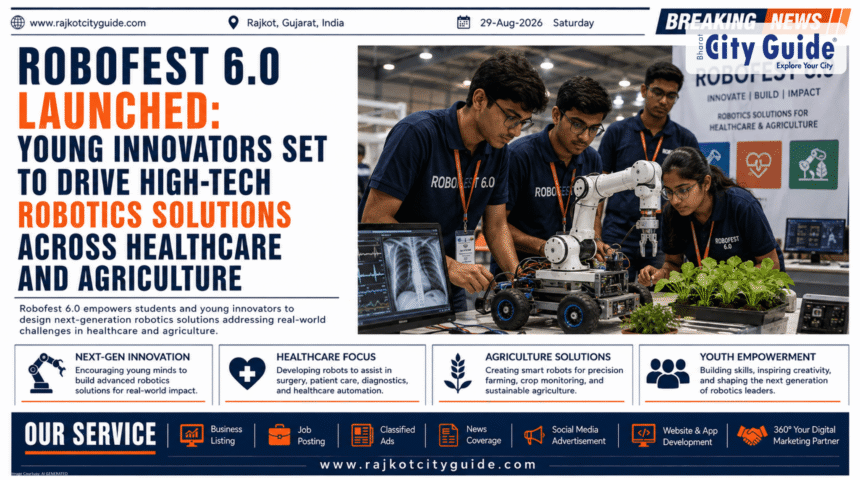
In an ambitious move designed to accelerate technological self-reliance and empower the next generation of engineers, Robofest 6.0 Launched as the latest edition of Gujarat’s premier national-level robotics innovation competition. Organised by the Gujarat Council on Science and Technology (GUJCOST) under the Department of Science and Technology, Government of Gujarat, the flagship initiative has officially opened its doors to school students, ITI trainees, diploma holders, and undergraduate and postgraduate STEM innovators across the nation.
- Introduction
- What is Robofest 6.0 Launched?
- Why This News is Important
- Background Information
- Key Highlights
- Detailed Explanation of the Event
- Benefits, Features, and Importance
- How It Impacts People
- Expert Insights / Industry Perspective
- Challenges and Limitations
- Future Outlook
- Frequently Asked Questions (FAQs)
- Conclusion
With a total prize pool and prototype support funding scaling up to ₹5 crore, this sixth edition shifts the spotlight toward real-world application building. Rather than creating static academic models, participating student teams are tasked with engineering working, autonomous robotic systems capable of delivering practical solutions in high-priority sectors such as smart agriculture, modern healthcare, deep-sea exploration, autonomous industrial transport, and defense technology.
The launch event in Gandhinagar underscored Gujarat’s expanding footprint as a global high-tech hub for sunrise industries—ranging from semiconductor manufacturing and artificial intelligence to advanced drone ecosystems and robotics. By bridging classroom theory with hands-on prototype building, Robofest 6.0 offers young minds the resources, mentorship, and financial backing needed to turn creative concepts into market-ready technological products.
What is Robofest 6.0 Launched?
The announcement that Robofest 6.0 Launched marks the return of India’s most comprehensive multi-stage robotics engineering competition for young scholars and researchers. Conceived under the Science, Technology, and Innovation (STI) policy of Gujarat, Robofest aims to cultivate practical technical expertise in fields where traditional academic curricula often fall short.
┌────────────────────────────────────────────────────────────────────────┐
│                        ROBOFEST 6.0 COMPETITION STRUCTURE             │
├────────────────────────────────────────────────────────────────────────┤
│  LEVEL 1: IDEATION                                                     │
│  Concept Note Submission & Technical Methodology Evaluation             │
├────────────────────────────────────────────────────────────────────────┤
│  LEVEL 2: PROOF OF CONCEPT (PoC)                                       │
│  Functional Small-Scale Prototype Development (4-6 Month Window)        │
├────────────────────────────────────────────────────────────────────────┤
│  LEVEL 3: FULL PROTOTYPE DEVELOPMENT                                   │
│  Deployable Working System & Performance Testing (6-8 Month Window)     │
├────────────────────────────────────────────────────────────────────────┤
│  LEVEL 4: COMMISSIONING & EXHIBITION                                   │
│  Public Demonstration & Placement in Gujarat Science City Galleries     │
└────────────────────────────────────────────────────────────────────────┘
The competition is structured into distinct junior and senior brackets alongside a specialized AI-Powered Robotics Innovation Hackathon. It guides participants through a rigorous four-stage pipeline:
- Ideation Stage (Level 1): Teams submit detailed concept notes outlining mechanical design, sensor integration, software methodology, and target application areas.
- Proof of Concept (Level 2): Selected teams receive initial seed grants to build and demonstrate functional scaled-down working models.
- Full Prototype Development (Level 3): Shortlisted finalists receive substantial development funding to construct full-scale, autonomous operational robots capable of tackling real-world task environments.
- Commissioning and Commercialization (Level 4): Winning prototypes are showcased at state-of-the-art facilities like the Gujarat Science City Robotics Gallery and prepared for startup incubation or industrial adoption.
Why This News is Important
The launch of Robofest 6.0 represents a crucial step in transforming how technical education is delivered and commercialized in India:
- Democratizing Innovation Funding: High hardware costs often prevent talented students from building physical prototypes. Robofest provides direct financial support at every stage, eliminating economic barriers for young creators.
- Focusing on Practical Solutions: The competition targets urgent societal needs, encouraging students to design machines for automated crop monitoring, surgical assistance, hazardous waste clearance, and border security.
- Strengthening India’s Tech Ecosystem: By linking robotics with ongoing investments in semiconductor fabrication and drone infrastructure, the initiative helps build domestic manufacturing capabilities in line with national self-reliance goals.
- Fostering Student Startups: The competition goes beyond academic grading, helping winning teams file patents, launch technology startups, and secure venture capital support.
Background Information
Robotics and Artificial Intelligence have evolved from niche academic research fields into essential technologies for modern industry, agriculture, and defense. Recognizing this shift early on, GUJCOST introduced the Robofest series to build technical capacity among engineering and school students across Gujarat and India.
Previous editions of Robofest have produced dozens of impressive prototypes, including Autonomous Underwater Vehicles (AUVs), crop-disease detection rovers, and automated healthcare assistants. Many of these student-led projects are now permanently displayed at the Robotic Gallery in Gujarat Science City, where they serve as interactive educational exhibits for millions of visitors.
With Robofest 6.0 Launched, GUJCOST has expanded the initiative’s scope by integrating artificial intelligence and machine learning into all competition categories. This reflects the growing convergence of physical robotics with advanced AI algorithms. Simultaneously, the state signed complementary MoUs—such as a partnership with Rashtriya Raksha University (RRU) to establish a statewide Drone Laboratory Network—creating a complete ecosystem for autonomous systems research.
Key Highlights
- Flagship Initiative: Launched in Gandhinagar by Science and Technology Minister Arjun Modhwadia under the auspices of GUJCOST.
- Substantial Financial Backing: Features a total prize pool and prototype funding framework worth ₹5 crore.
- Multi-Tiered Participation: Open to STEM students from schools (Classes 9–12), ITIs, diploma institutes, and undergraduate/postgraduate university programs nationwide.
- Key Sector Focus: Project categories target high-impact fields including healthcare automation, smart agricultural machinery, deep-sea exploration, defense/border surveillance, and industrial logistics.
- AI Integration: Features a dedicated “AI-Powered Robotics Innovation Hackathon” to encourage advanced software, computer vision, and machine learning implementations.
- Ecosystem MoUs: Accompanied by strategic agreements, including a partnership with Rashtriya Raksha University to set up a hub-and-spoke Drone Laboratory Network across Gujarat.
Detailed Explanation of the Event
During the official launch ceremony in Gandhinagar, officials emphasized that technology education must move beyond theoretical textbooks toward experiential, project-based learning. Live demonstrations of winning robotic systems from Robofest 5.0 showcased the real-world value of student innovation.
                 [ GUJARAT HIGH-TECH INNOVATION ECOSYSTEM ]
                                     │
       ┌─────────────────────────────┼─────────────────────────────┐
       ▼                             ▼                             ▼
 [ ROBOFEST 6.0 ]             [ DRONE LAB NETWORK ]       [ SEMICONDUCTOR HUB ]
 Student Robotics & AI       RRU Hub-and-Spoke Training    Fab Plants & Microchip
 Prototype Grants            & Security Research           Manufacturing Ecosystem
The competition is structured into clear phases to help students transition from basic ideas to fully operational machines:
1. Sectoral Problem Statements
Participants select real-world challenges defined by industry experts and research bodies. In agriculture, teams might design lightweight autonomous rovers that spot crop diseases early or deliver targeted fertilizer, reducing chemical waste. In healthcare, projects range from patient-assistive exoskeletons to robotic arms designed for sterile laboratory environments.
2. Mentorship and Faculty Guidance
Each senior team works under the direct guidance of a regular university faculty mentor with proven STEM teaching experience. This setup ensures technical discipline, proper mechanical design, and sound software engineering practices throughout the multi-month build process.
3. Rigorous Technical Reviews
Promising concept notes clear Level 1 and receive financial grants to build functional working models. A panel of expert reviewers from academia, defense organizations, and industrial technology companies evaluates these prototypes during Level 2 and Level 3 trials, assessing mechanical durability, safety protocols, and software reliability.
Benefits, Features, and Importance
The table below outlines how Robofest 6.0 compares to conventional academic project formats across key technological and educational parameters:
| Metric / Parameter | Conventional University Projects | Robofest 6.0 Framework | Practical Value Delivered |
| Funding Source | Out-of-pocket student expenses | Direct state grants (Up to ₹10 lakh top awards) | Removes financial hurdles to purchasing sensors, motors, & microcontrollers. |
| Technical Scope | Basic simulation software or static models | Fully autonomous, hardware-integrated prototypes | Prepares students for real-world engineering environments. |
| Software Integration | Standard coding scripts | Deep integration of AI, Computer Vision, & ML | Builds high-demand skillsets in modern autonomous software. |
| Industry Exposure | Internal department evaluation | Review panels featuring industry & defense experts | Connects promising talent directly with technology employers. |
| Post-Event Path | Archived academic reports | Incubation, patent filing, & Science City exhibition | Turns academic projects into viable technology startups. |
How It Impacts People
For Engineering and School Students
Robofest 6.0 gives young innovators a national platform to gain hands-on experience in electronics, mechanical design, microchip integration, and artificial intelligence. The milestone-based funding allows students to experiment with high-grade components without financial strain, building confidence and accelerating career growth.
For Farmers and Healthcare Workers
Technologies developed during the competition target everyday challenges. Smart farming rovers can help smallholder farmers monitor soil health, automate irrigation, and control pests, driving down labor costs. In healthcare, affordable rehabilitation robots and automated support systems can improve patient care in tier-2 and tier-3 hospital settings.
For Industry and Technology Startups
The event serves as an ideal talent pipeline for India’s emerging hardware and robotics sectors. Technology companies gain access to job-ready graduates who have already built and tested complex physical systems. Meanwhile, incubator support helps participating teams turn award-winning prototypes into commercial tech startups.
Expert Insights / Industry Perspective
Technology leaders and academic experts strongly support initiatives like Robofest that bridge theoretical education and real-world implementation.
Industry analysts emphasize that as global supply chains shift toward automated manufacturing and AI-driven logistics, India must build strong domestic capabilities in both software algorithms and robotic hardware. Programs that combine financial grants with expert mentorship help move engineering education away from rote learning toward original research and product design.
Furthermore, expert observers highlight the strategic value of linking student robotics competitions with wider state initiatives—such as semiconductor assembly plants and drone research centers. This integrated approach ensures that young engineers have access to local manufacturing ecosystems, helping turn raw prototypes into market-ready products.
Challenges and Limitations
While Robofest 6.0 Launched opens up exciting opportunities, participants and organizers face several practical challenges:
- Supply Chain Delays: Sourcing specialized robotic hardware—such as high-torque servo motors, advanced LiDAR sensors, and dedicated AI processing boards—can take time and involve import hurdles.
- Interdisciplinary Coordination: Building successful autonomous robots requires smooth collaboration across mechanical, electrical, and computer science engineering disciplines, which can be challenging for early-stage student teams.
- Transitioning to Commercial Scale: Moving a functional prototype from a controlled competition environment to a rugged, field-tested commercial product demands ongoing venture capital, patent support, and industrial testing facilities.
Future Outlook
The launch of Robofest 6.0 reflects a broader shift in how India approaches technology development and engineering education:
- Regional Innovation Hubs: Over the next three to five years, prototype funding initiatives like Robofest are expected to spur dedicated robotics incubator hubs across regional engineering colleges.
- Expansion of Drone and Defense Tech: With the new GUJCOST-RRU Drone Laboratory Network, upcoming editions will likely place even greater emphasis on aerial robotics, defense tech, and swarm intelligence.
- Commercializing Indigenous IP: As student teams refine their designs through multi-stage evaluations, more indigenously designed robots will enter market trials in agriculture, industrial automation, and municipal services.
Frequently Asked Questions (FAQs)
1. Who is eligible to participate in Robofest 6.0?
The competition is open to students across India, including school students from Classes 9–12 (STEM tracks), ITI trainees, diploma students, and undergraduate or postgraduate STEM candidates.
2. What is the total funding and prize pool allocated for Robofest 6.0?
The event features a total financial commitment of ₹5 crore, covering milestone-based prototype development grants and final category cash awards.
3. Which government agency organizes the Robofest competition?
Robofest is organized by the Gujarat Council on Science and Technology (GUJCOST), operating under the Department of Science and Technology, Government of Gujarat.
4. What are the key focus areas for project entries?
Key application areas include smart agriculture, healthcare automation, deep-sea exploration, autonomous industrial transport, humanitarian aid, border security, and AI-driven robotics.
5. How does Robofest support teams beyond cash prizes?
In addition to cash awards, winning prototypes receive incubation assistance, patent filing support, commercialization guidance, and potential exhibition opportunities at Gujarat Science City.
6. Are teams required to have a faculty mentor?
Yes, senior-level university teams must include a regular faculty mentor with a minimum of three years of STEM teaching experience.
7. What is the deadline and timeline for the competition stages?
Following the official launch, teams submit initial ideation concept notes, after which shortlisted projects advance through 4 to 8-month proof-of-concept and prototype building phases leading to the grand finale.
Conclusion
With Robofest 6.0 Launched, Gujarat reinforces its commitment to establishing a world-class technology ecosystem driven by youth innovation and hands-on engineering. By offering structured financial backing, expert mentorship, and real-world problem statements, the initiative transforms student ideas into tangible technological solutions. As participating teams across the country begin building their autonomous systems, Robofest 6.0 stands as a powerful catalyst for technological self-reliance, empowering young innovators to solve critical challenges in agriculture, healthcare, and industrial automation.