Introduction
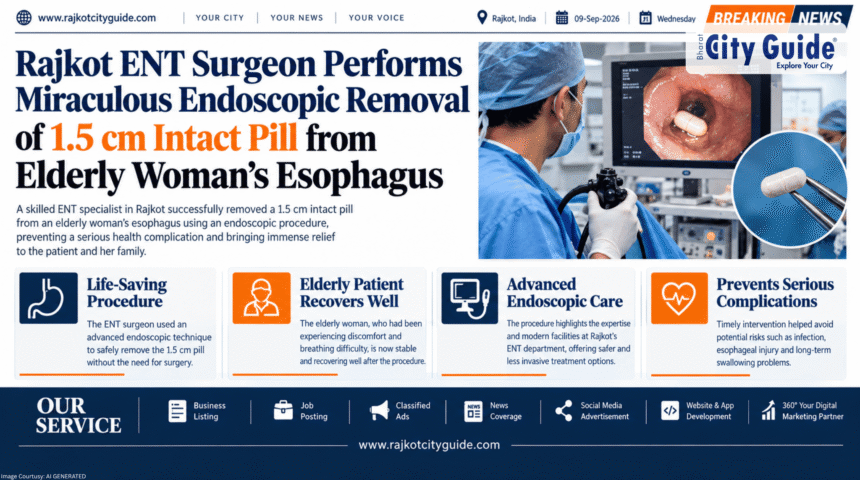
Accidental swallowing of large foreign objects or intact medications presents an immediate medical emergency, particularly among elderly individuals. A critical incident recently unfolded in Rajkot, Gujarat, where an elderly woman swallowed an unusually large 1.5 cm pill. Rather than dissolving or passing smoothly into the stomach, the large tablet lodged tightly inside her esophagus. The stuck medication posed a severe threat, causing intense pain, difficulty swallowing (dysphagia), and the potential risk of esophageal perforation or chemical ulceration from the concentrated drug formulation.
- Introduction
- What is a Rajkot ENT Surgeon?
- Why This News is Important
- Background Information
- Key Highlights
- Detailed Explanation of the Event
- Benefits and Importance of Endoscopic Intervention
- How It Impacts the Community and Healthcare Landscape
- Expert Insights and Medical Perspective
- Challenges and Technical Limitations
- Future Outlook
- Frequently Asked Questions (FAQs) Practo
- Conclusion
Navigating such delicate anatomical blockages requires profound clinical precision and rapid surgical response. A highly skilled Rajkot ENT Surgeon successfully intervened using advanced endoscopic equipment. Performing a meticulous procedure with specialized endoscopic tools (endoscope/laparoscopic scope), the specialist safely retrieved the entire 1.5 cm pill in a single piece without breaking it apart inside the food pipe.
Removing an intact pill without crushing it is a major medical triumph. Crushing or fragmenting an undissolved tablet inside an irritated esophageal lining risks spilling concentrated active chemical compounds directly onto raw tissue, potentially inducing severe chemical mucosal burns. Thanks to the prompt and expert intervention by the Rajkot ENT Surgeon, the patient avoided major open surgical trauma, experienced immediate relief, and received a fresh lease on life.
What is a Rajkot ENT Surgeon?
A Rajkot ENT Surgeon (Otorhinolaryngologist) is a specialized medical practitioner trained in diagnosing, treating, and surgically managing disorders affecting the ears, nose, throat, head, and neck region. Within the scope of otolaryngology and upper gastrointestinal endoscopy, these specialists frequently treat conditions involving the upper aerodigestive tract.
+-------------------------------------------------------------------------+
|                    ENT SURGEON CLINICAL SCOPE                           |
+-------------------------------------------------------------------------+
                                     |
    +--------------------------------+--------------------------------+
    |                                |                                |
    v                                v                                v
[ EAR PROCEDURES ]             [ NOSE & SINUS ]            [ THROAT & ESOPHAGUS ]
- Microscopic Ear Surgery      - Endoscopic Sinus Surgery  - Foreign Body Extraction
- Hearing Restoration          - Septoplasty & Rhinoplasty - Laryngeal/Esophageal Care
In cases involving swallowed foreign bodies—such as coins, denture fragments, fish bones, or large pharmaceutical pills—a Rajkot ENT Surgeon utilizes rigid or flexible endoscopic instruments passed through the oral cavity. By employing real-time video magnification, micro-forceps, and specialized retrieval optics, the surgeon can examine the mucosal walls of the pharynx and esophagus to extract impacted objects safely without resorting to open neck or chest surgery.
Why This News is Important
Medical emergencies involving esophageal foreign body impaction carry high morbidity rates if not addressed immediately. This event highlights several critical aspects of modern healthcare delivery:
- Geriatric Vulnerability: Elderly individuals frequently suffer from age-related swallowing dysfunctions (presbyphagia), reduced salivary flow, or neurological conditions that increase the risk of choking on large solid oral dosage forms.
- Technological Advancement in Regional Hubs: The successful execution of endoscopic retrieval demonstrates that Rajkot’s medical infrastructure is equipped with state-of-the-art diagnostic and therapeutic endoscopic systems, matching global standards for emergency ENT interventions.
- Prevention of Severe Complications: Leaving a 1.5 cm solid tablet lodged in the esophagus can result in local necrosis, esophageal ulceration, mediastinitis (inflammation of the chest cavity space), or fatal tissue perforation. The swift extraction averted life-threatening emergency complications.
Background Information
The human esophagus is a muscular tube approximately 25 centimeters long that transports food and liquids from the pharynx to the stomach. It features three natural anatomical narrowings where swallowed objects commonly become stuck:
- Upper Esophageal Sphincter (Cricopharyngeus muscle): The narrowest point located right behind the larynx.
- Mid-Esophageal Narrowing: Where the esophagus crosses the aortic arch and left main bronchus.
- Lower Esophageal Sphincter (Gastroesophageal junction): Where the esophagus passes through the diaphragm into the stomach.
When elderly patients attempt to swallow large tablets or capsules without sufficient water, the pill can stick to the dry esophageal mucosa. As the pill absorbs moisture, it swells, causing localized muscle spasms that clamp the esophageal walls tightly around the object.
Historically, removing a smooth, slippery, and fragile foreign body like an intact tablet required complex surgical maneuvers or risky push-techniques into the stomach. Today, advanced endoscopic techniques enable a skilled Rajkot ENT Surgeon to visually locate, grasp, and extract intact foreign bodies directly through the mouth within minutes under controlled anesthesia or sedation.
Key Highlights
- Patient Profile: An elderly woman presented with severe esophageal blockage after accidentally swallowing a large 1.5 cm tablet.
- Complex Extraction: The foreign body was removed entirely in a single piece without being broken down or crushed inside the food pipe.
- Advanced Endoscopic Procedure: A Rajkot ENT Surgeon performed the intervention using high-definition endoscopic visualization (durbin/endoscope).
- Prevention of Chemical Burns: Extracting the pill intact prevented the release of concentrated medicinal chemicals that could burn or erode delicate esophageal tissue.
- Rapid Patient Recovery: The minimally invasive endoscopic approach eliminated the need for invasive incisions, resulting in immediate symptomatic relief and short hospital recovery time.
Detailed Explanation of the Event
The emergency unfolded when the elderly woman ingested a large prescribed tablet measuring 1.5 cm in diameter. Almost immediately after swallowing, she experienced severe retrosternal chest discomfort, acute pain, inability to swallow her own saliva, and sensation of an obstruction in her throat. Recognizing the gravity of the situation, her family rushed her to a specialized medical facility in Rajkot.
Upon clinical evaluation, the attending Rajkot ENT Surgeon promptly ordered endoscopic evaluation to confirm the position and nature of the blockage. High-resolution camera optics revealed that the large pill was firmly lodged against the mucosal lining of the esophagus.
+-------------------------------------------------------------------------+
|                 ENDOSCOPIC PILL EXTRACTION WORKFLOW                     |
+-------------------------------------------------------------------------+
                                     |
                                     v
                  [ Patient Arrival with Acute Dysphagia ]
                                     |
                                     v
                 [ Urgent Endoscopic Diagnostic Evaluation ]
                                     |
                                     v
               [ Identification of 1.5 cm Intact Lodged Pill ]
                                     |
                                     v
              [ Deployment of Endoscopic Retrieval Forceps/Grasp ]
                                     |
                                     v
             [ Careful Single-Piece Extraction via Oral Cavity ]
                                     |
                                     v
               [ Mucosal Inspection & Full Patient Recovery ]
The primary technical hurdle during this surgery was preventing the pill from breaking apart. If the surgeon applied excessive mechanical pressure using retrieval forceps, the tablet could crumble. Crushing the pill would leave powder residue trapped along the inflamed esophageal walls, causing severe drug-induced esophagitis or tissue erosion.
Exercising extraordinary precision, the Rajkot ENT Surgeon positioned delicate endoscopic graspers around the perimeter of the 1.5 cm pill. With steady control, the surgeon gently dislodged the intact tablet from the spastic esophageal muscle tissue and guided it out through the mouth. Subsequent inspection confirmed that the esophageal mucosa remained intact without major tearing or bleeding.
Benefits and Importance of Endoscopic Intervention
Minimally invasive endoscopic removal of foreign bodies offers distinct advantages over traditional open surgical methods:
1. Zero External Incisions
Endoscopic procedures utilize natural body passages (the mouth and throat). Patients suffer no external scars, surgical wounds, or muscle dismemberment.
2. Reduced Infection and Perforation Risks
By avoiding major surgical cuts, the risk of secondary hospital-acquired infections or mediastinal contamination is minimized.
3. Immediate Symptom Relief
Once the physical obstruction is extracted, swallowing capabilities begin to normalize rapidly, relieving retrosternal pain almost instantly.
4. Minimal Hospitalization and Cost Efficiency
Patients undergoing successful endoscopic foreign body removal typically require short observation periods, drastically reducing healthcare expenditure and emotional strain on families.
How It Impacts the Community and Healthcare Landscape
For Senior Citizens and Families
This case serves as an important lesson in medication safety for the elderly. It highlights the importance of cutting large tablets (when medically approved), utilizing pill splitters, taking medications with plenty of water, and avoiding swallowing pills while lying down.
For Medical Students and Practitioners
The successful case demonstrates practical management of non-metallic foreign body impactions. It provides an illustrative clinical benchmark for young ENT residents, gastroenterologists, and emergency care doctors dealing with acute upper airway and digestive tract obstructions.
For Regional Healthcare Infrastructure
Rajkot’s growing status as a premier medical hub in the Saurashtra region is reinforced. Citizens no longer need to travel to larger metropolitan cities like Ahmedabad or Mumbai for complex endoscopic head and neck emergencies.
Expert Insights and Medical Perspective
ENT specialists and clinical gastroenterologists emphasize that pill-induced esophageal impaction is a preventable yet dangerous condition.
“Pill esophagitis and mechanical impaction represent underestimated dangers in geriatric care. When a large tablet lodges in the esophagus, time is of the essence. Using specialized endoscopic tools to retrieve an intact tablet requires immense control, as breaking the pill releases concentrated active ingredients that can chemically burn delicate mucosal tissue.”
Medical guidelines recommend that patients swallowing solid oral dosage forms adhere to basic safety measures:
- Drink at least 150–200 mL of water with every pill.
- Remain in an upright seated or standing position for at least 30 minutes post-ingestion.
- Consult a pharmacist or physician to evaluate whether large pills can be crushed, split, or replaced with liquid formulations.
Challenges and Technical Limitations
Despite the successful outcome in this instance, endoscopic foreign body retrieval poses several technical challenges:
- Slippery and Fragile Targets: Unlike metallic objects or coins, pharmaceutical tablets become slimy and structural fragile upon absorbing saliva, making them hard to grip.
- Airway Compromise: Working in close proximity to the laryngeal inlet carries a risk of accidental aspiration into the trachea, which could cause acute airway blockage.
- Patient Movement and Spasms: Spontaneous esophageal spasms or patient movement under light sedation can complicate delicate surgical maneuvers.
Future Outlook
As advanced medical technology spreads throughout regional healthcare centers, treatment approaches for ear, nose, and throat emergencies continue to evolve:
- Ultra-Slim HD Endoscopes: The introduction of micro-endoscopes with enhanced optical magnification will make foreign body identification faster and safer.
- Improved Retrieval Devices: Customized net-retrieval systems, soft basket grippers, and silicone protective hoods will minimize tissue friction during foreign body extraction.
- Geriatric Medication Design: Pharmaceutical manufacturers are increasingly exploring easier-to-swallow coatings and liquid alternative delivery systems to protect elderly patients from choking risks.
Frequently Asked Questions (FAQs) Practo
1. Why should I consult a Rajkot ENT Surgeon for a swallowed object?
A Rajkot ENT Surgeon possesses specialized endoscopic equipment and surgical expertise focused specifically on the upper aerodigestive tract, allowing for safe removal of foreign bodies lodged in the throat or esophagus.
2. What are the symptoms of a pill stuck in the esophagus?
Common symptoms include acute pain in the throat or chest, difficulty swallowing food or liquids (dysphagia), painful swallowing (odynophagia), excessive salivation, and a sensation of a lump in the chest.
3. Why was it important not to break the pill during extraction?
Breaking the pill inside the esophagus can release concentrated chemical compounds directly onto raw tissue, causing drug-induced mucosal burns, ulcerations, or severe chemical esophagitis.
4. How long does endoscopic foreign body removal take?
In expert hands, an uncomplicated endoscopic foreign body retrieval usually takes between 15 to 45 minutes, depending on the position, size, and shape of the object.
5. Can swallowing a pill without water cause it to get stuck?
Yes. Taking pills without enough water is a leading cause of pill impaction. Water provides the necessary lubrication for the tablet to pass smoothly into the stomach.
Practo
6. Is endoscopic removal of foreign objects painful?
The procedure is performed under local anesthesia, conscious sedation, or general anesthesia, ensuring that the patient feels no pain during the extraction.
7. What should families do if an elderly person chokes on a pill?
Do not try to force solid food down to push the pill, as this can worsen the blockage. Seek immediate emergency care at an ENT hospital equipped with endoscopic facilities.
Practo
Conclusion
The successful extraction of an intact 1.5 cm pill from an elderly woman’s esophagus marks another landmark achievement in regional medical care. By employing advanced endoscopic visualization and specialized surgical techniques, the Rajkot ENT Surgeon eliminated a dangerous obstruction without causing chemical burns or tissue trauma. This remarkable procedure not only saved an elderly patient from severe complications but also underscores the high level of medical expertise available to citizens in Rajkot.