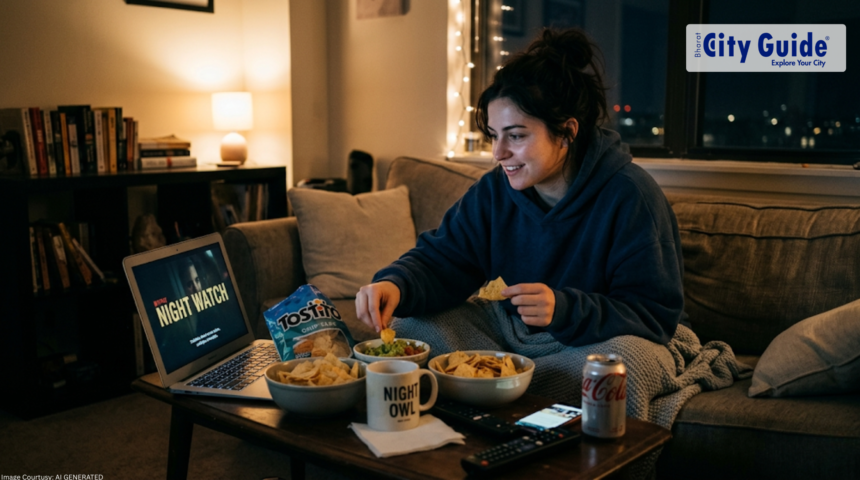
It’s 10:30 pm.
You finally sit down after a long day. Dinner is reheated. Your favorite show is queued up. One episode turns into three. Somewhere in between, a handful of namkeen becomes half a packet, then something sweet.
- Key Research Insights
- 1) Shift Dinner Slightly Earlier (If Possible)
- 2) Avoid Very Heavy Late Meals
- 3) Use a “Light Dinner Rule”
- 4) Plan a Balanced Evening Snack
- 5) Pre-Portion Snacks
- 6) Choose Better Snack Options
- 7) The “Pause Before Play” Habit
- 8) Try Screen-Free Eating for Dinner
- 9) Set a “Kitchen Closing Time”
- 1) Is eating after 10 pm bad?
- 2) Does late eating cause weight gain?
- 3) What is a good late dinner?
- 4) Is fruit okay at night?
- 5) How to stop OTT snacking?
You’re not alone.
In 2026, late dinners and screen snacking are quietly becoming one of the biggest lifestyle habits affecting Indian metabolic health — more than any single “superfood” or diet trend.
This isn’t about guilt. It’s about understanding what’s happening and making small, doable shifts.
Let’s break it down calmly and scientifically.
Why Late-Night Eating Is So Common Now
Modern Indian routines have changed:
✔ Longer work hours
✔ Late commutes
✔ Work-from-home spillover
✔ OTT binge culture
✔ Social dinners and deliveries
✔ Night-owl sleep schedules
For many families, dinner naturally shifts to 9–11 pm.
So the issue isn’t “eating late once in a while.”
It’s when late eating becomes daily and heavy.
What Science Says About Late-Night Eating
Your body follows a circadian rhythm — an internal clock that affects:
✔ Hormones
✔ Digestion
✔ Blood sugar control
✔ Sleep quality
✔ Fat metabolism
During daytime, your body handles food efficiently.
At night, metabolism slows and insulin sensitivity reduces.
Key Research Insights
Recent research on chrononutrition (timing of eating) shows:
✅ Late-night eating is linked with poorer blood sugar control
✅ It may increase fat storage when calories are high
✅ It can disrupt hunger hormones
✅ It often worsens sleep quality
This doesn’t mean one late dinner ruins health.
It means regular late, heavy meals can strain metabolism over time.
Why Late Eating Feels So Tempting
Evenings are when:
✔ Stress drops
✔ Willpower dips
✔ Hunger catches up
✔ Entertainment begins
✔ Food becomes “reward”
Biologically, your brain seeks comfort and dopamine at night.
Food + screens = double stimulation.
That’s why mindless snacking happens easily.
The Real Problem: Screen Snacking
Late dinners are one part.
Screen snacking is often the bigger issue.
When watching screens:
❌ You eat faster
❌ You notice fullness less
❌ You over-serve portions
❌ You crave salty/sweet foods
❌ You keep reaching for “just a little more”
Studies consistently show distracted eating leads to higher calorie intake.
Not because of hunger — but because attention is elsewhere.
How Late-Night Eating Affects Sleep
Heavy late meals can:
✔ Cause acidity
✔ Increase bloating
✔ Raise body temperature
✔ Delay deep sleep
✔ Lead to restless nights
Poor sleep then affects:
❌ Hunger hormones (ghrelin/leptin)
❌ Cravings next day
❌ Energy levels
❌ Weight regulation
So it becomes a cycle.
Late-Night Eating and Weight Gain — The Nuanced Truth
Late eating alone doesn’t magically cause weight gain.
But it often leads to:
✔ Extra calories
✔ Sugary snacking
✔ Larger portions
✔ Emotional eating
✔ Reduced activity afterward
So indirectly, yes — it can contribute.
Timing + quality + quantity together matter.
Indian Lifestyle Reality (2026)
Let’s be practical.
Not everyone can eat dinner at 7 pm.
Many Indians:
✔ Return home after 8–9 pm
✔ Share dinner as family time
✔ Have late social dinners
✔ Work night shifts
✔ Study late
So the goal is not unrealistic rules.
It’s smarter structure.
Signs Late-Night Eating May Be Affecting You
You might notice:
✔ Morning heaviness
✔ Low appetite at breakfast
✔ Frequent acidity
✔ Night cravings
✔ Weight creeping up
✔ Poor sleep
✔ Energy crashes next day
If several apply, small changes can help.
Gentle Strategies to Improve Late-Night Eating
No extremes. No starvation. Just balance.
1) Shift Dinner Slightly Earlier (If Possible)
Even moving dinner:
👉 30–60 minutes earlier
can help digestion and sleep.
Small shifts matter.
2) Avoid Very Heavy Late Meals
Late dinner doesn’t have to be huge.
Better late dinners:
✔ Dal + sabzi + small roti
✔ Khichdi + curd
✔ Soup + paneer/eggs
✔ Veg pulao (light oil) + raita
Avoid:
❌ Deep-fried food
❌ Heavy sweets
❌ Large rice portions
3) Use a “Light Dinner Rule”
If eating after 9:30–10 pm:
👉 Keep it lighter than lunch.
This supports digestion and sleep.
4) Plan a Balanced Evening Snack
Often late overeating happens because of long gaps.
Try a 6–7 pm snack:
✔ Fruit + nuts
✔ Roasted chana
✔ Sprouts chaat
✔ Buttermilk + peanuts
This reduces extreme hunger at dinner.
Smart Strategies for Screen Snacking
5) Pre-Portion Snacks
Never eat from the packet.
Take:
✔ A small bowl
✔ A fixed portion
Then stop.
6) Choose Better Snack Options
Better OTT snacks:
✔ Makhana
✔ Roasted chana
✔ Peanuts
✔ Fruit slices
✔ Popcorn (lightly salted)
Less ideal:
❌ Chips
❌ Cream biscuits
❌ Sugary sweets
❌ Fried namkeen in large amounts
7) The “Pause Before Play” Habit
Before starting your show:
Ask:
👉 “Am I hungry or just bored?”
If bored — tea, water, or brushing teeth helps.
8) Try Screen-Free Eating for Dinner
Even 10–15 minutes of mindful eating helps.
You notice fullness earlier.
9) Set a “Kitchen Closing Time”
Example:
✔ Kitchen closes at 10 pm
✔ Only water/herbal tea after
This reduces grazing.
Emotional Side of Night Eating
Night eating is often about:
✔ Stress relief
✔ Comfort
✔ Habit
✔ Loneliness
✔ Reward after a hard day
Food becomes soothing.
Recognizing this is powerful.
Sometimes rest, conversation, or relaxation works better than snacks.
What Most People Misunderstand
“Never eat after 7 pm.”
Too rigid for Indian life.
“Fruit at night turns to fat.”
Not true.
“Skipping dinner is healthier.”
Can backfire if it leads to overeating later.
Balance beats extremes.
One Simple Habit to Start This Week
Try this:
👉 Keep late dinners lighter
👉 And avoid eating directly from packets
Just these two changes can reduce mindless intake significantly.
Cultural Wisdom We Already Had
Traditional Indian habits often included:
✔ Earlier dinners
✔ Lighter night meals
✔ Buttermilk at night
✔ Simple khichdi dinners
✔ Less packaged snacking
Modern life shifted this.
We can borrow the helpful parts back.
Who Should Be Extra Careful
People with:
✔ Diabetes
✔ Acidity/GERD
✔ Sleep issues
✔ Weight concerns
✔ PCOS
✔ Night-shift routines
Meal timing matters more here.
Late-Night Eating for Night-Shift Workers
If you work nights:
✔ Keep meals structured
✔ Avoid constant grazing
✔ Prioritize protein + fiber
✔ Limit sugary snacks
✔ Maintain regular sleep
Your “day” is simply shifted.
A Balanced Perspective
Food is not the enemy.
Timing is a tool.
Late dinners happen.
Festivals happen.
Binge nights happen.
What matters is your usual pattern.
Conclusion
Late-night eating isn’t a moral failure — it’s a modern lifestyle pattern.
But small shifts can:
✅ Improve sleep
✅ Stabilize energy
✅ Reduce cravings
✅ Support weight balance
✅ Help digestion
You don’t need strict rules.
You need gentle awareness.
Eat when hungry.
Stop when satisfied.
Snack mindfully.
Sleep well.
Health grows from patterns, not perfection.
FAQs
1) Is eating after 10 pm bad?
Not automatically. Regular heavy late meals may affect metabolism and sleep.
2) Does late eating cause weight gain?
Extra calories and poor food choices at night can contribute.
3) What is a good late dinner?
Light, balanced, and easy to digest — dal, sabzi, khichdi, soup.
4) Is fruit okay at night?
Yes. Fruit is fine if portions are moderate.
5) How to stop OTT snacking?
Pre-portion snacks and avoid eating from packets.
Gujarati TV Entertainment: Rooted in Culture, Growing with Time
Gujarati TV entertainment has developed into a thriving space for regional content, offering a wide mix of serials, reality shows, comedy programs, and culturally driven storytelling. It highlights the traditions, lifestyle, and everyday emotions of Gujarati families, making the content highly relatable and engaging for viewers. Most programs focus on strong family connections and social values, which continue to attract audiences from different age groups. With the expansion of digital platforms, Gujarati TV shows are now accessible to viewers not only in Gujarat but also across India and internationally. This wider reach, along with advancements in production quality and fresh narratives, has enabled Gujarati television to grow while staying deeply connected to its cultural roots.