Introduction
The city of Rajkot, recognized as the cultural and spiritual hub of Saurashtra, is currently witnessing an inspiring display of faith, self-discipline, and penance. During the sacred period of Chaturmas (the four-month monsoon retreat), spiritual activities across the state reach their peak. Within Jainism, Chaturmas provides an extraordinary opportunity for householders and ascetics alike to step back from worldly desires, purify their karma, and dedicate themselves to strict vows of austerity.
- Introduction
- What is Rajkot Jain Community Siddhi Tap?
- Why This News is Important
- Background Information
- Key Highlights
- Detailed Explanation of the Event
- Importance and Features of Spiritual Austerity (Tapasya)
- How It Impacts Different Audiences
- Expert Insights and Spiritual Perspective
- Challenges and Health Considerations
- Future Outlook
- Frequently Asked Questions (FAQs)
- Conclusion
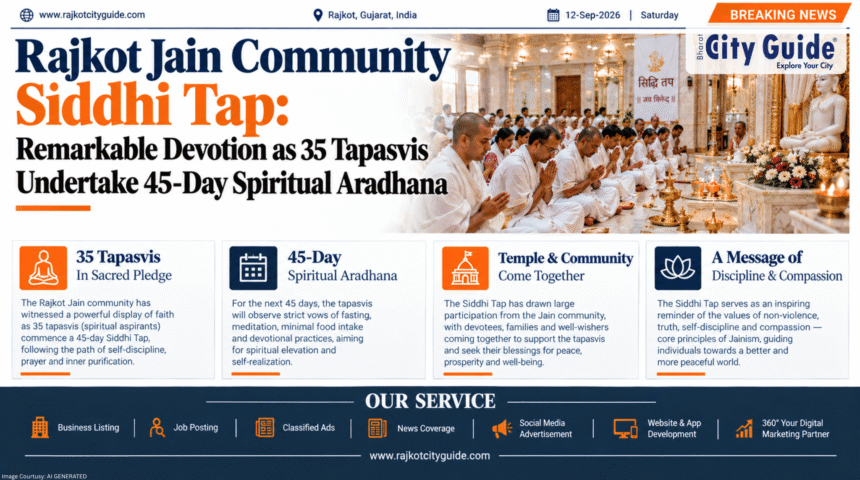
In a remarkable religious milestone, the Rajkot Jain Community Siddhi Tap has drawn widespread admiration across Gujarat. Under the guidance of revered Sthanakvasi Jain saints and mahasatijis in Rajkot, 35 dedicated tapasvis (practitioners of severe fasting) have committed to the challenging 45-day Siddhi Tap Aradhana. What makes this event deeply touching is the diverse cross-section of participants: the group ranges from 15-year-old unmarried young women (kumarikas) to senior citizens aged up to 75 years.
This incredible feat of physical endurance and mental fortitude highlights how ancient Jain spiritual values remain vibrant across generations. As these 35 individuals progress through their 45-day fast under strict religious guidelines, the entire Sthanakvasi Jain community in Rajkot has united to support, honor, and celebrate their sacred journey.
What is Rajkot Jain Community Siddhi Tap?
To truly grasp the significance of the Rajkot Jain Community Siddhi Tap, one must understand the unique structure and rigorous spiritual nature of Siddhi Tap in Jain philosophy. Unlike a continuous long-term fast, Siddhi Tap follows an escalating mathematical sequence of fasting and break days that tests both bodily control and spiritual determination.
+--------------------------------------------------------------------------+
|                    STRUCTURE OF SIDDHI TAP ARADHANA                      |
+--------------------------------------------------------------------------+
                                     |
    +--------------------------------+--------------------------------+
    |                                |                                |
    v                                v                                v
[ FASTING PROGRESSION ]       [ DAILY TIMINGS ]           [ DIETARY RULES ]
- 1 Fast -> 1 Parna          - Water consumed only       - Only boiled water
- 2 Fasts -> 1 Parna           between Sunrise & Sunset    - Zero solid food on
- 3 Fasts -> 1 Parna         - Complete boiled water       fasting days
- Continues up to 8 Fasts      diet during fasts         - Simple satvik food
  (Total: 44 Fasting Days)                                 on Parna days
Key Elements of Siddhi Tap
- Escalating Fasting Cycles: The fast begins with 1 day of complete fasting followed by 1 day of Parna (breaking the fast with satvik food). It then progresses to 2 consecutive days of fasting followed by 1 Parna, 3 fasts followed by 1 Parna, continuing incrementally up to 8 consecutive fasts.
- Total Duration of 45 Days: Across the entire sequence, the practitioner completes 44 days of complete fasting and 7 or 8 specific Parna days, totaling 45 days of rigorous spiritual observance.
- Boiled Water Guidelines (Ubalu Jal): On fasting days, tapasvis consume only water that has been boiled and cooled, taken strictly between sunrise and sunset. After sunset, complete abstinence from both food and water (Chouviar) is maintained.
- Focus on Internal Purification: The physical act of abstaining from food is considered secondary to the internal work: conquering anger, pride, deceit, and greed (Kashaya) while engaging in continuous scriptural study (Swadhyay) and meditation (Dhyan).
Why This News is Important
The announcement and ongoing observance of the Rajkot Jain Community Siddhi Tap carry profound cultural, social, and spiritual weight for several reasons:
1. Inspiring Intergenerational Participation
Seeing a 15-year-old school student and a 75-year-old grandmother undertake the exact same 45-day spiritual discipline side-by-side offers a powerful testament to shared devotion. It proves that spiritual resilience is not limited by age or generation.
2. Spiritual Revival During Chaturmas
Chaturmas is historically designated for introspection and minimizing harm to living beings. High-level spiritual observances like Siddhi Tap invigorate the local community, encouraging hundreds of other families to adopt smaller daily vows of simplicity and non-violence.
3. Community Solidarity and Mental Health
In an era dominated by digital distractions and fast-paced lifestyles, the collective dedication of 35 tapasvis serves as an anchor for the community. It reinforces values of mindfulness, emotional restraint, self-control, and communal harmony.
Background Information
Rajkot holds a prominent position in the history of the Sthanakvasi Jain tradition in Gujarat. Home to historic Upashrays (monastic halls) such as Virani Paushadhshala, Royal Upashray, and various Sthanakvasi Sangh centers across Prahlad Plot and Diwanpara, the city has long provided a strong foundation for monastic guidance and lay community worship.
[ Ancient Jain Ascetic Traditions ]
                   |
                   v
[ Monastic Chaturmas Retreats in Rajkot Upashrays ]
                   |
                   v
[ Lay Devotees (Shravaks/Shravikas) Taking Vows ]
                   |
                   v
[ Modern Aradhana: 35 Tapasvis Undertaking Siddhi Tap ]
Every year during the rainy season, Jain monks (Sadhus) and nuns (Sadhvis) pause their barefoot travels (Vihar) and settle in designated cities for Chaturmas to avoid harming micro-organisms that thrive during the rains. During these four months, they deliver daily discourses (Pravachans) that inspire lay followers (Shravaks and Shravikas) to undertake intensive spiritual practices like Upvas (fasting), Ayambil (eating one plain meal without spices or oils), Masa-Khaman (30-day fasts), and Siddhi Tap.
Key Highlights
- 35 Dedicated Tapasvis: A group of 35 Sthanakvasi Jain devotees in Rajkot are collectively performing the 45-day Siddhi Tap Aradhana.
- Wide Age Span: Participants range from 15-year-old young girls (kumarikas) balancing school studies with vows to 75-year-old senior citizens.
- 45-Day Spiritual Protocol: The ritual involves a total of 44 fasting days structured in an escalating sequence from 1 to 8 consecutive fasts.
- Strict Daily Discipline: Fasting days permit only boiled water consumed during daylight hours; evenings are spent in prayer, Pratikraman, and Swadhyay.
- Sthanakvasi Sangh Guidance: The tapasya is taking place under the spiritual guidance of Sthanakvasi Jain saints and satiyanjis hosted at Rajkot upashrays during Chaturmas.
- Grand Upcoming Parna Mahotsav: The community is preparing for a grand celebratory procession and collective breaking of the fast (Parna) upon completion of the 45 days.
Detailed Explanation of the Event
The Chaturmas period in Rajkot has turned into an extraordinary celebration of faith as 35 members of the Sthanakvasi Jain community stepped forward to take the lifelong spiritual vow (Pachchhkhan) for Siddhi Tap.
+--------------------------------------------------------------------------+
|                      DAILY ROUTINE OF A SIDDHI TAPASVI                   |
+--------------------------------------------------------------------------+
| Time Window           | Religious Practice / Observance                  |
+-----------------------+--------------------------------------------------+
| Early Morning         | Navkar Jaap, Devotion & Guru Vandana            |
| Morning Hours         | Pravachan (Spiritual Discourse) at Upashray      |
| Mid-Day (Daylight)    | Consumption of Boiled Water (Ubalu Jal)          |
| Evening (Pre-Sunset)  | Chouviar (Complete cessation of water intake)   |
| Night                 | Devotional Pratikraman & Silent Meditation       |
+-----------------------+--------------------------------------------------+
Every morning, the 35 tapasvis gather at the local Upashray to perform Guru Vandana (paying respects to ascetics) and receive daily blessings. Despite the physical toll of abstaining from food for days at a time, these devotees continue their daily religious routines with joy. Young student participants manage their educational responsibilities alongside their spiritual vows, while elderly participants draw strength from deep devotion and meditation.
On Parna days (the designated break days between fasting cycles), special satvik food prepared according to strict Jain dietary rules—free of roots, green vegetables, or heavy spices—is offered to the tapasvis in a calm, prayerful environment. The surrounding community views serving these tapasvis as an act of immense spiritual merit (Punya).
Importance and Features of Spiritual Austerity (Tapasya)
In Jain philosophy, Tapa (penance or austerity) is recognized as one of the four essential pillars of spiritual practice, alongside Gyan (knowledge), Darshan (faith), and Charitra (conduct).
1. Burning Past Karmas (Nirjara)
Jain doctrine teaches that intentional self-discipline and voluntary physical restraint burn away accrued negative karmic particles attached to the soul, facilitating spiritual liberation (Moksha).
2. Cultivating Absolute Willpower and Equanimity
Fasting trains the mind to remain unaffected by bodily cravings, temperature changes, or discomfort. It develops Samabhava—an unshakeable state of mental poise and equanimity.
3. Promoting Compassion (Ahimsa)
By experiencing hunger firsthand, practitioners cultivate deep empathy for all living beings who suffer from deprivation. This reinforces the core Jain principle of non-violence (Ahimsa Parmo Dharma).
How It Impacts Different Audiences
| Audience Group | Direct Impact & Event Relevance |
| Youth & Students | Demonstrates self-control, focus, and mental resilience, proving that youth can master mind over body. |
| Elderly Citizens | Provides inspiration to embrace spiritual devotion late in life with energy and purpose. |
| Jain Community (Sangh) | Unites families in collective service (Vaiyavachch), fostering strong social bonds and mutual support. |
| Broader Society | Serves as an inspiring example of peace, voluntary simplicity, and restraint in a material world. |
Expert Insights and Spiritual Perspective
Spiritual scholars and Jain community leaders emphasize that the Rajkot Jain Community Siddhi Tap represents far more than physical fasting; it is a profound exercise in mental and emotional transformation.
“Tapasya in Jainism is not about inflicting pain on the body; it is about freeing the soul from dependence on physical matter. When a 15-year-old girl or a 75-year-old grandfather completes Siddhi Tap, it shows that spiritual strength comes from inner conviction, not mere physical muscle.”
Scholars also note that the supportive environment provided by the Sthanakvasi Jain Sangh in Rajkot plays a crucial role in enabling devotees to complete such intense vows safely and with peaceful minds.
Challenges and Health Considerations
Executing a 45-day spiritual fast with 44 fasting days requires careful attention to body signals and strict safety precautions:
- Hydration Management: Tapasvis must ensure adequate intake of boiled water during permitted daylight hours to prevent dehydration.
- Balanced Parna Diet: On break days, food must be light, easily digestible, and non-greasy to prevent gastrointestinal stress.
- Medical Monitoring: Family members and community physicians keep a close watch on the vital signs of young and elderly participants to ensure their well-being throughout the 45 days.
Future Outlook
As the 45-day Siddhi Tap Aradhana nears its completion during the ongoing Chaturmas, the Sthanakvasi Jain community in Rajkot is preparing for a grand series of celebrations:
- Massive Shobha Yatra (Procession): A grand celebratory procession will be organized through key avenues of Rajkot to honor the 35 tapasvis with traditional music, palanquins, and spiritual banners.
- Grand Parna Mahotsav: A community gathering will be held where all 35 tapasvis will break their final fast collectively amidst blessings from Jain ascetics and praises from the community.
- Continued Chaturmas Discourses: The spiritual momentum generated by this event will continue to inspire daily Swadhyay and religious activities across Rajkot until the conclusion of Chaturmas.
Frequently Asked Questions (FAQs)
1. What is the focus of the Rajkot Jain Community Siddhi Tap news?
The news highlights 35 Sthanakvasi Jain devotees in Rajkot, aged 15 to 75, who are performing the grueling 45-day Siddhi Tap fasting ritual during Chaturmas.
2. How many days of fasting are involved in Siddhi Tap?
Siddhi Tap consists of 44 days of complete fasting and 7 or 8 break days (Parna), structured in an escalating sequence over a 45-day period.
3. What dietary rules do tapasvis follow on fasting days?
On fasting days, practitioners consume only boiled water that has been cooled, strictly between sunrise and sunset. No solid food or other liquids are consumed.
4. Who is participating in the Rajkot Jain Community Siddhi Tap?
The group of 35 tapasvis includes young unmarried girls (kumarikas) as young as 15 years old alongside senior citizens up to 75 years of age.
5. What is the significance of Chaturmas in Jainism?
Chaturmas is a four-month monsoon retreat where Jain ascetics stay in one location to avoid harming micro-organisms. Lay followers use this period for intense spiritual reflection, fasting, and scriptural study.
6. What sect of Jainism is organizing this Siddhi Tap in Rajkot?
This event is being celebrated primarily within the Sthanakvasi Jain community across various Upashrays in Rajkot.
7. How does the community celebrate the completion of Siddhi Tap?
Completion is celebrated with a grand Parna Mahotsav (fast-breaking ceremony) and a public Shobha Yatra (honor procession) celebrating the tapasvis’ endurance and faith.
Conclusion
The Rajkot Jain Community Siddhi Tap stands as an incredible testament to the power of faith, self-discipline, and spiritual devotion. By bringing together 35 individuals spanning six decades in age—from 15-year-old youth to 75-year-old elders—this 45-day fasting journey illustrates the timeless strength of Jain spiritual traditions during Chaturmas.
As Rajkot prepares to honor these tapasvis during their upcoming Parna Mahotsav, their shared commitment continues to inspire the entire city, offering a shining example of mind over matter, communal harmony, and devotion.