Introduction
Fostering a culture of scientific inquiry, innovation, and technological development is fundamental to India’s vision of becoming a global knowledge superpower. In recent years, bridging the gap between world-class research institutions and aspiring young minds across regional centers has emerged as a major priority for academic leaders and science communicators. Virtual platforms have revolutionized how scientific knowledge is disseminated, allowing students and early-career researchers from small towns and rural areas to interact directly with top-tier scientists without geographical constraints.
- Introduction
- What is Vigyan Yatra 3.0?
- Why This News is Important
- Background Information
- Key Highlights
- Detailed Explanation of the Event
- Benefits and Importance of Virtual Science Outreach
- How It Impacts Different Audiences
- Expert Insights and Industry Perspective
- Challenges and Considerations in Virtual Science Events
- Future Outlook
- Frequently Asked Questions (FAQs)
- Conclusion
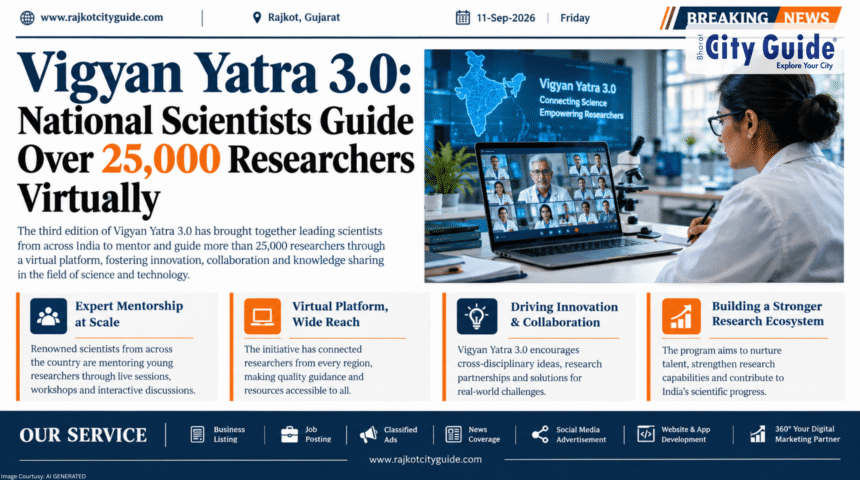
Marking a monumental achievement in digital science outreach, the virtual launch of Vigyan Yatra 3.0 has brought together 15 renowned national scientists to mentor more than 25,000 researchers, scholars, and science enthusiasts from the comfort of their homes. Organized with robust technical coordination from regional academic and scientific hubs in Gujarat, including major centers in Rajkot, this online initiative aims to spark curiosity, offer research mentorship, and highlight emerging frontiers in STEM (Science, Technology, Engineering, and Mathematics).
The virtual conduct of Vigyan Yatra 3.0 reflects the growing success of democratizing scientific education. By offering direct access to veteran researchers, the initiative empowers the next generation of innovators to pursue meaningful scientific careers and contribute to national research capabilities.
What is Vigyan Yatra 3.0?
Vigyan Yatra 3.0 is the third iteration of a major flagship science awareness and mentorship campaign designed to connect leading scientific minds with students, school scholars, and university researchers. Unlike traditional physical roadshows or physical conferences, the 3.0 edition leverages advanced virtual conferencing infrastructure to reach a massive audience simultaneously across urban and remote regions.
+--------------------------------------------------------------------------+
|                       VIGYAN YATRA 3.0 VIRTUAL ECOSYSTEM                 |
+--------------------------------------------------------------------------+
                                     |
    +--------------------------------+--------------------------------+
    |                                                                 |
    v                                                                 v
[ NATIONAL SCIENTISTS (15) ]                               [ PARTICIPANTS (25,000+) ]
- ISRO & CSIR Experts                                      - University Researchers
- Premier University Professors                            - High School STEM Students
- Specialized Research Mentors                             - Young Faculty Members
                                     |
                                     v
                       [ VIRTUAL SESSIONS & WEBINARS ]
                       - Live Interactive Lectures
                       - Research Methodology Guidance
                       - Q&A & Innovation Workshops
The core objective of the program is to inspire young minds by showcasing breakthroughs in space science, biotechnology, artificial intelligence, renewable energy, material science, and fundamental physics. It serves as an interactive platform where participants receive real-time career guidance, learn about advanced research methodologies, and understand how indigenous research addresses real-world societal problems.
Why This News is Important
The virtual staging of this nationwide science journey holds deep significance for Gujarat’s academic landscape and India’s broader research ecosystem:
1. Unprecedented Scale and Accessibility
Connecting over 25,000 participants in a single virtual event breaks geographical barriers. Students in Tier-2 and Tier-3 cities or rural districts gain the exact same quality of mentorship as those attending elite metro institutions.
2. Direct Access to National Luminaries
Interacting directly with 15 elite scientists who lead national laboratories, space missions, and advanced research projects demystifies complex scientific disciplines and makes research careers feel achievable.
3. Cost-Effective Knowledge Dissemination
Hosting the event virtually maximizes reach while minimizing travel overhead, accommodation logistics, and venue constraints, establishing a sustainable template for future academic outreach programs.
Background Information
Science outreach initiatives in Gujarat have expanded significantly following the establishment of regional science centers across major districts like Rajkot, Patan, Bhavnagar, and Bhuj. Guided by the Gujarat Council on Science and Technology (GUJCOST) and the Department of Science and Technology (DST), the state has consistently prioritized hands-on scientific literacy and research encouragement.
[ Traditional In-Person Science Exhibitions (Limited Reach) ]
                          |
                          v
[ Regional Science Centers Established (Rajkot, Patan, Bhuj) ]
                          |
                          v
[ Digital & Virtual Adaptation (Vigyan Yatra 1.0 & 2.0) ]
                          |
                          v
[ VIGYAN YATRA 3.0: 15 Scientists + 25,000+ Participants ]
Earlier editions of Vigyan Yatra focused primarily on physical mobile science vans and local school exhibitions. However, the success of hybrid and virtual learning models demonstrated that online platforms could scale impact exponentially. Vigyan Yatra 3.0 represents the evolution of this movement, converting regional outreach into a massive online summit that connects classroom learners directly with high-caliber research institutions.
Key Highlights
- Massive Participant Base: Over 25,000 students, research scholars, and educators registered and joined the virtual sessions from home.
- 15 Elite National Scientists: Keynotes and technical sessions were delivered by 15 leading scientists representing premier national research laboratories and universities.
- Zero Location Barriers: The virtual format allowed seamless participation from remote villages, rural schools, and urban university campuses alike.
- Diverse Scientific Domains: Topics covered spanned space exploration, artificial intelligence, sustainable green energy, biotechnology, and advanced material physics.
- Interactive Q&A Sessions: Young researchers engaged in direct virtual question-and-answer rounds to address research queries, career paths, and project ideation.
Detailed Explanation of the Event
The virtual inauguration of Vigyan Yatra 3.0 commenced with opening addresses from senior science communicators and academic administrators. Technical teams ensured high-definition video streaming and multi-channel interactive access to handle the massive digital traffic generated by 25,000 registered users.
+--------------------------------------------------------------------------+
|                      VIRTUAL EVENT SESSION STRUCTURE                     |
+--------------------------------------------------------------------------+
| Phase                 | Focus Area                                       |
+-----------------------+--------------------------------------------------+
| Inaugural Keynote     | Science & Technology Vision for Atmanirbhar Bharat|
| Domain Deep-Dives     | Space Research, AI, Biotech & Green Energy Talks |
| Research Methodology  | How to frame hypotheses and publish papers       |
| Live Q&A Forum        | Direct interaction between students & scientists |
+-----------------------+--------------------------------------------------+
Across multiple scheduled technical tracks, the 15 invited scientists presented insights into cutting-edge developments. Speakers highlighted India’s achievements in space missions, quantum computing, and indigenous vaccine research. Rather than relying solely on theoretical lectures, scientists demonstrated visual simulation models, laboratory setups, and real-world project case studies.
During the interactive segments, young researchers submitted questions regarding doctoral fellowships, international research collaborations, patent filing procedures, and cross-disciplinary research strategies. The expert panelists provided actionable advice, urging students to focus on solving local challenges through scientific innovation.
Benefits and Importance of Virtual Science Outreach
Virtual platforms like Vigyan Yatra 3.0 bring transformative benefits to the broader education and research landscape:
1. Equalizing Educational Opportunities
Students from underprivileged backgrounds or rural schools gain equal access to elite scientists, helping bridge the urban-rural divide in quality science education.
2. Mentorship for Early-Career Researchers
Postgraduate students and PhD candidates receive guidance on selecting relevant research problems, drafting grant proposals, and adhering to ethical research standards.
3. Boosting STEM Career Enrolment
Exposing young learners to high-impact scientific discoveries creates enthusiasm for basic sciences, encouraging more students to choose research careers over conventional non-technical paths.
How It Impacts Different Audiences
| Audience Category | Direct Impact & Operational Benefit |
| School & College Students | Inspires curiosity, demystifies complex scientific concepts, and provides clear academic direction. |
| Research Scholars & PhDs | Offers insights into contemporary research methodologies, patent processes, and grant opportunities. |
| Educators & School Teachers | Exposes faculty to modern teaching tools, scientific trends, and innovative practical demonstration methods. |
| Regional Institutions (e.g., Rajkot) | Strengthens digital infrastructure and enhances the reach of local science centers into surrounding rural belts. |
Expert Insights and Industry Perspective
Science policy experts and academic researchers consider large-scale virtual mentorship programs vital for building a sustainable research pipeline in India.
“True scientific progress happens when high-level knowledge escapes elite university walls and reaches curious minds in every corner of the nation. Initiatives like Vigyan Yatra 3.0 use digital connectivity to democratize research mentorship, ensuring that talent—regardless of location—receives world-class guidance.”
Distinguished scientists participating in the event emphasized that early exposure to critical thinking and scientific inquiry is essential for building indigenous technological solutions in health, agriculture, and clean energy.
Challenges and Considerations in Virtual Science Events
While the virtual model offers unprecedented reach, organizers must continually address specific technical and operational challenges:
- Digital Divide & Connectivity: Students in deep rural pockets may face occasional internet bandwidth issues or lack access to high-specification devices.
- Hands-on Practical Limitations: Virtual sessions excel at conceptual explanation and Q&A, but cannot completely replace physical laboratory experiments and hands-on kit manipulation.
- Maintaining High Engagement: Keeping thousands of virtual attendees actively engaged requires dynamic presentation styles, live polls, and interactive break-out features.
Future Outlook
Building on the massive response to Vigyan Yatra 3.0, educational authorities and science councils plan to expand the initiative’s digital footprint:
- Archived Digital Knowledge Hub: Recorded sessions and presentation materials will be indexed into a permanent online portal for ongoing student access.
- Hybrid Outreach Models: Future editions will combine virtual lectures by national experts with localized hands-on workshops at regional science centers.
- Specialized Mentorship Cohorts: High-performing research scholars identified during the Q&A sessions will be connected to domain experts for long-term project mentoring.
Frequently Asked Questions (FAQs)
1. What is Vigyan Yatra 3.0?
Vigyan Yatra 3.0 is a major virtual science outreach initiative that connects leading national scientists with thousands of students and researchers to promote STEM education and research mentorship.
2. How many participants attended Vigyan Yatra 3.0 virtually?
Over 25,000 research scholars, students, and educators joined the virtual program from their homes and academic institutions.
3. How many scientists served as mentors during the event?
A total of 15 eminent national scientists from premier research institutions and universities delivered lectures and guided participants.
4. What topics were covered during Vigyan Yatra 3.0?
Key topics included space science, artificial intelligence, biotechnology, renewable energy, material physics, and modern research methodologies.
5. Who organized and supported this virtual science initiative?
The event was organized with technical and administrative support from regional scientific bodies and educational networks in Gujarat, including science promotion units in Rajkot.
6. Can students from rural areas benefit from this virtual model?
Yes. The virtual format allows anyone with an internet-connected device to join from home or school, removing travel barriers completely.
7. Will the session materials be available for later viewing?
Yes, organizers typically archive session recordings and instructional resources on official educational portals for ongoing reference.
Conclusion
The successful virtual execution of Vigyan Yatra 3.0 marks a significant milestone in modern science communication and research encouragement. By bringing 15 distinguished national scientists directly onto the screens of more than 25,000 young researchers and students, the program demonstrates the power of digital technology in spreading knowledge.
As India continues to strengthen its research capabilities, initiatives like Vigyan Yatra 3.0 ensure that young, curious minds—no matter where they live—receive the guidance, inspiration, and tools needed to shape the future of science and technology.