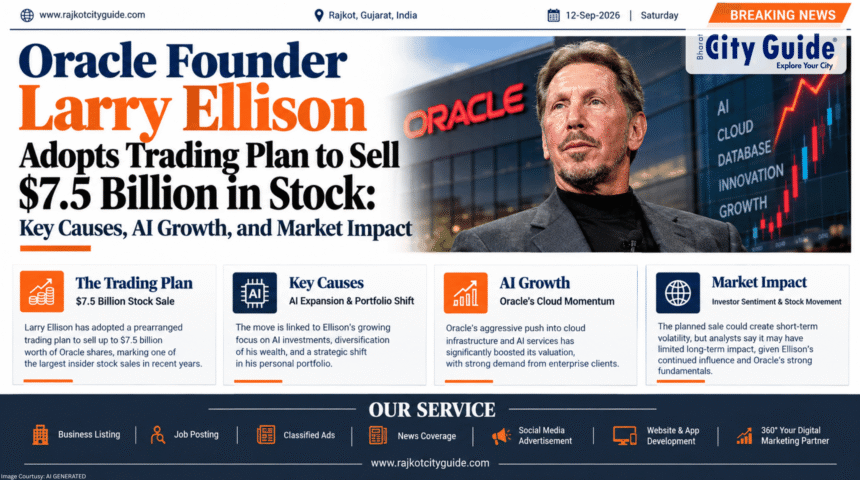
Global tech and financial markets were shocked by news involving enterprise software giant Oracle. Founder and Chairman Larry Ellison entered into a pre-arranged Rule 10b5-1 trading plan that allows him to sell up to 50 million shares of Oracle stock, valued at approximately $7.5 billion at current market prices.
- What is Oracle Corporation?
- Why Is the Oracle Stock Sale Important for Markets and Investors?
- Key Highlights of Oracle’s Business Transformation
- Current Situation: Larry Ellison’s $7.5 Billion Stock Sale Plan
- Detailed Analysis of Oracle’s Core Features and Offerings
- Specifications and Technical Overview of OCI vs. Competitors
- Safety, Security, and Enterprise Reliability Standards
- Financial Plans & Subscription Models
- Competitor Comparison: Oracle vs. Enterprise Cloud Rivals
- Advantages and Disadvantages of Oracle’s Position
- Who Should Consider Investing in or Using Oracle Solutions?
- Future Expectations and Growth Roadmap
- Frequently Asked Questions (FAQs)
- Conclusion and Final Market Overview
+-------------------------------------------------------------------------+
|                LARRY ELLISON TRADING PLAN AT A GLANCE                   |
+-------------------------------------------------------------------------+
|  • Shares Covered under Plan : Up to 50 million shares                  |
|  • Total Estimated Value      : ~$7.5 Billion (at current stock price)  |
|  • Plan Adoption Date         : June 22                                 |
|  • Expiration Date            : October 24                              |
|  • Remaining Ownership Stake  : Over 1.1 billion shares (~40%+ control) |
+-------------------------------------------------------------------------+
This development is notable because Ellison has historically held onto his equity stake in the enterprise database and cloud leader he co-founded in 1977. Since the turn of the century, Ellison has rarely sold more than 25,000 shares of Oracle at any given time. For Indian investors tracking global tech shares, cloud infrastructure expansion, and international equity portfolios, understanding the mechanics of this divestment and Oracle‘s core fundamentals is essential.
What is Oracle Corporation?
Oracle Corporation is a global technology conglomerate headquartered in Austin, Texas. Founded in 1977 by Larry Ellison, Bob Miner, and Ed Oates, the enterprise became world-famous for developing multi-model database management systems and enterprise enterprise resource planning (ERP) software applications.
+-------------------------------------------------------------------------+
|                  CORE BUSINESS PILLARS OF ORACLE                        |
+-------------------------------------------------------------------------+
|  1. Oracle Cloud Infrastructure (OCI) - High-performance AI compute     |
|  2. Enterprise Software Applications (ERP, SCM, HCM, Fusion, NetSuite)  |
|  3. Autonomous Database & Database Management Systems                   |
|  4. Specialized Industry Hardware & Enterprise Storage Solutions        |
+-------------------------------------------------------------------------+
Over the past decade, Oracle shifted from legacy on-premises software licensing to cloud computing. Through Oracle Cloud Infrastructure (OCI), the company has established itself as a major provider of AI training infrastructure, competing directly with Amazon Web Services (AWS), Microsoft Azure, and Google Cloud Platform (GCP).
Why Is the Oracle Stock Sale Important for Markets and Investors?
When a founder of an enterprise software giant schedules a multi-billion dollar stock liquidation, global equities and retail investors take note.
+-------------------------------------------------------------------------+
|                MACRO & CORPORATE IMPACT OF THE DISCLOSURE               |
+-------------------------------------------------------------------------+
|  • Automated Insider Execution : Prevents sudden block dump market shocks|
|  • Reinvestment Capital        : Funds family office commitments & media|
|  • AI Infrastructure Benchmark : Signals massive demand for cloud compute |
|  • Liquidity & Free Float      : Modest increase in tradable shares      |
+-------------------------------------------------------------------------+
Institutional and Retail Investor Takeaways
- No Loss of Founder Control: Ellison remains the single largest individual shareholder, keeping his leadership role as Chairman and Chief Technology Officer intact.
- Capital Allocation Realignment: Media reports indicate part of the liquidity may support private investment commitments, including funding for his son David Ellison’s Skydance Media merger with Paramount.
- Reassurance of Pre-Planned Architecture: The execution through a Rule 10b5-1 trading framework means trades are executed algorithmically without market timing based on unreleased earnings.
Key Highlights of Oracle’s Business Transformation
+-------------------------------------------------------------------------+
|                         ORACLE HIGHLIGHTS AT A GLANCE                   |
+-------------------------------------------------------------------------+
|  1. Founder Larry Ellison adopts plan to sell up to 50M shares ($7.5B)  |
|  2. Ellison retains over 1.1 billion shares and ~40%+ controlling stake  |
|  3. Cloud Infrastructure (OCI) revenue surged 121% year-over-year      |
|  4. Latest quarterly earnings beat consensus Wall Street revenue estimates|
|  5. Massive corporate investment in global AI data center buildouts     |
+-------------------------------------------------------------------------+
Current Situation: Larry Ellison’s $7.5 Billion Stock Sale Plan
According to official regulatory filings, Larry Ellison adopted a pre-arranged Rule 10b5-1 trading plan on June 22. This arrangement allows for the orderly execution of up to 50 million Oracle shares through October 24.
+-------------------------------------------------------------------------+
|            KEY DEVELOPMENTS DRIVING THE LATEST ORACLE UPDATE            |
+-------------------------------------------------------------------------+
|  • Regulatory Filing Disclosure: SEC filing reveals 10b5-1 trading plan |
|  • Cloud Infrastructure Surge  : OCI revenue grew 121% YoY in latest quarter|
|  • Quarterly Earnings Outperformance: Top-line revenue exceeded consensus |
|  • Leverage and Capital Expenditure: Heavy debt used for data centers  |
|  • Financing External Deals    : Skydance & Paramount media merger funding|
+-------------------------------------------------------------------------+
121% Cloud Growth vs. Infrastructure Debt Concerns
The filing disclosure arrived right after Oracle reported strong quarterly financial results that topped Wall Street estimates. The highlight of the earnings report was a 121% year-over-year surge in cloud infrastructure revenue, driven by enterprise demand for high-performance AI clusters.
However, funding this aggressive data center expansion required Oracle to take on substantial debt. Balance sheet leverage, combined with broader market volatility, has pressured the stock down roughly 20% this year.
Minimal Impact on Voting Control
Despite the scale of the $7.5 billion figure, the move represents a fractional adjustment to Ellison’s total holding. Holding over 1.1 billion shares, Ellison retains more than 40% voting control over Oracle. Market analysts note that executive trading plans under SEC Rule 10b5-1 are structured months in advance to automate trades and eliminate insider trading concerns.
Detailed Analysis of Oracle’s Core Features and Offerings
+-------------------------------------------------------------------------+
|                   ORACLE CLOUD ECOSYSTEM ARCHITECTURE                   |
+-------------------------------------------------------------------------+
| Oracle Cloud Infrastructure (OCI Gen 2 Bare Metal Compute)              |
|   |                                                                     |
|   v                                                                     |
| Enterprise Database Engine (Autonomous Database, MySQL HeatWave)        |
|   |                                                                     |
|   v                                                                     |
| Cloud Software Applications (ERP, Fusion, NetSuite, Healthcare EHR)     |
+-------------------------------------------------------------------------+
Oracle Cloud Infrastructure (OCI)
OCI is Oracle‘s second-generation cloud platform engineered specifically for heavy enterprise workloads and AI model training. By using flat, high-speed non-blocking networks and bare-metal servers, OCI provides faster data throughput at lower costs than traditional hyperscalers, attracting key partnerships with major AI developers.
Autonomous Database Technologies
Oracle‘s Autonomous Database leverages machine learning algorithms to automate database patching, tuning, security updates, and routine management without human intervention. This setup reduces operational overhead, eliminates human administration errors, and maintains enterprise-grade availability.
Enterprise Resource Planning (ERP) Cloud
Through flagship products like Oracle Fusion Cloud ERP and Oracle NetSuite, the organization commands a dominant share in enterprise financial management, supply chain tracking, and human capital management software globally.
Specifications and Technical Overview of OCI vs. Competitors
| Technical Metric / Spec | Oracle Cloud Infrastructure (OCI) | Traditional Hyperscalers | Strategic Advantage |
| Network Architecture | Off-loaded RDMA network fabric | Virtualized software routing | Ultra-low latency for AI clusters |
| Deployment Model | Public Cloud, Dedicated Region, OCI@Customer | Public Cloud / Hybrid extensions | Full cloud capabilities on-premises |
| Database Integration | Native Autonomous DB & Exadata | Native DB / Managed Third-Party | Maximum transaction processing speed |
| Pricing Model | Uniform global pricing structure | Regional price variations | Lower overall total cost of ownership |
| Target Workload Focus | Enterprise ERP, Heavy AI Training | General Web Apps, Microservices | Optimized for intensive data tasks |
Safety, Security, and Enterprise Reliability Standards
Enterprises and government institutions rely on Oracle because of its security and compliance features:
+-------------------------------------------------------------------------+
|                     ORACLE SECURITY & COMPLIANCE MATRIX                 |
+-------------------------------------------------------------------------+
|  1. Isolated Network Virtualization: Separates customer code from host  |
|  2. Always-On Encryption            : Protects data at rest and in transit|
|  3. Sovereign Cloud Regions         : Complies with EU & national privacy|
|  4. Strict Enterprise Certifications: SOC 1/2/3, ISO 27001, HIPAA, FedRAMP|
+-------------------------------------------------------------------------+
Financial Plans & Subscription Models
Oracle operates primarily under predictable, high-margin cloud subscription and license support models:
- Pay-As-You-Go (PAYG): Elastic cloud infrastructure billing calculated per hour or second based on consumed compute, storage, and networking capacity.
- Universal Credits (UCC): Enterprise contracts where customers commit to a baseline annual spend, unlocking significant volume discounts across all Oracle Cloud Infrastructure (OCI) services.
- SaaS Subscription Licensing: Per-user or per-module monthly pricing for enterprise applications like Fusion ERP, NetSuite, and HCM.
Competitor Comparison: Oracle vs. Enterprise Cloud Rivals
Comparing Oracle with alternative enterprise tech majors:
| Performance Metric | Oracle Corporation | Microsoft (Azure) | Amazon (AWS) |
| Cloud Infrastructure Growth | Extremely High (121% YoY in OCI) | High (~25-30% YoY) | Steady (~17-20% YoY) |
| Database Dominance | Industry Standard for Enterprise | Strong (SQL Server) | Strong (DynamoDB/Aurora) |
| Enterprise SaaS Apps | Market Leader (ERP/NetSuite) | Market Leader (Office 365) | Limited SaaS Portfolio |
| Valuation Multiple (P/E) | Moderate (Discounted by Debt) | Premium Valuation | Premium Valuation |
Advantages and Disadvantages of Oracle’s Position
Key Advantages
- Hyper-Growth in AI Infrastructure: Exceptional demand for OCI compute clusters positions Oracle as a key beneficiary of the global AI boom.
- Sticky Enterprise Customer Base: Fortune 500 corporations rely heavily on core Oracle database systems, ensuring recurring cash flows.
- Cost Efficiency for AI: Differentiated cloud hardware architecture provides cost advantages for training large language models.
Possible Disadvantages
- Elevated Debt Load: Aggressive capital expenditure on data centers has increased debt on Oracle‘s balance sheet, weighing on near-term stock valuation.
- Perception Shock from Founder Selling: Large headline stock sales by founders can trigger temporary market volatility among retail investors.
Who Should Consider Investing in or Using Oracle Solutions?
- Large Enterprises & Multinationals: Organizations modernizing core financial systems, ERP databases, or supply chain tracking onto secure cloud environments.
- AI Startups & Research Labs: Technology teams seeking high-performance GPU clusters and low-latency networking for training complex models.
- Long-Term Technology Investors: Shareholders seeking exposure to a profitable legacy enterprise software provider successfully reinventing itself as a cloud hyperscaler.
Future Expectations and Growth Roadmap
Industry analysts expect Oracle to maintain its aggressive expansion in AI cloud infrastructure over the next several fiscal years.
+-------------------------------------------------------------------------+
|                    ORACLE FUTURE OUTLOOK SCENARIOS                      |
+-------------------------------------------------------------------------+
| Base Case Scenario : OCI maintains strong double-digit growth; balance   |
|                      sheet debt is gradually payed down via cloud cash. |
| Bullish Scenario   : AI infrastructure demand accelerates, pushing OCI |
|                      market share closer to tier-one cloud providers.   |
| Bearish Scenario   : High interest rates increase debt servicing costs,  |
|                      slowing down data center expansion plans.          |
+-------------------------------------------------------------------------+
While Larry Ellison’s $7.5 billion stock sale plan will draw headline attention through its October expiration, Oracle‘s fundamental trajectory will remain tied to its cloud execution, customer retention, and debt management.
Frequently Asked Questions (FAQs)
Why is Larry Ellison selling $7.5 billion worth of Oracle stock?
Larry Ellison entered into a pre-arranged Rule 10b5-1 trading plan to sell up to 50 million Oracle shares. Executed for personal liquidity, financial diversification, and funding investments like the Skydance-Paramount media deal, the sale represents a small portion of his overall holding.
Will Larry Ellison lose control of Oracle after this stock sale?
No. Larry Ellison currently owns over 1.1 billion shares of Oracle, representing more than 40% of the company. Even after selling 50 million shares under this plan, he will remain the controlling shareholder, Chairman, and Chief Technology Officer.
What is a Rule 10b5-1 trading plan?
A Rule 10b5-1 plan is a pre-scheduled trading arrangement established under US Securities and Exchange Commission (SEC) guidelines. It allows corporate insiders to set up automated stock sales in advance, preventing accusations of trading on insider information.
How fast is Oracle’s cloud infrastructure business growing?
In its latest quarterly report, Oracle disclosed a 121% year-over-year surge in cloud infrastructure (OCI) revenue, driven by enterprise demand for high-performance AI compute capacity.
Why has Oracle stock experienced downside pressure recently?
Despite beating revenue and earnings expectations, Oracle‘s stock has faced pressure due to investor concerns over the high debt taken on to finance massive AI data center construction.
How does Oracle Cloud Infrastructure compare with AWS and Microsoft Azure?
Oracle Cloud Infrastructure (OCI) offers specialized bare-metal compute networking designed for AI workloads and native integration with Oracle enterprise database software, often providing lower costs than traditional hyperscalers.
Does Larry Ellison frequently sell large amounts of Oracle stock?
No. Historically, Larry Ellison has rarely sold more than 25,000 shares of Oracle at any given time, choosing instead to hold onto his equity stake. This $7.5 billion trading plan represents a rare divestment for the founder.
Conclusion and Final Market Overview
Larry Ellison’s pre-arranged plan to sell up to $7.5 billion in Oracle stock marks a notable moment for one of Silicon Valley’s longest-tenured founders. While the headline number is large, the execution under Rule 10b5-1 ensures an orderly process without altering Ellison’s 40%+ controlling stake or executive leadership at the company.
At its core, Oracle remains in the middle of a massive structural transition. With OCI revenue growing 121% year-over-year, the business has proven its ability to capture enterprise AI demand. For investors and industry observers, tracking Oracle‘s balance sheet management and cloud execution will remain far more critical to long-term value than short-term founder stock sales.