Introduction
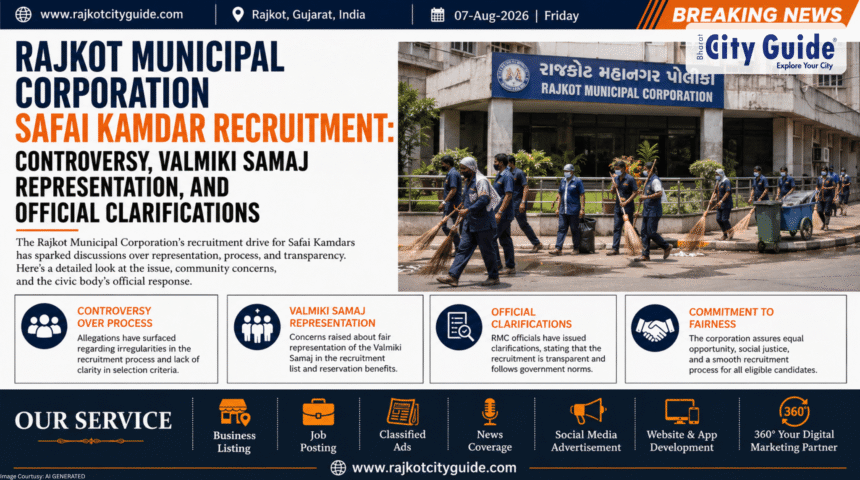
The administrative and civic landscape in urban Gujarat frequently witnesses complex intersections of labor welfare, public administration, and social representation. A significant development recently emerged at the headquarters of the Rajkot Municipal Corporation (RMC), centered around the Rajkot Municipal Corporation Safai Kamdar Recruitment process. Members and leaders of the local Valmiki community assembled at the civic body headquarters, chanting slogans such as “Rajkot Valmiki Samaj Zindabad” to voice their demands regarding employment conditions, voluntary retirement schemes, and daily attendance verification procedures.
- Introduction
- What is Rajkot Municipal Corporation Safai Kamdar Recruitment?
- Why This News is Important
- Background Information
- Key Highlights
- Detailed Explanation of the Event
- Benefits, Features, and Importance of Streamlined Sanitation Recruitment
- How It Impacts People
- Expert Insights & Industry Perspective
- Challenges and Limitations
- Future Outlook
- Frequently Asked Questions (FAQs)
- Conclusion
Sanitation workers form the backbone of urban public health and municipal cleanliness in Rajkot. Any policy shift, administrative review, or procedural adjustment related to their recruitment and service rules directly impacts hundreds of families dependent on civic employment. During the recent delegation meeting with the Mayor and top municipal officials, representatives presented a formal memorandum outlining key grievances regarding recruitment timelines, compassionate appointment schemes, and biometric attendance mechanisms.
At the same time, community leaders addressed and strongly refuted allegations regarding the submission of fake medical certificates during compassionate appointments or service transfers. This comprehensive article delves deep into the origin of the controversy, the structural mechanics of municipal sanitation recruitment in Gujarat, the administrative position taken by RMC, and the broader social implications for urban sanitation staff.
What is Rajkot Municipal Corporation Safai Kamdar Recruitment?
The Rajkot Municipal Corporation Safai Kamdar Recruitment refers to the official process by which the RMC hires permanent and contractual sanitation staff (Safai Kamdars or Safai Karamcharis) responsible for solid waste management, street sweeping, drainage maintenance, and general public hygiene across Rajkot city.
In Gujarat municipal corporations, Safai Kamdar recruitment typically operates under specific statutory frameworks and welfare guidelines established by the state government and urban local bodies. A vital component of this recruitment system is the compassionate appointment framework—often referred to as the “Varsadar” (heir/successor) scheme or voluntary retirement option (“Swaichhik Rajinama”). Under traditional municipal rules in Gujarat, if a permanent sanitation worker develops physical incapacitation, severe health conditions, or opts for voluntary retirement under prescribed guidelines, a direct relative (such as a son, daughter, or spouse) can be considered for appointment to ensure family financial security.
Because sanitation work involves significant physical labor and health risks, regular recruitment drives, service rule adjustments, and transparent appointment mechanisms remain critical for maintaining stable municipal operations in Rajkot.
Why This News is Important
The recent developments at the Rajkot Municipal Corporation hold immense significance for several reasons:
- Impact on Urban Sanitation: Sanitation workers ensure the daily cleanliness, health, and hygiene of millions of Rajkot residents. Discontent or administrative delays in recruitment can directly impact urban municipal service delivery.
- Social Welfare & Community Representation: The Valmiki community constitutes a major portion of the municipal sanitation workforce. Ensuring fair representation, respectful treatment, and transparent hiring practices is vital for community empowerment and social harmony.
- Addressing Corruption Allegations: Allegations concerning fake medical or disability certificates in compassionate appointments can undermine trust in public administration. Refuting unfounded claims while demanding transparent verification protects honest workers.
- Policy Governance in Civic Bodies: The discussion highlights critical operational policies, including biometric attendance, attendance monitoring, service transfer rules, and retirement benefit processing within civic authorities across Gujarat.
Background Information
To fully understand the context behind the recent gathering at the Rajkot Municipal Corporation (RMC) office, one must look at the history of municipal sanitation labor management in Rajkot. Over the years, the system of municipal sanitation hiring has evolved from purely informal or traditional systems into formalized civil employment governed by local body service rules.
Historically, the Valmiki community has provided the core labor force for urban sanitation in Gujarat. Recognizing the challenging nature of the work, various state schemes and labor commission guidelines established safeguards—such as job security, pension provisions, provident fund (PF) tracking, and heir-based compassionate hiring when a worker faces medical unfitness.
However, in recent years, friction points have emerged between union representatives and municipal administrators:
- Biometric Attendance Tracking: The implementation of electronic or mobile-based attendance marking systems sometimes leads to disputes over technical glitches, field duty tracking, and salary deductions.
- Processing Timelines for Resignations: Delays in approving voluntary resignations under the successor scheme leave families without immediate income when a primary earner becomes physically incapable of performing field duties.
- Contractual vs. Permanent Hiring: Tensions exist over the balance between permanent municipal staff and third-party contractor hiring, with unions pushing for standardized wages and permanent recruitment drives.
When allegations surfaced in local public discourses claiming that certain individuals used forged or fraudulent medical unfitness certificates to secure successor appointments, community leaders decided to step forward publicly to clarify facts and submit their formal representations to the Mayor.
Key Highlights
- Active Representation: Representatives of the Valmiki community and Safai Kamdar unions assembled at the Rajkot Municipal Corporation office, raising slogans in support of community unity and labor rights.
- Submission of Memorandum: A delegation met with the Mayor and senior administrative authorities to present key demands regarding recruitment schedules, voluntary retirement approvals, and attendance logging.
- Rejection of Fake Certificate Allegations: Community leaders explicitly rejected allegations regarding bogus or fraudulent medical certificates, demanding that systemic administrative checks be conducted fairly without defaming legitimate workers.
- Attendance & Duty Mechanics: Issues regarding daily attendance systems, field monitoring, and workplace conditions were brought to the municipal leadership’s attention.
- Assurance from Civic Authorities: Municipal leadership heard the representations and assured systematic review of valid grievances in accordance with civic administrative guidelines.
Detailed Explanation of the Event
The event unfolded at the central offices of the Rajkot Municipal Corporation, where members of the Valmiki community gathered to highlight long-pending service issues. Holding discussions around labor welfare, delegates marched to the administrative wing while chanting slogans emphasizing community solidarity and worker rights.
During the meeting with the Mayor, delegation leaders raised three major operational issues:
1. Expediting Safai Kamdar Recruitment and Successor Appointments
The delegation pointed out that several applications for voluntary retirement on medical grounds and subsequent appointment of family heirs (“Varsadar”) remained pending in various administrative stages. They requested the corporation to streamline medical board evaluations and accelerate the issuing of appointment letters so that vulnerable families do not face prolonged financial distress.
2. Streamlining Attendance Verification Frameworks
Sanitation work involves active field duty across diverse municipal zones, wards, and residential sectors. Representatives highlighted practical challenges associated with rigid attendance marking systems, advocating for fair mechanisms that account for actual ground conditions, emergency duties, and monsoon maintenance tasks without imposing unfair salary penalties.
3. Clear Stand on Medical Unfitness Allegations
Addressing recent claims circulating in local media and political circles regarding bogus medical certificates, union and community spokespersons clarified their position. They stated that medical evaluation for unfitness is conducted by official medical boards and designated civil hospital authorities, not by individual workers. Therefore, painting all compassionate appointments with broad suspicion is unjust. They welcomed official, transparent inquiries into specific discrepancies while requesting that administrative delays not be forced upon genuine applicants awaiting legitimate recruitment.
Benefits, Features, and Importance of Streamlined Sanitation Recruitment
A transparent and efficient recruitment policy for civic sanitation staff yields multiple benefits for the municipality and urban residents alike:
| Feature / Aspect | Benefit to Sanitation Staff | Impact on Municipal Governance & City |
| Timely Recruitment Drives | Provides stable employment and financial security to eligible youth. | Maintains adequate workforce levels to keep city streets clean. |
| Clear Successor Rules | Protects families of medically unfit or aging workers. | Sustains morale and trust between municipal administration and staff. |
| Transparent Medical Reviews | Eliminates fraudulent claims and ensures genuine cases get priority. | Enhances accountability and public confidence in civic hiring. |
| Fair Attendance Systems | Protects workers from arbitrary wage deductions due to technical errors. | Ensures disciplined field operations across all municipal wards. |
How It Impacts People
1. Impact on Sanitation Workers and Their Families
For the families of sanitation workers, municipal employment represents vital socioeconomic stability. Quick resolution of recruitment delays and fair evaluation of voluntary retirement schemes directly safeguard household livelihoods.
2. Impact on Rajkot Citizens
A well-organized, motivated, and fully staffed sanitation department ensures efficient waste collection, cleaner roads, effective storm-water drain cleaning, and reduced disease transmission across Rajkot’s urban zones.
3. Impact on Municipal Administration
By engaging directly with labor unions and community leaders, the Rajkot Municipal Corporation maintains operational stability, avoids prolonged labor strikes, and upholds administrative transparency in compliance with state labor codes.
Expert Insights & Industry Perspective
Urban administration analysts and labor welfare experts emphasize that municipal corporations in fast-growing cities like Rajkot must balance digitized administrative control with practical labor management.
Experts point out that while biometric and GPS-tracked attendance systems enhance operational oversight, they must be supported by responsive grievance redressal channels. Furthermore, in matters of compassionate appointments and medical unfitness retirements, expert consensus advocates for:
- Establishing centralized, independent medical boards with transparent verification procedures to completely rule out fake documentation.
- Time-bound SLA (Service Level Agreements) for processing retirement and replacement applications to eliminate bureaucratic backlogs.
- Digital tracking portals where applicants can track the status of heir-appointment files in real time.
Challenges and Limitations
While the representation brought critical issues to the surface, several challenges persist in resolving the situation completely:
- Verification Deadlocks: Rigorous verification of medical unfitness claims takes time, which can slow down legitimate appointments.
- Budgetary Constraints: Municipal corporations operate under strict financial budgets, limiting the rapid conversion of contractual posts into permanent positions.
- Balancing Tech Implementation with Ground Realities: Deploying high-tech attendance solutions across field workers requires continuous training and system calibration to avoid misclassifying present workers as absent.
Future Outlook
Moving forward, the Rajkot Municipal Corporation is expected to review the pending files related to sanitation recruitment and voluntary resignations under existing state rules. Increased transparency through digital document tracking and official medical board streamline processes could resolve the controversy surrounding fake certificate allegations.
If civic authorities and community representatives maintain constructive dialogue, Rajkot can establish a model framework for sanitation labor governance—combining strict administrative oversight with compassionate labor welfare.
Frequently Asked Questions (FAQs)
1. What is the main issue regarding Rajkot Municipal Corporation Safai Kamdar Recruitment?
The main issue involves demands by workers and Valmiki community leaders for timely recruitment, faster processing of voluntary retirement/successor applications, fair attendance rules, and clarification regarding fake certificate allegations.
2. Why did the Valmiki community demonstrate at the RMC office?
Representatives gathered to present a formal memorandum to the Mayor, requesting resolutions for pending recruitment files, successor appointment delays, and operational challenges with daily attendance systems.
3. What stand did community leaders take regarding fake certificate claims?
Leaders refuted allegations that workers submit fake unfitness certificates, emphasizing that medical assessments are conducted by official civil hospital boards and demanding fair administrative checks without penalizing genuine workers.
4. What is the “Varsadar” or successor scheme in municipal sanitation recruitment?
It is a compassionate appointment provision allowing a direct relative of a permanently incapacitated or medically unfit sanitation worker to apply for employment, ensuring family financial continuity.
5. How does attendance tracking affect RMC Safai Kamdars?
Attendance tracking systems monitor daily field presence. Worker union delegates requested adjustments to address technical errors and ground-level field conditions to prevent unfair wage deductions.
6. Who conducts medical evaluations for voluntary retirement on health grounds?
Medical evaluations are performed by authorized government medical boards and civil hospital doctors, ensuring official scrutiny before any resignation or successor appointment is approved.
7. How does resolving this recruitment controversy help Rajkot residents?
Resolving recruitment delays ensures adequate staffing for solid waste management, daily street cleaning, and urban sanitation, leading to a cleaner and healthier city.
Conclusion
The recent representation at the Rajkot Municipal Corporation highlights the vital relationship between civic administration and the sanitation workforce powering urban cleanliness. By addressing concerns surrounding Rajkot Municipal Corporation Safai Kamdar Recruitment, voluntary resignations, attendance tracking, and medical verification with transparency, the RMC can build a fair, accountable, and welfare-oriented framework. Constructive collaboration between community leaders and municipal authorities will ultimately ensure social justice for workers and superior civic services for the people of Rajkot.