Introduction
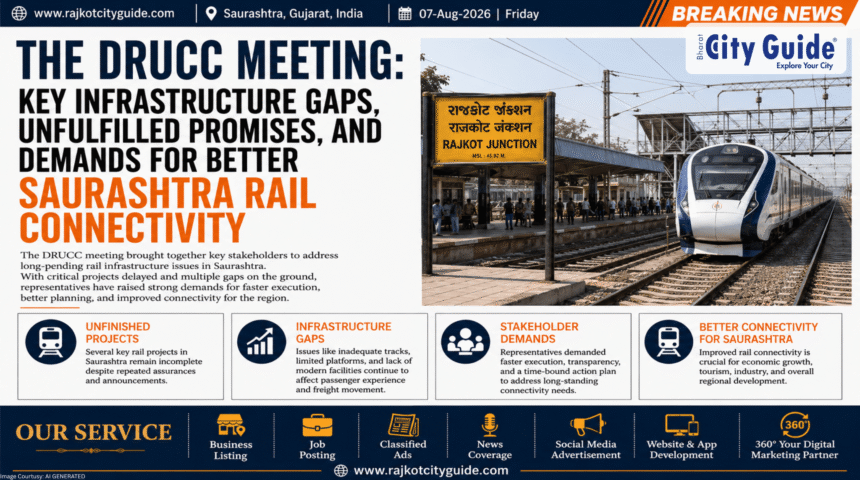
The Divisional Railway Users Consultative Committee serves as a crucial bridge between rail passengers, regional commercial stakeholders, and Indian Railways administrative leadership. Recently, The DRUCC Meeting held under the Rajkot Railway Division brought long-standing passenger grievances and infrastructure delays into sharp focus. While Indian Railways continues to promote nationwide network upgrades, electrification drives, and track doubling projects, ground-level user groups are expressing growing frustration over stalled train extensions and unexpected service suspensions.
- Introduction
- What is The DRUCC Meeting?
- Why This News is Important
- Background Information and Regional Context
- Key Highlights of The DRUCC Meeting
- Detailed Explanation of Issues Raised at the Meeting
- Importance of Consultative Railway Forums
- How These Issues Impact Different Groups
- Industry Perspective on Railway Operations
- Administrative Challenges and Obstacles
- Future Outlook for Saurashtra Rail Services
- Frequently Asked Questions (FAQs)
- Conclusion
A central focus of the discussions was the stark contrast between completed railway electrification and track doubling infrastructure on the Ahmedabad-Rajkot line and the lack of corresponding passenger service expansions. Despite over a year passing since the completion of electrification and doubling works on this key corridor, promised extensions for six major long-distance trains originating from Ahmedabad remain stuck in administrative limbo.
Adding to passenger frustration, high-profile premium services like the Tejas Express have faced complete operational shutdowns rather than route expansions. Attended by key representatives, including members of the Rajkot Chamber of Commerce and Industry (RCCI), The DRUCC Meeting highlighted a comprehensive list of demands aimed at improving passenger amenities, optimizing train schedules, and enhancing long-distance rail connectivity for Saurashtra. This detailed report examines the primary issues raised, the historical background, and the path forward for regional rail development.
What is The DRUCC Meeting?
The DRUCC Meeting refers to the official forum of the Divisional Railway Users Consultative Committee. Operating across all railway divisions in India, the DRUCC functions as a statutory consultative body established under the Ministry of Railways to ensure public participation in railway planning and operations.
The committee brings together a diverse panel of stakeholders, including:
- Representatives from regional Chambers of Commerce and Industry
- Passenger welfare and commuter associations
- Agricultural and trade union delegates
- Nominated public representatives and local civic authorities
- Senior Divisional Officers led by the Divisional Railway Manager (DRM)
[Divisional Railway Manager (DRM) & Officials]
                    ▲
                    │  (Direct Consultative Interface)
                    ▼
[The DRUCC Meeting Forum]
   ├── Rajkot Chamber of Commerce & Industry (RCCI)
   ├── Passenger Welfare Associations
   └── Trade & Agricultural Delegates
During these structured sessions, members submit formal representations detailing local operational challenges, station amenity deficits, ticketing issues, and demands for new train routes or schedule adjustments. The railway administration reviews these points, provides official updates on ongoing engineering works, and forwards macro-level demands directly to the Railway Board for further consideration.
Why This News is Important
The discussions at The DRUCC Meeting hold significant implications for the economic and daily life of the Saurashtra region. Rajkot is the commercial heart of Saurashtra, housing vast industrial parks, engineering foundries, machine tool manufacturing units, and silver jewelry processing clusters. Thousands of business owners, technicians, traders, and daily commuters rely heavily on efficient rail connections to commercial centers like Ahmedabad, Mumbai, Surat, and North Indian trading hubs.
When major rail infrastructure projects—such as multi-crore electrification and track doubling initiatives—reach completion, the public expects an immediate increase in train frequency and improved route connectivity. The failure to extend announced long-distance trains to Rajkot forces travelers to rely on overcrowded connecting services or more expensive road transport.
Furthermore, the operational closure of premium train options like the Tejas Express highlights an ongoing gap between infrastructure investment and passenger service availability. Addressing these concerns through official platforms like the DRUCC is essential for keeping regional transportation aligned with economic growth.
Background Information and Regional Context
The rail corridor connecting Ahmedabad, Rajkot, Hapa, Jamnagar, and Okha forms the logistical backbone of Western Gujarat. For decades, this line operated as a heavily congested single-track network powered largely by diesel locomotives, creating transit bottlenecks and limiting the total number of trains that could run daily.
To solve these constraints, Indian Railways approved massive capital projects to double the tracks and electrify the entire Rajkot-Ahmedabad route. Over the past few years, civil engineering and electrical teams successfully commissioned the double-line track along with 25 kV AC overhead electrification.
+-----------------------------------------------------------------------------------+
| Corridor Upgrade: Ahmedabad - Rajkot Line                                         |
+-----------------------------------------------------------------------------------+
| Historical Status : Single Track | Diesel Traction | Frequent Loop-Line Delays   |
| Current Status    : Double Track | 25 kV AC Electric | Expanded Line Capacity      |
| Public Expectation: Immediate Extension of Long-Distance Services to Rajkot       |
+-----------------------------------------------------------------------------------+
Following the completion of these major upgrades, political leaders and senior railway officials publicly announced that six key long-distance express trains originating from Ahmedabad would be extended to Rajkot. These included:
- Ahmedabad–Patna Express
- Ahmedabad–Prayagraj Express
- Ahmedabad–Kolkata Express
- Ahmedabad–Kolhapur Express
- Ahmedabad–Nagpur Express
- Gujarat Sampark Kranti Express (Ahmedabad to Hazrat Nizamuddin)
However, despite full electrification and double-track operations functioning for over a year, these promised extensions remain stalled. This delay formed the core grievance presented during the committee session.
Key Highlights of The DRUCC Meeting
- Stalled Train Extensions: Members strongly criticized the delay in extending six major Ahmedabad-originating long-distance express trains up to Rajkot despite earlier public announcements.
- Impact of Electrification: Committee members noted that even though the double track and electrification have been operational for over a year, passengers have seen little expansion in long-distance services.
- Tejas Express Discontinuation: Severe disappointment was voiced over the operational shutdown of the premium Tejas Express service instead of optimizing its route or schedule.
- Duronto Express Extension: The RCCI submitted representations calling for the immediate implementation of the proposal to extend the Ahmedabad–Pune Duronto Express to Rajkot.
- Saurashtra Mail Rescheduling: Delegates demanded that the departure time of the iconic Saurashtra Mail be restored to its original 6:30 PM schedule to avoid operational overlap with the Saurashtra Janta Express.
- Platform Amenity Gaps: Serious safety and accessibility concerns were raised regarding platforms 4 and 5 at Rajkot station, which lack coach indicators, lifts, escalators, and adequate passenger sheds.
- Demand for Vande Bharat Sleeper: Committee members formally requested the introduction of a premium Vande Bharat Sleeper train on the high-demand Rajkot–Mumbai corridor.
Detailed Explanation of Issues Raised at the Meeting
1. The Delay in Extending 6 Major Trains
The most prominent agenda item at The DRUCC Meeting was the delay in extending six long-distance express trains. Representatives pointed out that when single-line track constraints existed, delays were blamed on network congestion. However, now that the line is fully doubled and electrified, keeping these trains originating at Ahmedabad forces thousands of Saurashtra-bound travelers to make unnecessary connections, increasing travel time and expenses.
2. Discontinuation of the Tejas Express
The committee discussed the closure of the Tejas Express service. Rather than adjusting ticket pricing structures or extending the route further into Saurashtra to capture more passenger demand, the service was shut down. Members argued that premium, high-speed rail options are commercially viable if routed thoughtfully through major business hubs like Rajkot and Jamnagar.
3. Station Infrastructure Deficits on Platforms 4 and 5
With the expansion to a double-track system, Rajkot station frequently utilizes platforms 4 and 5 to handle incoming and outgoing traffic. However, representatives highlighted that these platforms lack basic passenger amenities.
[Rajkot Station Platforms 4 & 5 Infrastructure Status]
├── Coach Indicators : ABSENT  ---> Causes platform confusion during arrivals
├── Escalators/Lifts : ABSENT  ---> Creates severe hurdles for elderly/disabled
├── Platform Sheds   : LACKING ---> Exposes passengers to rain and extreme heat
└── Catering Stalls  : LACKING ---> Inconveniences long-distance commuters
The absence of digital coach indicators creates platform confusion when trains pull in, raising safety risks during peak hours. Additionally, the lack of lifts and escalators makes transferring between platforms difficult for elderly passengers, families with luggage, and travelers with disabilities.
4. Schedule Clashes and Timetable Adjustments
The committee addressed scheduling conflicts between closely timed services. Specifically, the current timetables leave only a narrow 30-minute window between the departure of the Saurashtra Janta Express and the Saurashtra Mail on the Mumbai route. Reverting the Saurashtra Mail back to its traditional 6:30 PM departure would spread out options, reduce station platform crowding, and better serve evening commuters.
Importance of Consultative Railway Forums
The issues brought forward during The DRUCC Meeting demonstrate why statutory advisory committees remain essential to public transport management:
- Direct Accountability: The forum creates direct interaction between senior railway managers and local community representatives.
- Highlighting Ground-Level Issues: While central planning focuses on network-wide projects, DRUCC members highlight localized issues, such as missing platform sheds or awkward train departure times.
- Data-Driven Advocacy: Business chambers use market data, passenger volume trends, and trade requirements to present strong, well-supported cases for new train routes.
- Safety Surveillance: Identifying safety risks—like platform crowding caused by missing digital indicators—allows division staff to make fixes before accidents happen.
How These Issues Impact Different Groups
Business Owners and Trade Delegates
For regional entrepreneurs, corporate executives, and traders, direct rail access to major commercial cities is vital. Stalled train extensions force business travelers onto highways or require transfer stops at Ahmedabad, adding unnecessary travel hours and raising operational expenses.
Daily Commuters and Long-Distance Travelers
General passengers face crowded conditions on existing routes due to limited long-distance options starting directly from Rajkot. The lack of basic platform facilities on frequently used platforms like 4 and 5 turns daily commuting into an uncomfortable, stressful experience.
Tourism and Religious Travel
Saurashtra draws millions of pilgrims and tourists every year visiting sites like the Somnath Temple and the Dwarkadhish Temple in Dwarka. Inadequate direct train options from Eastern, Northern, and Southern states limit regional tourism growth and strain local transport networks.
Industry Perspective on Railway Operations
Transport planners and railway operational experts note that extending train services involves managing complex operational resources. Adding route mileage to long-distance trains requires allocating additional rake sets, coordinating maintenance schedules at terminal yards, and finding open platform slots at receiving stations.
However, industry analysts emphasize that once major track doubling and electrification projects are completed, railways must prioritize operational adjustments to deliver clear benefits to passengers. Keeping long-distance trains terminated at intermediate stations like Ahmedabad when downstream line capacity is available leaves network potential underutilized. Modernizing platform technology and streamlining schedules are cost-effective ways to increase passenger satisfaction and boost railway revenues.
Administrative Challenges and Obstacles
While passenger demands raised at The DRUCC Meeting are clear, railway administrators face several operational challenges in implementing them quickly:
- Pit-Line and Maintenance Bottlenecks: Extending multiple trains to new destination stations requires available pit-lines for watering, cleaning, and primary maintenance.
- Terminal Platform Availability: Managing additional originating and terminating trains requires open platform windows at Rajkot, Hapa, and Jamnagar stations during peak hours.
- Inter-Divisional Timetable Coordination: Adjusting long-distance train schedules requires approval across multiple railway zones to prevent cascading delays on main trunk lines.
- Budget Allocations for Platform Upgrades: Installing lifts, escalators, full-length platform covers, and digital signaling boards requires dedicated civil engineering budgets that depend on multi-stage approval cycles.
Future Outlook for Saurashtra Rail Services
Following the representations made at The DRUCC Meeting, railway officials, led by the Divisional Railway Manager, assured delegates that these concerns would be organized into formal proposals and submitted to Western Railway Headquarters and the Railway Board for review.
[DRUCC Representation Submitted]
               │
               ▼
[Rajkot Divisional Railway Management Review]
               │
               ▼
[Western Railway HQ (Mumbai) Evaluation]
               │
               ▼
[Railway Board Final Approval & Notification]
In the coming months, public attention will focus on whether the Railway Board approves the stalled train extensions. With track doubling and electrification work finished, introducing modern services—such as the requested Vande Bharat Sleeper—remains a realistic goal. Station upgrade works on platforms 4 and 5 at Rajkot are also expected to move forward as divisional development funds are allocated.
Frequently Asked Questions (FAQs)
What is the primary purpose of The DRUCC Meeting?
The Divisional Railway Users Consultative Committee (DRUCC) meeting brings together railway administrators and regional public representatives to address passenger concerns, discuss service updates, and propose improvements to rail infrastructure.
Which six trains were proposed for extension from Ahmedabad to Rajkot?
The six trains announced for extension are the Ahmedabad–Patna Express, Ahmedabad–Prayagraj Express, Ahmedabad–Kolkata Express, Ahmedabad–Kolhapur Express, Ahmedabad–Nagpur Express, and the Gujarat Sampark Kranti Express.
Why are passengers frustrated despite completed track electrification?
Passengers are frustrated because even though track doubling and electrification work on the Ahmedabad–Rajkot route has been complete for over a year, promised train extensions have not been put into action.
What concerns were raised about platforms 4 and 5 at Rajkot Railway Station?
Committee members pointed out that platforms 4 and 5 lack essential amenities like digital coach indicators, passenger lifts, escalators, adequate shelter sheds, and catering stalls.
What change was requested regarding the Saurashtra Mail schedule?
Representatives requested that the Saurashtra Mail’s departure time be moved back to its original 6:30 PM schedule to avoid running too close to the Saurashtra Janta Express and to better serve evening travelers.
Was there a demand for new premium train services at the meeting?
Yes, representatives formally requested the introduction of a new Vande Bharat Sleeper train service on the busy Rajkot–Mumbai route.
What happened to the Tejas Express service on this corridor?
Rather than being extended further into Saurashtra to capture more passenger demand, the Tejas Express service was shut down, raising concerns among business commuters.
How do railway officials respond to the demands raised during DRUCC meetings?
Divisional authorities evaluate local infrastructure requests, make small operational adjustments where possible, and forward major proposals requiring fleet or timetable changes directly to the Railway Board.
Conclusion
The DRUCC Meeting highlighted the ongoing gap between major railway infrastructure completions and actual passenger service upgrades. While track doubling and electrification have modernized the Rajkot-Ahmedabad rail line, the delay in extending six long-distance trains, the cancellation of the Tejas Express, and amenity gaps on platforms 4 and 5 show that significant work remains to be done.
Addressing these grievances is vital for supporting Saurashtra’s economic growth and ensuring travelers see the direct benefits of national rail investments. As divisional managers forward these requests to the Railway Board, passengers and regional business leaders will be watching closely for concrete progress on train extensions, schedule fixes, and station upgrades across the region.