Introduction
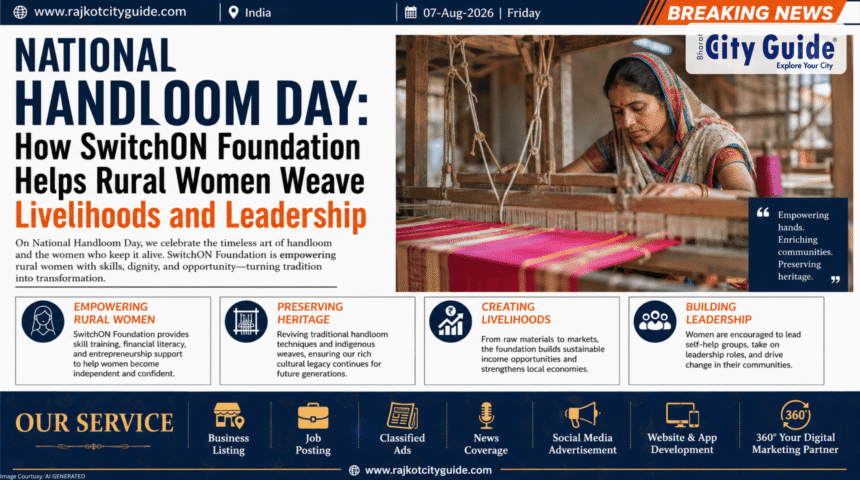
Every year on 7 August, India comes together to celebrate National Handloom Day, a historic occasion dedicated to honoring millions of artisanal weavers across the nation. Every piece of handloom fabric carries a legacy of years of skill, generational knowledge, and the living stories of the communities behind the loom. When someone drapes an authentic handwoven saree or carries a handcrafted textile, they are holding far more than intricate patterns; they are embracing a living piece of Indian history, heritage, and culture.
- Historical Roots and the Swadeshi Movement
- The Cultural and Economic Importance of Handlooms
- Key Challenges Facing Rural Weavers
- Recent Policy Updates and Sector Progress
- Overview of SwitchON Foundation
- Understanding the Udyamini Initiative
- 1. Skill Enhancement and Up-skilling
- 2. Design Modernization and Product Diversification
- 3. Financial Inclusion and Business Literacy
- 4. Market Access and Building Producer Collectives
- Grassroots Leadership and Social Change
- Preserving Living Heritage
- Driving Sustainable and Slow Fashion
- Choosing Authentic Products
In today’s rapidly evolving economic landscape, National Handloom Day serves as an essential reminder that India’s weaving tradition continues to sustain millions of rural families. According to national records, over 35 lakh weavers and allied workers power this traditional sector, with women making up more than 72% of the workforce. The occasion highlights how ancient craft techniques can be transformed into robust, modern economic opportunities when supported by structured skill development, direct market linkages, and grassroots collective action.
At the forefront of this rural transformation is the SwitchON Foundation. Working across eight states in India, SwitchON Foundation leverages National Handloom Day to showcase how grassroot interventions can elevate traditional women weavers into thriving entrepreneurs and influential community leaders. Through its flagship Udyamini initiative, the organization addresses the systemic challenges faced by rural women artisans—moving beyond basic loom operation to deliver comprehensive business mentorship, design innovation, financial inclusion, and market access.
This comprehensive article explores the true significance of National Handloom Day, examines the socio-economic realities of India’s weaving communities, and details how non-governmental organizations like SwitchON Foundation are reshaping the handloom value chain. Readers will discover how empowerments in rural craft hubs are preserving cultural heritage while creating sustainable, dignified livelihoods for generations to come.
What is National Handloom Day?
Historical Roots and the Swadeshi Movement
To fully appreciate National Handloom Day, one must look back to 7 August 1905, when the Swadeshi Movement was formally launched at the Calcutta Town Hall. The movement emerged as a powerful boycott against foreign goods and championed indigenous production, self-reliance (Atmanirbhar), and domestic artisanal crafts. Handwoven textiles became the ultimate symbol of national resilience and economic independence.
To commemorate this landmark historical event, the Government of India officially declared 7 August as National Handloom Day in 2015. The inaugural celebration was inaugurated by Prime Minister Narendra Modi in Chennai, establishing a yearly national platform to celebrate handloom weavers and highlight their vital contributions to India’s socio-economic fabric.
The Cultural and Economic Importance of Handlooms
India’s handloom industry is the largest cottage industry in the country and accounts for nearly 95% of the world’s handwoven fabric. From the intricate silk brocades of Banaras and the vibrant Kanjeevarams of Tamil Nadu to the delicate Jamdanis of West Bengal and the rich Mekhela Chadors of Assam, Indian handlooms represent unmatched diversity.
Beyond cultural symbolism, the sector is an indispensable pillar of the rural economy:
- Employment: It is the second-largest employer in rural India after agriculture, providing direct and indirect livelihoods to over 35 lakh individuals.
- Sustainability: Handloom production is intrinsically eco-friendly, relying primarily on human power, natural fibers, and low-carbon production cycles.
- Gender Empowerment: Female artisans constitute the vast majority of pre-loom, loom, and post-loom operations, making handloom a direct vehicle for gender equity in rural areas.
Current Situation: Challenges and Recent Developments
Key Challenges Facing Rural Weavers
Despite its glorious legacy, the traditional handloom sector faces multiple structural bottlenecks that threaten artisan livelihoods:
- Supply Chain Exploitation: Middlemen often absorb the majority of retail profits, leaving weavers with low daily wages.
- High Raw Material Costs: Fluctuations in the prices of yarn, silk threads, and dyes reduce net profit margins for small-scale artisans.
- Lack of Direct Market Linkages: Rural artisans in remote villages frequently lack access to urban exhibitions, export buyers, and e-commerce platforms.
- Competition from Powerlooms: Cheap, machine-made imitations passed off as genuine handlooms erode consumer trust and undercut price points.
- Inadequate Capital and Credit: Rural women face double barriers due to lack of property ownership, restricting their access to formal banking channels.
Recent Policy Updates and Sector Progress
Observances around National Handloom Day have catalyzed renewed government and institutional focus. Recent initiatives aimed at modernizing the handloom ecosystem include:
- Digital Identification (e-Pehchan Portal): Launched to streamline weaver registration and deliver direct benefits, social security, and identity cards to artisans across India.
- Handloom Mark and GI Branding: Rigorous enforcement of the Handloom Mark and Geographical Indication (GI) certifications to protect authentic handmade products from counterfeit powerloom fabrics.
- MUDRA Credit Facilitation: Financial assistance and subsidized working capital loans transferred directly to weavers through digital portals.
- Raw Material Supply Scheme (RMSS): Subsidized yarn delivery to ensure small weaver units can maintain uninterrupted production without high upfront costs.
SwitchON Foundation and the Udyamini Project
Overview of SwitchON Foundation
SwitchON Foundation (registered as Environment Conservation Society) is an award-winning non-profit organization established in 2008. Operating across eight Indian states—including West Bengal, Assam, Jharkhand, Odisha, and Bihar—the foundation works at the intersection of clean energy, sustainable agriculture, green skills, and rural entrepreneurship.
SwitchON believes that true rural empowerment requires building resilient, decentralized enterprise models led by local communities. By combining environmental sustainability with economic mobility, the foundation has directly impacted thousands of smallholders and rural micro-entrepreneurs.
Understanding the Udyamini Initiative
The term “Udyamini” translates to a female entrepreneur. The Udyamini project was launched by SwitchON Foundation as a multi-sectoral program designed to cultivate Rural Women Entrepreneurs (RWEs) across various value chains, including agriculture, livestock, digital services, and handlooms.
In the handloom sector, the Udyamini project addresses systemic gaps by providing end-to-end institutional support to over 4,000 rural women weavers in states like West Bengal and Assam. The project transforms traditional weavers from passive piece-rate wage earners into confident business owners who control their production, pricing, and market reach.
How SwitchON Foundation Transforms Rural Women Weavers
SwitchON Foundation’s approach to elevating handloom artisans revolves around four core strategic pillars: capacity building, design modernization, financial inclusion, and collective leadership.
  +-----------------------------------------------------------------+
  |                UDYAMINI VALUE CHAIN INTERVENTION                |
  +-----------------------------------------------------------------+
                                   |
         +-------------------------+-------------------------+
         |                                                   |
  [ 1. Skill Enhancement ]                   [ 2. Design Innovation ]
  • Advanced weaving techniques              • Contemporary color palettes
  • Ergonomic loom operation                 • Market-aligned motifs
  • Yarning & natural dyeing                 • Fusion textile creation
         |                                                   |
         +-------------------------+-------------------------+
                                   |
         +-------------------------+-------------------------+
         |                                                   |
  [ 3. Financial Linkages ]                  [ 4. Market & Leadership ]
  • MUDRA & bank accounts                    • Producer collectives (FPOs)
  • Micro-credit assistance                  • Direct urban expos & e-commerce
  • Digital financial literacy               • Community leadership roles
1. Skill Enhancement and Up-skilling
Traditional weaving skills are often passed down informally, which can restrict weavers to older, time-consuming techniques. SwitchON Foundation conducts structured training workshops in craft clusters like Bankura and Nadia in West Bengal, as well as Kamrup and Goalpara in Assam.
- Master Weaver Training: Introducing advanced loom attachments and flying shuttles that boost daily production output without extra physical strain.
- Quality Standardization: Teaching precise thread-count maintenance, uniform weaving density, and flawless finishing techniques required by export markets.
- Natural Dyeing & Sustainable Practices: Encouraging eco-friendly, chemical-free processing that aligns with global sustainable fashion trends.
2. Design Modernization and Product Diversification
Urban consumers and international markets demand a blend of traditional authenticity and modern aesthetics. SwitchON collaborates with textile designers to upgrade rural product lines:
- Contemporary Patterns: Adapting traditional motifs into minimalist, modern designs suited for contemporary wardrobes and home decor.
- Product Diversification: Guiding weavers to create items beyond traditional sarees and gamusas, such as stoles, scarves, cushion covers, table runners, and tote bags.
- Raw Material Sourcing: Facilitating bulk purchase of high-grade organic cotton, silk, and eco-dyes to ensure premium product output.
3. Financial Inclusion and Business Literacy
Lack of capital often forces rural weavers into debt traps with local moneylenders. The Udyamini project embeds financial literacy into its core curriculum:
- Formal Banking Access: Helping women open individual bank accounts and access government schemes like MUDRA loans.
- Costing and Pricing Strategy: Training women to calculate raw material costs, labor hours, overheads, and fair profit margins so they never underprice their craft.
- Digital Payments: Equipping artisans with UPI tools and mobile banking, allowing them to transact directly with urban customers and buyers.
4. Market Access and Building Producer Collectives
Direct market linkages are the ultimate driver of sustainable income growth. SwitchON Foundation eliminates intermediary exploitation by creating direct channels:
- Producer Groups and Collectives: Organizing individual women weavers into formal Self-Help Groups (SHGs) and Producer Organizations, building bargaining power and economies of scale.
- Exhibition and Expo Participation: Facilitating artisan stalls at major national craft melas, urban expos, and corporate pop-ups across metropolitan cities.
- E-Commerce Integration: Onboarding handloom collectives onto digital marketplaces and social commerce platforms, allowing rural artisans to sell products directly nationwide.
Real Impact: Key Metrics and Outcomes
The holistic interventions of the Udyamini project have delivered measurable socio-economic benefits across target handloom clusters. The table below highlights the comparative transformation before and after structured NGO intervention:
| Impact Indicator | Before Udyamini Intervention | After Udyamini Support |
| Average Monthly Income | Rs 3,500 – Rs 5,000 (Irregular piece-rate) | Rs 9,000 – Rs 15,000+ (Steady enterprise revenue) |
| Market Exposure | Restricted to local traders & middlemen | Direct access to expos, urban buyers & digital platforms |
| Banking & Credit | Reliance on informal village moneylenders | Formal bank accounts, MUDRA loans & digital UPI payments |
| Product Range | Limited to basic traditional garments | Diversified lifestyle items, stoles, and contemporary wear |
| Community Status | Passive family laborers | Recognized business owners & decision-makers |
Grassroots Leadership and Social Change
Beyond financial metrics, the celebration of National Handloom Day underscores a deeper transformation: the rise of female leadership in rural India. As women weavers generate steady household income, social dynamics shift dramatically:
- Enhanced Household Decision-Making: Women gain equal say in family expenditures, children’s education, and healthcare investments.
- Increased School Retention for Girls: Higher household earnings allow families to keep daughters in school longer, breaking intergenerational cycles of poverty.
- Community Advocacy: Empowered women lead local village councils, advocate for clean drinking water and sanitation, and mentor younger women to pursue independent livelihoods.
Why National Handloom Day Matters for Modern Consumers
Preserving Living Heritage
Handloom is not an obsolete museum piece; it is a dynamic, living craft traditions passed through generations. Supporting handlooms on National Handloom Day directly ensures that ancient weaving techniques—such as Jamdani, Ikat, Chanderi, and Kantha—do not disappear in the face of industrial automation.
Driving Sustainable and Slow Fashion
Fast fashion contributes significantly to industrial pollution, landfill waste, and high carbon emissions. In contrast, Indian handloom represents the ultimate form of slow fashion:
- Zero-Carbon Footprint: Handlooms operate manually without consuming electricity.
- Biodegradable Fabrics: Made primarily from natural fibers like organic cotton, jute, wool, and mulberry silk.
- Ethical Production: Supporting fair wages, dignified working conditions, and craft preservation.
Choosing Authentic Products
Consumers can contribute to the handloom ecosystem by making conscious buying choices:
- Look for the Handloom Mark: Always verify the presence of official Handloom Mark labels to ensure authenticity.
- Support Geographical Indication (GI) Products: Purchase certified Geographical Indication GI-tagged weaves that protect traditional regional crafts.
- Buy Direct from Artisan Collectives: Purchase directly from producer groups, artisan expos, and credible developmental platforms like SwitchON Foundation’s partner collectives.
Strategic Roadmap for the Future of Indian Handlooms
To keep India’s handloom sector competitive and vibrant in global markets, sustained multi-stakeholder collaboration is essential:
  +-----------------------------------------------------------------+
  |                  FUTURE HANDLOOM ECOSYSTEM ROADMAP              |
  +-----------------------------------------------------------------+
                                   |
         +-------------------------+-------------------------+
         |                                                   |
  [ Public Sector Support ]                  [ Private Sector & CSR ]
  • Subsidized credit & raw yarn             • Corporate gift procurement
  • Infrastructure for craft villages        • Ethical brand partnerships
  • Protection against powerlooms            • Designer collaboration labs
         |                                                   |
         +-------------------------+-------------------------+
                                   |
         +-------------------------+-------------------------+
         |                                                   |
  [ Grassroots Innovation ]                  [ Consumer Awareness ]
  • Tech-enabled supply tracking             • "Vocal for Local" campaigns
  • Youth artisan mentorship                 • Slow fashion education
  • Sustainable eco-dyeing labs              • Global market promotion
- CSR and Corporate Partnerships: Corporate houses can integrate handloom products into corporate gifting, procurement, and supply chains while funding artisan development projects.
- Technology Integration: Utilizing blockchain and QR-code technology to trace a fabric’s origin directly back to the individual weaver, creating consumer trust through transparency.
- Engaging Young Consumers: Marketing handloom fabrics through youth-focused fashion channels, showcasing versatile, everyday clothing options alongside traditional ceremonial wear.
- Expanding Infrastructure: Establishing more Craft Handloom Villages that blend artisan workshops with eco-tourism, allowing visitors to experience the weaving process firsthand.
Frequently Asked Questions (FAQs)
FAQ 1: Why is National Handloom Day celebrated on August 7?
National Handloom Day is celebrated on August 7 every year to mark the anniversary of the Swadeshi Movement, which was launched on August 7, 1905, at the Calcutta Town Hall. The movement encouraged domestic production and indigenous crafts, placing handwoven fabrics at the center of India’s economic self-reliance. The Government of India formally declared August 7 as National Handloom Day in 2015 to honor the country’s weaving community and preserve its rich textile heritage.
FAQ 2: What is the main objective of National Handloom Day?
The primary objective of National Handloom Day is to generate awareness about the socio-economic contributions of the handloom sector to India’s economy. It aims to promote handloom products, protect traditional craftsmanship, increase the income of weavers, and highlight women’s leadership in rural artisan communities. The occasion brings national attention to government schemes, NGO interventions, and market linkages that empower weavers across the nation.
FAQ 3: How does SwitchON Foundation support rural women weavers?
SwitchON Foundation supports rural women weavers through its Udyamini project by offering comprehensive interventions across the handloom value chain. The foundation provides advanced technical skill training, modern design development, access to financial schemes like MUDRA, and direct market linkages through exhibitions and e-commerce. By organizing women into producer collectives, SwitchON helps weavers transition from low-wage workers into self-sustaining entrepreneurs and leaders.
FAQ 4: What is the Udyamini project initiated by SwitchON Foundation?
The Udyamini project is a specialized initiative by SwitchON Foundation aimed at fostering Rural Women Entrepreneurs (RWEs) across various sectors, including handlooms, agriculture, and livestock. In the handloom sector, Udyamini equips female weavers with business literacy, design innovations, yarn sourcing assistance, and market access, enabling thousands of rural women across states like West Bengal and Assam to build sustainable enterprises.
FAQ 5: What percentage of Indian handloom workers are women?
According to the Fourth All India Handloom Census, women constitute over 72% of the total handloom workforce in India, which comprises more than 35 lakh weavers and allied workers. Women play a vital role across pre-loom preparation, spinning, weaving, and post-loom finishing, making National Handloom Day a central moment for celebrating female economic empowerment in rural areas.
FAQ 6: How can consumers identify authentic handloom products?
Consumers can identify authentic handloom products by looking for the official Handloom Mark logo and Silk Mark certifications issued by the Government of India. Genuine handwoven textiles often feature minor, natural variations in weave texture, unlike machine-made fabrics which are perfectly uniform. Purchasing directly from recognized artisan collectives, government expos, and certified NGOs ensures authenticity and fair wages for weavers.
FAQ 7: How does the handloom industry contribute to environmental sustainability?
The handloom industry is inherently eco-friendly because it relies primarily on manual labor rather than electricity, resulting in a near-zero carbon footprint during fabric creation. Handloom textiles use natural fibers such as organic cotton, silk, and wool, along with plant-based dyes. Supporting handloom products encourages slow, sustainable fashion while reducing industrial wastewater and environmental pollution caused by fast fashion factories.
FAQ 8: What are the main challenges facing rural handloom weavers today?
Rural handloom weavers face several critical challenges, including competition from cheap machine-made powerloom fabrics, rising raw material costs, limited access to formal credit, and exploitation by intermediaries. Furthermore, a lack of direct market access and modern design exposure often limits their earning potential. Programs like SwitchON Foundation’s Udyamini initiative work to overcome these barriers through training, financial inclusion, and collective marketing.
Conclusion
National Handloom Day is far more than an annual tribute; it is a powerful movement toward economic justice, cultural preservation, and sustainable development. Across rural India, handwoven textiles represent centuries of artistic mastery, community resilience, and environmental wisdom.
The work of SwitchON Foundation through its Udyamini project proves that when rural women weavers are provided with proper training, design tools, financial inclusion, and direct market access, they do not merely survive—they thrive. By building producer collectives and transforming individual weavers into confident business leaders, SwitchON is helping reshape the socio-economic landscape of rural India.
As consumers, corporate stakeholders, and citizens, our choices carry immense power. By choosing authentic handloom products, supporting ethical brands, and advocating for artisan welfare, we actively participate in preserving India’s living heritage while empowering millions of rural women to weave a brighter, more self-reliant future.