Introduction
The annual Janmashtami celebration in Saurashtra is incomplete without the iconic cultural carnival held in the heart of Rajkot city. Known across Gujarat as the premier cultural gathering of the region, the Rajkot Lokmela Fair attracts over a million visitors every year during the festive week of Janmashtami. Organized by the District Lokmela Committee under the supervision of the Rajkot District Collectorate at the spacious Race Course Ground, this mega folk fair represents a perfect blend of tradition, rural craftsmanship, street cuisine, high-thrill amusement rides, and vibrant community entertainment.
- Introduction
- What is Rajkot Lokmela Fair?
- Why This News is Important
- Background Information
- Key Highlights
- Detailed Explanation of the Event
- Benefits, Features, and Importance
- How It Impacts People
- Expert Insights and Industry Perspective
- Challenges and Limitations
- Future Outlook
- Frequently Asked Questions (FAQs)
- Conclusion
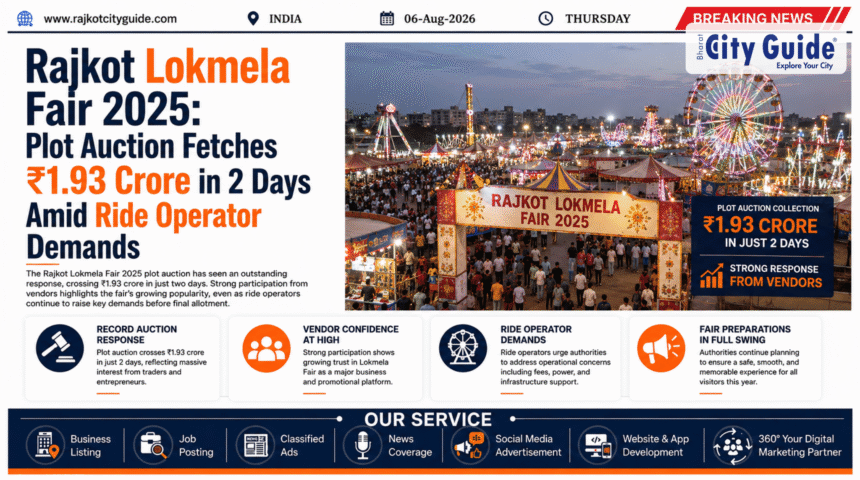
The administrative machinery and commercial preparation for this grand event kick off weeks in advance with the public auctioning of commercial plots, amusement ride spaces, food kiosks, and toy stalls. In the latest development from the ongoing preparations for the upcoming fair, the two-day plot auction conducted by the Lokmela Committee generated a massive revenue of ₹1.93 crore. The enthusiastic bidding from stall vendors and amusement park organizers reflects strong commercial interest and high economic expectations for this year’s festivities.
However, alongside the roaring auction numbers, the event also brought key operational demands to light. Ride operators and amusement park organizers have formally requested local authorities to permit small children’s merry-go-rounds (locally known as chakaradi) alongside major mechanical rides. This request aims to cater to toddlers and young families while ensuring economic viability for ride managers operating under stringent government safety standard operating procedures (SOPs).
What is Rajkot Lokmela Fair?
The Rajkot Lokmela Fair is the largest public folk festival in the Saurashtra region of Gujarat, held annually on the occasion of Krishna Janmashtami at the central Race Course Ground in Rajkot. Spanning five action-packed days, the fair serves as a socio-economic centerpiece for the entire district, drawing visitors not only from Rajkot city but also from rural villages across Saurashtra, as well as tourists from across India and abroad.
Rooted in centuries-old regional traditions of celebrating lord Krishna’s birth through community gatherings, the modern version of the fair is managed systematically by a government-appointed Lokmela Committee headed by the District Collector. The sprawling Race Course arena is carefully planned into distinct zones, including handicraft stalls, government exhibition pavilions, traditional toy bazaars, street food stalls selling iconic Gujarati snacks, and a massive amusement park zone featuring giant wheels (Chakdol), roller coasters, dragon rides, and break-dance merry-go-rounds.
Beyond amusement, the fair provides a massive economic boost to local micro-entrepreneurs, traditional artisans, food vendors, street hawkers, and small-scale amusement park contractors. For rural families, it offers an annual escape into carnival lights, traditional music, and shopping, making it a culturally irreplaceable event in Gujarat’s annual calendar.
Why This News is Important
This news holds immense significance for municipal administrators, business owners, local residents, and festival enthusiasts for several compelling reasons:
- Indicator of Local Economic Health: Generating ₹1.93 crore in just two days of public plot auctions demonstrates robust commercial confidence. It signals that vendors anticipate high visitor turnout and strong consumer spending during the festive period.
- Balancing Public Safety and Business Viability: Following recent safety reviews across Gujarat’s entertainment zones, compliance with safety SOPs for high-thrill rides has become paramount. The dialogue between ride operators and the district administration highlights the delicate balance between strict safety enforcement and practical business operations.
- Family-Centric Festive Experience: The demand by operators to allow small children’s rides (chakaradi) next to large mechanical rides directly affects consumer experience. Ensuring that toddlers have safe, age-appropriate amusement options prevents crowding and enhances safety for young families.
- Revenue Generation for Civic Infrastructure: Proceeds from the plot auctions are reinvested by the district administration into managing event logistics, installing extensive CCTV security networks, deploying emergency medical services, managing sanitation, and creating public amenities across the fairgrounds.
Background Information
To fully appreciate the dynamics of the recent auction and operator demands, it is essential to understand the historical and operational context of the event.
Historical Context of the Fair
Historically, folk fairs (lokmelas) were informal village gatherings centered around temples and riverbanks during Janmashtami. Over decades, as Rajkot grew into Saurashtra’s primary commercial hub, the local government institutionalized the event at the Race Course Ground to handle rising footfalls safely. The district collectorate took charge of plot distribution, safety certifications, fire security, traffic routing, and crowd management.
The Evolving Regulatory Landscape
In recent years, regulatory oversight regarding public carnivals and temporary amusement parks across Gujarat has tightened significantly. Following public safety mandates issued by the State Government and the High Court of Gujarat, all mechanical rides operating at public fairs must undergo rigorous structural integrity testing, electrical safety audits, third-party insurance coverage, and licensing from the Roads & Buildings (R&B) Department as well as the police department.
While these strict measures have vastly improved public safety standards, they have also increased operational costs for ride owners. As a result, auction bidding strategy and plot layout design have become critical financial factors for ride contractors looking to recover their investments over the five days of the fair.
Key Highlights
- Record Auction Earnings: The two-day plot auction for the upcoming fair generated ₹1.93 crore in revenue for the District Lokmela Committee.
- High Commercial Demand: Stalls for food, handicrafts, games, toys, and sweet shops witnessed competitive bidding from local and regional vendors.
- Ride Operators’ Demand: Amusement ride owners formally requested permission to install small children’s merry-go-rounds (chakaradi) alongside large high-thrill mechanical rides.
- Focus on Family Inclusion: Allowing small rides beside major attractions ensures that families with toddlers do not have to navigate separate zones, optimizing space utilization and visitor flow.
- Strict SOP Compliance: All rides, both big and small, remain subject to structural stability checks, mechanical fitness certificates, fire safety protocols, and insurance requirements prior to receiving operational licenses.
- Infrastructure Investment: Auction revenues will directly fund fairground infrastructure, including medical camps, lost-and-found booths, temporary sanitation facilities, police control rooms, and broad security fencing.
Detailed Explanation of the Event
The plot auction for the fair was organized by the District Lokmela Committee under transparent bidding procedures at the district headquarters in Rajkot. Hundreds of prospective vendors, contractors, and business owners gathered to secure prime locations on the Race Course Ground.
The Two-Day Auction Process
The auction was divided into distinct categories to ensure structured bidding across different commercial sectors:
- Amusement Ride Plots: Prime large-format plots reserved for major mechanical rides like Giant Wheels, Tora-Tora, Dragon Coasters, Break-Dance, and 360-degree spinners commanded the highest bids due to their heavy footfall drawing power.
- Food and Refreshment Stalls: Dedicated zones for traditional Gujarati snacks, ice creams, cold drinks, and fast food saw aggressive bidding from established regional caterers.
- Toy and Handicraft Kiosks: Smaller plots allocated for rural artisans, traditional wooden toy makers, household utility stalls, and festive decor vendors were auctioned smoothly to micro-entrepreneurs.
By the end of the second day, the cumulative collections crossed ₹1.93 crore, marking a highly successful financial start for the festival administration.
The Ride Operators’ Core Request
During the post-auction administrative meetings, representatives of the Rajkot Amusement Ride Operators Association raised an operational concern. Under the current spatial guidelines, plots are strictly classified by ride size. Operators argued that placing major mechanical rides in isolated zones without adjacent small rides creates an inconvenient setup for families.
When parents take older children to major rides, younger toddlers are left without entertainment nearby. By permitting small, low-powered children’s merry-go-rounds (chakaradi) within or immediately adjacent to large ride plots, operators can offer complete family entertainment packages on a single plot. Furthermore, operators emphasized that small rides help offset the rising fixed costs of safety compliance, insurance premiums, and high plot auction fees.
Benefits, Features, and Importance
The systematic management of the fair through transparent auctions and collaborative policy dialogue yields multiple benefits across society:
1. Transparent Revenue Mobilization
Public auctions eliminate favoritism and ensure that public land is monetized transparently. The ₹1.93 crore generated directly funds administrative overheads, ensuring the fair operates smoothly without straining municipal budgets.
2. Enhanced Safety and Quality Control
Regulated plot allocation ensures that every commercial operator is officially registered with the district administration. This registry makes it easier for fire safety officers, electrical inspectors, and police authorities to enforce safety protocols and conduct daily inspections during the fair.
3. Balanced Family Entertainment
Integrating small children’s rides alongside major attractions ensures a better experience for multi-generational families. It allows parents to supervise young toddlers on low-speed merry-go-rounds while older family members enjoy higher-thrill attractions nearby.
4. Direct Economic Support for Micro-Vendors
By categorizing stall sizes and setting reasonable base prices for smaller craft kiosks, the fair provides a platform for rural artisans, women’s self-help groups, and small-scale traders to sell products directly to hundreds of thousands of consumers.
How It Impacts People
The news and developments surrounding the fair directly influence various segments of society:
1. Local Residents and Visitors
For the citizens of Rajkot and neighboring towns across Saurashtra, a well-organized fair means better security, manageable crowds, accessible food zones, and diverse entertainment options. A layout that includes both big rides and small children’s merry-go-rounds makes the grounds far more convenient for families pushing strollers or managing young children.
2. Small Business Owners and Vendors
Sellers who win plot bids gain access to one of the highest-density retail crowds in Gujarat over a five-day window. For many seasonal vendors, earnings from the fair represent a substantial portion of their annual income.
3. Ride Contractors and Amusement Companies
Amusement ride owners face significant capital investments in purchasing, maintaining, and transporting heavy mechanical machinery. Favorable plot policies and clear regulatory guidance allow them to operate profitably while maintaining strict safety standards.
4. District Administration and Emergency Services
A high auction yield gives administrators the financial flexibility to deploy top-tier infrastructure, including high-definition CCTV coverage, emergency ambulance bays, public address systems, and lost-child assistance centers, ensuring a safe environment for all visitors.
Expert Insights and Industry Perspective
Industry experts and civic administration analysts highlight the importance of modernizing traditional folk carnivals through adaptive management:
- Public Safety Experts: Safety consultants note that while stringent SOPs are necessary to prevent mechanical failures and accidents, regulations should be practical and clear. Allowing multi-tier ride setups (combining large and small rides) within well-delineated safety boundaries can improve spatial efficiency without compromising visitor safety.
- Urban Event Managers: Event planning experts praise the public auction model used by the Rajkot Collectorate as a benchmark for municipal event monetization. Clear zoning for food, shopping, and rides prevents bottlenecking and optimizes crowd circulation across the Race Course loop.
- Tourism Analysts: Tourism experts emphasize that the fair is a cultural brand for Gujarat. Enhancing visitor comfort, streamlining ride licensing, and maintaining affordable entry and ride pricing help preserve the fair’s status as an accessible folk festival rather than an expensive commercial park.
Challenges and Limitations
Despite strong auction performance and administrative planning, organizing an event of this magnitude presents ongoing challenges:
- Weather Vulnerabilities: Held during the height of the monsoon season in late August or early September, heavy rainfall can cause waterlogging on the Race Course grounds, disrupt ride operations, and lower footfalls on peak fair days.
- Stringent Inspection Timelines: Ensuring that dozens of high-capacity mechanical rides receive comprehensive mechanical, electrical, and structural fitness certificates within short setup windows requires round-the-clock work from government inspection engineers.
- Crowd Control and Traffic Management: Managing traffic flow and parking for hundreds of thousands of vehicles around the Race Course ring road requires massive police deployment and strict temporary traffic diversions.
- Price Control on Rides and Food: Preventing stall owners and ride operators from overcharging visitors during peak evening hours remains a persistent enforcement challenge for the Lokmela Committee.
Future Outlook
Looking ahead, the successful completion of the plot auction paves the way for intense ground preparation at the Race Course arena. In the coming days, the district administration will finalize decisions regarding the ride operators’ request for small children’s merry-go-rounds, balancing spatial safety with operator flexibility.
As setting up begins, government inspection teams from the R&B Department, Fire Services, and Gujarat Police will conduct multi-stage safety audits on all installed machinery. With strong auction revenues funding public amenities, robust security infrastructure, and widespread community enthusiasm, the upcoming fair is set to deliver an exceptional festive experience while setting high standards for public event management in Saurashtra.
Frequently Asked Questions (FAQs)
1. What is the Rajkot Lokmela Fair?
The Rajkot Lokmela Fair is the largest annual folk festival in the Saurashtra region of Gujarat, organized during Janmashtami at the Race Course Ground in Rajkot by the District Lokmela Committee.
2. How much revenue did the recent plot auction generate?
The two-day public plot auction organized by the District Lokmela Committee generated ₹1.93 crore in revenue from commercial stalls, food outlets, and amusement ride plots.
3. What demand did ride operators raise during the preparations?
Ride operators formally requested permission to install small children’s merry-go-rounds (chakaradi) alongside major high-thrill mechanical rides to cater to toddlers and improve overall plot viability.
4. Where is the fair organized every year?
The fair is held at the central Race Course Ground in Rajkot, Gujarat, utilizing its large open circular loop to accommodate millions of visitors over five days.
5. Who organizes and manages the event?
The fair is officially organized and managed by the District Lokmela Committee, led by the Rajkot District Collector, in coordination with the Rajkot Municipal Corporation (RMC) and Rajkot City Police.
6. How is public safety ensured on amusement rides at the fair?
All mechanical rides must comply with strict government SOPs, including structural integrity reports from R&B engineers, electrical safety audits, fire safety compliance, third-party insurance, and final licensing by the police department before operation.
7. What happens to the money collected from the plot auctions?
Revenues generated from plot auctions are used by the Lokmela Committee to build public infrastructure, deploy CCTV surveillance, arrange emergency medical services, set up sanitation facilities, and manage event logistics across the fairgrounds.
Conclusion
The Rajkot Lokmela Fair remains an irreplaceable symbol of Saurashtra’s vibrant culture, community spirit, and festive joy. The successful two-day plot auction, yielding ₹1.93 crore in revenue, highlights the strong commercial vitality and public enthusiasm surrounding this iconic Janmashtami celebration. By addressing the practical demands of ride operators—such as allowing small children’s merry-go-rounds alongside major attractions—while strictly maintaining government safety protocols, local authorities can ensure a safe, inclusive, and joyous carnival for every family. As final preparations get under way at the Race Course Ground, Rajkot stands ready to welcome millions of visitors to Gujarat’s finest celebration of folk culture and community fun.