Introduction
Ganesh Chaturthi is celebrated across Western India with immense fervor, joy, and spiritual devotion. In recent years, however, the joyous celebrations have been accompanied by growing environmental concerns regarding aquatic pollution caused by the immersion of non-biodegradable Plaster of Paris (PoP) idols coated with toxic chemical paints into local rivers, lakes, and oceans. To address this challenge at the grassroots level, the civic and educational leadership of Rajkot has unveiled an exemplary civic initiative. The Rajkot Eco Friendly Ganesh Festival initiative represents a joint collaborative effort between the Rajkot Municipal Corporation (RMC) and the Self-Financed School Management Association (Svanirbhar School Sanchalak Mandal) aimed at transforming the socio-cultural landscape of the city during the festive season.
- Introduction
- What is Rajkot Eco Friendly Ganesh Festival?
- Why This News is Important
- Background Information
- Key Highlights
- Detailed Explanation of the Event
- Benefits, Features, and Importance
- How It Impacts People
- Expert Insights and Industry Perspective
- Challenges and Limitations
- Future Outlook
- Frequently Asked Questions (FAQs)
- Conclusion
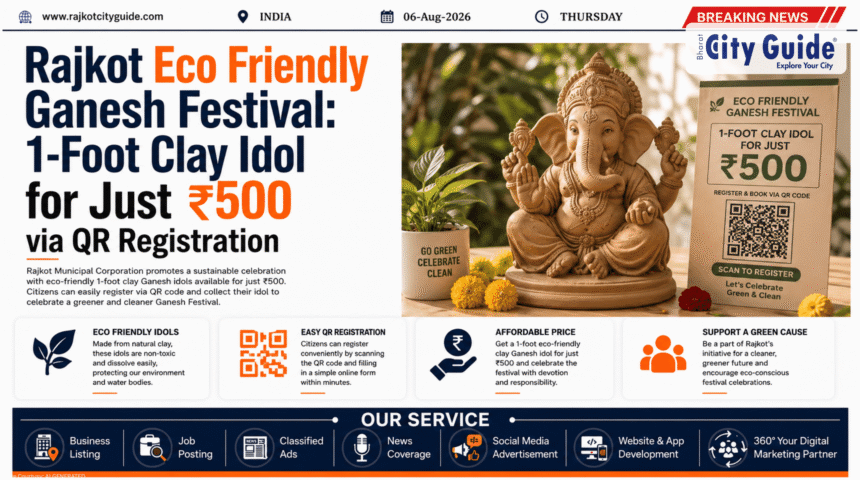
Under this groundbreaking community initiative, citizens of Rajkot can register using a simple QR code to reserve a 1-foot handcrafted eco-friendly soil/clay (Shaddu Mati) Lord Ganesha idol for a nominal subsidized price of just ₹500. Designed to serve at least 10,000 households across the city, this joint drive addresses both environmental conservation and economic accessibility. By leveraging the vast outreach network of private self-financed schools alongside municipal infrastructure, local authorities aim to make eco-friendly celebration accessible to every family.
This article explores the details, importance, registration process, social impact, and broader ecological footprint of this initiative as Rajkot sets a benchmark for green festival management across Gujarat.
What is Rajkot Eco Friendly Ganesh Festival?
The Rajkot Eco Friendly Ganesh Festival drive is a large-scale environmental campaign launched jointly by the Rajkot Municipal Corporation (RMC) and private self-financed school associations. Its primary objective is to promote sustainable festive practices by replacing traditional Plaster of Paris (PoP) idols with natural, quick-dissolving clay (Shaddu Mati) idols across thousands of homes.
Rather than relying purely on regulatory bans and punitive enforcement against PoP idol makers, this initiative focuses on supply-side solutions and consumer incentives. By mass-producing standardized 1-foot eco-friendly idols and offering them at a heavily subsidized cost of ₹500—compared to commercial market rates that often exceed ₹1,200 to ₹2,000 for similar eco-friendly clay sculptures—the civic body and school management board are removing the financial barrier to adopting sustainable festive practices.
Furthermore, the integration of modern digital registration via QR codes ensures a smooth, transparent, and hassle-free distribution process for up to 10,000 registered residents, encouraging young students and families to become active participants in environmental stewardship.
Why This News is Important
The timing and scale of this initiative carry major significance for urban environmental policy and civic governance in Gujarat:
- Mitigating Urban Water Pollution: The immersion of thousands of chemical-laden PoP idols during Anant Chaturdashi depletes dissolved oxygen levels in local water bodies, introduces heavy metal toxins (such as lead, cadmium, and chromium from synthetic paints), and causes severe siltation in city lakes like Aji, Nyari, and LalPari.
- Public-Private Partnership Model: It highlights a successful collaborative model where local municipal authorities partner with private educational institutions, using school students as primary ambassadors for ecological awareness.
- Affordability & Accessibility: By capping the cost at ₹500 for a quality 1-foot clay idol, the initiative disproves the common perception that eco-friendly products are prohibitively expensive for middle and lower-income households.
- Digital Integration for Mass Mobilization: Utilizing QR-code-based pre-registration enables precise demand forecasting, eliminating waste, chaotic distribution lines, and last-minute supply shortages.
Background Information
For decades, Plaster of Paris (PoP) has been the dominant material used in crafting festival idols across India due to its lightweight nature, quick setting time, structural strength, and low raw material cost for artisans. However, PoP is composed of calcium sulfate hemihydrate, a chemical compound that does not dissolve easily in water. A PoP idol can remain intact under water for months, or even years, releasing harmful chemicals and disfiguring sacred imagery post-immersion.
Legal and Regulatory Context
- Central Pollution Control Board (CPCB) Guidelines: The Central Pollution Control Board (CPCB) issued strict directives banning the manufacture, sale, and immersion of PoP idols in natural water bodies, mandating the use of natural clays like Shaddu Mati, multani mitti, or organic plant-seed embedded sculptures.
- Implementation Hurdles: Despite regulatory bans, municipal authorities across major cities frequently struggle with enforcement due to a shortage of natural clay artisans, higher transportation costs for fragile soil idols, and price gouging by commercial vendors ahead of Ganesh Chaturthi.
- The Rajkot Strategy: Recognizing these structural challenges, Rajkot’s municipal leaders and school administrators realized that prohibition alone is insufficient. Creating an affordable, high-volume alternative distributed through educational networks directly addresses the problem at its root.
Key Highlights
- Subsidized Pricing: High-quality, 1-foot eco-friendly clay idols offered at a flat price of just ₹500 per unit.
- Mass Target: The drive aims to reach 10,000 households across Rajkot city.
- Digital Pre-Registration: Citizens can register and book their idol by scanning an official QR code distributed through local school channels and civic portals.
- Joint Collaboration: A partnership between Rajkot Municipal Corporation (RMC) and the Self-Financed School Management Association.
- School Network Integration: Over hundreds of private self-financed schools act as distribution nodes and awareness hubs, engaging students as green ambassadors.
- In-Home Immersion (Visarjan) Drive: Promotes dissolving the clay idol at home in a bucket or garden container, returning the sacred soil back to plant pots and urban green spaces.
Detailed Explanation of the Event
The announcement of the eco-friendly Ganesha drive marks a systematic approach to festival management in Rajkot. To ensure that 10,000 clay idols are crafted, transported, and distributed seamlessly without damaging fragile natural clay structures, the administration introduced a structured execution plan.
1. Collaborative Framework
The Rajkot Municipal Corporation joined hands with the Svanirbhar School Sanchalak Mandal (Self-Financed School Management Association). The school association committed to utilizing its extensive communication channels—including student parent portals, WhatsApp groups, and school notice boards—to distribute the registration QR codes.
2. QR Code Registration Mechanism
To ensure fair distribution and avoid overbooking, a centralized digital registration portal accessible via QR codes was launched.
- Citizens scan the designated QR code using their smartphones.
- They fill in basic details including name, contact number, ward location, and selected school pick-up center.
- Upon submitting the online form and making the payment of ₹500, a digital confirmation token/receipt is generated.
- This token is presented at designated school distribution centers prior to Ganesh Chaturthi to collect the 1-foot eco-friendly idol.
3. Artisan Sourcing and Quality Assurance
To meet the demand for 10,000 clay idols, RMC engaged skilled traditional artisans specializing in Shaddu soil craft. The idols are crafted using 100% natural, eco-friendly soil mixed with natural binders and painted exclusively using non-toxic, water-soluble natural colors. This guarantees that upon immersion in water, the idol completely dissolves within 30 to 45 minutes without leaving hazardous residue behind.
Benefits, Features, and Importance
The Rajkot Eco Friendly Ganesh Festival offers wide-ranging ecological, civic, and educational benefits:
Environmental Benefits
- Water Body Protection: Eliminates thousands of kilograms of non-biodegradable gypsum plaster and heavy metal paints from entering local lakes and reservoirs like the Aji River basin.
- Soil Nutrient Recycling: Dissolved clay from home immersions can be reused as fertile soil for indoor potted plants, balcony gardens, or urban tree plantations, embodying the concept of circular living.
- Reduced Aquatic Toxicity: Protects aquatic flora and fauna from chemical poisoning and preserves dissolved oxygen levels in local water ecosystems.
Civic and Economic Features
- Economical Access: At ₹500, it provides a cost-effective option compared to commercial market rates, ensuring families across economic strata can participate in green practices.
- Decongestion of Immersion Sites: By encouraging home immersion (Ghar Pe Visarjan), the campaign significantly reduces traffic congestion, noise pollution, and municipal cleanup loads at public lakes and artificial immersion tanks.
- Support for Traditional Clay Artisans: Provides direct bulk orders and reliable revenue to traditional soil artisans who faced declining market share due to mass-produced industrial PoP molds.
How It Impacts People
This initiative positively impacts various segments of society across Rajkot:
1. Students and Youth
Schoolchildren are at the heart of this campaign. By serving as environmental ambassadors within their households, students learn practical lessons in sustainability, social responsibility, and civic duty. Participating in a QR-code driven green campaign instils eco-conscious values at a formative age.
2. Households and Devotees
Devotees gain access to beautifully sculpted, traditional Ganesha idols without paying premium prices charged by private commercial markets. Furthermore, home immersion offers a peaceful, pious ritual environment away from overcrowded public immersion sites.
3. Municipal Administration and Sanitation Workers
Post-festival cleanups are often challenging for sanitation workers, who must manually collect disfigured PoP idols from riverbeds and lake shores. Widespread adoption of clay idols and home immersion dramatically reduces post-festival municipal waste management burdens.
4. Local Artisans and Potters
Bulk procurement of clay idols directly supports traditional potters and rural artisans, safeguarding traditional craftsmanship and ensuring sustained economic livelihoods.
Expert Insights and Industry Perspective
Environmental scientists and civic administration experts have praised public-school partnership models for urban sustainability drives:
- Ecological Experts: Environmental researchers note that urban water bodies around cities like Rajkot suffer from severe eutrophication and heavy metal accumulation post-monsoon. Programs that cut off chemical input at the source are far more cost-effective than post-pollution lake restoration projects.
- Urban Planners: Civic experts emphasize that utilizing school networks as distribution centers decentralizes urban logistics. Instead of thousands of citizens crowding a few municipal depots, distributing idols across neighborhood schools ensures smooth traffic flow and community participation.
- Behavioral Economists: Experts point out that combining a reasonable price tag (₹500) with a digital QR booking system leverages basic behavioral nudges. When a sustainable choice is convenient, affordable, and digitally accessible, public adoption increases exponentially.
Challenges and Limitations
While the initiative is well-designed, certain operational challenges require careful management:
- Fragility and Transport: Clay (Shaddu Mati) idols are heavier and considerably more fragile than PoP idols. Transporting 10,000 clay units from artisan workshops to school distribution centers without breakage requires specialized packaging and careful handling.
- Digital Literacy Barriers: While QR-code registration is convenient for smartphone users, elderly citizens or families without digital access might face initial difficulties in booking their idols without assistance from school staff.
- Water Sensitivity During Transport: Natural clay idols painted with water-soluble colors are extremely sensitive to rain. Unseasonal monsoon downpours during distribution days could damage unsealed idols if storage facilities are not completely waterproofed.
- Meeting High Demand: With a cap of 10,000 idols, demand may exceed supply quickly, leaving late-registering citizens dependent on private markets.
Future Outlook
The launch of the Rajkot Eco Friendly Ganesh Festival initiative sets a benchmark for civic-led sustainability drives across Gujarat.
In the coming years, this model can easily be expanded to cover larger idol sizes, higher supply volumes (scaling from 10,000 to 50,000+ units), and additional municipal corporations across Surat, Vadodara, Ahmedabad, and Bhavnagar. Furthermore, integrating tree-Ganesha concepts—where seeds are embedded directly within the clay idol along with organic fertilizer—could transform every immersed idol into a shade-giving tree, further enhancing urban green cover.
As Rajkot continues to modernize its urban infrastructure, blending cultural tradition with environmental conservation will remain a cornerstone of its smart-city vision.
Frequently Asked Questions (FAQs)
1. What is the Rajkot Eco Friendly Ganesh Festival initiative?
It is a joint eco-friendly initiative by the Rajkot Municipal Corporation (RMC) and the Self-Financed School Management Association to provide 1-foot clay (Shaddu Mati) Lord Ganesha idols to 10,000 citizens at a subsidized price of ₹500 using QR code registration.
2. How can citizens register to get a ₹500 eco-friendly idol?
Citizens can scan the official QR code distributed across self-financed schools, official municipal notifications, and civic digital portals. After scanning, they fill in their contact details, select a pick-up center, and complete the online registration.
3. What material is used to craft these eco-friendly idols?
The idols are sculpted using 100% natural clay/soil (Shaddu Mati) and painted with non-toxic, water-soluble natural colors that dissolve completely in water without polluting the environment.
4. Why are clay idols better than Plaster of Paris (PoP) idols?
Unlike PoP, which takes months or years to degrade and releases harmful chemical toxins and synthetic dyes into lakes, clay idols dissolve completely within 30 to 60 minutes in a simple bucket of water, leaving no toxic residues.
5. How many eco-friendly idols are being distributed under this drive?
The initiative has set an initial target of supplying 10,000 eco-friendly clay Ganesha idols to registered households across Rajkot.
6. Where can citizens collect their registered idols from?
Registered users can collect their pre-booked idols from designated self-financed school pick-up centers across various wards in Rajkot by presenting their digital registration receipt.
7. How does this drive help in water body conservation?
By encouraging citizens to adopt clay idols and perform immersion (Visarjan) at home in water buckets or garden pots, the drive reduces the dumping of non-biodegradable waste, chemicals, and silt into local lakes like Aji and Nyari reservoirs.
Conclusion
The Rajkot Eco Friendly Ganesh Festival drive demonstrates how visionary civic governance, community partnership, and digital convenience can come together to preserve cultural heritage while protecting our environment. By providing 1-foot natural clay idols for just ₹500 via QR code registration, the Rajkot Municipal Corporation and the Self-Financed School Management Association have dismantled financial and logistical barriers to green celebrations. As 10,000 households welcome eco-friendly Ganesha idols into their homes this festival season, Rajkot not only protects its vital water bodies and aquatic ecosystems but also inspires cities across Gujarat to embrace a cleaner, greener, and more sustainable future.