Introduction
Local governance forms the cornerstone of grassroots democracy in India, bridging the gap between state policy objectives and local execution. In Gujarat, the Panchayati Raj framework dictates that the administration of rural districts hinges heavily upon the leadership of the Jilla Panchayat. The highly anticipated Rajkot Jilla Panchayat First Meeting marks a seminal turning point in the administrative calendar of the region. This first assembly transitions a newly elected political body into an official executive machine capable of crafting and executing socio-economic policies for millions of residents.
- Introduction
- What is the Rajkot Jilla Panchayat First Meeting?
- Why This News Matters
- Background Information
- Key Highlights
- Detailed Explanation of the Event
- Benefits and Institutional Importance
- How It Impacts the Local Population
- Expert Insights and Industry Perspective
- Challenges and Governance Limitations
- Future Outlook
- Frequently Asked Questions (FAQs)
- Conclusion
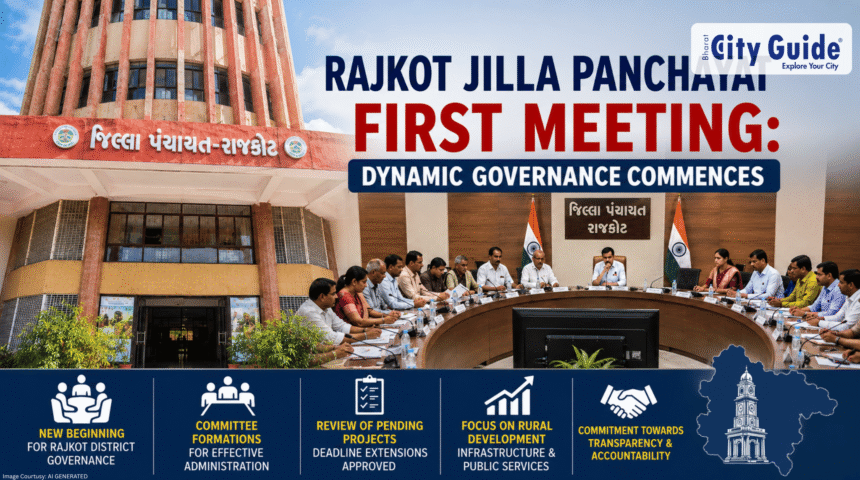
The Rajkot Jilla Panchayat First Meeting is not a mere symbolic gathering. It represents the official initiation of civic responsibilities for the elected members, shifting public expectations into measurable legislative agendas. During this inaugural assembly, the newly structured political administration formally convenes to form essential committees, debate ongoing infrastructural timelines, and outline financial accountability strategies. This meeting sets the tone for future regional development by finalizing long-overdue executive extensions for various incomplete public works. Understanding the inner workings of this governance framework provides invaluable context into how rural empowerment, infrastructural growth, and fiscal management operate across Saurashtra.
What is the Rajkot Jilla Panchayat First Meeting?
The Rajkot Jilla Panchayat First Meeting serves as the statutory opening session of the newly formed district council following a democratic election cycle. Governed under the mandates of the Gujarat Panchayats Act, 1993, this meeting brings together all elected representatives from various territorial constituencies across the Rajkot district. The session marks the formal transition from a purely representative structure to an active, operational administrative body.
At its core, the primary objective of this assembly is to institutionalize governance. This is achieved by taking oath-like transitions into policy design and assigning specific portfolios to qualified elected members. Rather than managing all administrative actions collectively, the first general assembly splits responsibilities into focused committees. These sub-groups handle portfolios like health, education, finance, and public infrastructure. This division of labor ensures that the specific challenges of rural Rajkot are managed effectively by dedicated executive oversight teams.
Why This News Matters
This developmental shift is highly significant for the socio-economic future of the Rajkot district. In decentralized governance, administrative delays at the district level can lead to major bottlenecks in rural infrastructure, local healthcare delivery, and primary education quality. The initiation of the Rajkot Jilla Panchayat First Meeting effectively breaks any administrative gridlock caused by election-season pauses or political transitions.
Furthermore, the decisions finalized during this specific session have a direct impact on the distribution of state and central development funds. By establishing official working committees and addressing pending projects, the Jilla Panchayat ensures that financial allocations do not lapse or get mismanaged. For the common citizen, this assembly means faster project completions, better public safety nets, and clear visibility into how tax revenues are being utilized for rural infrastructure.
Background Information
To fully appreciate the scope of the Rajkot Jilla Panchayat First Meeting, one must examine the broader historical and statutory context of the Panchayati Raj framework in Gujarat. Following the 73rd Constitutional Amendment Act of 1992, India adopted a formal three-tier structure for local governance:
- Gram Panchayats at the village level.
- Taluka (Block) Panchayats at the intermediate level.
- Jilla (District) Panchayats at the apex level.
As the apex local body, the Rajkot Jilla Panchayat carries immense institutional weight. It oversees development plans spanning multiple talukas, balances rural budgets, and manages state-sponsored public welfare initiatives.
Before this inaugural meeting, the district administration often relies on transitional leadership or basic bureaucratic oversight. While this setup keeps routine operations running, it lacks the legislative authority required to approve major financial policies, change long-term project terms, or form specialized executive panels. The calling of the first session marks the return of a fully democratic, representative body ready to drive local policy and infrastructure goals.
Key Highlights
The general meeting brought several high-stakes legislative, administrative, and economic discussions to the forefront. The critical highlights of the assembly include:
- Statutory Committee Formation: The formal creation and selection of leadership for essential executive committees, including Finance, Public Works, Health, and Education.
- Infrastructural Deadline Extensions: Detailed reviews of pending or stalled rural infrastructure projects, leading to approved timeline adjustments to prevent contract terminations.
- Executive Coordination: Establishing updated operational guidelines between elected political leaders and permanent civil service officers (such as the District Development Officer).
- Fund Allocation Reviews: Strategic tracking of budget utilization for ongoing rural housing, water supply, and road network projects across the district.
Detailed Explanation of the Event
The session commenced under a structured legislative protocol designed to validate the authority of the newly formed body. The primary order of business focused on creating a balance of power through specialized portfolios. While a single Jilla Panchayat President cannot track every micro-development issue across the region, a designated Public Works Committee can easily supervise rural road building, and a dedicated Health Committee can manage local clinics.
A significant portion of the session focused on addressing stalled public works. Due to fluctuating material costs, shifting labor conditions, and past administrative delays, several critical rural development projects faced imminent deadlines. Stopping these initiatives mid-way would cause massive financial waste and leave communities without essential resources.
To address this, the council carefully analyzed proposals for project deadline extensions. This review allowed contractors extra time to finish key infrastructure projects without facing unfair penalties, ensuring that public funds spent on half-completed structures were not wasted.
Benefits and Institutional Importance
The structured setup of the Jilla Panchayat framework provides a reliable template for long-term regional development:
1. Accelerated Project Execution
By approving strategic deadline extensions for delayed contracts, the council ensures that vital public projects—such as rural roadways, school repairs, and water pipelines—are completed smoothly rather than being tied up in legal disputes.
2. Specialized Portfolio Governance
The formation of specialized committees brings greater precision to local administration. Representatives with backgrounds in agriculture, education, or finance can be placed where their skills generate the most value for the public.
3. Enhanced Financial Transparency
By addressing budget proposals during an open general assembly, the Jilla Panchayat keeps fund management highly transparent, minimizing administrative friction and protecting public resources from misuse.
How It Impacts the Local Population
The administrative decisions finalized during the assembly directly shape day-to-day life across Rajkot’s rural and semi-urban communities:
- Rural Communities and Farmers: The timely renewal of irrigation, agricultural support, and rural road building programs ensures better market access and stronger logistical networks for local farmers.
- Students and Educators: The newly formed Education Committee directly impacts the maintenance of primary schools, the supply of educational resources, and the overall quality of local learning facilities.
- Daily Commuters: Extending timelines for pending bridge and road construction ensures that critical transportation routes are completed safely and efficiently, reducing travel times and improving safety.
Expert Insights and Industry Perspective
Political analysts and public administration experts emphasize that the success of any district-level government depends heavily on how early it establishes its core committees. A common point of failure in local governance is prolonged political gridlock over portfolio assignments, which can stall developmental progress for months. By organizing these committees during the very first general assembly, Rajkot sets an excellent example of proactive public management.
Furthermore, management professionals note that granting deadline extensions for public works is often a highly practical choice. While strict enforcement of contract timelines sounds ideal on paper, canceling a contract halfway through often triggers long, costly legal battles. Extending timelines allows the district to minimize legal overhead and focus resources on completing essential infrastructure.
Challenges and Governance Limitations
Despite the structured framework, the newly formed body must navigate several operational hurdles to achieve its development goals:
Financial Dependency
The Jilla Panchayat remains heavily reliant on state and central grant allocations. Limited independent revenue generation can sometimes constrain the council’s ability to fund custom local projects that fall outside traditional state-sponsored schemes.
Bureaucratic Coordination
Maintaining clear, constructive alignment between elected political figures and permanent bureaucratic officials requires constant communication. Friction between these two branches can slow down policy implementation.
Contractor Accountability
While deadline extensions keep essential projects moving forward, the council must implement strict oversight to ensure that contractors do not exploit this flexibility to delay work indefinitely.
Future Outlook
Looking ahead, the successful conclusion of the Rajkot Jilla Panchayat First Meeting clears the path for an active phase of regional development. Over the next few quarters, observers can expect the newly formed committees to launch targeted audits of rural healthcare facilities, primary schools, and agricultural support networks.
With clear administrative terms established, the district is well-positioned to roll out advanced smart-governance tools, digital tracking for public works, and optimized public grievance systems. If these committees maintain steady, collaborative momentum, Rajkot’s rural development models could serve as a highly effective benchmark for other districts across Gujarat.
Frequently Asked Questions (FAQs)
What is the primary focus of the Rajkot Jilla Panchayat First Meeting?
The main focus is to officially swear in the newly elected governing body, form specialized administrative committees (such as Finance, Health, and Education), and review timeline extensions for pending rural development projects.
How do committee formations improve local governance?
Committees divide the broad responsibilities of the Jilla Panchayat into focused portfolios. This allows dedicated teams of representatives to manage specific sectors like public works, healthcare, and schools with greater efficiency.
Why does the Jilla Panchayat grant deadline extensions for public works?
Extensions prevent incomplete projects from being abandoned due to unexpected delays. This practical approach ensures that past public investments yield functioning infrastructure instead of resulting in costly legal deadlocks.
What legislation governs the operations of the Jilla Panchayat in Gujarat?
The Jilla Panchayat operates under the statutory provisions of the Gujarat Panchayats Act, 1993, which aligns with the 73rd Constitutional Amendment of the Indian Constitution.
Who is responsible for executing the decisions made during the general meeting?
While the elected political body votes on and approves policies, the administrative execution is carried out by permanent civil service officers, led by the District Development Officer (DDO).
How can local citizens track the progress of projects discussed in the meeting?
Citizens can access project updates, meeting minutes, and financial allocation details through the official Gujarat double-entry panchayat portals and local district administration notices.
Conclusion
The successful execution of the Rajkot Jilla Panchayat First Meeting marks a vital step forward in establishing structured, proactive governance for the district. By prioritizing committee formations and resolving outstanding project timelines, the newly assembled council has laid a solid foundation for sustainable regional development. As these committees begin active operations, their focus on balanced development, fiscal responsibility, and efficient project execution will play a defining role in elevating the socio-economic landscape of rural Rajkot.
To better understand the practical implementation of these local policies and see how these administrative bodies operate on the ground during their sessions, you can watch this Rajkot District Panchayat Assembly Coverage. This broadcast offers clear visual insights into the legislative dynamics and discussions that take place during important local governance meetings.