Introduction
Managing civic finances can often feel like an uphill battle for urban residents, especially when accrued penalties and interest accumulate over time. In a major move to provide substantial financial relief to middle-class and lower-income families, the civic authorities in Gujarat have announced a major policy intervention. The launch of the Rajkot Property Tax Interest Waiver Scheme marks a significant turning point for local taxpayers who have been struggling to clear their past dues due to mounting interest rates.
- Introduction
- What is the Rajkot Property Tax Interest Waiver Scheme?
- Why This News is Important
- Background Information
- Key Highlights
- Detailed Explanation of the Event
- Benefits and Importance
- How It Impacts People
- Expert Insights and Industry Perspective
- Challenges and Limitations
- Future Outlook
- Frequently Asked Questions (FAQs)
- Conclusion
This progressive relief measure is specifically designed to alleviate the financial burden carried by small-scale property holders across the city. Property taxes serve as the primary lifeline for urban infrastructure development, funding everything from clean drinking water networks to well-maintained roads and public sanitation systems. However, when citizens fall behind on these payments, heavy interest penalties often create a cycle of non-compliance. By introducing the Rajkot Property Tax Interest Waiver Scheme, the municipal administration aims to break this cycle, offering a clean slate to thousands of residents while simultaneously boosting civic revenue collection.
For property owners in Rajkot, this announcement comes at a crucial time. Understanding how this scheme works, who is eligible, and how to maximize its benefits is essential for every homeowner in the region. This detailed guide explores the intricacies of the waiver, its structural background, and the tangible economic impact it will have on the community.
What is the Rajkot Property Tax Interest Waiver Scheme?
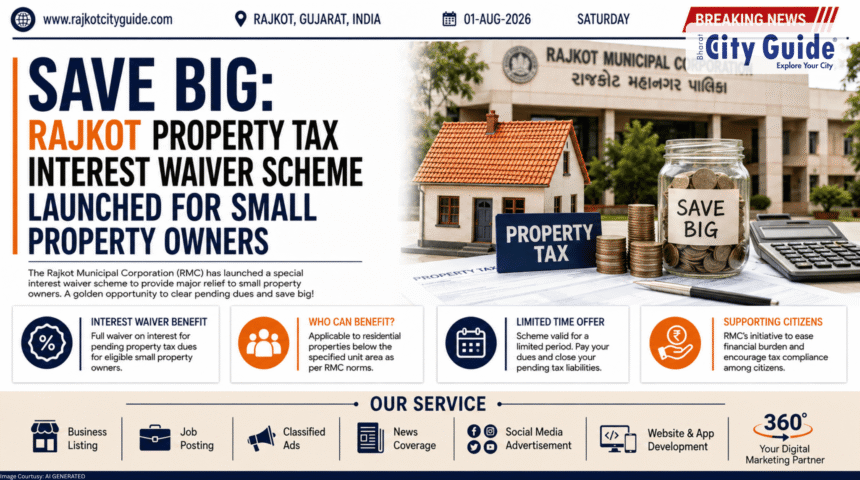
The Rajkot Property Tax Interest Waiver Scheme is a targeted fiscal amnesty program introduced by the Rajkot Municipal Corporation (RMC). The core objective of this initiative is to waive accumulated interest penalties on outstanding property tax bills for specific categories of taxpayers. Under the rules of this temporary relief window, eligible property owners can receive an interest waiver of up to ₹5,000 on their outstanding property tax liabilities.
This scheme operates within a strictly defined timeline, opening on August 1, 2026, and concluding on September 30, 2026. During this two-month window, individuals with unpaid property taxes can settle their principal tax amounts without being forced to pay the heavy interest penalties that usually accrue on delayed payments. The waiver is engineered to primarily assist small-scale domestic and commercial property owners, ensuring that those who need financial breathing room the most receive it directly. By capping the interest relief at ₹5,000, the municipal body ensures that the financial benefits are distributed equitably among ordinary citizens rather than disproportionating benefiting massive commercial conglomerates.
Why This News is Important
This administrative announcement carries immense weight for both the local citizenry and the urban governance model of Gujarat. For the average resident, especially small-time shopkeepers and independent homeowners, accumulated tax interest can quickly become a stressful financial bottleneck. When a basic tax liability gets compounded annually with penalty percentages, the total payable amount can swell far beyond the taxpayer’s immediate capacity. This initiative provides an immediate escape hatch from that financial stress.
From a governance perspective, the news is highly significant because it reflects a shift toward empathetic civic administration. Rather than resorting to punitive measures like sealing properties or cutting off utility connections, the civic body is using a positive incentive system to encourage voluntary compliance. It highlights a strategic effort to balance human-centric welfare with aggressive municipal revenue generation, proving that public administration can be both compassionate and fiscally responsible.
Background Information
To fully appreciate the scope of the Rajkot Property Tax Interest Waiver Scheme, one must look at the broader landscape of municipal finance in Gujarat. Local self-governments, known as Municipal Corporations, rely heavily on domestic and commercial property taxes to fund daily operations. Over the past few years, economic fluctuations, shifts in commercial market dynamics, and the lingering recovery patterns of small businesses have caused a noticeable rise in tax delinquencies.
Historically, the Rajkot Municipal Corporation has utilized strict penalties to deter late payments, frequently applying standard annual interest rates on overdue balances. While this system works well during periods of high economic stability, it can become counterproductive during financial downturns, resulting in a large volume of “frozen” accounts where citizens simply stop trying to pay because the total accumulation is too high.
Recognizing that millions of rupees remained locked up in unrecoverable interest dues, the RMC leadership decided to implement a pragmatic amnesty window. Similar schemes have achieved stellar success in other tier-2 and tier-3 Indian cities, where breaking the ice with taxpayers via temporary waivers triggered massive surges in immediate cash flows. The 2026 scheme is a refined iteration of these historic strategies, fine-tuned to address modern economic realities.
Key Highlights
- Implementation Period: The scheme remains strictly operational from August 1, 2026, until September 30, 2026.
- Maximum Relief Amount: Eligible taxpayers can claim a waiver of up to ₹5,000 on accumulated interest penalties.
- Target Audience: Specifically structured to benefit approximately 1.40 lakh small property holders within the city limits.
- Primary Objective: To provide financial relief to the middle class while systematically clearing long-standing municipal tax arrears.
- Administrative Scope: Covers both residential properties and small-scale commercial establishments falling within the specified valuation brackets.
Detailed Explanation of the Event
The official rollout of the Rajkot Property Tax Interest Waiver Scheme marks a coordinated administrative push by the RMC. The program was formally approved following extensive deliberations within the municipal standing committee, where data revealed that a vast percentage of unpaid property tax accounts belonged to small-scale holdings.
Mechanistically, the process has been streamlined to minimize bureaucratic friction. Taxpayers do not need to navigate complex, multi-layered approval chains to claim the waiver. When a property owner logs into the official RMC online payment portal or visits a physical civic center during the August-September window, the system automatically calculates the eligible interest deduction. If an individual owes a principal tax amount along with ₹4,500 in accumulated interest, the entire interest component is instantly wiped clean upon payment of the principal. If the interest component stands at ₹7,000, the individual receives the maximum discount of ₹5,000 and only needs to clear the remaining ₹2,000 of interest alongside the core principal.
The timing of the launch is also deeply strategic. Running through August and September, the scheme aligns perfectly with the festival season in Gujarat, a time when households traditionally look to clear outstanding debts and organize their domestic finances. The municipal corporation has setup dedicated help desks across all ward offices in Rajkot to manage the anticipated influx of taxpayers, ensuring smooth operational execution.
Benefits and Importance
The advantages of the Rajkot Property Tax Interest Waiver Scheme extend across multiple layers of the local ecosystem:
1. Direct Household Savings
The most immediate benefit is the preservation of household disposable income. Saving up to ₹5,000 in penalty fees allows families to redirect those crucial funds toward education, healthcare, or essential household consumption.
2. Regularization of Legal Property Status
Unpaid taxes can complicate property transactions, inheritance transfers, and loan applications against property collateral. By clearing these arrears via the waiver scheme, owners can successfully regularize their property records, securing their long-term legal and financial standing.
3. Surge in Municipal Revenue
While the corporation is technically writing off interest receivables, it is unlocking massive volumes of stuck principal tax capital. This sudden influx of liquidity allows the RMC to accelerate pending public works, upgrade sewage treatment facilities, and enhance green spaces across the city.
4. Reduction in Administrative Backlogs
Tracking, auditing, and issuing legal notices to over a hundred thousand delinquent accounts requires immense manpower and administrative expense. Clearing these accounts en masse dramatically lightens the paperwork load for municipal workers, allowing them to focus on active urban development.
How It Impacts People
The demographic ripple effect of this waiver scheme is widespread, touching various segments of Rajkot’s population differently.
For Average Citizens and Homeowners
For the typical middle-class family owning a modest residential home, this scheme offers peace of mind. Many families fall behind on taxes during unexpected medical crises or employment transitions. The waiver acts as a compassionate safety net, allowing them to get back on track without facing crippling penalties.
For Small Business Owners and Shopkeepers
Small retail shopkeepers, micro-entrepreneurs, and local traders often operate on tight, volatile profit margins. A slow business quarter can easily disrupt their tax schedules. The inclusion of small commercial properties in this scheme helps local businesses reduce their overhead costs, promoting a healthier local commercial economy.
For Property Investors and Real Estate Markets
A market cluttered with tax-defaulted properties naturally suffers from reduced liquidity and transaction friction. As thousands of small properties clear their titles over these two months, the local real estate ecosystem gains clarity, making property valuations more transparent and reliable for potential buyers and investors.
Expert Insights and Industry Perspective
Urban planning experts and public finance analysts generally view targeted tax amnesty programs as highly effective mechanisms for mid-sized cities. Economists point out that in growing urban economies like Rajkot, the cost of keeping tax arrears on the books often exceeds the actual value collected from strict penalty enforcement over time.
Industry analysts emphasize that schemes capping the benefit—such as the ₹5,000 limit applied here—are far more socially progressive than open-ended waivers. By setting a ceiling, the municipal corporation prevents luxury property owners and massive real estate corporations from exploiting a system designed for social welfare. It ensures that public funds are utilized efficiently to support vulnerable sectors while maintaining accountability across high-value tax brackets.
Challenges and Limitations
Despite its undeniable benefits, the implementation of the Rajkot Property Tax Interest Waiver Scheme does come with certain challenges that administrative bodies must navigate carefully.
1. Risk of Moral Hazard
One primary concern raised by public policy experts is the potential development of a “moral hazard.” If citizens begin to expect regular interest waivers every few years, honest, punctual taxpayers might feel discouraged from paying their taxes on time in the future, choosing instead to wait for the next amnesty announcement.
2. Digital Infrastructure Strain
Given that a large percentage of modern tax collections happen online, the RMC web servers face the risk of severe traffic congestion, particularly during the final weeks of September. System crashes or slow payment gateways could frustrate users trying to take advantage of the deadline.
3. Outreach in Semi-Urban Pockets
Reaching all 1.40 lakh small property holders requires an aggressive, multi-channel communication strategy. Residents living in peripheral areas or elderly citizens who lack digital literacy might miss out on the window if physical outreach and local language advertising are not executed perfectly.
Future Outlook
Looking ahead, the success of this two-month window will likely influence how Rajkot handles public debt and civic collections moving forward. If the project hits its targets, we can expect the Rajkot Municipal Corporation to invest heavily in modernizing its database systems, potentially rolling out predictive AI tools to identify tax distress early before heavy penalties accumulate.
Furthermore, this successful execution could serve as a blueprinted model for other municipal corporations across Gujarat, such as Surat, Vadodara, or Bhavnagar. The trend toward setting clear caps on interest relief is expected to become standard practice, paving the way for data-driven, highly targeted civic governance that relies on carrots rather than sticks to build healthy, compliant communities.
Frequently Asked Questions (FAQs)
What is the exact duration of the Rajkot Property Tax Interest Waiver Scheme?
The scheme officially opens on August 1, 2026, and will remain active until September 30, 2026. Payments must be completed within this period to qualify for the interest deduction.
How much financial relief can a property owner get under this scheme?
A qualified property owner can receive a maximum interest waiver of up to ₹5,000 on their accumulated outstanding property tax interest penalties.
Who is the primary target group for this tax relief initiative?
The initiative is structured to directly benefit small property holders. It is estimated that approximately 1.40 lakh small-scale residential and commercial property owners across Rajkot will fall within the scope of this benefit.
Do I need to fill out a separate application form to claim the waiver?
No, the Rajkot Municipal Corporation has integrated the system automatically. The waived amount will be automatically calculated and deducted when you pay your principal dues through the official online portal or at designated physical civic payment counters.
What happens if my accumulated tax interest is higher than ₹5,000?
If your total accumulated interest exceeds ₹5,000, the maximum limit of ₹5,000 will be deducted from your bill. You will still be responsible for paying the remaining balance of the interest along with the full principal tax amount.
Can commercial properties benefit from this interest waiver?
Yes, small-scale commercial property owners are included in the scheme, provided they meet the specific property size or valuation criteria outlined by the RMC guidelines for small holders.
Conclusion
The introduction of the Rajkot Property Tax Interest Waiver Scheme represents a highly balanced approach to modern urban governance. By offering a pragmatic, time-bound window for interest relief, the Rajkot Municipal Corporation is addressing the practical economic challenges faced by 1.40 lakh small property holders while strengthening its own financial capacity to build a better city.
For the citizens of Rajkot, this window from August 1 to September 30, 2026, is an invaluable opportunity to secure their property records, clear outstanding debts without stress, and save up to ₹5,000 in unnecessary penalty fees. Taking advantage of this well-structured program not only benefits individual household budgets but also contributes directly to the shared growth and infrastructure development of the entire city. Make sure to visit the official RMC portal or your nearest ward office early to check your eligibility and clear your dues before the September deadline.