Introduction
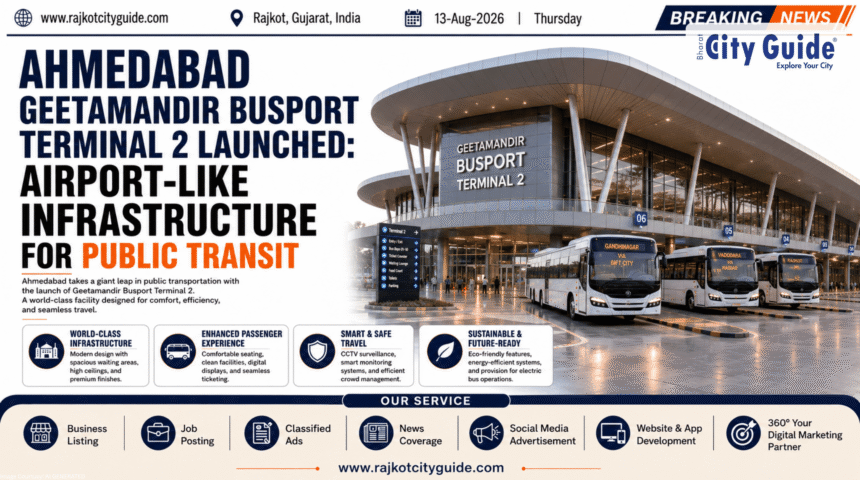
In a massive leap forward for public transportation infrastructure in Gujarat, the state government has officially inaugurated the state-of-the-art Terminal 2 (North Block) at the central Ahmedabad Geetamandir Busport. Inaugurated by Deputy Chief Minister and Home Minister Harsh Sanghavi, alongside Minister of State for Transport Pravin Mali and Minister of State for Urban Development Darshana Vaghela, this redevelopment project elevates interstate and intrastate bus transit to world-class standards. Designed to deliver an airport-like travel experience, the new terminal aims to decongest public transit, enhance passenger comfort, and modernize the daily commute for tens of thousands of travelers.
- Introduction
- What is Ahmedabad Geetamandir Busport?
- Why This News is Important
- Background Information
- Key Highlights
- Detailed Explanation of the Event
- Benefits, Features, and Importance
- How It Impacts Travelers and Citizens
- Expert Insights and Industry Perspective
- Challenges and Limitations
- Future Outlook
- Frequently Asked Questions (FAQs)
- Conclusion
For decades, Geetamandir has served as the central nerve center for public road transport in Ahmedabad, connecting Gujarat’s mega-city to every corner of the state and neighboring regions. However, rapidly growing passenger volumes demanded a modern, scalable, and highly efficient terminal structure. With the opening of Terminal 2, buses bound for Saurashtra, Kutch, and North Gujarat will now operate directly from this dedicated modern block, while South Gujarat routes remain streamlined at Terminal 1. Spanning over thousands of square meters with futuristic facilities, high-tech passenger amenities, and comprehensive crew support zones, the upgraded Ahmedabad Geetamandir Busport establishes a brand-new benchmark for public transport in India.
What is Ahmedabad Geetamandir Busport?
The Ahmedabad Geetamandir Busport is the flagship central bus terminal of the Gujarat State Road Transport Corporation (GSRTC), located in the heart of Ahmedabad near Astodia and Kankaria. Historically known simply as Geetamandir ST Bus Stand, the location underwent a complete transformation into a public-private partnership (PPP) model busport, blending commercial infrastructure with modern transit terminals.
Unlike traditional, dusty bus depots of the past, a modern busport functions similarly to an international airport terminal. It integrates air-conditioned waiting lounges, automated passenger information displays, digital ticketing counters, organized boarding platforms, integrated commercial spaces, food courts, and strict security protocol. The Ahmedabad Geetamandir Busport serves as the central hub connecting intrastate routes across Saurashtra, Kutch, North Gujarat, and South Gujarat, as well as interstate routes linking Gujarat to Rajasthan, Maharashtra, and Madhya Pradesh.
Why This News is Important
The inauguration of Terminal 2 at the Ahmedabad Geetamandir Busport marks a strategic shift in how urban and regional transit hubs are designed and managed in Western India. Public bus transportation remains the lifeline of mobility for millions of citizens, including students, everyday commuters, rural residents, business professionals, and tourists.
Here is why this development is a monumental milestone:
- Route Rationalization & Decongestion: By splitting regional bus departures across designated terminals—assigning Saurashtra, Kutch, and North Gujarat routes to Terminal 2—passenger traffic and bus congestion inside the central terminal are drastically reduced.
- Airport-Grade Commuter Experience: The facility brings high-end amenities like air-conditioned waiting lounges, expansive seating areas, clean hygienic washrooms, automated public address systems, and digital signage to common public transit users.
- Boost to State Logistics & Commerce: Efficient connectivity between Ahmedabad—Gujarat’s commercial powerhouse—and industrial zones in Saurashtra, Kutch, and North Gujarat fosters faster trade, business travel, and economic integration.
- Driver & Staff Welfare: Moving beyond passenger comfort, the project incorporates modern dormitories and rest rooms for GSRTC drivers and conductors, prioritizing staff safety and well-being.
Background Information
The Gujarat State Road Transport Corporation (GSRTC) was established in 1960 and has long been recognized as one of India’s most efficient public transport undertakings. Over the last decade, the Government of Gujarat initiated a visionary plan to convert traditional bus stands in major cities like Ahmedabad, Vadodara, Surat, Rajkot, and Mehsana into modern, multi-modal “Busports.”
The initial redevelopment of the Geetamandir bus station under a Public-Private Partnership (PPP) model with Hubtown Bus Terminal (Ahmedabad) Pvt Ltd created a modern commercial-cum-transit hub. However, with the exponential growth of Ahmedabad’s population and urban expansion, the existing infrastructure experienced peak-hour bottlenecks.
To resolve these operational challenges, the construction of the Terminal 2 North Block was undertaken at an overall project investment scale of ₹186.67 crore. Built across a massive 4,309 square meters of built-up area, Terminal 2 was specifically designed to handle high-frequency regional corridors heading towards Northern Gujarat, the Saurashtra peninsula, and the Kutch district, effectively doubling the station’s operational handling capacity.
Key Highlights
Here are the key facts, figures, and specifications of the newly launched Terminal 2 at the Ahmedabad Geetamandir Busport:
- Total Built-Up Area: 4,309 square meters dedicated to the Terminal 2 North Block structure.
- Boarding & Alighting Platforms: 39 modern, high-capacity platforms engineered for smooth bus maneuvering and safe passenger boarding.
- Total Seating Capacity: Accommodations for over 570 passengers across multiple waiting areas.
- Dedicated Waiting Lounges: 200-seat main waiting hall split into General Waiting (100 seats), Ladies’ Lounge (75 seats), and Deluxe Lounge (25 seats).
- Concourse Seating: 370 additional seats spread over 412 square meters in the main boarding and alighting concourse.
- Ticketing & Enquiry Facilities: 3 comprehensive enquiry and ticketing counters spanning 218 square meters, along with a dedicated Tourist Information Centre (39.38 sq. m) and Concessionaire Office.
- Dining & Refreshments: A spacious 130-seater modern canteen providing clean, affordable food and beverage options.
- Baggage & Freight Services: A 45-square-meter secure cloakroom for luggage storage and a 71.57-square-meter parcel room for logistical operations.
- Parking Infrastructure: 3,000 square meters of dedicated bituminous/concrete parking space for buses and operational vehicles.
- Staff Welfare Amenities: A 255-square-meter dedicated rest room and dormitory facility located on the 3rd floor for drivers and conductors.
- Accessibility & Sanitation: State-of-the-art sanitation facilities featuring 29 toilets and 7 bathrooms for women, 21 toilets, 5 bathrooms, and 33 urinals for men, along with 3 specialized accessible facilities for Divyangjan (persons with disabilities).
Detailed Explanation of the Event
The formal inauguration of the Ahmedabad Geetamandir Busport Terminal 2 took place in a high-profile ceremony led by Deputy Chief Minister and Home Minister Harsh Sanghavi. The event was attended by senior government dignitaries, including Minister of State for Transport Pravin Mali, Minister of State for Urban Development Darshana Vaghela, senior GSRTC officials, and public representatives.
During the launch event, Deputy Chief Minister Harsh Sanghavi inspected the new facility, reviewed the technological integrations, and officially flagged off a new fleet of high-tech GSRTC buses. Addressing the gathering, Minister Sanghavi emphasized that public transport in Gujarat is undergoing a revolutionary transformation. He noted that the state government is committed to ensuring that everyday citizens who rely on public buses receive world-class comfort, safety, and dignity comparable to air travelers.
New Operational Scheme for Buses
With the commissioning of Terminal 2 (North Block), GSRTC has restructured its route dispatch system from Geetamandir to optimize bus traffic:
- Terminal 2 (North Block): Operations dedicated exclusively to buses departing for Saurashtra (Rajkot, Jamnagar, Bhavnagar, Junagadh, Amreli, Porbandar, Surendranagar), Kutch (Bhuj, Gandhidham, Anjar), and North Gujarat (Mehsana, Palanpur, Patan, Banaskantha, Sabarkantha, Gandhinagar).
- Terminal 1: Operations dedicated to buses servicing South Gujarat (Vadodara, Surat, Bharuch, Valsad, Navsari, Vapi) and central/eastern corridors, as well as interstate departures toward Maharashtra and Madhya Pradesh.
This separation ensures clear signage, eliminates crowd confusion, reduces passenger walking distances, and significantly minimizes bus idling times inside the terminal campus.
Benefits, Features, and Importance
The expansion of the Ahmedabad Geetamandir Busport brings numerous structural and operational advantages to Gujarat’s public transport landscape.
+-----------------------------------------------------------------------------------+
|                        AHMEDABAD GEETAMANDIR BUSPORT TERMINAL 2                   |
+------------------------------------+----------------------------------------------+
| Key Feature                        | Operational Benefit                          |
+------------------------------------+----------------------------------------------+
| 39 Modern Platforms                | Faster bus turnaround & zero bay congestion  |
| 570+ Passenger Capacity            | Comfortable, air-conditioned waiting space   |
| Route Segregation                  | Clear navigation for North/Saurashtra trips  |
| 3,000 sq. m. Parking               | Organized bus staging and traffic flow       |
| 3rd Floor Driver Dormitories       | Rested, alert drivers ensuring road safety   |
| Divyangjan Friendly Layout         | Accessible ramps, elevators, and toilets     |
+------------------------------------+----------------------------------------------+
1. Superior Passenger Comfort and Hygiene
Unlike conventional bus stands, Terminal 2 offers clean, climate-controlled waiting areas with dedicated sections for women and families. The inclusion of clean sanitation facilities, purified drinking water stations, and a hygienic 130-seat canteen ensures that long-distance travelers enjoy a stress-free layover.
2. Enhanced Safety and Accessibility
Safety is a primary pillar of the new design. The terminal is equipped with full-coverage CCTV surveillance, central public address systems, digital schedule boards, and emergency response points. For elderly passengers and individuals with disabilities, ramps, tactile flooring, and specialized accessible washrooms provide barrier-free mobility.
3. Priority on Crew Rest and Road Safety
Driver fatigue is a leading cause of highway accidents. Recognizing this, Gujarat State Road Transport Corporation (GSRTC) built a dedicated 255-square-meter crew rest facility on the 3rd floor. Complete with comfortable beds, clean shower facilities, and quiet break areas, drivers and conductors operating long-distance night routes across Saurashtra and Kutch can properly rest before taking the wheel.
4. Seamless Cargo and Parcel Logistics
GSRTC’s express parcel service generates substantial revenue while serving small businesses and individuals across the state. The dedicated 71.57-square-meter parcel room and 45-square-meter cloakroom streamline goods handling, enabling safe transit of cargo without obstructing passenger pathways.
How It Impacts Travelers and Citizens
The launch of Terminal 2 directly affects diverse groups across Gujarat:
- Daily Commuters and Business Travelers: Professionals traveling between Ahmedabad and industrial centers like Rajkot, Morbi, Sanand, or Mehsana benefit from precise departure schedules, reduced boarding delays, and modern amenities.
- Students and Young Professionals: Thousands of students traveling from rural areas to universities in Ahmedabad now have a safe, well-lit, and affordable transit station equipped with charging stations and seating space.
- Migrant Workers and Rural Passengers: Laborers traveling to and from Kutch, Saurashtra, and North Gujarat receive dignified facilities, affordable food options at the terminal canteen, and clear audio-visual information in local languages.
- Tourists and Pilgrims: Travelers heading to iconic destinations such as the Statue of Unity, Somnath, Dwarka, Gir National Park, or the Rann of Kutch can easily access tourist assistance at the dedicated Tourist Information Centre inside the terminal.
- Local Urban Residents: By organizing bus ingress and egress through designated lanes, external traffic congestion on the busy Astodia, Geetamandir, and Kankaria arterial roads will see a noticeable reduction.
Expert Insights and Industry Perspective
Urban transport planners and infrastructure experts have consistently advocated for the modernization of intercity bus terminals in India. In rapidly growing urban centers, bus transit accounts for over 60% to 70% of public intercity travel.
Industry analysts note that upgrading bus depots into multi-functional “Busports” achieves three crucial goals:
- Modal Shift to Public Transit: When bus stations mirror the cleanliness, order, and safety of airports or modern railway stations, choice riders (those who own private vehicles) are far more likely to choose public buses, reducing highway congestion and carbon emissions.
- Financial Sustainability via PPP: Leveraging Public-Private Partnership models allows transit corporations like GSRTC to fund high-capital infrastructure through commercial real estate monetization while maintaining low fare structures for passengers.
- Hub-and-Spoke Integration: Modern busports serve as efficient transfer hubs that seamlessly connect intercity buses with urban transit networks like the Ahmedabad Metro and BRTS (Bus Rapid Transit System).
Challenges and Limitations
While the launch of Terminal 2 at the Ahmedabad Geetamandir Busport is a landmark accomplishment, maintaining its success involves addressing several operational challenges:
- Crowd Management during Peak Festivals: During major Indian festivals like Diwali, Raksha Bandhan, and Holi, passenger volume at Geetamandir spikes exponentially. Ensuring smooth operations across 39 platforms will require strict crowd control and real-time platform management.
- Upkeep and Maintenance Standards: High passenger footfall can quickly wear down public facilities. Maintaining airport-level hygiene in washrooms, waiting halls, and canteens will necessitate rigorous, round-the-clock facility management.
- Traffic Congestion on Connecting Roads: Even with internal terminal efficiency, the surrounding road networks around Geetamandir remain densely populated. Synchronized city traffic management and BRTS/Metro integration will be essential to prevent outside bottle-necks.
- Passenger Adaptation: Travelers accustomed to single-terminal departures will need clear signage, announcements, and guidance staff to adapt seamlessly to the new North Block division for Saurashtra, Kutch, and North Gujarat routes.
Future Outlook
The opening of Terminal 2 is part of a broader, state-wide strategy by the Gujarat State Road Transport Corporation and the Government of Gujarat to overhaul public transit infrastructure.
Looking ahead, several future developments are set to further enhance connectivity:
- Fleet Modernization: GSRTC is progressively introducing electric buses (e-buses), premium Volvo sleeper coaches, and eco-friendly BS-VI buses into its fleet, many of which will operate out of the new terminal.
- Digital Ticketing Integration: Automated ticket vending machines (ATVMs), contactless smart cards, and mobile app-based QR ticketing will increasingly replace traditional cash ticketing at counters.
- Multi-Modal Connectivity: Plans are underway to further integrate the Ahmedabad Geetamandir Busport with nearby Ahmedabad Metro stations and BRTS lines, allowing passengers to move seamlessly between intercity and intra-city travel modes without leaving transit corridors.
Frequently Asked Questions (FAQs)
1. What is the new update regarding the Ahmedabad Geetamandir Busport?
The Gujarat government has inaugurated the newly built Terminal 2 (North Block) at the Ahmedabad Geetamandir Busport. Built at a cost of over ₹186 crore, it features 39 platforms, an airport-like waiting lounge, and dedicated departure zones for Saurashtra, Kutch, and North Gujarat buses.
2. Which bus routes operate from Terminal 2 of Geetamandir Busport?
Buses heading towards Saurashtra (Rajkot, Bhavnagar, Jamnagar, Junagadh), Kutch (Bhuj, Gandhidham), and North Gujarat (Mehsana, Palanpur, Patan, Gandhinagar) now depart exclusively from Terminal 2 (North Block).
3. Which routes will continue to operate from Terminal 1?
Buses traveling to South Gujarat destinations (such as Vadodara, Surat, Bharuch, Vapi, Navsari) and central/interstate routes continue to operate from Terminal 1 of the Geetamandir Busport.
4. Who inaugurated the new Terminal 2 at Ahmedabad Geetamandir Busport?
The terminal was officially inaugurated by Gujarat’s Deputy Chief Minister and Home Minister Harsh Sanghavi, alongside Minister of State for Transport Pravin Mali and MoS Urban Development Darshana Vaghela.
5. What amenities are available for passengers at Terminal 2?
Passengers can access air-conditioned waiting halls (General, Ladies, and Deluxe lounges), 570+ total seats, 3 enquiry and ticketing counters, a Tourist Information Centre, a 130-seat canteen, cloakroom, parcel storage, clean drinking water rooms, and accessible washrooms.
6. Are there specific facilities for drivers and conductors at the terminal?
Yes, a 255-square-meter modern rest room and dormitory facility has been constructed on the 3rd floor specifically for GSRTC drivers and conductors to rest between shifts.
7. Is the new terminal accessible for disabled passengers (Divyangjan)?
Yes, Terminal 2 is built with full accessibility in mind, featuring barrier-free ramps, elevators, tactile flooring, and 3 dedicated accessible toilets and shower rooms for individuals with disabilities.
8. How does Terminal 2 help reduce traffic and overcrowding?
By segregating regional routes into specific terminal blocks and providing 39 organized boarding bays along with 3,000 square meters of parking, the terminal drastically reduces platform congestion and streamlines bus movement in and around Geetamandir.
Conclusion
The inauguration of Terminal 2 (North Block) at the Ahmedabad Geetamandir Busport represents a momentous leap in Gujarat’s vision for modern, inclusive, and efficient public transportation. By offering airport-grade amenities, dedicated departure zones for Saurashtra, Kutch, and North Gujarat, and prioritizing staff welfare alongside passenger comfort, the newly upgraded facility sets a gold standard for transit hubs across India. As Gujarat continues to grow as an economic and cultural powerhouse, modern infrastructure like the Ahmedabad Geetamandir Busport ensures that every citizen travels with safety, efficiency, and dignity.