Introduction
Saurashtra’s most iconic cultural carnival, the Rajkot Janmashtami Fair, is preparing to welcome millions of visitors to the sprawling Race Course Ground in Rajkot. Held annually to celebrate Lord Krishna’s birth during the auspicious festive days of Shravan, this multi-day mega-fair brings together thrill rides, local handicrafts, traditional food stalls, live cultural performances, and family entertainment. As final logistical preparations wrap up, the Rajkot District Collectorate, Lokmela Samiti, and Rajkot City Police have rolled out an unprecedented infrastructure and security masterplan designed to handle high footfalls, streamline traffic flow, and ensure complete public safety.
- Introduction
- What is Rajkot Janmashtami Fair?
- Why This News is Important
- Background Information
- Key Highlights
- Detailed Explanation of the Event
- Benefits, Features, and Importance
- How It Impacts People
- Expert Insights and Industry Perspective
- Challenges and Limitations
- Future Outlook
- Frequently Asked Questions (FAQs)
- Conclusion
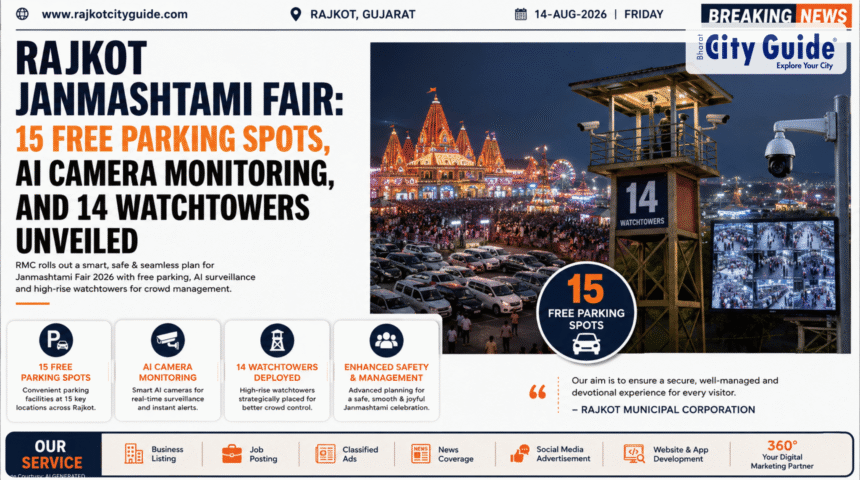
The biggest highlight of this year’s administrative preparation is the establishment of 15 designated free parking zones around the Race Course perimeter alongside cutting-edge high-tech security measures. To maintain constant vigilance over crowds exceeding hundreds of thousands daily, the event grounds will be monitored using Artificial Intelligence (AI) enabled CCTV cameras, drone surveillance, and 14 strategically positioned high-level watchtowers. Furthermore, emergency response corridors, bike ambulances, direct control rooms, and a ₹12 crore comprehensive insurance cover have been integrated into the venue framework. These proactive measures highlight how modern municipal administration and advanced AI surveillance are raising the bar for security, crowd control, and visitor convenience at major cultural gatherings in Gujarat.
What is Rajkot Janmashtami Fair?
The Rajkot Janmashtami Fair (popularly known as Rajkot Lokmela) is the premier cultural folk festival of the Saurashtra and Kutch regions, organized annually by the Rajkot District Collectorate and the Lokmela Committee at the Race Course Ground in Rajkot, Gujarat. Taking place over five days during the peak Janmashtami celebrations in August and September, the fair serves as a socio-economic and cultural hub where urban residents and rural visitors gather in high spirits.
                  ┌──────────────────────────────────────────────┐
                  │           RAJKOT JANMASHTAMI FAIR            │
                  │        Race Course Ground • 5 Days           │
                  └──────────────────────┬───────────────────────┘
                                         │
        ┌────────────────────────────────┼────────────────────────────────┐
        ▼                                ▼                                ▼
┌────────────────────────┐    ┌────────────────────────┐    ┌────────────────────────┐
│ TRAFFIC & PARKING      │    │ AI & HIGH-TECH SAFETY  │    │ FAIR & ENTERTAINMENT   │
│ • 15 Free Parking Spots│    │ • AI CCTV & Drones     │    │ • 228 Stalls & Plots   │
│ • Zero Parking Fees    │    │ • 14 Watchtowers       │    │ • High-Thrill Rides    │
│ • Traffic Rerouting    │    │ • Emergency Corridors  │    │ • Cultural Stages      │
└────────────────────────┘    └────────────────────────┘    └────────────────────────┘
Rooted deep in Gujarati heritage, the event represents a massive economic platform for small traders, artisans, food vendors, and amusement park owners. The fairground is traditionally divided into organized sectors hosting over 200 stalls for local crafts, toys, Kathiawadi street foods, sweets, games, and large mechanical amusement rides like giant wheels, breakdance rides, and roller coasters. Combining traditional devotional festivities with modern carnival entertainment, the fair stands as an irreplaceable annual landmark for the entire region.
Why This News is Important
The announcement of 15 free parking locations, AI camera monitoring, and 14 watchtowers for the Rajkot Janmashtami Fair carries immense weight for public safety, city logistics, and festival administration. Here is why these security and infrastructure updates matter:
- Enhanced Public Safety & Surveillance: Integrating AI-driven facial recognition, crowd density monitoring, and real-time incident detection via CCTV and drones allows police personnel to spot suspicious activity, lost children, or overcrowding before emergencies occur.
- Congestion-Free Parking: Parking around Race Course Ring Road has historically caused severe traffic gridlocks. Designating 15 dedicated free parking zones removes vehicle crowding along primary roadways and prevents unauthorized fee collection.
- Rapid Emergency Response: Dedicated emergency corridors and bike ambulances ensure that paramedics and fire teams can reach any point on the fairgrounds instantly without getting blocked by dense crowds.
- Public Reassurance & Risk Management: Backing the event with a massive ₹12 crore insurance policy and 14 elevated watchtowers reinforces public confidence, encouraging families to enjoy the festivities safely.
Background Information
Managing public safety at the Rajkot Lokmela has long been a complex challenge for city administrators. With over 1.5 million visitors attending the fairgrounds over five days, crowd control, traffic management, and emergency readiness require careful planning.
In previous years, vehicle parking around Race Course Road was often fragmented, leading to traffic bottlenecks, unauthorized parking operators charging inflated fees, and long walking distances for visitors. On the security front, traditional CCTV cameras required manual, round-the-clock monitoring by police teams, which made tracking specific incidents across dense crowds difficult.
To solve these recurring issues, the Rajkot District Collectorate alongside the City Police Chief introduced a comprehensive revamp. The transition to AI-integrated visual analytics, automated crowd tracking, elevated police watchtowers, and a multi-zone free parking network reflects a multi-year effort to modernize Saurashtra’s flagship public event.
Key Highlights
- 15 Free Parking Zones: Designated parking spaces set up across 15 key points around the Race Course perimeter to provide hassle-free, zero-cost vehicle parking for visitors.
- AI Camera Surveillance: Deployment of AI-powered CCTV cameras and aerial surveillance drones capable of real-time crowd analysis, face matching, and unattended baggage detection.
- 14 Elevation Watchtowers: High-visibility watchtowers erected at critical intersections and high-density zones inside the fairground for continuous manual police oversight.
- Emergency Access Corridors: Reserved inner routes kept clear for fast movement of emergency services, fire tenders, and bike ambulances.
- Comprehensive Insurance Cover: An estimated ₹12 crore public liability insurance policy secured by the Lokmela Committee to safeguard visitors against unforeseen incidents.
- 228 Commercial Plots & Stalls: Well-organized allocation of food stalls, handicraft booths, game centers, and ride zones under strict safety compliance checks.
Detailed Explanation of the Event
Preparing the Race Course Ground for the Rajkot Janmashtami Fair involves seamless coordination between the District Collectorate, Rajkot Municipal Corporation (RMC), PGVCL (electricity board), and Rajkot City Police.
                           [ FAIR MANAGEMENT GRID ]
                                      │
  ┌───────────────────────────────────┼───────────────────────────────────┐
  ▼                                   ▼                                   ▼
[Phase 1: Traffic & Transit]       [Phase 2: Security & Surveillance] [Phase 3: Visitor Amenities]
 • 15 Free Parking Hubs             • AI CCTV & Drone Network          • 228 Stalls & Food Zones
 • Ring Road Diversions             • 14 Elevated Watchtowers          • Emergency Medical Desks
 • Pedestrian Safe Corridors        • Centralized Command Room         • ₹12 Cr Public Insurance
Free Parking Architecture
To eliminate parking confusion, city authorities mapped out 15 spacious parking lots within easy walking distance of the fairground gates. These free parking hubs cater to both two-wheelers and four-wheelers arriving from various entry routes across Rajkot, Jamnagar, Junagadh, and Morbi highways. Traffic police personnel and wardens are deployed at each parking node to prevent traffic slowdowns and stop unauthorized roadside parking.
AI Surveillance & Command Center
A high-tech control room has been constructed directly inside the Race Course complex. High-definition AI-enabled CCTV cameras continuously stream video feeds to powerful analytical servers. The AI software automatically alerts control room operators if:
- Crowd density in a specific aisle exceeds safe limits.
- An object or bag is left unattended for an extended period.
- Movement patterns suggest a physical altercation or stampede risk.
- Blacklisted individuals or known offenders match facial recognition databases.
Surveillance drones fly above the fairgrounds during peak evening hours, giving police command staff an unobstructed overhead view of pedestrian movements across all sectors.
Elevated Watchtowers and Ground Security
To complement digital surveillance, 14 elevated watchtowers staffed by armed police personnel and searchlight operators are stationed across the main walking avenues. These towers provide clear line-of-sight coverage over stall rows, ride enclosures, and entry-exit gates, allowing ground teams to respond to incidents immediately.
Benefits, Features, and Importance
The security and infrastructure framework established for the Rajkot Janmashtami Fair brings tangible benefits to attendees, city officials, and local businesses alike:
| Domain | Key Feature | Primary Advantage |
| Visitor Convenience | 15 Free Parking Locations | Prevents parking extortion and keeps main roads clear of parked vehicles. |
| Crowd Safety | AI CCTV & Drone Analytics | Enables proactive crowd management and rapid detection of security threats. |
| Emergency Medicals | Dedicated Emergency Corridors | Allows bike ambulances and medical teams to reach patients rapidly. |
| Visual Oversight | 14 Elevated Watchtowers | Delivers clear line-of-sight monitoring across crowded fairground aisles. |
| Risk Mitigation | ₹12 Crore Public Insurance | Protects visitors against accidental injuries or unexpected emergency hazards. |
How It Impacts People
The new security protocols and free parking arrangements at the Rajkot Janmashtami Fair positively impact various visitor groups:
- Families and Tourists: Visitors from across Gujarat can explore stalls, buy traditional goods, and enjoy amusement rides with complete peace of mind regarding personal safety and vehicle security.
- Senior Citizens and Children: Elevated watchtowers, lost-and-found booths, and AI monitoring make it easier to track lost individuals and assist vulnerable attendees in crowded zones.
- Daily Commuters in Rajkot: Diverting fair-bound vehicles into 15 designated parking zones prevents citywide traffic jams along Race Course Road, keeping everyday transit smooth for local residents.
- Vendor & Stall Merchants: Small traders benefit from steady, secure customer footfalls without fear of theft, rowdy behavior, or fire hazards disrupting their businesses.
Expert Insights and Industry Perspective
Urban security specialists and public administration analysts have commended the integration of AI surveillance at high-density public carnivals. Managing temporary crowds exceeding hundreds of thousands in an open park demands proactive technology over reactive policing.
Security experts note that combining automated video analytics with physical infrastructure like elevated watchtowers and reserved emergency corridors reduces incident response times by over 60 percent. Furthermore, providing structured, free parking hubs addresses a major source of urban festival friction, establishing a reliable blueprint for managing large-scale cultural events across India.
Challenges and Limitations
Despite high-level preparations, managing an event of this magnitude presents ongoing operational demands:
- High Vehicle Volumes: During peak festival evenings (Satam-Aatham), the total number of incoming vehicles may challenge the capacity of even 15 parking grounds, requiring rapid traffic diversions.
- Monsoon Weather Disruptions: Heavy late-monsoon downpours can create muddy ground conditions in open-air parking lots and temporarily limit drone flight operations.
- Maintaining AI System Uptime: Keeping high-definition cameras, wireless transmitters, and AI servers running continuously under outdoor weather conditions demands reliable power backup and dedicated IT teams.
- Public Compliance: Encouraging all drivers to use designated parking spaces rather than dropping passengers along busy road margins requires strict police enforcement.
Future Outlook
The security and logistical standards deployed at the Rajkot Janmashtami Fair point toward a modern future for public event management in Western India:
- Smart Parking Apps: Future fairs may introduce real-time mobile apps displaying live parking slot availability across all 15 locations, helping drivers navigate directly to open spots.
- Permanent Command Infrastructure: Success with temporary AI surveillance networks could encourage municipal authorities to build permanent smart surveillance feeds around Race Course Park.
- Integrated RFID/QR Ticketing: Future editions may feature digital entry passes or QR-based crowd counting to maintain precise real-time headcount limits across individual fair sectors.
Frequently Asked Questions (FAQs)
1. Where is the Rajkot Janmashtami Fair held?
The fair is held at the historic Race Course Ground located in the center of Rajkot city, Gujarat.
2. Is parking free at the Rajkot Janmashtami Fair?
Yes, the district administration and city police have set up 15 designated free parking zones around the Race Course perimeter to ensure hassle-free vehicle parking for all visitors.
3. How is AI technology being used at the Rajkot Lokmela?
AI-enabled CCTV cameras and drones monitor crowd density in real time, scan for unattended items, assist with facial recognition, and alert police control room operators to potential safety risks instantly.
4. How many watchtowers are set up for security at the fairgrounds?
A total of 14 elevated watchtowers have been erected at strategic locations across the fairgrounds for physical police monitoring and crowd control.
5. What medical emergency facilities are available at the fair?
The event features dedicated emergency access corridors, bike ambulances, on-site medical posts, and first-responder teams to handle health emergencies rapidly.
6. Is the Rajkot Janmashtami Fair covered by insurance?
Yes, the Lokmela Committee secures a comprehensive public liability insurance policy worth approximately ₹12 crore to cover visitors and vendor stalls against unforeseen accidents.
7. What are the dates for the fair?
The fair runs for five action-packed days during the Janmashtami festival period, attracting over 1.5 million visitors from across Saurashtra and Gujarat.
Conclusion
The Rajkot Janmashtami Fair stands as a vibrant celebration of Saurashtra’s rich cultural heritage, bringing together traditions, trade, and family entertainment. By introducing 15 designated free parking zones, AI-powered camera surveillance, drone monitoring, and 14 elevated watchtowers, the Rajkot District Collectorate and City Police have set a high standard for public event safety and visitor convenience. These proactive measures ensure that millions of devotees and festival-goers can celebrate Lord Krishna’s birth in a secure, well-managed environment. As Rajkot merges modern technology with centuries-old traditions, the Rajkot Janmashtami Fair promises to be safer, smoother, and more enjoyable than ever before.