Introduction
Air connectivity serves as a vital catalyst for economic expansion, regional integration, and commercial prosperity in modern industrial hubs. In Gujarat’s Saurashtra region, trade, manufacturing, and tourism rely heavily on seamless transportation infrastructure to connect local markets with major Indian metropolitan cities and international business destinations.
- Introduction
- What is Rajkot Hirasar International Airport?
- Why This News is Important
- Background Information
- Key Highlights
- Detailed Explanation of the Event
- Benefits and Importance of the Traffic Growth
- How It Impacts Different Audiences
- Expert Insights and Industry Perspective
- Challenges and Limitations
- Future Outlook
- Frequently Asked Questions (FAQs)
- Conclusion
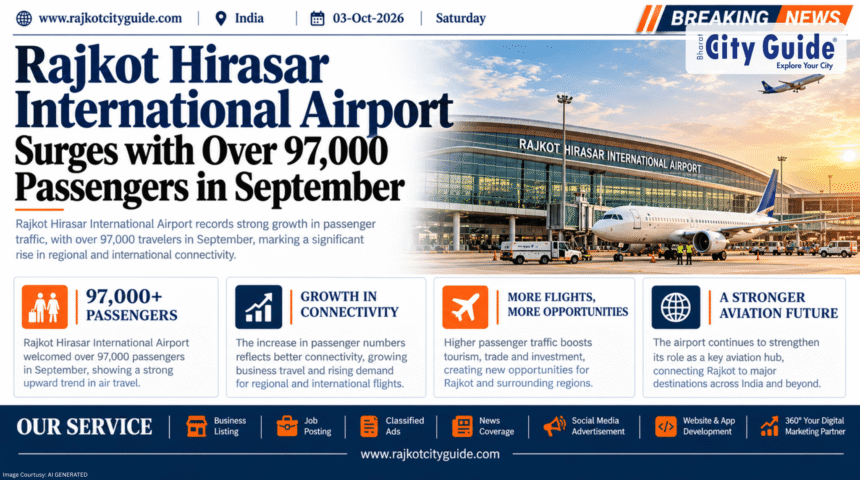
The latest operational metrics from Rajkot Hirasar International Airport highlight a significant surge in regional air mobility. During September, the greenfield airport handled over 97,000 passengers, registering a substantial monthly increase of more than 10,000 travelers compared to August figures. This steady growth reflects expanding flight schedules, increased business travel, and rising demand across the industrial belts of Rajkot, Morbi, Jamnagar, and Junagadh.
This traffic milestone underscores the growing importance of Hirasar Airport as a key aviation hub for Western Gujarat. As passenger throughput approaches the 100,000-per-month threshold, local trade bodies, industrial associations, and tourism operators are observing positive knock-on effects across various sectors, including ceramics, engineering, brass parts, and jewelry manufacturing.
What is Rajkot Hirasar International Airport?
Rajkot Hirasar International Airport (IATA: HSR, ICAO: VAHS) is a state-of-the-art greenfield aviation facility situated near Hirasar village, approximately 28 to 30 kilometers northeast of Rajkot along National Highway 8B. Developed by the Airports Authority of India (AAI) over an expansive area of more than 2,500 acres, the airport was constructed to replace the older, space-constrained legacy airport near Rajkot’s city center.
+--------------------------------------------------------------------------+
|          RAJKOT HIRASAR INTERNATIONAL AIRPORT PROFILE & STATS            |
+--------------------------------------------------------------------------+
                                     |
    +--------------------------------+--------------------------------+
    |                                |                                |
    v                                v                                v
[ GREENFIELD INFRASTRUCTURE ]     [ OPERATIONAL CAPACITY ]     [ SEPTEMBER TRAFFIC METRIC ]
- Total Area: 2,500+ Acres       - Terminal Capacity: 1,800/hr - Monthly Total: 97,000+ Passengers
- Location: Hirasar (NH 8B)      - Parking Bays: 14 Aircraft   - MoM Gain: +10,000 Passengers
- Code-E / Widebody Capable      - Aerobridges: 4 Operational  - Core Focus: Business & Tourism
Inaugurated by Prime Minister Narendra Modi in July 2023, Hirasar Airport features a modern passenger terminal building depicting local Saurashtra art forms, a 3,040-meter runway capable of accommodating C-category and wide-body aircraft, multiple aerobridges, and dedicated air cargo handling facilities. The airport serves as the primary air gateway for the entire Saurashtra peninsula.
Why This News is Important
The steady growth in passenger traffic at Hirasar International Airport carries several important implications for the region:
- Economic Velocity Indicator: Crossing 97,000 monthly passengers demonstrates strong commercial vitality across Saurashtra’s industrial hubs.
- Justification for Route Expansion: Consistent month-on-month passenger growth strengthens the commercial case for airlines to introduce new domestic routes and direct international flights.
- Support for Export Industries: Increased passenger movement complements air cargo operations, benefiting high-value export sectors such as ceramics, engineering, and jewelry.
- Regional Connectivity Hub: Demonstrates that moving the airport to a modern highway location outside the city center has successfully scaled operations without dampening traveler demand.
Background Information
The historical Rajkot Airport, located within city limits, faced severe spatial constraints that prevented runway extension or terminal expansion. Consequently, larger aircraft could not operate, limiting flight frequencies and capping regional economic growth.
To address these constraints, the Central Government and Government of Gujarat sanctioned a major greenfield airport project in Hirasar. Built at an investment of over ₹2,600 crore, the facility was designed to meet Saurashtra’s long-term aviation needs for the next several decades.
[ Legacy City Airport Constraints ] ---> [ Greenfield Hirasar Development (₹2,600+ Cr) ]
                                                       |
                                                       v
[ July 2023 Inauguration ] ----------> [ Flight Route Expansion & Increased Frequency ]
                                                       |
                                                       v
[ Sept 2026 Milestone ] -------------> [ 97,000+ Monthly Passengers (+10,000 MoM) ]
Since opening commercial operations in late 2023, traffic has grown steadily. The recent September figure of over 97,000 passengers highlights a significant acceleration in regional air travel.
Key Highlights
- 97,000+ Passengers Handled: Hirasar Airport processed over 97,000 passengers during September.
- Monthly Increase of 10,000+: Passenger traffic surged by more than 10,000 travelers compared to August figures.
- Expanded Domestic Connectivity: Increased seat occupancy across flights connecting Rajkot to Delhi, Mumbai, Bengaluru, Goa, and Hyderabad.
- Commercial Demand Driving Growth: Industrial trips from Morbi, Rajkot, and Jamnagar accounted for a major share of the passenger traffic.
- Infrastructure Readiness: The terminal handled peak-hour passenger flows smoothly using its four operational aerobridges and expanded parking bays.
Detailed Explanation of the Event
1. Breakdown of September Passenger Growth
The milestone of over 97,000 travelers in September represents one of the highest monthly passenger tallies recorded at Hirasar Airport since commercial operations began. The month-on-month addition of 10,000+ passengers highlights both increased flight frequencies and higher seat load factors across major domestic airlines.
+--------------------------------------------------------------------------+
|             MONTHLY TRAFFIC & OPERATIONAL COMPARISON METRICS             |
+--------------------------------------------------------------------------+
| Indicator Metric        | August Volume        | September Volume        |
+-------------------------+----------------------+-------------------------+
| Total Passenger Volume  | ~87,000 Passengers   | 97,000+ Passengers      |
| Net Monthly Growth      | Baseline             | +10,000+ Passengers     |
| Primary Growth Drivers  | Business & Industrial| Pre-Festive & Commerce  |
| Top Air Connections     | Mumbai, Delhi, Blr   | Mumbai, Delhi, Blr, Hyd |
+-------------------------+----------------------+-------------------------+
Airlines operating at the airport have responded to demand by deploying higher-capacity narrow-body aircraft on trunk routes like Rajkot-Mumbai and Rajkot-Delhi. This expanded capacity has made business travel more accessible for regional executives and technicians.
2. Commercial Drivers Behind the Passenger Surge
Several factors contributed to the September traffic growth:
- Business Travel in Manufacturing Hubs: The ceramic industries of Morbi and auto-component manufacturers in Rajkot saw increased domestic business travel ahead of Q3 production cycles.
- Pre-Festive Business Preparation: Traders, wholesalers, and buyers traveled extensively to finalize inventory ahead of the upcoming festive season.
- Highway & Bus Connectivity: Smooth transit via the Rajkot-Ahmedabad highway (NH 8B) and dedicated electric bus connectivity from the Rajkot Central Bus Port simplified travel to the airport terminal.
Benefits and Importance of the Traffic Growth
1. Strengthening Saurashtra’s Industrial Ecosystem
Direct air connectivity reduces travel friction for corporate executives, foreign buyers, and technical experts visiting industrial clusters in Rajkot, Morbi, Jamnagar, and Metoda GIDC.
2. Boosting Regional Tourism and Pilgrimage
Hirasar Airport serves as an air transit hub for tourists and pilgrims traveling to Somnath, Dwarka, Gir National Park, and Diu, supporting hospitality and local transport services across Saurashtra.
3. Economic Multiplier Effect
Rising passenger numbers create direct and indirect local employment in ground handling, retail, taxi services, logistics, and hotel operations.
How It Impacts Different Audiences
| Stakeholder Group | Direct Impact & Event Relevance |
| Business Leaders & Exporters | Saves transit time when traveling to national commercial hubs for trade meetings and exhibitions. |
| Local Citizens & Travelers | Offers a comfortable travel experience with modern amenities, aerobridges, and expanded lounge spaces. |
| Tourism & Hospitality Sector | Increases hotel bookings and tourist movement toward Gir, Dwarka, and coastal Saurashtra. |
| Airlines & Aviation Sector | Provides strong financial yields and high load factors, encouraging fleet deployment and route expansion. |
Expert Insights and Industry Perspective
Aviation analysts and regional trade representatives view the 97,000-passenger figure as a sign of Saurashtra’s growing air travel market.
“Sustained passenger growth at a newly opened greenfield airport demonstrates strong underlying demand. Hirasar Airport’s modern infrastructure easily handles larger aircraft and higher passenger volumes. As monthly passenger figures approach 100,000, airlines are well-positioned to introduce direct international routes to destinations like Dubai, further integration with global supply chains.”
Challenges and Limitations
While passenger growth is strong, the airport faces a few operational considerations:
- Eager Anticipation for International Routes: Despite holding “International” status, regular scheduled direct international flights are still pending final regulatory clearances and airline approvals.
- Distance from City Center: Located around 30 km from Rajkot city, maintaining reliable, affordable shuttle services and public transport remains essential for travelers.
- Seasonal Demand Fluctuations: Maintaining high seat occupancy rates during non-peak travel months requires consistent business traffic.
Future Outlook
With monthly passenger throughput passing 97,000, Hirasar Airport is on track to cross annual traffic milestones in the coming year.
Airlines are evaluating additional direct connections to southern and eastern Indian business cities. Furthermore, ongoing developments in the airport’s cargo terminal are expected to boost air freight exports of perishable goods, pharmaceuticals, and precision machinery components.
Frequently Asked Questions (FAQs)
1. Where is Rajkot Hirasar International Airport located?
The airport is situated near Hirasar village on National Highway 8B, approximately 28 to 30 kilometers northeast of Rajkot city.
2. How many passengers did Hirasar Airport handle in September?
Hirasar Airport handled over 97,000 passengers in September, reflecting a monthly gain of more than 10,000 travelers.
3. Which major domestic cities are directly connected to Rajkot Hirasar Airport?
The airport offers direct and connecting flights to major Indian hubs, including Mumbai, Delhi, Bengaluru, Hyderabad, and Goa.
4. What is the terminal passenger capacity of Hirasar Airport?
The main terminal building is designed to handle up to 1,800 passengers during peak operational hours.
5. What are the primary transport options to reach the airport from Rajkot city?
Travelers can access the airport via pre-booked taxis, auto-rickshaws, personal vehicles, and GSRTC electric express bus services running from the Rajkot Central Bus Port.
6. How does Hirasar Airport support trade in Saurashtra?
By providing fast transit for corporate buyers and technical specialists, the airport supports key industries in Rajkot, Morbi, and Jamnagar, including ceramics, auto components, and brass parts.
Conclusion
The growth recorded by Rajkot Hirasar International Airport in September—handling over 97,000 passengers with a 10,000-traveler monthly increase—highlights Saurashtra’s expanding economic footprint. Modern greenfield infrastructure, efficient highway access, and growing airline connectivity have positioned Hirasar Airport as an essential driver of regional trade, manufacturing, and tourism. As flight frequencies increase and air cargo operations expand, the airport will continue to play a key role in connecting Saurashtra with major national and global markets.