Introduction
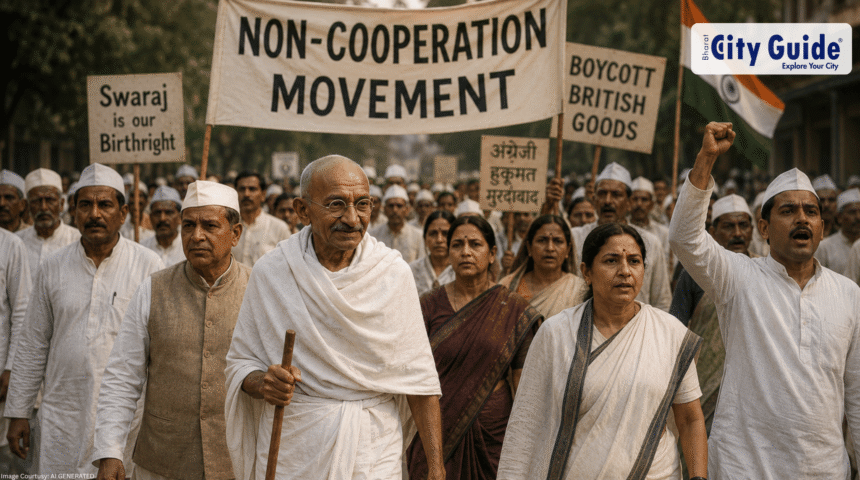
The early 20th century marked a decisive turning point in India’s struggle for independence from British colonial rule. Among the many movements that shaped this era, the Non-Cooperation Movement stands out as one of the first large-scale, nationwide mass protests that brought ordinary Indians directly into the freedom struggle.
- Introduction
- Key Idea:
- 1. Post-World War I Discontent
- 2. The Rowlatt Act
- 3. Jallianwala Bagh Massacre (1919)
- 4. Rise of Mahatma Gandhi
- Key Goals:
- 1. Boycott of British Goods
- 2. Boycott of Institutions
- 3. Promotion of Khadi
- 4. Nonviolent Protest
- Participants Included:
- Key Effects:
- 1. Strengthening National Unity
- 2. Weakening British Authority
- 3. Rise of Mass Politics
- 1. Lack of Uniform Participation
- 2. Occasional Violence
- 3. Suspension of Movement
- Outcome:
- Long-Term Contributions:
- Key Legacy Points:
- Key Lessons:
- 1. What was the Non-Cooperation Movement?
- 2. Who led the Non-Cooperation Movement?
- 3. What were its main methods?
- 4. Why was it started?
- 5. Why did it end?
- 6. What was its biggest impact?
- 7. Was it successful?
Launched under the leadership of Mahatma Gandhi, the Non-Cooperation Movement transformed Indian nationalism from an elite political struggle into a mass civil resistance movement involving students, farmers, workers, traders, and professionals across the country. It represented a powerful shift from constitutional petitions and limited political dialogue to active nonviolent resistance.
The Non-Cooperation Movement became a defining moment in India’s independence journey, demonstrating the strength of collective action and the effectiveness of peaceful protest against colonial authority.
In this detailed article, we explore the origins, objectives, methods, major events, impact, limitations, and lasting legacy of the Non-Cooperation Movement.
What Was the Non-Cooperation Movement?
The Non-Cooperation Movement was a nationwide campaign launched in 1920 as part of India’s freedom struggle against British rule.
Key Idea:
To resist British authority through nonviolent refusal to cooperate with colonial institutions.
Background of the Non-Cooperation Movement
1. Post-World War I Discontent
After World War I:
- Economic hardship increased
- Inflation rose
- Promises of political reforms remained unfulfilled
2. The Rowlatt Act
The Rowlatt Act allowed:
- Arrest without trial
- Suppression of civil liberties
This created widespread anger.
3. Jallianwala Bagh Massacre (1919)
One of the most tragic events in Indian history:
- Hundreds of peaceful protesters were killed
- Public outrage intensified
- Trust in British rule declined sharply
4. Rise of Mahatma Gandhi
Mahatma Gandhi emerged as the central leader advocating:
- Nonviolent resistance (Satyagraha)
- Civil disobedience
- Mass participation
Objectives of the Non-Cooperation Movement
Key Goals:
- End British rule in India
- Achieve self-governance (Swaraj)
- Boycott British institutions
- Promote Indian self-reliance
Methods Used in the Non-Cooperation Movement
1. Boycott of British Goods
Indians were encouraged to avoid:
- Imported textiles
- Foreign products
2. Boycott of Institutions
People withdrew from:
- British schools and colleges
- Courts
- Government offices
3. Promotion of Khadi
Hand-spun cloth became a symbol of self-reliance.
4. Nonviolent Protest
Peaceful resistance was the core principle.
Mass Mobilization Across India
The movement spread widely across:
- Cities
- Villages
- Rural regions
Participants Included:
- Students
- Farmers
- Lawyers
- Traders
- Workers
Role of Students and Youth
Students played a major role by:
- Leaving government schools
- Joining national institutions
- Participating in protests
Economic Impact of the Movement
Key Effects:
- Reduced demand for British goods
- Growth of indigenous industries
- Promotion of local craftsmanship
Political Impact
1. Strengthening National Unity
Different communities united under a common cause.
2. Weakening British Authority
Non-cooperation reduced administrative efficiency.
3. Rise of Mass Politics
Ordinary citizens became active participants.
Limitations of the Movement
1. Lack of Uniform Participation
Not all regions participated equally.
2. Occasional Violence
Some incidents deviated from nonviolent principles.
3. Suspension of Movement
The movement was suspended in 1922 after violent incidents.
Chauri Chaura Incident
A key turning point where violence led to the withdrawal of the movement.
Outcome:
- Police station was attacked
- Lives were lost
- Gandhi suspended the movement
Impact on India’s Freedom Struggle
Long-Term Contributions:
- Inspired future movements
- Strengthened nationalist sentiment
- Established nonviolent resistance as a strategy
Legacy of the Non-Cooperation Movement
The movement left a lasting impact on India’s independence struggle.
Key Legacy Points:
- Mass political awakening
- Foundation for civil disobedience movements
- Strengthened leadership of Gandhi
Non-Cooperation Movement and Global Influence
The movement influenced global leaders and civil rights movements by demonstrating:
- Power of nonviolence
- Strength of mass resistance
Why the Movement Still Matters Today
Key Lessons:
- Collective action can bring change
- Nonviolence can be powerful
- Civic participation is essential in democracy
Frequently Asked Questions (FAQs)
1. What was the Non-Cooperation Movement?
It was a mass protest against British rule launched in 1920.
2. Who led the Non-Cooperation Movement?
Mahatma Gandhi led the movement.
3. What were its main methods?
Boycott of British goods, institutions, and nonviolent resistance.
4. Why was it started?
Due to anger over British policies like the Rowlatt Act and Jallianwala Bagh massacre.
5. Why did it end?
It was suspended after the Chauri Chaura incident in 1922.
6. What was its biggest impact?
It mobilized millions of Indians into the freedom struggle.
7. Was it successful?
It did not achieve immediate independence but significantly strengthened the movement.
Conclusion
The Non-Cooperation Movement was a landmark moment in India’s struggle for independence. By transforming passive dissatisfaction into active mass resistance, it brought millions of Indians into the political process for the first time. Although it was eventually suspended, its influence reshaped the direction of the freedom movement and laid the foundation for future struggles.
More importantly, it demonstrated the power of unity, discipline, and nonviolent resistance in challenging colonial rule. The movement remains a powerful example of how collective action can inspire national awakening and long-term political change.