Introduction
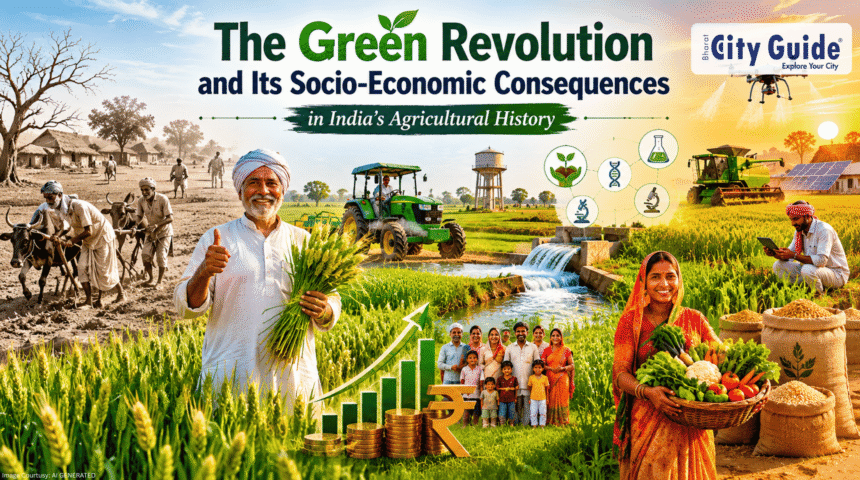
India’s agricultural history has witnessed several major transformations, but few have been as significant as the Green Revolution in India. Introduced during the 1960s, the Green Revolution changed the country’s farming system through modern technology, improved seeds, chemical fertilizers, irrigation expansion, and scientific agricultural methods. At a time when India was struggling with food shortages, poverty, and dependence on foreign grain imports, the Green Revolution helped the country move toward food self-sufficiency.
- Introduction
- Understanding the Green Revolution in India
- Historical Background of the Green Revolution
- Main Features of the Green Revolution in India
- Objectives of the Green Revolution
- Major Achievements of the Green Revolution
- Socio-Economic Consequences of the Green Revolution
- Positive Socio-Economic Effects
- Negative Socio-Economic Consequences
- Environmental Consequences of the Green Revolution
- Regional Impact of the Green Revolution
- Role of Government in the Green Revolution
- Green Revolution and Food Security
- Criticism of the Green Revolution
- The Need for a Second Green Revolution
- Green Revolution’s Legacy in Modern India
- Frequently Asked Questions (FAQs)
- Conclusion
The Green Revolution is often described as a turning point in the nation’s economic and agricultural development. It increased crop production, improved food availability, and strengthened rural economies in many regions. However, alongside these achievements, the Green Revolution also created several social, economic, and environmental challenges.
While some farmers became prosperous due to higher agricultural productivity, others faced inequality, debt, and resource-related difficulties. The revolution also affected land ownership patterns, employment opportunities, migration trends, and environmental sustainability.
This article explores the Green Revolution in India, its origins, key features, major achievements, socio-economic consequences, regional effects, criticisms, and its long-term impact on India’s agricultural development.
Understanding the Green Revolution in India
The Green Revolution in India refers to a period of rapid agricultural growth that began in the mid-1960s through the adoption of modern farming techniques and scientific agricultural practices.
The movement mainly focused on:
- High-yielding variety (HYV) seeds
- Chemical fertilizers
- Pesticides
- Irrigation systems
- Mechanized farming
The primary goal was to increase food grain production, especially wheat and rice, to solve India’s food crisis.
The Green Revolution transformed agriculture from traditional farming methods into a more technology-driven and commercialized system.
Historical Background of the Green Revolution
After independence in 1947, India faced severe agricultural challenges.
The country experienced:
- Low crop productivity
- Food shortages
- Frequent famines
- Poor irrigation facilities
- Rapid population growth
India depended heavily on food imports, particularly under the United States’ PL-480 food aid program.
During the early 1960s, consecutive droughts created a serious food crisis. This situation forced policymakers to adopt modern agricultural reforms.
The Green Revolution in India gained momentum under the leadership of:
- Prime Minister Lal Bahadur Shastri
- Agriculture Minister C. Subramaniam
- Agricultural scientist M. S. Swaminathan
American scientist Norman Borlaug’s research on high-yield wheat varieties also played a major role in shaping India’s agricultural reforms.
Main Features of the Green Revolution in India
The Green Revolution introduced several important changes in Indian agriculture.
High-Yielding Variety Seeds
HYV seeds were developed to produce higher crop yields compared to traditional seeds.
These seeds:
- Grew faster
- Responded better to fertilizers
- Produced more grain
Wheat and rice became the primary focus crops.
Expansion of Irrigation
Reliable irrigation systems became necessary for modern farming methods.
India expanded:
- Canals
- Tube wells
- Dams
- Groundwater irrigation
Chemical Fertilizers and Pesticides
Farmers increasingly used:
- Nitrogen fertilizers
- Phosphate fertilizers
- Insecticides
- Weed-control chemicals
to improve crop productivity.
Farm Mechanization
Modern machines such as:
- Tractors
- Harvesters
- Pump sets
- Threshers
improved farming efficiency.
Institutional Support
The government supported farmers through:
- Subsidies
- Minimum Support Prices (MSP)
- Agricultural loans
- Research institutions
- Extension services
Objectives of the Green Revolution
The Green Revolution in India aimed to achieve multiple national goals.
Achieving Food Security
The biggest objective was increasing food production to reduce hunger and food imports.
Modernizing Agriculture
India wanted to replace traditional farming with scientific agriculture.
Increasing Rural Income
Higher crop production was expected to improve farmers’ incomes and reduce rural poverty.
Supporting Economic Growth
Agricultural growth was considered essential for industrial development and overall economic stability.
Major Achievements of the Green Revolution
The Green Revolution produced several important successes.
Massive Increase in Food Grain Production
India’s wheat and rice production increased dramatically.
Wheat production especially saw rapid growth in states like:
- Punjab
- Haryana
- Uttar Pradesh
India gradually became self-sufficient in food grains.
Reduction in Food Imports
Before the Green Revolution, India relied heavily on imported grains.
After increased agricultural production, dependence on foreign food aid declined significantly.
Improvement in Rural Infrastructure
The Green Revolution encouraged:
- Better roads
- Electricity supply
- Irrigation systems
- Agricultural markets
Growth of Agricultural Industries
Industries related to:
- Fertilizers
- Farm equipment
- Food processing
- Irrigation technology
expanded rapidly.
Strengthening National Economy
Higher agricultural productivity contributed to:
- Economic growth
- Price stability
- Employment generation
Socio-Economic Consequences of the Green Revolution
Although the Green Revolution in India improved food production, it also produced complex socio-economic consequences.
Positive Socio-Economic Effects
Increased Farmer Income
Many farmers experienced higher earnings due to improved crop yields and market sales.
Rural Economic Development
Agricultural prosperity increased demand for:
- Transportation
- Banking
- Retail businesses
- Agricultural services
Employment Opportunities
The agricultural sector generated jobs in:
- Irrigation construction
- Fertilizer industries
- Food processing
- Rural trade
Rise of Commercial Farming
Agriculture became more market-oriented and profit-driven.
Strengthening of Middle-Class Farmers
Many medium-sized landowners gained economic and political influence in rural areas.
Negative Socio-Economic Consequences
Despite progress, the Green Revolution also created major inequalities and challenges.
Regional Inequality
The benefits were concentrated mainly in:
- Punjab
- Haryana
- Western Uttar Pradesh
Many eastern and central Indian states did not benefit equally.
Income Inequality Among Farmers
Large farmers benefited more because they could afford:
- Modern machinery
- Irrigation systems
- HYV seeds
- Chemical fertilizers
Small and marginal farmers often struggled financially.
Rural Debt
Many farmers borrowed money to buy:
- Seeds
- Fertilizers
- Machinery
Crop failures or low prices sometimes trapped farmers in debt cycles.
Land Ownership Imbalances
Wealthier farmers expanded land ownership while smaller farmers often became economically vulnerable.
Decline of Traditional Farming
Traditional crop varieties and indigenous farming practices declined significantly.
Environmental Consequences of the Green Revolution
The Green Revolution also caused serious environmental problems.
Soil Degradation
Excessive use of fertilizers reduced soil fertility over time.
Groundwater Depletion
Intensive irrigation caused falling groundwater levels in many agricultural regions.
Chemical Pollution
Pesticides and fertilizers polluted:
- Soil
- Rivers
- Groundwater
Loss of Biodiversity
Traditional crop diversity decreased because farmers focused heavily on wheat and rice.
Stubble Burning Issues
Modern farming practices contributed to crop residue burning, causing severe air pollution.
Regional Impact of the Green Revolution
The Green Revolution affected different Indian states differently.
Punjab and Haryana
These states became India’s agricultural hubs due to:
- Strong irrigation systems
- Government support
- Fertile land
Eastern India
States like Bihar and Odisha benefited less because of:
- Poor infrastructure
- Limited irrigation
- Weak institutional support
Southern India
Some southern states later adopted Green Revolution technologies successfully, especially in rice cultivation.
Role of Government in the Green Revolution
Government policies played a major role in the success of the Green Revolution in India.
Minimum Support Price (MSP)
The government guaranteed fixed prices for crops to protect farmers from market fluctuations.
Agricultural Research Institutions
Institutions like:
- Indian Agricultural Research Institute (IARI)
- ICAR
supported scientific agricultural development.
Rural Credit and Subsidies
Banks and cooperatives provided:
- Loans
- Fertilizer subsidies
- Equipment financing
Public Distribution System (PDS)
Increased food production strengthened India’s food distribution programs.
Green Revolution and Food Security
One of the greatest achievements of the Green Revolution was improving India’s food security.
India transformed from:
- A food-deficient country
to - A major agricultural producer
Food grain availability improved significantly, reducing famine risks.
India later became one of the world’s largest producers of:
- Wheat
- Rice
- Milk
- Fruits
- Vegetables
Criticism of the Green Revolution
Many economists, environmentalists, and social activists criticize certain aspects of the Green Revolution.
Unsustainable Farming Practices
Heavy dependence on chemicals and groundwater created long-term sustainability concerns.
Neglect of Rainfed Areas
The Green Revolution mainly benefited irrigated regions while dryland farming areas remained underdeveloped.
Social Inequality
Critics argue the revolution widened economic gaps between:
- Rich and poor farmers
- Developed and underdeveloped regions
Monoculture Risks
Overdependence on wheat and rice reduced agricultural diversity.
The Need for a Second Green Revolution
Experts now discuss the need for a more sustainable agricultural transformation.
The future agricultural strategy should focus on:
- Organic farming
- Water conservation
- Climate-resilient crops
- Sustainable irrigation
- Precision farming
- Digital agriculture
The goal is to improve productivity while protecting environmental resources.
Green Revolution’s Legacy in Modern India
The Green Revolution permanently changed India’s agricultural system.
Its long-term legacy includes:
- Food self-sufficiency
- Rural modernization
- Agricultural commercialization
- Scientific farming culture
However, its environmental and social consequences also continue to influence policymaking today.
Modern agricultural reforms increasingly focus on balancing:
- Productivity
- Sustainability
- Farmer welfare
- Ecological protection
Frequently Asked Questions (FAQs)
What was the Green Revolution in India?
The Green Revolution in India was a period of rapid agricultural growth through the use of HYV seeds, fertilizers, irrigation, and modern farming methods.
When did the Green Revolution start in India?
The Green Revolution began in the mid-1960s.
Who is known as the father of the Green Revolution in India?
M. S. Swaminathan is widely regarded as the father of the Green Revolution in India.
Which crops benefited the most from the Green Revolution?
Wheat and rice benefited the most.
Which states gained the most from the Green Revolution?
Punjab, Haryana, and Western Uttar Pradesh gained the most benefits.
What were the negative effects of the Green Revolution?
Major negative effects included:
- Soil degradation
- Groundwater depletion
- Rural inequality
- Chemical pollution
Why is a second Green Revolution needed?
A second Green Revolution is needed to promote sustainable and climate-friendly agriculture.
Conclusion
The Green Revolution in India remains one of the most important chapters in the country’s agricultural and economic history. It transformed India from a food-deficient nation into one of the world’s leading agricultural producers. Through scientific farming methods, improved seeds, irrigation expansion, and government support, the Green Revolution helped strengthen food security and rural development.
However, the revolution also created significant socio-economic and environmental challenges. While many farmers prospered, others faced inequality, debt, and resource pressures. Environmental damage caused by excessive chemical use and groundwater exploitation continues to affect Indian agriculture today.
The lessons of the Green Revolution remain highly relevant as India faces new agricultural challenges related to climate change, sustainability, and rural welfare. The future of Indian agriculture will depend on balancing productivity with environmental protection and inclusive rural development.