Introduction
The story of the Harappan Civilization lost port Lothal reveals one of the most fascinating chapters of ancient Indian history. More than 4,000 years ago, a thriving port city existed on the western coast of the Indian subcontinent, playing a crucial role in international maritime trade.
Located in present-day Gujarat near the city of Ahmedabad, Lothal was one of the most important trade centers of the Indus Valley Civilization. Archaeological evidence suggests that the city functioned as a sophisticated port where goods were transported between South Asia and distant regions such as Mesopotamia.
Dating back to around 2500 BCE, Lothal demonstrates that the Harappan people possessed advanced knowledge of engineering, urban planning, and maritime trade.
In this article, we explore the discovery of Lothal, the port’s design, its international trade networks, and why historians consider it one of the earliest known dockyards in the world.
The Discovery of Lothal
The Harappan Civilization lost port Lothal remained buried for thousands of years before archaeologists uncovered its ruins during excavations in the 1950s.
The discovery was made by the Archaeological Survey of India, which conducted extensive excavations at the site.
These excavations revealed:
- A massive dockyard structure
- Urban housing and drainage systems
- Workshops for bead-making
- Warehouses used for storing trade goods
The findings confirmed that Lothal was not just a settlement but a major commercial port within the Indus Valley Civilization.
Lothal: One of the World’s Oldest Dockyards
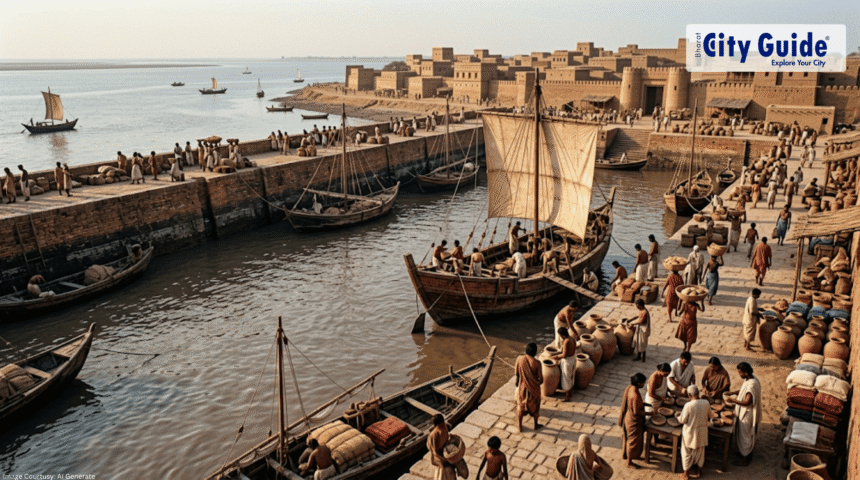
The most remarkable feature of the Harappan Civilization lost port Lothal is its massive dockyard.
Archaeologists believe this structure was designed to allow ships to enter through a canal connected to a nearby river system.
Key features of the dockyard include:
- A rectangular basin measuring approximately 218 meters long
- Thick brick walls designed to withstand water pressure
- Channels controlling water flow and tides
- A nearby warehouse used for storing cargo
Historians believe this dockyard allowed Harappan merchants to load and unload goods efficiently, making Lothal one of the earliest examples of maritime infrastructure.
Maritime Trade in 2500 BCE
The Harappan Civilization lost port Lothal played a central role in ancient international trade networks.
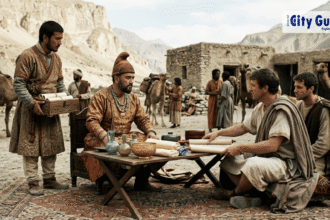
Archaeological discoveries show that Harappan merchants traded with several distant regions.
Major trading partners included:
- Mesopotamia
- Persian Gulf
- Oman
- Bahrain
Evidence of Harappan trade has been found in Mesopotamian cities, where ancient texts refer to a trading region called Meluhha, believed to be the Indus civilization.
Goods Traded Through Lothal
The Harappan Civilization lost port Lothal was famous for its skilled craftsmen and valuable trade goods.
Artifacts found at the site suggest that merchants exported a variety of products.
Exports from Lothal likely included:
- Carnelian beads
- Shell jewelry
- Cotton textiles
- Copper tools
- Precious stones
In return, merchants imported materials such as:
- Silver
- Tin
- Semi-precious stones
- Exotic goods from West Asia
These discoveries demonstrate that the Harappan economy was highly connected with global trade networks of the ancient world.
Advanced Urban Planning at Lothal
Like other cities of the Indus Valley Civilization, the Harappan Civilization lost port Lothal displayed remarkable urban planning.
The city was carefully designed with well-organized streets and drainage systems.
Important features of the city included:
- Grid-pattern streets
- Sophisticated drainage and sanitation systems
- Residential houses built with baked bricks
- Public warehouses and administrative buildings
These innovations demonstrate the advanced engineering knowledge of Harappan society.
The Bead-Making Industry
One of the most unique aspects of the Harappan Civilization lost port Lothal was its bead-making industry.
Archaeologists discovered workshops where craftsmen produced decorative beads using semi-precious stones.
The bead industry involved:
- Cutting stones into small shapes
- Polishing them using specialized tools
- Drilling tiny holes for jewelry
These beads were exported to distant markets, highlighting the craftsmanship and trade skills of the Harappan people.
Why Lothal Declined
Despite its success, the Harappan Civilization lost port Lothal eventually declined around 1900 BCE.
Historians believe several factors may have contributed to its decline.
Possible reasons include:
- Changes in river courses affecting the port’s access to the sea
- Climate changes causing droughts
- Decline of the Indus Valley Civilization itself
- Reduction in international trade networks
Over time, the port was abandoned and gradually buried under layers of soil.
Why Lothal Is Important Today
Today, Lothal remains one of the most important archaeological sites in India.
The site provides valuable insights into ancient trade, engineering, and maritime history.
Key reasons Lothal is historically significant:
- It demonstrates early maritime trade networks
- It contains one of the world’s earliest dockyards
- It highlights the technological achievements of the Harappan civilization
- It shows how ancient societies were connected through global trade
Modern researchers continue to study the Harappan Civilization lost port Lothal to better understand ancient economic systems.
Conclusion
The Harappan Civilization lost port Lothal stands as a remarkable testament to the ingenuity and global outlook of one of the world’s earliest urban civilizations.
Around 2500 BCE, this thriving port connected the Indian subcontinent with distant regions through maritime trade networks. Its advanced dockyard, skilled craftsmanship, and well-planned city layout reveal a society far ahead of its time.
Although the port eventually declined, the archaeological discoveries at Lothal continue to reshape our understanding of ancient history.
More than four millennia later, the story of Lothal remains a powerful reminder that global trade and cultural exchange have deep roots in human civilization.
FAQs
1. What is Lothal in the Harappan Civilization?
Lothal was a major port city of the Indus Valley Civilization known for maritime trade.
2. When was Lothal built?
The city was established around 2500 BCE during the peak of the Harappan Civilization.
3. Why is Lothal famous?
Lothal is famous for having one of the world’s earliest known dockyards and being a major trade center.
4. What goods were traded from Lothal?
Merchants exported beads, cotton textiles, jewelry, and copper tools.
5. Why did Lothal decline?
Possible causes include environmental changes, shifting river routes, and the decline of the Indus Valley Civilization.