Introduction
The history of Southern India is a rich tapestry woven with diverse cultures, traditions, and influences. Among the most significant contributors to this cultural evolution were the Deccan Sultanates cultural fusion, which emerged during the medieval period and left a lasting imprint on the region’s identity.
- Introduction
- What Were the Deccan Sultanates?
- Historical Context and Rise
- What Is Deccan Sultanates Cultural Fusion?
- Architectural Marvels of the Deccan Sultanates
- Influence on Art and Literature
- Language and Literary Fusion
- Music and Performing Arts
- Religious and Social Harmony
- Economic and Trade Contributions
- The Role of Golconda in Global Trade
- Political Dynamics and Conflicts
- The Battle of Talikota
- Legacy of Deccan Sultanates Cultural Fusion
- Influence on Modern South Indian Identity
- Challenges in Preserving This Heritage
- Efforts to Preserve Deccan Heritage
- FAQs
- Conclusion
These Sultanates were not merely political entities; they were vibrant centers of art, architecture, language, and cultural exchange. Their legacy reflects a remarkable blending of Persian, Turkish, and indigenous Indian traditions, creating a unique cultural synthesis that continues to influence South India today.
What Were the Deccan Sultanates?
The Deccan Sultanates were five Islamic kingdoms that ruled parts of the Deccan Plateau between the 15th and 17th centuries.
Major Sultanates:
- Ahmadnagar Sultanate
- Bijapur Sultanate
- Golconda Sultanate
- Bidar Sultanate
- Berar Sultanate
These states emerged after the decline of the Bahmani Sultanate.
Historical Context and Rise
The fragmentation of the Bahmani Sultanate led to the formation of independent kingdoms. Each Sultanate developed its own administrative system, culture, and artistic traditions while maintaining connections with Persian and Central Asian influences.
What Is Deccan Sultanates Cultural Fusion?
Deccan Sultanates cultural fusion refers to the blending of:
- Islamic and Persian traditions
- Local Hindu customs
- Regional languages and art forms
This fusion created a unique cultural identity distinct from North India.
Architectural Marvels of the Deccan Sultanates
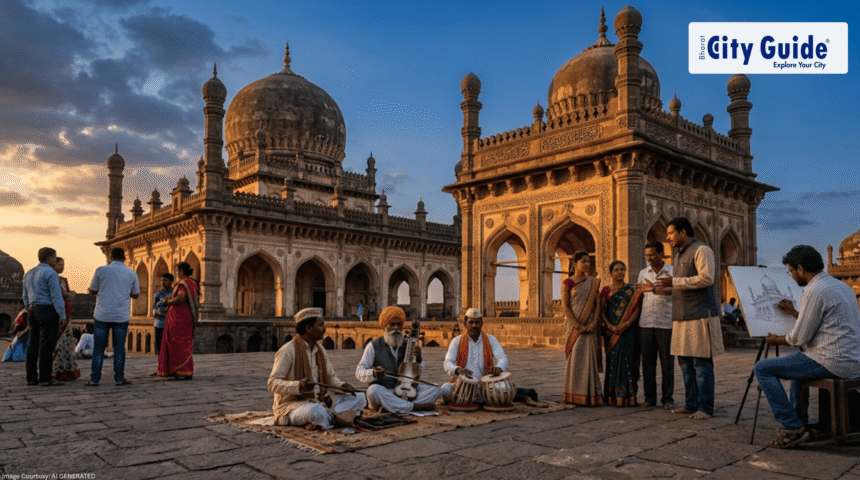
Architecture is one of the most visible examples of cultural fusion.
Key Features:
- Massive domes and arches
- Intricate carvings
- Use of local materials
- Blend of Islamic and Indian styles
Notable Monuments
- Gol Gumbaz – famous for its massive dome
- Charminar – iconic symbol of Hyderabad
- Golconda Fort – known for its acoustic design
Influence on Art and Literature
The Sultanates patronized artists, poets, and scholars.
Key Contributions:
- Development of miniature painting styles
- Promotion of Persian literature
- Emergence of Dakhani language
Language and Literary Fusion
One of the most important aspects of Deccan Sultanates cultural fusion was the development of new languages.
Dakhani Language:
- Blend of Urdu, Persian, and local dialects
- Used in poetry and administration
Music and Performing Arts
The Deccan courts supported diverse musical traditions.
Features:
- Fusion of Persian and Indian music
- Development of new instruments
- Court performances and cultural gatherings
Religious and Social Harmony
The Sultanates promoted a degree of coexistence.
Key Aspects:
- Interaction between different communities
- Shared festivals and traditions
- Influence of Sufi culture
Economic and Trade Contributions
The Deccan Sultanates were economically vibrant.
Highlights:
- Trade with Persia, Arabia, and Europe
- Export of textiles, diamonds, and spices
- Growth of urban centers
The Role of Golconda in Global Trade
The Golconda Sultanate was famous for its diamond mines.
Impact:
- Attracted international traders
- Boosted regional economy
Political Dynamics and Conflicts
While culturally rich, the Sultanates also faced:
- Rivalries among themselves
- Conflicts with the Vijayanagara Empire
- Internal power struggles
The Battle of Talikota
A significant event was the Battle of Talikota, where the Sultanates united against Vijayanagara.
Outcome:
- Fall of Vijayanagara
- Rise of Deccan power
Legacy of Deccan Sultanates Cultural Fusion
The legacy continues to influence modern South India.
Lasting Impacts:
- Architectural heritage
- Linguistic diversity
- Cultural traditions
Influence on Modern South Indian Identity
Cities like Hyderabad reflect this fusion in:
- Cuisine (Hyderabadi biryani)
- Language
- Architecture
Challenges in Preserving This Heritage
- Urbanization
- Neglect of historical sites
- Lack of awareness
Efforts to Preserve Deccan Heritage
Government and organizations are working to:
- Restore monuments
- Promote tourism
- Raise awareness
FAQs
What were the Deccan Sultanates?
Medieval kingdoms in the Deccan region of India.
What is cultural fusion in this context?
A blend of Islamic and Indian traditions.
Why are they important?
They shaped South India’s cultural identity.
What is Dakhani language?
A mix of Urdu, Persian, and local dialects.
Which monuments are famous?
Gol Gumbaz, Charminar, and Golconda Fort.
Conclusion
The Deccan Sultanates cultural fusion represents one of the most fascinating chapters in Indian history. By blending diverse cultural influences, these kingdoms created a unique and enduring legacy that continues to shape Southern India’s identity.
Their contributions to architecture, language, art, and social harmony highlight the power of cultural exchange in building vibrant societies. Understanding this heritage not only enriches our knowledge of the past but also inspires appreciation for diversity in the present.