Introduction
Food security remains one of the most fundamental pillars of social welfare, economic stability, and national development. In a country as vast and diverse as India—where millions depend on affordable access to staple food grains—the relationship between agricultural procurement, welfare distribution, and public policy is central to both poverty reduction and social justice. Against this backdrop, India’s National Food Security Act (NFSA), enacted in 2013, represents one of the world’s largest rights-based food welfare frameworks.
- Introduction
- What is India’s National Food Security Act?
- Why India’s National Food Security Act Was Introduced
- How Rural Procurement Supports the NFSA
- Minimum Support Price (MSP) and Farmer Incentives
- Public Distribution System (PDS): The Delivery Backbone
- Rural India and Distribution Realities
- Benefits of India’s National Food Security Act
- Nutrition vs Calorie Security
- Procurement Concentration and Regional Imbalances
- Technology and Reform in NFSA Implementation
- Financial and Fiscal Considerations
- Crisis Response and Food Security
- Challenges Facing India’s National Food Security Act
- Future of India’s Food Security Framework
- Frequently Asked Questions About India’s National Food Security Act
- Conclusion
India’s National Food Security Act was designed to legally entitle a substantial portion of the population to subsidized food grains through the Public Distribution System (PDS), while also strengthening nutritional support for vulnerable groups such as pregnant women, lactating mothers, and children. The Act aimed not only to reduce hunger but also to institutionalize food access as a welfare commitment.
However, the true performance of the NFSA depends on more than policy design. Its effectiveness is deeply tied to:
- Rural procurement systems
- Minimum Support Price (MSP) structures
- Food Corporation logistics
- Distribution efficiency
- Leakages
- Beneficiary identification
- State-level governance capacity
Analysing India’s National Food Security Act requires examining how well it balances farmer procurement incentives with equitable household food access, particularly in rural India where agricultural livelihoods and welfare dependency often intersect.
Understanding this law offers insight into how one of the world’s largest food systems attempts to bridge agriculture, welfare, and social protection.
What is India’s National Food Security Act?
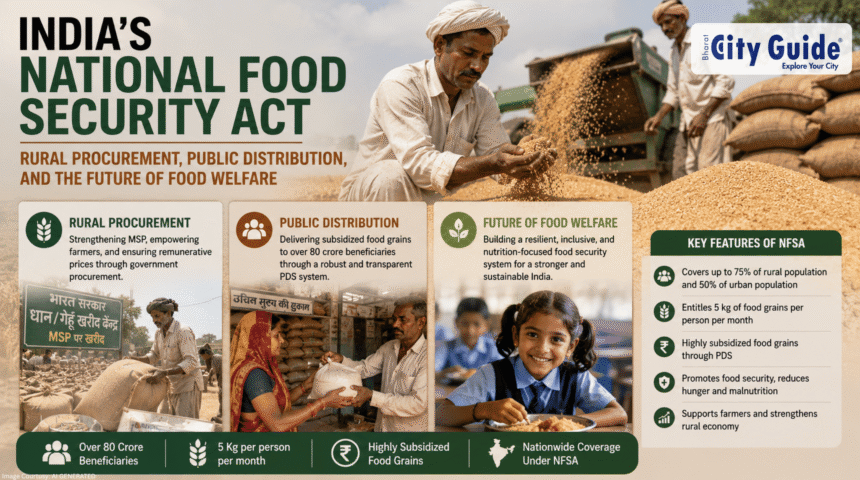
India’s National Food Security Act (NFSA) is a major welfare legislation that seeks to provide subsidized food grains to eligible households through a rights-based framework.
Core Objective:
Ensure affordable food access for a large share of the population.
Main Provisions:
- Subsidized rice, wheat, and coarse grains
- Targeted Public Distribution System (TPDS)
- Nutritional support for women and children
- Legal entitlements
In Simple Terms:
It aims to make essential food grains more accessible for vulnerable populations.
Why India’s National Food Security Act Was Introduced
Key Drivers:
- Poverty
- Hunger
- Malnutrition
- Food price volatility
- Rural vulnerability
Strategic Goal:
Shift from welfare discretion toward legal food entitlement.
Public Policy Significance:
Food security became a governance responsibility.
How Rural Procurement Supports the NFSA
The NFSA depends heavily on procurement from farmers.
Main Mechanism:
Government agencies purchase grains, often at MSP.
Major Benefits:
- Supports farmers
- Builds buffer stocks
- Enables welfare distribution
Strategic Link:
Procurement and welfare are structurally interconnected.
Minimum Support Price (MSP) and Farmer Incentives
Why MSP Matters:
It can:
- Encourage production
- Stabilize incomes
- Support procurement systems
Key Challenge:
Procurement may be regionally uneven.
Important Concern:
Some states benefit more than others due to infrastructure differences.
Public Distribution System (PDS): The Delivery Backbone
Core Role:
Distribute subsidized food grains to beneficiaries.
Potential Strengths:
- Large reach
- Poverty support
- Welfare continuity
Common Challenges:
- Leakages
- Diversion
- Identification errors
- Supply inefficiencies
Rural India and Distribution Realities
Major Rural Strengths:
- Wider need-based relevance
- Welfare dependence
- Agricultural integration
Persistent Challenges:
- Last-mile delivery
- Storage
- Transportation
- Digital exclusion
- Administrative quality
Key Lesson:
Infrastructure often determines policy effectiveness.
Benefits of India’s National Food Security Act
Potential Positive Outcomes:
- Reduced food insecurity
- Affordable grain access
- Welfare safety net
- Nutritional support
- Social protection
Broader Social Value:
Food access can stabilize vulnerable households.
Nutrition vs Calorie Security
Important Debate:
Does food grain distribution alone ensure nutrition?
Concern:
Staples may reduce hunger, but balanced nutrition may still require:
- Protein
- Micronutrients
- Dietary diversity
Strategic Insight:
Food security and nutrition security are related but distinct.
Procurement Concentration and Regional Imbalances
Common Issue:
Certain agricultural states often dominate procurement.
Potential Effects:
- Regional inequality
- Crop concentration
- Water stress concerns
Policy Challenge:
How to diversify sustainably?
Technology and Reform in NFSA Implementation
Emerging Tools:
- Digitization
- Aadhaar-linked systems
- E-POS devices
- Supply chain monitoring
Potential Benefits:
- Leak reduction
- Better targeting
- Transparency
Risks:
- Exclusion errors
- Technical barriers
Financial and Fiscal Considerations
Major Questions:
- Cost sustainability
- Subsidy burden
- Storage costs
- Efficiency
Strategic Reality:
Large welfare systems require constant balancing of fiscal and social priorities.
Crisis Response and Food Security
During economic or social disruptions, food systems become even more critical.
NFSA Strength:
Can serve as a resilience mechanism.
Policy Lesson:
Strong welfare logistics can support national stability.
Challenges Facing India’s National Food Security Act
Major Issues:
- Leakage
- Identification gaps
- Regional disparity
- Nutrition quality
- Fiscal burden
- Procurement concentration
Bigger Reality:
Scale creates both strength and complexity.
Future of India’s Food Security Framework
Strategic Priorities:
- Nutrition-sensitive reforms
- Crop diversification
- Better storage
- Improved inclusion
- Rural logistics modernization
Broader Goal:
Move from grain security toward comprehensive food resilience.
Frequently Asked Questions About India’s National Food Security Act
What is the NFSA?
A law providing subsidized food grain access to eligible populations.
Who benefits?
Eligible households, women, and children under specified provisions.
Why is procurement important?
Without grain procurement, distribution systems cannot function effectively.
Does NFSA solve malnutrition?
It supports food access, but broader nutrition requires more.
What is the biggest challenge?
Efficient implementation and equitable reach.
Is technology improving the system?
It may improve transparency but can also create access concerns.
Why is rural procurement important?
It connects agriculture with welfare.
Conclusion
India’s National Food Security Act stands as one of the most ambitious food welfare systems in the world, linking farmer procurement, public distribution, and social protection on a national scale. Its impact on hunger reduction and household food access has made it a central pillar of India’s welfare architecture.
Yet, its long-term success depends not only on grain procurement and distribution volume, but on improving efficiency, reducing leakages, strengthening nutrition outcomes, and ensuring equitable access across diverse populations.
As India’s food policy evolves, the future challenge is clear: transforming food security from basic calorie access into a more inclusive, nutritionally robust, and sustainable system that supports both farmers and consumers alike.