Introduction
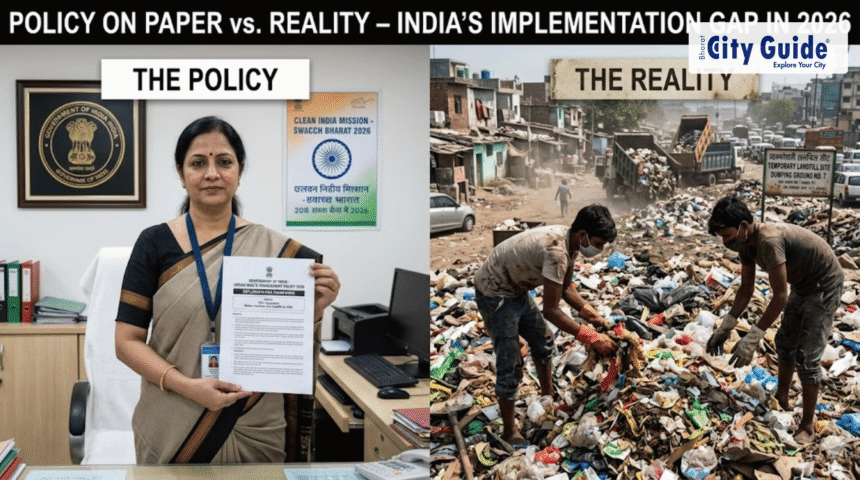
India in 2026 is a nation brimming with ambitious policies. From Viksit Bharat 2047’s long-term vision to climate targets, digital regulation, labour reforms, and welfare schemes, the country has no shortage of ideas. Yet, the challenge is translating these policies into real, tangible improvements in citizens’ lives—in cities, towns, and villages.
- Introduction
- Policy Overview – The “Policy Maze” of 2026
- Policy in Simple Terms
- Key Issues in Policy Implementation
- Who Benefits, Who Struggles – Ground Reality vs Intent
- Expected Reforms and Emerging Solutions
- Real-Life or Practical Implications
- What This Means for Common Citizens
- Future Outlook
- Conclusion: What Citizens Should Know
- FAQ
The Economic Survey 2025–26 highlights a crucial reality: India’s macro buffers are strong, and reforms are underway, but the biggest constraint is implementation, shaped by institutional incentives, bureaucratic culture, and coordination capacity. Independent research confirms that visionary schemes often stumble due to systemic inefficiencies.
This article examines the gap between policy on paper and reality on the ground, exploring challenges, emerging solutions, and practical implications for citizens.
Policy Overview – The “Policy Maze” of 2026
India’s policy landscape in 2026 resembles a dense maze:
- Long-term visions: Viksit Bharat 2047 targets a developed India by 2047, with structural reforms in economy, infrastructure, social welfare, and climate.
- Sectoral reforms: Labour Codes, GST 2.0, infrastructure projects, digital regulations, and climate policies are being implemented simultaneously.
- Welfare schemes: Food security, cash transfers, health insurance, and pensions cover hundreds of millions of people.
Despite abundant policy activity, analysts stress that macro stability and budgets alone do not guarantee better outcomes. Implementation depends on how civil servants interpret their mandates, how regulators function, and whether incentive systems reward initiative over procedural compliance.
Policy in Simple Terms
India’s challenge today is not about the number of schemes, but about whether these schemes work as intended. Citizens experience policy impact differently depending on local governance, state capacity, and awareness.
In essence, the country’s governance challenge is: We have policies. Now, can we make them matter in everyday life?
Key Issues in Policy Implementation
Research, government analyses, and the Economic Survey 2025–26 identify several recurring hurdles:
1. Bureaucratic Incentives and Risk Aversion
- Officials often face higher personal or political risk for taking initiative than for following strict procedures.
- Consequence: Excessive paperwork, “safe” decisions, and delays in delivering citizen services.
- Result: Policies may exist, but citizens experience friction and frustration.
2. Fragmentation and Coordination Gaps
- Many programs require collaboration between central ministries, state departments, and local bodies.
- Coordination failures lead to duplication, confusion, and delayed delivery.
- Citizens trying to navigate multiple schemes often struggle with eligibility, documentation, and approvals.
3. Underfunding and Capacity Constraints
- Ambitious policies in education, healthcare, rural development, and climate adaptation are frequently underfunded relative to their objectives.
- Frontline staff shortages—teachers, health workers, local administrators—limit the quality and reach of services.
4. Weak Monitoring and Feedback Loops
- Schemes are rarely tracked using outcome-based metrics.
- Policies often continue even when evidence shows limited or skewed impact.
- Lack of monitoring means there are few course-correction mechanisms on the ground.
5. Electoral and Short-Term Pressures
- High-visibility “freebies” and direct benefits sometimes crowd out structural reforms.
- Politically driven, short-term measures can undermine long-term policy effectiveness.
Who Benefits, Who Struggles – Ground Reality vs Intent
Implementation gaps create uneven outcomes across states and social groups:
- Better-off regions and capable states: Schemes often succeed, amplifying existing advantages.
- Weaker states and marginalised groups: Partial or delayed delivery widens regional and social disparities.
- Middle-class/formal sector citizens: Easier navigation of digital systems and documentation.
- Poor or less literate citizens: Higher risk of exclusion due to procedural hurdles.
The Economic Survey emphasizes that governance is project-oriented and time-bound, benefiting from flexible teams, incentive alignment, and risk-tolerant administration.
In short, the quality of outcomes depends less on the policy itself and more on execution, incentives, and local governance capacity.
Expected Reforms and Emerging Solutions
Despite persistent challenges, several trends aim to bridge the implementation gap:
1. Focus on “Entrepreneurial Governance”
- Encourages piloting innovative solutions, learning from success, and scaling what works.
- Shifts focus from rule enforcement to problem-solving and measurable outcomes.
2. Compliance Reduction and Deregulation
- Simplifying regulations reduces bureaucratic friction.
- Helps civil servants and citizens navigate schemes faster, promoting effective delivery.
3. Regulators and Independent Bodies
- Specialised regulatory agencies improve continuity, expertise, and oversight.
- Raises questions of accountability, transparency, and fairness.
4. Citizen Feedback Platforms and Digital Tools
- Apps, portals, and grievance mechanisms allow citizens to track progress and report failures.
- Examples include MyGov, RTI portals, e-Shram tracking, and local service dashboards.
- Effective use improves transparency and government responsiveness, but accessibility and follow-up are crucial.
5. Outcome-Based Monitoring and Evaluation
- Shift from inputs (funds spent, forms filed) to outcomes (learning, health, service reliability).
- Allows policymakers to adapt schemes in real time, rather than continuing ineffective programs.
Real-Life or Practical Implications
For an ordinary citizen, implementation gaps manifest as everyday frictions:
- A scheme exists but is poorly advertised, leaving people unaware of eligibility.
- Online portals register applications but stall processing.
- Local offices demand repeated visits due to fear of responsibility or poor coordination.
For professionals, such as policy writers, coaches, or wellness consultants in Rajkot, understanding these gaps is essential:
- Explains why outcomes vary between districts.
- Highlights why success stories and failures coexist under the same policy label.
What This Means for Common Citizens
- Citizens should use feedback tools, RTI, and grievance redress platforms.
- Local media and civil society can monitor scheme implementation and amplify gaps.
- Policy literacy—knowing entitlements and avenues for complaint—is a practical empowerment tool.
Future Outlook
Analysts predict 2026–2030 will be shaped by:
- Sustained high economic growth to meet long-term objectives like Viksit Bharat 2047.
- Rising welfare commitments, particularly direct cash transfers and targeted schemes.
- Governance reforms focusing on delivery, better incentive structures, data-driven monitoring, and institutional redesign.
Economic Survey 2025–26 recommends rewarding problem-solving over procedural compliance and differentiating between honest mistakes and corruption, promoting accountable, responsive governance.
Conclusion: What Citizens Should Know
The era of launching policies is over; the real test is making them work on the ground.
- For citizens: Know your entitlements, track schemes, and engage with grievance platforms.
- For administrators: Incentives must reward initiative, risk-taking, and effective problem-solving.
- For policymakers: Focus must shift from adding new schemes to improving quality, access, and impact of existing ones.
Every scheme now prompts two questions:
- Who ensures it works where I live?
- How can I track progress or seek recourse if it fails?
Active participation and vigilance are key to closing the policy-to-reality gap.
FAQ
Q1: What is India’s implementation gap?
A: It is the difference between policy design and actual delivery, often caused by bureaucratic incentives, coordination failures, and capacity constraints.
Q2: Why do some schemes fail in India?
A: Factors include risk-averse officials, underfunding, staff shortages, fragmented coordination, and weak monitoring.
Q3: How can citizens help bridge the gap?
A: Use feedback platforms, RTI, grievance mechanisms, and local media, and monitor policy outcomes.
Q4: What is “entrepreneurial governance”?
A: Governance that encourages calculated risk-taking, innovation, and scaling successful pilots rather than strict procedural compliance.
Q5: How are digital tools improving implementation?
A: Apps, portals, and dashboards track progress, register complaints, and enhance transparency, making schemes more accountable.
Q6: Does policy implementation vary across India?
A: Yes. Better-off states implement more effectively, while weaker states and marginalized groups may face delays or partial access.
Q7: What is the role of outcome-based monitoring?
A: It measures impact rather than inputs, helping policymakers adapt programs in real-time to maximize effectiveness.
Q8: How does this relate to Viksit Bharat 2047?
A: Effective policy execution is critical for long-term goals like economic development, social equity, and infrastructure targets, ensuring that citizens benefit equitably.