Introduction
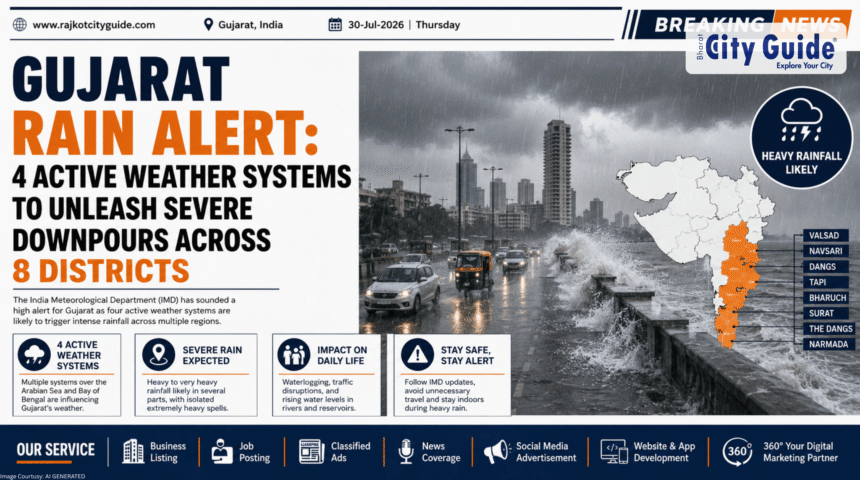
The Indian Meteorological Department (IMD) has issued a critical Gujarat Rain Alert as the state braces for an intense spell of monsoon fury over the next six days. A rare meteorological phenomenon has developed over the region, with four powerful weather systems simultaneously becoming active over Gujarat and its adjoining areas. This atmospheric convergence is set to trigger exceptionally heavy to very heavy rainfall across multiple districts, prompting state authorities to go into high alert.
- Introduction
- What is Gujarat Rain Alert?
- Why This News is Important
- Background Information
- Key Highlights
- Detailed Explanation of the Event
- Importance of Early Warning Systems
- How It Impacts People
- Expert Insights / Industry Perspective
- Challenges and Limitations
- Future Outlook
- Frequently Asked Questions (FAQs)
- Conclusion
Recognizing the imminent threat to public safety and infrastructure, the weather department has escalated warnings across major urban centers and rural belts. For regions like Surat and seven neighboring districts, an immediate orange alert has been placed. Meanwhile, the threat level peaks on July 31, with a severe red alert issued for Vadodara, Ahmedabad, Anand, Bharuch, Narmada, Tapi, and Dang.
In response to the alarming forecasts, local administrations have taken proactive measures. The Vadodara district administration has officially declared a holiday for all educational institutions, including schools and colleges, on July 31 to prevent any untoward incidents.
As low-lying urban sectors prepare for potential waterlogging and rural belts brace for rising river levels, understanding the scale of this monsoon development is essential for every resident. This extensive report breaks down the science behind the active systems, administrative preparations, and critical safety guidelines for citizens during this extended high-alert period.
What is Gujarat Rain Alert?
A Gujarat Rain Alert is an official meteorological warning issued by the Indian Meteorological Department (IMD) to communicate potential risks associated with severe rainfall events in the state. These alerts are categorized using a standardized color-coded system—Yellow, Orange, and Red—to signify the increasing severity of the weather and the corresponding level of preparation required by citizens and disaster management teams.
- Yellow Alert: Indicates watchfulness. It implies that bad weather is possible and could degrade localized conditions, though day-to-day activities may not be completely disrupted.
- Orange Alert: Signals preparation. This indicates a high probability of heavy to very heavy rainfall that can significantly disrupt transport, power supplies, and daily infrastructure.
- Red Alert: Demands immediate action. Reserved for extremely heavy rainfall scenarios, a red alert implies that communities must take active safety precautions as severe flooding, waterlogging, and transport closures are highly likely.
The current Gujarat Rain Alert is particularly significant because it is driven by four overlapping atmospheric cyclonic circulations and low-pressure troughs. When multiple systems merge, they continuously feed moisture from both the Arabian Sea and the Bay of Bengal into the mainland, resulting in sustained, high-intensity downpours over several days rather than a passing thunderstorm.
Why This News is Important
This weather development carries critical importance due to its direct impact on human life, urban stability, and economic activities. Gujarat’s unique geography, featuring a long coastline alongside heavily populated industrial hubs like Surat, Ahmedabad, and Vadodara, makes it highly sensitive to extreme precipitation events.
Firstly, the synchronization of four weather systems means the volume of water precipitated over a short duration could overwhelm existing drainage systems. Urban centers are highly susceptible to flash floods, which trap citizens, stall public transit, and halt commercial activity.
Secondly, the timing of the red alert necessitates swift systemic shifts, such as the pre-emptive closure of schools and academic institutions in Vadodara. Ensuring students remain safely indoors reduces the pressure on emergency rescue operations if streets flood rapidly during school hours.
Lastly, it puts the State Emergency Operation Center (SEOC) and national disaster response forces on the highest tier of mobilization, serving as a live test of the region’s climate resilience and disaster mitigation strategies.
Background Information
The ongoing monsoon season in Gujarat has displayed highly erratic and localized weather patterns. While some regions like Devbhumi Dwarka have experienced relatively lower cumulative rainfall, other pockets like Valsad and Navsari have recorded nearly 100% of their seasonal average within a condensed timeframe. A striking example of this extreme behavior occurred in Dholka, where an unprecedented 20 inches of rain fell in a mere two hours, causing massive flash floods.
This sharp variability highlights the changing dynamics of the Indian subcontinental monsoon, where short, violent bursts of rainfall are replacing evenly distributed seasonal showers. The accumulation of moisture from four simultaneous weather systems—including low-pressure troughs over the Arabian Sea and cyclonic circulations over central India—creates a massive atmospheric funnel directly over the Gujarat landmass.
Historically, such overlapping systems have triggered notable historical floods in the Vishwamitri river basin in Vadodara and the Tapi river basin in Surat, making the current warnings a top priority for state climatologists and administrators alike.
Key Highlights
- Six-Day Critical Window: Meteorological models indicate that the next six days are incredibly vulnerable, with four active weather systems dumping rain continuously.
- Red Alert for 8 Districts: A severe red alert is enforced for July 31 across Ahmedabad, Vadodara, Surat, Anand, Bharuch, Narmada, Tapi, and Dangs.
- Orange Alert Areas: Immediate orange alerts govern Surat and seven other districts, alongside parts of the Saurashtra region.
- Educational Closures: Vadodara has declared a total holiday for schools and colleges on July 31 as a primary safety measure.
- Mass Evacuations: Over 53,600 citizens have already been moved to safer, elevated locations across South Gujarat, with 9,600 rescued directly from floodwaters.
- High-Level Deployment: NDRF, SDRF, the Indian Coast Guard, and Army units are mapped and pre-positioned for immediate rescue operations.
Detailed Explanation of the Event
The unfolding meteorological event in Gujarat is a consequence of extreme atmospheric instability. The IMD notes that the presence of four distinct weather systems has created a conveyor belt of moisture-laden winds targeting the state. The primary impact zones are shifting dynamically, moving from South Gujarat up toward Central and Northern regions over the six-day forecast period.
On July 29 and 30, heavy to very heavy rainfall targeted Panchmahal, Dahod, Vadodara, Bharuch, and Surat. The intensity is projected to peak significantly on July 31, where the status elevates to a Red Alert for the major urban corridors of Ahmedabad, Vadodara, and Surat. Following this, by August 1, the core of the heavy downpour is expected to shift toward North Gujarat, which will then experience an Orange Alert.
+-------------------------------------------------------------+
|               CHRONOLOGICAL WEATHER FORECAST                |
+------------------------------+------------------------------+
| DATE / PERIOD                | EXPECTED WEATHER STATUS      |
+------------------------------+------------------------------+
| July 29 - July 30            | Heavy rain in Panchmahal,    |
|                              | Dahod, Bharuch, & Surat      |
+------------------------------+------------------------------+
| July 31 (Peak Danger)        | RED ALERT: Ahmedabad, Surat, |
|                              | Vadodara, Anand, & Bharuch   |
+------------------------------+------------------------------+
| August 1                     | ORANGE ALERT: Shift towards  |
|                              | Northern Gujarat districts   |
+------------------------------+------------------------------+
To manage the situation, Relief Commissioner Gaurang Makwana chaired a critical “Weather Watch Group” meeting at the State Emergency Operation Center (SEOC) in Gandhinagar. The administration has ordered the immediate removal of weak commercial hoardings, banners, and the cordoning off of dilapidated architectural structures to prevent wind-and-rain-induced collapses.
Furthermore, local municipal commissioners, particularly in Surat and Vadodara, have urged citizens to minimize non-essential movement, especially during peak nighttime hours when visibility drops and water accumulates rapidly.
Importance of Early Warning Systems
The active distribution of the Gujarat Rain Alert highlights the monumental importance of early warning frameworks in modern disaster management. Rather than reacting to floods after they occur, the pre-emptive mapping of weather systems allows a sequence of protective measures:
- Preservation of Life: Moving vulnerable communities before waters rise drastically reduces casualty rates.
- Resource Management: Disaster response teams National Disaster Response Force (NDRF) State Disaster Response Fund/Force (SDRF) can position heavy boats, dewatering pumps, and medical kits in districts before roads become impassable.
- Infrastructure Control: Dams can execute planned, incremental releases of water rather than sudden, massive discharges that submerge downstream villages.
- Economic Mitigation: Businesses, logistics firms, and cargo hubs at ports can alter schedules, reducing damage to goods and vehicles.
How It Impacts People
Students and Educational Institutions
The immediate impact is felt by the student community. With Vadodara announcing a holiday on July 31, thousands of children stay out of transit risks. Other districts under the Red Alert zone are constantly evaluating local conditions, and parents are advised to keep track of official collector mandates before sending children to schools.
Daily Commuters and Travelers
Urban flooding immediately paralyzes public transport systems, including local buses and trains. Low-lying subways and underpasses in cities like Ahmedabad and Surat face swift closure due to water accumulation. Commuters risk vehicle breakdowns, extreme traffic snarls, and structural road cave-ins.
Farmers and Rural Communities
While monsoonal rain is crucial for Kharif crops, excessive downpours lead to crop washing, field submergence, and soil erosion. Rural populations living near active riverbanks face the threat of sudden dam water releases, affecting livestock and mud-brick housing.
Industrial and Business Sectors
Gujarat’s manufacturing and diamond-processing facilities rely heavily on supply chain logistics. Interrupted highway connectivity across the Golden Corridor (Ahmedabad-Vadodara-Surat-Mumbai) delays raw materials and halts daily shifts, causing minor economic shocks to daily-wage workers and logistics entities.
Expert Insights / Industry Perspective
Disaster management experts and meteorologists point out that the current scenario requires localized execution rather than generic state-wide alerts. Weather experts emphasize that when multiple systems align, traditional precipitation models can underreport the actual rainfall, leading to localized cloudburst-like events, similar to what occurred in Dholka.
Climatologists suggest that the extreme contrast between dry zones and high-saturation zones within the state is a clear marker of climate volatility. Emergency management professionals praise the “Weather Watch” protocol, stating that the primary focus must always remain on ensuring that early warnings reach the lowest economic strata—such as migratory laborers living on construction sites or temporary settlements—as they lack sturdy shelters to withstand sustained six-day downpours.
Challenges and Limitations
Despite high levels of preparation, mitigating the effects of a sustained Gujarat Rain Alert comes with notable challenges:
- Urban Micro-Flooding: Older structural designs and concrete paving prevent natural water absorption, causing severe waterlogging even if municipal pumps work at maximum capacity.
- Communication Gaps: Reaching remote rural pockets or marginalized urban slums via digital alerts can be slow, leaving them dependent on word-of-mouth warnings.
- Erratic Weather Shifts: The rapid movement of cyclonic circulations makes it difficult to pin down the exact hour a local cloudburst might occur, reducing the reaction time for evacuations.
- Refusal to Evacuate: In many rural zones, citizens often delay moving to temporary state shelters out of fear of losing their livestock or domestic belongings to theft.
Future Outlook
As the state navigates this intense six-day window, the focus will gradually pivot from emergency rescue to post-flood rehabilitation and health management. Once the four active systems weaken or drift toward central India, municipal corporations will face the massive task of draining accumulated water from basements, cleaning debris, and repairing damaged asphalt networks.
In the long term, these recurrent severe alerts will compel Gujarat’s urban planners to redesign city infrastructure. Incorporating “sponge city” concepts, expanding storm-water drain capacities, and creating artificial retention lakes will become vital steps to ensure that future active weather systems do not cause widespread urban standstills.
Frequently Asked Questions (FAQs)
1. What triggered the current major Gujarat Rain Alert?
The alert is triggered by the simultaneous activation of four distinct weather systems—consisting of low-pressure troughs and cyclonic circulations—drawing massive moisture reserves into Gujarat.
2. Which districts are placed under a Red Alert for July 31?
A severe Red Alert has been issued for eight key districts: Ahmedabad, Vadodara, Surat, Anand, Bharuch, Narmada, Tapi, and Dang.
3. Are schools and colleges closed due to the heavy rain forecast?
Yes, the Vadodara district administration has officially declared a holiday for all educational institutions on July 31. Residents in other red-alert districts should track updates from their respective local collectors.
4. What is the difference between an Orange Alert and a Red Alert?
An Orange Alert advises residents to prepare for severe disruptions due to heavy rain, while a Red Alert signifies extremely heavy rainfall and demands immediate action to ensure personal safety.
5. How many people have been evacuated so far due to the floods?
State emergency forces have successfully evacuated more than 53,600 citizens from high-risk zones in South Gujarat, rescuing over 9,600 people directly from active floodwaters.
6. How long is this severe weather system expected to last?
According to the IMD, the state faces a heavy weather window spanning at least six days, with the intensity gradually shifting toward North Gujarat by the start of August.
7. What safety measures should citizens follow during a Red Alert?
Citizens should stay indoors, avoid traveling through flooded underpasses, store adequate clean drinking water, keep electronic devices charged, and strictly follow updates from local administrative bodies.
Conclusion
The active convergence of four potent weather systems presents a significant environmental challenge for Gujarat. With an active Gujarat Rain Alert driving orange and red warnings across high-population zones like Surat, Vadodara, and Ahmedabad, safety remains the absolute priority. The preemptive school closures in Vadodara and the strategic relocation of over 53,000 citizens demonstrate the state’s active stance toward minimizing casualties.
As the state navigates this six-day weather window, the collective cooperation of citizens is vital. By adhering to official administrative directives, avoiding unnecessary travel, and remaining alert to changing local conditions, communities can effectively mitigate the risks of this severe monsoon phase. Stay safe, monitor official channels, and prioritize well-being above all else during this period of intense weather activity.