Introduction
Few technological advances have had a more direct impact on human survival than the Green Revolution. Beginning in the 1940s, agricultural innovations led by scientists such as Norman Borlaug transformed food production on a global scale. High-yield hybrid seeds, combined with fertilizers, irrigation, and improved farming practices, dramatically increased crop output and helped avert mass famine.
- Introduction
- The World Before the Green Revolution
- Norman Borlaug and the Birth of High-Yield Crops
- How Green Revolution Agriculture Worked
- Real-World Impact: Feeding Billions
- Population Growth and Food Security
- Criticisms and Trade-Offs
- Evolution Into Modern Sustainable Agriculture
- Why the Green Revolution Matters Today
- A Counterfactual: A World Without the Green Revolution
- Conclusion
The story of green revolution agriculture is fundamentally about survival. At a time when population growth threatened to outpace food supply, these innovations ensured that billions of people could be fed. Today, as the global population approaches 8 billion, the Green Revolution remains one of the most important examples of technology preventing large-scale human catastrophe.
The World Before the Green Revolution
Before the mid-20th century, agriculture was highly vulnerable to nature. Crop yields were low and unpredictable, especially in developing regions. A poor monsoon, drought, or plant disease could trigger widespread famine.
In the first half of the 20th century, many experts feared that population growth would inevitably lead to global starvation. Countries in Asia, Latin America, and parts of Africa struggled to feed rapidly growing populations using traditional farming methods.
Food insecurity was not theoretical. Famines in India, China, and Europe had killed millions within living memory. Against this backdrop, the Green Revolution emerged not as a luxury, but as a necessity for survival.
Norman Borlaug and the Birth of High-Yield Crops
At the center of green revolution agriculture was Norman Borlaug, an American agronomist working in Mexico in the 1940s and 1950s. Borlaug focused on improving wheat varieties to increase yields and resist disease.
His key breakthrough was the development of dwarf, high-yield wheat. Traditional wheat plants often collapsed under the weight of heavy grain heads, especially when fertilized. Borlaug’s dwarf varieties were shorter and sturdier, allowing them to absorb more nutrients and produce far more grain per acre.
These hybrid seeds matured faster, resisted rust diseases, and could be grown in multiple climates. The result was a dramatic leap in productivity.
How Green Revolution Agriculture Worked
The Green Revolution was not a single invention but a technological system. Its success depended on several interconnected components:
- High-yield hybrid seeds for wheat, rice, and maize
- Synthetic fertilizers to replenish soil nutrients
- Irrigation systems to stabilize water supply
- Pesticides and herbicides to control crop losses
- Mechanized farming equipment to scale production
Together, these technologies transformed farming from a largely weather-dependent activity into a more controlled and predictable system.
In many regions, crop yields doubled or even tripled within a generation. This sudden increase reshaped national food supplies and global grain markets.
Real-World Impact: Feeding Billions
The impact of the Green Revolution was most dramatic in Asia and Latin America. Countries that once relied on food imports or emergency aid became self-sufficient or even net exporters of grain.
India is a widely cited example. In the 1960s, it faced recurring food shortages and famine risk. After adopting Green Revolution wheat and rice varieties, India achieved food self-sufficiency within a decade.
According to estimates frequently cited by the Food and Agriculture Organization (FAO) and historians of agriculture, Green Revolution technologies helped prevent up to one billion deaths that might otherwise have occurred due to famine and malnutrition during the 20th century.
This scale of impact places green revolution agriculture among the most life-saving technologies in human history.
Population Growth and Food Security
One of the defining features of the modern world is population size. In 1950, the global population was about 2.5 billion. Today, it exceeds 8 billion.
Without the yield gains of the Green Revolution, feeding this many people would have required vastly more farmland, accelerating deforestation and environmental collapse. Instead, higher productivity allowed more food to be grown on roughly the same amount of land.
In this sense, green revolution agriculture not only fed billions but also buffered ecosystems from even greater expansion of farmland.
Criticisms and Trade-Offs
While the Green Revolution saved lives, it also introduced challenges. Heavy reliance on fertilizers and pesticides contributed to soil degradation, water pollution, and declining biodiversity in some regions.
Small farmers sometimes struggled to afford inputs, leading to inequality in who benefited most from new technologies. Irrigation projects occasionally strained water supplies.
These issues are real and important. However, they must be weighed against the alternative: widespread famine on a global scale. The Green Revolution did not eliminate hunger everywhere, but it prevented the kind of mass starvation that many experts once believed inevitable.
Evolution Into Modern Sustainable Agriculture
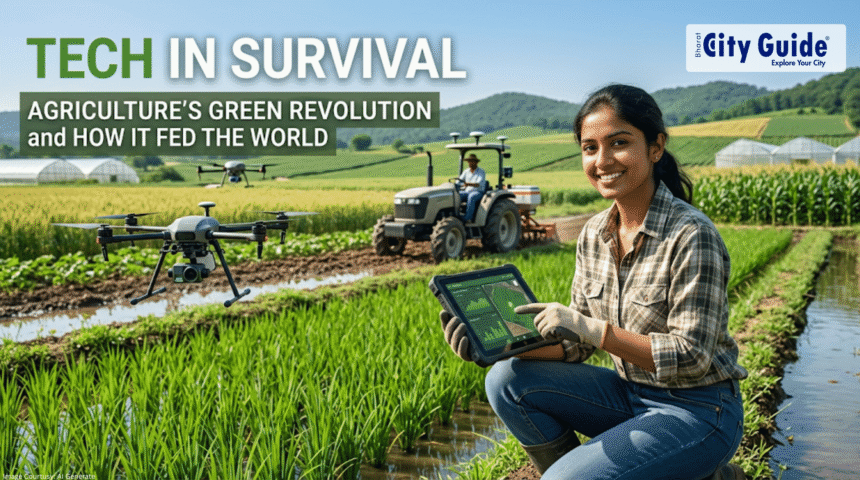
Today’s agricultural innovation builds directly on Green Revolution foundations while addressing their limitations. Precision farming, improved crop genetics, integrated pest management, and climate-resilient seeds aim to increase yields with fewer environmental costs.
Rather than rejecting green revolution agriculture, modern systems are refining it. The core lesson remains the same: technology is essential to feeding large populations.
As climate change introduces new stresses, the need for continued innovation in agriculture is as urgent as it was in the 1940s.
Why the Green Revolution Matters Today
The importance of the Green Revolution is not confined to history. It explains why modern civilization can exist at its current scale.
Survival at Scale
Feeding 8 billion people requires reliable, high-output food systems. Local, low-yield agriculture alone cannot meet this demand.
Stability and Peace
Food scarcity is a major driver of conflict and political instability. By reducing famine risk, green revolution agriculture has contributed to global stability.
Foundation for Urban Life
Modern cities depend on surplus food produced elsewhere. Without agricultural technology, large urban populations would collapse.
The Green Revolution shows that technology is not optional when survival is at stake.
A Counterfactual: A World Without the Green Revolution
Without Green Revolution technologies, global food production would lag far behind population growth. Prices would skyrocket, malnutrition would spread, and famines would be frequent.
Humanity would likely be forced into drastic population checks through starvation, conflict, and disease. Modern life expectancy and global development would be impossible to sustain.
In this context, the Green Revolution represents a rare moment where technology decisively bent history away from catastrophe.
Conclusion
The story of green revolution agriculture is the story of technology applied directly to survival. Beginning with Norman Borlaug’s hybrid seeds in the 1940s, agricultural innovation doubled yields, prevented massive famines, and enabled the modern world to feed billions.
While not without costs, the Green Revolution remains one of humanity’s greatest life-saving achievements. As the global population grows and climate pressures intensify, its central lesson endures: without agricultural technology, modern civilization cannot survive.