Introduction
India faces mounting climate risks, with extreme weather costing the economy ₹3-4 lakh crore annually, affecting agriculture, urban infrastructure, and public health. In response, the National Green Hydrogen Mission (NGHM), launched in 2023 under NAPCC, aims to accelerate the transition to clean energy, reduce dependence on fossil fuels, and position India as a global leader in green hydrogen.
By 2026, NGHM is central to India’s net-zero by 2070 vision, aligning with renewable energy expansion, industrial decarbonization, and the emerging green technology economy.
Policy Overview
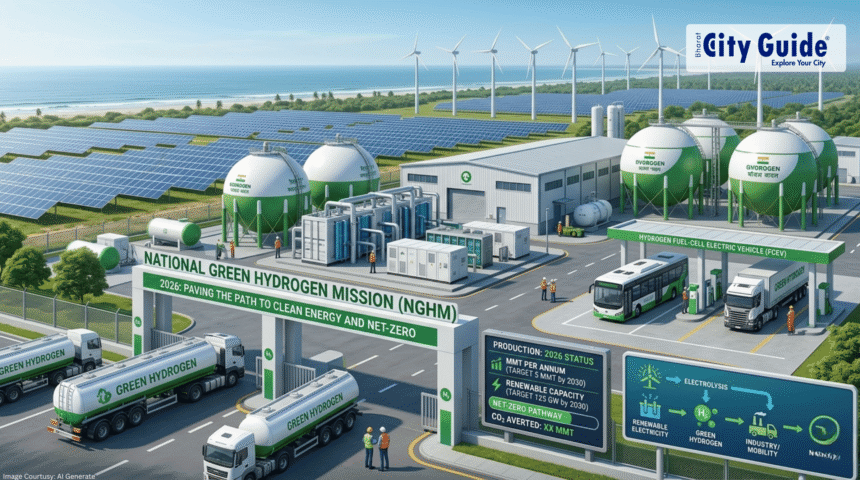
The NGHM is a ₹19,744 crore initiative targeting 5 million metric tonnes (MMT) of green hydrogen production by 2030. It also emphasizes derivatives like green ammonia and integrated energy storage.
Key components include:
- SIGHT Program: Incentivizes electrolyser manufacturing and deployment
- Demand Creation: Subsidies and PLI incentives for steel, fertilizer, and refining industries
- Renewable Energy Buildout: 125 GW RE capacity dedicated to hydrogen production
- Storage & Distribution: 10 GWh battery storage and tenders for 4.12 LMT H2 supply
Budget 2026 Focus:
- Green taxonomy clarity for energy projects
- Integration with carbon markets and CCUS research
- Incentives to attract private sector investment in electrolysers
Key Objectives and Provisions
Objectives
- Reduce fossil fuel imports by ₹1 lakh crore/year
- Abate 50 MMT CO2 annually
- Generate 6 lakh direct and indirect jobs in green energy
- Position India as a global green hydrogen export hub
Provisions
- PLI Scheme for Electrolysers: ₹17,490 crore to produce 1.5 GW electrolyser capacity/year
- Strategic Interventions: ₹1,466 crore for pilot projects in industrial clusters
- Green Hydrogen Storage & Tenders: 4.12 LMT H2 supply agreements to industrial hubs
- Renewable Energy Capacity: 125 GW allocation for H2 production and green ammonia
| Target Area | 2030 Goal |
| Green H2 Production | 5 MMT |
| Renewable Energy Capacity | 125 GW |
| CO2 Emission Reduction | 50 MMT |
| Jobs Created | 6 Lakh |
Who Is Affected and How
Industry
- Hard-to-abate sectors (steel, cement, refineries) can decarbonize cost-effectively
- Incentives lower operational costs and enable participation in green tenders
Farmers and Agro-Industry
- Adoption of green fertilizers reduces input costs and improves sustainability
- Integration with renewable energy ensures stable energy pricing for pumps and irrigation
MSMEs
- Access to hydrogen supply chains enables entry into emerging green industrial markets
- Enhanced competitiveness in global supply chains
Consumers
- Cleaner air and lower pollution exposure
- Potential for lower energy bills as hydrogen substitutes fossil fuels in industry and transport
Regional Hubs
- Gujarat and other coastal states emerge as manufacturing and export centers, generating local employment
Expected Benefits
Short-Term
- Surge in renewable energy jobs and manufacturing opportunities
- Pilot projects showcase industrial feasibility of green hydrogen adoption
Long-Term
- Export revenue: 10% contribution from hydrogen and derivatives
- Enhanced energy security by reducing fossil fuel dependence
- Industrial decarbonization drives CO2 abatement and compliance with climate commitments
Concerns, Challenges, or Criticisms
- High Production Costs: ₹300-400/kg vs ₹100/kg for grey hydrogen
- Electrolyser Dependence: Initial reliance on imports could slow scale-up
- Water Stress: Hydrogen production requires significant water input, particularly in arid regions
- Grid Integration: Delays in renewable energy synchronization could hinder continuous hydrogen production
- CCUS Roadmap Needed: Carbon capture and storage required for scaling industrial adoption
Policy Measures:
- PLI incentives to encourage domestic electrolyser manufacturing
- Renewable energy expansion aligned with hydrogen production clusters
- Research in CCUS and water-efficient electrolysis technologies
Real-Life Implications
- Rajkot Metal Fabricator: Switches to green hydrogen welding, reducing emissions by 30% and winning eco-friendly tenders
- Wellness Coach: EV charging via local H2 hubs enables sustainable travel for rural clients
- MSMEs: Lower energy costs and access to green tenders enhances profitability
What This Means for Common Citizens
- Energy bills could decrease as green hydrogen scales, particularly in industrial and urban use
- Green hydrogen jobs open opportunities for youth trained via Skill India and specialized courses
- Adoption of LiFE (Lifestyle for Environment) habits synergizes with national climate action
Action Points:
- Track NGHM projects via pib.gov.in
- Explore skill-building in electrolyser operations, renewable energy, and green tech entrepreneurship
- Support renewable energy adoption in daily life to enhance energy security
Future Outlook (2026 and Beyond)
- Budget 2026 Initiatives:
- Green taxonomy for energy projects
- Carbon market launch mid-2026
- Expansion of CCUS R&D
- Increased private investment in hydrogen production
- 2030 Vision:
- 5 MMT green H2 production
- 125 GW renewable energy dedicated to hydrogen
- 50 MMT CO2 abatement
- 6 lakh green jobs
- Global Integration: India positions as export hub for green hydrogen and ammonia, aligning with global clean energy targets
Conclusion: What Citizens Should Know
The National Green Hydrogen Mission is a game-changer for energy security, climate action, and industrial modernization. Citizens benefit from lower energy costs, cleaner air, and new employment opportunities. Industry gains access to green tenders, and India moves closer to net-zero by 2070.
Monitoring updates on pib.gov.in and participating in renewable initiatives can help individuals and businesses align with the green energy transition.
Key Takeaways
- NGHM Target: 5 MMT green hydrogen production by 2030, ₹19,744 Cr investment
- Incentives: PLI for electrolysers, demand support for industry, RE capacity 125 GW
- Benefits: Energy security, CO2 abatement, green jobs, export revenue
- Challenges: High cost, grid integration, water requirements, electrolyser dependence
- Citizen Action: Skill development, adoption of LiFE practices, track pilots
- 2026 Outlook: Green taxonomy, carbon trading, and CCUS research expansion
FAQs
Q1: What is the National Green Hydrogen Mission (NGHM)?
A: NGHM is India’s flagship program to produce 5 MMT green hydrogen by 2030, decarbonize industries, create jobs, and reduce fossil fuel dependence.
Q2: Who benefits from NGHM?
A: Hard-to-abate industries (steel, cement, refineries), farmers (green fertilizers), MSMEs, and consumers via cleaner air and energy security.
Q3: How does NGHM reduce emissions?
A: By replacing grey hydrogen and fossil fuels with green hydrogen, abating 50 MMT CO2 annually by 2030.
Q4: What are the main challenges?
A: High production costs, electrolyser import dependence, water use, grid integration, and scaling CCUS technologies.
Q5: How can citizens participate?
A: Training for green jobs via Skill India, adopting renewable energy, and supporting LiFE initiatives.
Q6: What is the role of Budget 2026?
A: Clarity on green taxonomy, carbon market launch, CCUS R&D expansion, and private investment incentives.
Q7: Will green hydrogen lower energy costs?
A: Yes, as production scales and industries switch from fossil fuels, household and industrial energy costs may stabilize and decrease.