Introduction
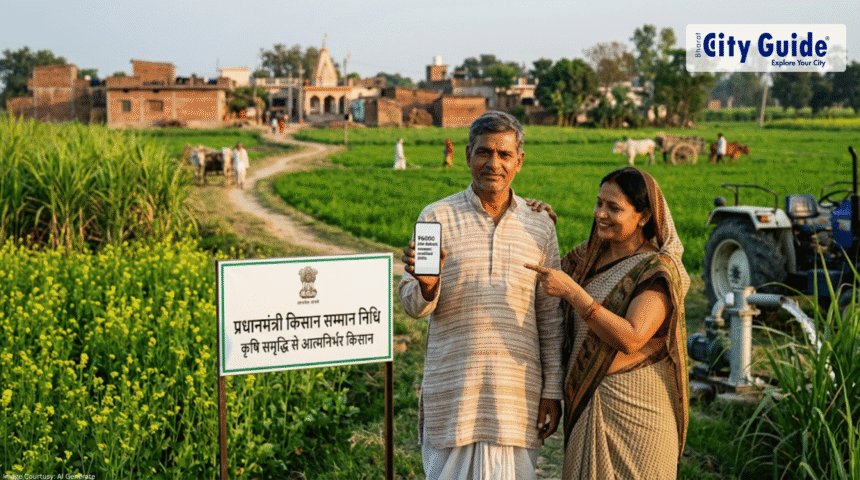
Farmers form the backbone of India’s economy, feeding 1.4 billion people while grappling with volatile incomes, rising input costs, and climate shocks. Launched in 2019, the PM Kisan Samman Nidhi (PM-KISAN) provides direct cash support to small and marginal farmers, ensuring predictable incomes, enabling investment in crops, and stabilizing rural consumption.
By 2026, PM-KISAN has disbursed over ₹3.45 lakh crore to 11.02 crore beneficiaries, creating a robust financial safety net that integrates with modern platforms like Jan Samarth and UMANG app, reflecting India’s push for digital, climate-resilient agriculture.
Policy Overview
Structure and Budget
- Objective: Income support to small/marginal farmers (<2 hectares)
- Coverage: 14.5 crore farmers across India
- Cash Transfer: ₹6,000 per year per family, divided into three ₹2,000 instalments
- Disbursal: Direct Benefit Transfer (DBT) to Aadhaar-linked accounts (73% linked)
- Integration: Jan Samarth portal, UMANG app, e-KYC verification
- Budget: ₹3.45 lakh crore spent till Jan 2026
Key Features
- Universal coverage post-exclusions (institutional landholders, deceased, surrender)
- 17 instalments completed by 2026
- Annual e-KYC to ensure correct beneficiaries
- State-level verification to prevent duplication or errors
Policy in Simple Terms:
Three ₹2,000 payments annually go straight to a farmer’s bank account—no middlemen, no paperwork beyond land proof. Funds can be used for seeds, farm inputs, children’s education, or debt repayment.
Key Objectives and Provisions
Objectives
- Income Support: Provide ₹6,000/year to small and marginal farmers
- Boost Rural Economy: Enable investments in seeds, equipment, and agri-inputs
- Digital Integration: Formalize land records via PM-KISAN portal and app
- Stabilize Consumption: Maintain rural purchasing power for families
Provisions
| Feature | Detail |
| Amount | ₹6,000 per family per year |
| Instalments | 3 × ₹2,000 |
| Coverage | 14.5 crore small/marginal farmers |
| Disbursal | DBT to Aadhaar-linked accounts (73%) |
| Monitoring | Jan Samarth portal, state verification |
| Exclusions | Institutional landholders, deceased |
| e-KYC Requirement | Annual |
Who Is Affected and How
Small and Marginal Farmers
- Majority beneficiaries (86% of holdings <2 ha) gain ₹50–100/day equivalent, ensuring liquidity for inputs and daily needs
- Women landowners automatically included, promoting financial inclusion
Rural Economy
- Multiplier effect 1.8x on local economies; small MSMEs supplying fertilizers, seeds, and agri-tools benefit
- Landless laborers indirectly benefit as supported farmers sustain consumption
Urban and Semi-Urban Stakeholders
- Predictable rural cash flows stabilize agricultural supply chains, ensuring steady food prices
- Content creators or agri-tech consultants serving villages gain reliable demand
Expected Benefits
Short-Term
- 20% rise in farm investments observed in pilot NSSO surveys
- Immediate relief for families facing inflation and crop input cost spikes
Long-Term
- Reduced farmer stress and suicides down by 10% in pilot districts
- Pathway to doubling farmer income by 2027 through complementary schemes and investments
- Stabilized rural economy, enabling better education, healthcare, and nutrition
| Benefit | Impact |
| Coverage | 14.5 crore small farmers |
| Investment Boost | +20% farm inputs and productivity |
| Income Security | ₹6,000/year per family |
| Multiplier Effect | 1.8x rural consumption |
| Long-Term Income | Double farmer income by 2027 |
Concerns, Challenges, or Criticisms
- Exclusion of Landless Farmers: 40% of rural workforce remains uncovered
- e-KYC Glitches: Over 1 crore pending verifications delay payments
- Input Costs Outpacing Support: ₹6,000 may not fully offset rising seed/fertilizer costs
- State-Level Arbitrary Exclusions: Inconsistent implementation
- Climate Risk Support Absent: Floods, droughts not yet linked to PM-KISAN payments
Policy Adjustments:
- Budget 2026 proposes PM-KISAN 2.0 with crop insurance tie-ups and climate-resilient add-ons
- Integration with digital land markets by 2030
Real-Life Implications
- Rajkot Farmer: Uses instalment to buy hybrid seeds, increasing yield by 15%; invests surplus in children’s coaching or wellness routines
- Content Creator/Agri-Tech Consultant: Rural clients stabilize due to predictable cash flows, enabling consistent service delivery
- Rural MSMEs: Seed and fertilizer demand increases ~10%, boosting local employment
What This Means for Common Citizens
- Farmers: Register at pmkisan.gov.in to receive payments
- Other Citizens: Rural employment opportunities rise due to better farm investment and demand
- Community Awareness: Ensure e-KYC and bank details are accurate to avoid delays
- Financial Literacy: Families can plan seed, fertilizer, or household expenditure with predictable cash flows
Future Outlook
Budget 2026 Initiatives
- PM-KISAN 2.0: Integration with crop insurance, climate-resilient support, and subsidies
- Digital Monitoring: Enhanced portal and mobile tracking for instalments
- Land Record Formalization: Digital land registration and verification by 2030
2030 Vision
- Streamlined direct income support for small farmers
- Reduced rural distress and stabilized consumption
- Integration with climate-smart agriculture, improving resilience to floods and droughts
Conclusion: What Citizens Should Know
PM-KISAN 2026 is more than a cash transfer; it’s a lifeline for India’s farmers, ensuring income stability, stimulating rural investment, and stabilizing consumption.
- Farmers: Complete e-KYC, monitor instalments via UMANG app or PM-KISAN portal
- Families: Use funds for seeds, crop investment, and children’s education
- Community Leaders: Advocate digital inclusion and prompt verification to maximize coverage
By participating fully, citizens ensure rural prosperity, economic stability, and long-term agricultural resilience.
Key Takeaways
- Cash Support: ₹6,000/year for 14.5 crore small/marginal farmers
- DBT Enabled: Direct to Aadhaar-linked accounts, ₹3.45 lakh crore disbursed till 2026
- Boosts Investment: 20% increase in farm inputs; 1.8x rural consumption multiplier
- Challenges: Exclusion of landless, e-KYC delays, rising input costs
- Action Required: Complete e-KYC and track payments via UMANG/PM-KISAN portals
- 2026 Outlook: PM-KISAN 2.0 with crop insurance, climate links, digital land records
FAQs
Q1: What is PM-KISAN?
A: PM-KISAN provides ₹6,000/year to small and marginal farmers in three instalments, stabilizing rural incomes.
Q2: Who is eligible for PM-KISAN?
A: Landholding farmers with <2 hectares land. Excludes institutional owners and deceased farmers.
Q3: How is the payment made?
A: Direct Benefit Transfer (DBT) to Aadhaar-linked bank accounts, tracked via PM-KISAN portal or UMANG app.
Q4: Can women farmers benefit?
A: Yes, women landowners are automatically included and can directly receive funds.
Q5: How does PM-KISAN affect the rural economy?
A: Boosts farm investment, consumption, and demand for agri-inputs; multiplier effect 1.8x.
Q6: What are the main challenges?
A: Exclusion of landless, delays in e-KYC, rising input costs, and lack of climate support in current scheme.
Q7: What’s new in PM-KISAN 2.0 for 2026?
A: Crop insurance tie-ups, climate-resilient add-ons, and digital land record integration.