Introduction
Indian Railways is currently undergoing a massive structural transformation. The primary focus is on expanding track capacities, modernizing signaling infrastructure, and eliminating transit bottlenecks across busy corridors. As part of this nationwide upgrade, Western Railway has initiated a critical phase of the Aliabada Hapa Jamnagar Railway Doubling project in the Saurashtra region of Gujarat. This infrastructure development is highly necessary for long-term regional connectivity. However, it requires immediate, extensive alterations to the daily schedules of thousands of passengers traveling to, from, and through the Saurashtra region.
- Introduction
- What is the Aliabada Hapa Jamnagar Railway Doubling Project?
- Why This News is Important
- Background Information and Context
- Key Highlights of the Rail Traffic Changes
- Detailed Explanation of the Affected Rail Services
- Benefits and Long-Term Importance of the Doubling Project
- How It Impacts Different Passenger Segments
- Expert Insights and Operational Perspective
- Challenges and Management Mitigation
- Future Outlook for the Saurashtra Rail Network
- Frequently Asked Questions (FAQs)
- Conclusion
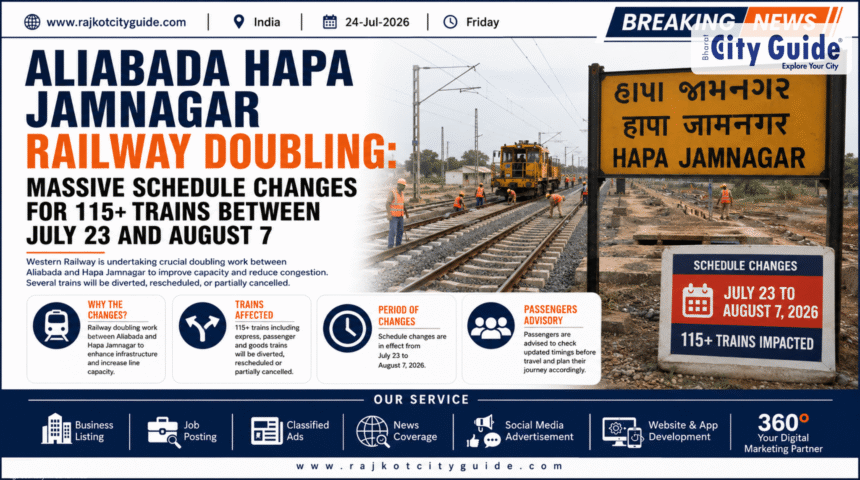
Due to the complex engineering works, non-interlocking block assignments, and track integration processes, train operations will experience significant adjustments. Specifically, from July 23 to August 7, the management of more than 115 trains will face temporary operational changes. These adjustments include complete cancellations, partial cancellations, short-terminations, and route diversions.
For routine daily commuters, long-distance travelers, industrial logistics managers, and businesses dependent on Western Railway, this phase requires careful planning. This comprehensive, highly detailed guide covers everything you need to know about the current situation. We break down the affected trains, explore the long-term economic benefits, highlight the inevitable short-term challenges, and provide actionable tips to navigate this travel period successfully.
What is the Aliabada Hapa Jamnagar Railway Doubling Project?
The Aliabada Hapa Jamnagar Railway Doubling project is a high-priority rail infrastructure initiative led by the Western Railway zone of Indian Railways. At its core, the project involves laying a parallel second set of tracks alongside the existing single-line corridor. This specific segment links the strategic stations of Aliabada, Hapa, and Jamnagar within the Rajkot division.
For years, this section has operated as a single-track bottleneck. On a single-line railway network, only one train can occupy a specific block section at a time. If an express train is traveling from Rajkot toward Jamnagar, an oncoming train from the opposite direction must wait on a loop line at a nearby station. This operational constraint limits overall track capacity and causes rolling delays across the entire network.
The track doubling initiative systematically eliminates this operational hurdle. By creating dedicated separate tracks for up and down train movements, the project allows for continuous traffic flow. The current work phase taking place between July 23 and August 7 represents the critical integration phase. During this time, engineering teams connect the newly laid tracks into the main grid, implement advanced electronic interlocking systems, and update automated signaling panels to support dual-track operations.
Why This News is Important
This operational update is incredibly important because it directly impacts regional mobility, industrial supply chains, and emergency travel coordination across Western India. Jamnagar is widely recognized as a critical global and national industrial hub, hosting the world’s largest grass-roots petroleum refinery alongside major brass industries and manufacturing clusters. Thousands of professionals, business owners, raw material suppliers, and specialized laborers travel along the Rajkot-Hapa-Jamnagar line every day.
Because more than 115 trains are experiencing sudden schedule adjustments over a two-week window, the economic and personal ripple effects are substantial. Commuters face immediate disruptions, while companies must re-evaluate their supply chain logistics. Knowing which services are operational, which routes have shifted, and how to access real-time railway data is essential to minimize financial losses and avoid getting stranded at regional stations.
Background Information and Context
To understand the scale of the Aliabada Hapa Jamnagar Railway Doubling initiative, it is helpful to look at the broader development plans for Western Railway’s Saurashtra network. The wider section connecting Ahmedabad, Rajkot, Hapa, Jamnagar, and Okha has seen a major increase in passenger and freight volumes over the last decade. This growth is driven by expanding industrial complexes, increasing freight traffic from coastal ports, and rising tourism to cultural sites like the Dwarkadhish Temple in Dwarka and Somnath.
Historically, the single-track infrastructure struggled to handle this heavy mixture of slow-moving freight trains and high-speed passenger expresses. Recognizing these limitations, the Ministry of Railways sanctioned track doubling projects across the Rajkot and Bhavnagar divisions.
The current engineering block represents the final stages of the line expansion. While the railway administration worked to complete secondary earthworks, bridge extensions, and initial track laying with minimal impact on active traffic, the final integration step requires heavy machinery and complete line blocks. This necessity is what led to the sweeping schedule changes announced for July 23 through August 7.
Key Highlights of the Rail Traffic Changes
- Total Affected Fleet: More than 115 passenger, express, and superfast trains will experience temporary schedule changes.
- Operational Window: The structural block and train diversions run from July 23 to August 7.
- Complete Cancellations: Multiple localized passenger services and specific intercity expresses are fully cancelled to clear track windows for engineering teams.
- Short-Terminations and Origin Changes: Dozens of long-distance trains originating from or heading to Okha, Porbandar, and Jamnagar will short-terminate or change origins at Rajkot or Hapa stations.
- Route Diversions: Several long-distance weekly and bi-weekly superfast trains will bypass the affected Rajkot-Hapa-Jamnagar section entirely, using alternative paths through neighboring divisions.
- Advanced Interlocking Work: The schedule adjustment allows for the installation of modern electronic interlocking systems, designed to improve track safety and maximize train speeds.
Detailed Explanation of the Affected Rail Services
The temporary adjustments implemented by Western Railway are divided into distinct operational categories. This helps the administration manage active construction zones while keeping vital parts of the network running.
1. Completely Cancelled Trains
To give engineering crews uninterrupted access to the tracks, several local daily passenger trains and specific intercity express routes are fully suspended. These cancellations primarily impact short-distance commuters who rely on daily local services to travel between Rajkot, Hapa, Jamnagar, and Ahmedabad.
2. Short-Terminated and Short-Originated Services
To keep traffic moving without entering the primary construction zones, many long-distance trains are being short-terminated. For example, a train heading from Mumbai Central to Okha may terminate early at Rajkot or Hapa station. The train will then clean, reverse, and start its return journey from that same intermediate station, bypassing the Aliabada-Jamnagar section entirely. Passengers booked for destinations beyond the termination point must arrange alternative road transport for the final leg of their journey.
3. Diverted Long-Distance Routes
For key superfast and long-distance weekly trains connecting Saurashtra to Northern, Eastern, and Southern states, Western Railway has introduced strategic diversions. These trains bypass the active construction area by taking alternative railway lines, which adds to their overall travel times but ensures passengers still reach their general destinations.
Benefits and Long-Term Importance of the Doubling Project
While the temporary cancellations cause short-term headaches, the long-term benefits of completing the Aliabada Hapa Jamnagar Railway Doubling project are game-changing for the region.
Enhanced Line Capacity and Reduced Delays
The primary benefit is a major increase in line capacity. By running up and down traffic on separate tracks, Indian Railways removes the need for trains to wait on loop lines for oncoming traffic. This dramatically improves punctuality, reduces overall travel times between Rajkot and Jamnagar, and allows the network to handle more trains daily.
Boosted Industrial Freight Efficiency
The industrial clusters in Jamnagar, including major oil refineries and brass manufacturing units, rely heavily on rail transport to move raw materials and finished products nationwide. A double-track network ensures freight trains move smoothly without delaying passenger services, making regional industries more competitive and efficient.
Improved Passenger Safety
The integration of new electronic interlocking systems during this block significantly reduces the risk of human error in signaling. Modernized track circuits, automated point operations, and advanced signaling systems provide layers of safety, ensuring smoother and safer journeys for everyone.
How It Impacts Different Passenger Segments
Daily Commuters and Small Business Owners
Local vendors, office workers, and students who commute daily between Rajkot, Hapa, and Jamnagar face the most immediate disruptions. The suspension of regular local trains forces many to switch to state transport buses or private vehicles, increasing daily travel costs and commute times.
Long-Distance Travelers and Tourists
Tourists heading to major spiritual destinations like the Dwarkadhish Temple in Okha/Dwarka need to review their bookings carefully. With multiple trains short-terminating at Rajkot or Hapa, travelers must plan for additional road transit, which can be challenging when traveling with family or heavy luggage.
+--------------------------+---------------------------------------------------------+
| Passenger Segment        | Core Direct Impact                                      |
+--------------------------+---------------------------------------------------------+
| Local Daily Commuters    | Loss of local services; higher road transit costs       |
| Long-Distance Tourists   | Short-terminations require extra road travel arrangements |
| Industrial Logistics     | Rerouted freight schedules; potential transit delays     |
+--------------------------+---------------------------------------------------------+
Industrial Logistics and Freight Management
Logistics managers handling cargo shipments out of Saurashtra’s industrial sectors must adjust to altered freight timetables. The temporary priority given to engineering blocks means freight schedules must be coordinated carefully to avoid inventory backups at production facilities.
Expert Insights and Operational Perspective
Railways and infrastructure analysts emphasize that intensive developmental blocks, while inconvenient, are necessary to modernize aging rail networks. Experts note that carrying out complex tracking and signaling updates on an active line requires a careful balance between ensuring worker safety and maintaining basic public mobility.
Logistics professionals point out that the temporary disruptions will quickly pay off once the line is fully open. The transition from a single-track bottleneck to a high-speed double-track corridor provides long-term dividends, including lower freight costs, improved scheduling reliability, and expanded capacity for future passenger routes.
Challenges and Management Mitigation
The primary challenge during this operational period is managing the heavy volume of displaced passengers. Relocating final arrival and departure zones to intermediate hubs like Rajkot or Hapa can cause temporary crowding at station platforms, ticket counters, and parking facilities.
To mitigate these challenges, Western Railway and local administrative bodies have introduced several support measures:
- Help Desks: Specialized informational counters are active at Rajkot, Hapa, and Jamnagar stations to guide passengers regarding cancellations and alternative routes.
- Refund Processing: Automated systems are helping clear refunds for passengers whose trains were fully cancelled.
- ST Bus Coordination: Local authorities are working to increase the frequency of Gujarat State Road Transport Corporation (GSRTC) buses running parallel to the affected rail routes, helping bridge the transit gap.
Future Outlook for the Saurashtra Rail Network
Once the integration phase wraps up on August 7, train services will gradually return to their normal schedules. Passengers will quickly notice the benefits of the completed infrastructure work, including improved punctuality and fewer unscheduled stops outside major stations.
Looking further ahead, the completion of the project sets the stage for future network enhancements. The expanded capacity opens the door for Indian Railways to introduce new high-speed services, expand daily intercity options, and seamlessly integrate upcoming tech upgrades like the KAVACH automated train protection system across the Saurashtra rail network.
Frequently Asked Questions (FAQs)
Why are so many trains affected between July 23 and August 7?
The changes are due to vital engineering work on the project. Teams are connecting new parallel tracks, updating signaling grids, and installing modern electronic interlocking systems.
How can I check if my specific train is cancelled or diverted?
Passengers can track real-time updates using the Indian Railways National Train Enquiry System (NTES) app or website, or by calling the central helpline at 139.
Will I get a full refund if my train is fully cancelled?
Yes. For trains completely cancelled by the railway administration, passengers who booked online will receive automatic full refunds to their accounts. Those with counter tickets can claim refunds at station PRS counters.
What does “short-termination” mean for my journey?
Short-termination means a train will end its journey at an intermediate station (like Rajkot or Hapa) instead of its final scheduled destination (like Jamnagar or Okha). Passengers must arrange alternative road transport for the remaining distance.
Are freight train movements completely stopped during this period?
Freight operations are not completely stopped, but they are highly regulated and periodically rerouted around active construction blocks to allow engineering teams sufficient track time.
Will train speeds increase after the completion of the project?
Yes. Moving from a single line to a double track eliminates operational delays, improves overall line capacity, and allows express trains to maintain higher average speeds safely.
Conclusion
The active phase of the Aliabada Hapa Jamnagar Railway Doubling project marks an important step forward for regional infrastructure development. While the temporary adjustments to over 115 trains bring short-term inconveniences for commuters and businesses, the long-term rewards are substantial.
By eliminating a long-standing transit bottleneck, Western Railway is building a faster, safer, and more reliable transportation network for Saurashtra. During this transition period, passengers are encouraged to double-check their train statuses, utilize official helplines, and plan travel with extra time buffers. The patience invested today ensures smoother, more efficient journeys for years to come.