Introduction
Weather patterns across Western India are undergoing a rapid post-monsoonal transition as seasonal atmospheric dynamics shift. In Gujarat, the seasonal rain-bearing cloud systems are retreating, giving way to clear skies, rising daytime temperatures, and a dry atmospheric spell. This transition marks the official conclusion of the southwest monsoon season, leaving behind a period characterized by sharp thermal contrast between scorching afternoons and cooler nights.
- Introduction
- What is Gujarat Monsoon?
- Why This News is Important
- Background Information
- Key Highlights
- Detailed Explanation of the Event
- Importance of Post-Monsoon Dry Weather
- How It Impacts Different Audiences
- Expert Insights and Meteorological Perspective
- Challenges and Limitations
- Future Outlook
- Frequently Asked Questions (FAQs)
- Conclusion
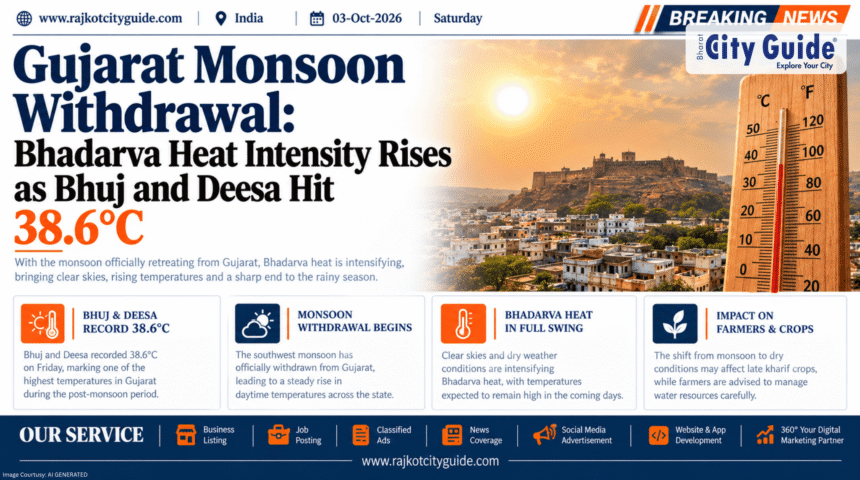
The Indian Meteorological Department (IMD) and regional meteorological observatories have confirmed that the Gujarat Monsoon is expected to complete its formal withdrawal from the entire state within the next 24 hours. As monsoon winds retreat, the traditional late-monsoon heat wave—locally referred to as “Bhadarva Heat” (Bhadarvani Garmi)—has settled heavily over multiple districts.
During the recent 24-hour observation cycle, Bhuj in Kutch and Deesa in Banaskantha recorded peak daytime maximum temperatures of 38.6°C, establishing them as the hottest regions in Gujarat. With zero rainfall warnings or active atmospheric disturbances issued for the coming week, residents across urban centers and rural belts are experiencing the sharp onset of October heat conditions.
What is Gujarat Monsoon?
The Gujarat Monsoon represents the annual southwest monsoon season that spans from mid-June to late September or early October across the Gujarat region, Saurashtra, and Kutch. Driven by moisture-laden winds originating over the Arabian Sea, this weather system provides over 95% of the state’s annual rainfall, filling major water reservoirs, nourishing Kharif agricultural crops, and replenishing groundwater reserves.
+--------------------------------------------------------------------------+
|                  GUJARAT MONSOON ANNUAL CYCLICAL STAGES                  |
+--------------------------------------------------------------------------+
                                     |
    +--------------------------------+--------------------------------+
    |                                |                                |
    v                                v                                v
[ SOUTHWEST ONSET ]          [ PEAK RAINFALL SPELLS ]      [ MONSOON RETREAT ]
- Mid-June Entry             - July & August Surges        - Late Sept / Early Oct
- Arabian Sea Moisture       - Reservoir Replenishment     - Clear Skies & Dry Air
- Kharif Crop Sowing         - Urban & Rural Hydration     - "Bhadarva Heat" Phase
When the southwest monsoon winds begin to reverse direction and dry, continental north-westerly to northerly winds establish dominance over North Gujarat and Saurashtra, the withdrawal line advances rapidly. The official declaration of monsoon withdrawal requires specific meteorological criteria: a continuous dry spell lasting several days, a substantial drop in atmospheric moisture, anti-cyclonic circulation establishment, and clear sky conditions.
Why This News is Important
The formal exit of the monsoon system and the simultaneous rise in autumn temperatures carry significant environmental, agricultural, and civic implications across Gujarat:
- Agricultural Transition Period: Farmers across Saurashtra and North Gujarat rely on dry weather indicators to schedule the harvesting and drying of mature Kharif crops such as groundnuts, cotton, and sesame.
- Health and Temperature Swings: The sudden surge in daytime temperatures combined with morning humidity creates prime conditions for seasonal viral infections, heat fatigue, and dehydration.
- Water Resource Baseline: With zero additional rainfall predicted, municipal corporations and irrigation boards must finalize their annual water management strategies based on existing dam levels.
- Energy Demand Changes: Scorching afternoon heat increases residential and commercial power consumption as air conditioning and cooling equipment operate at higher capacities.
Background Information
The Gujarati month of “Bhadarvo” (corresponding roughly to September–October) is historically recognized for harsh, humid weather that manifests immediately after major rain spells subside. During this window, intense solar radiation strikes the moist soil, generating elevated land temperatures alongside high relative humidity.
[ Monsoon Cloud Cover Dissipates ] ----> [ Direct Solar Radiation Strikes Ground ]
                                                   |
                                                   v
[ Dry Northerly Winds Take over ] ------> [ High Afternoon Temps (38.6°C in Bhuj/Deesa) ]
                                                   |
                                                   v
[ IMD Declares Official Monsoon Exit ] -> [ Seasonal Shift to Autumn & Early Winter ]
Over the past few days, the withdrawal line of the southwest monsoon has been steadily cutting through Naliya and Deesa. As atmospheric pressure systems stabilize and cloud cover dissolves completely, cities across the state—including Ahmedabad, Vadodara, Rajkot, and Surat—are witnessing afternoon temperature spikes between 35°C and 38.6°C.
Key Highlights
- Imminent Withdrawal: The southwest monsoon is projected to complete its exit from Gujarat within 24 hours.
- Highest Temperatures Recorded: Bhuj (Kutch) and Deesa (Banaskantha) topped the state temperature charts at 38.6°C.
- Dry Weather Forecast: The IMD forecasts 100% dry weather across all districts of Gujarat, Saurashtra, Kutch, Diu, Daman, and Dadra & Nagar Haveli for the next 7 days.
- Emergence of “Bhadarva Heat”: High daytime heat coupled with moderate night cooling creates noticeable thermal fluctuations.
- Zero Rainfall Warnings: No cyclonic circulations, low-pressure zones, or rain warnings are currently active over the Arabian Sea region.
Detailed Explanation of the Event
1. Temperature Escalation Across Districts
According to official weather observation charts released by the IMD, dry northerly to north-westerly winds are prevailing at lower atmospheric levels over the region. This wind pattern prevents moisture influx from the Arabian Sea and accelerates surface evaporation.
+--------------------------------------------------------------------------+
|                 GUJARAT REGIONAL MAXIMUM TEMPERATURE BREAKDOWN           |
+--------------------------------------------------------------------------+
| Region / Station       | Maximum Temp Recorded | Departure from Normal   |
+------------------------+-----------------------+-------------------------+
| Bhuj (Kutch)           | 38.6°C                | +2.7°C Above Normal     |
| Deesa (Banaskantha)    | 38.6°C                | Elevated Autumn High    |
| Ahmedabad & Region     | 37.0°C                | Clear, Dry Conditions   |
| Saurashtra (Rajkot)    | 36.5°C – 37.5°C        | Warm Afternoons         |
+------------------------+-----------------------+-------------------------+
Bhuj recorded 38.6°C, representing a departure of nearly 2.7°C above normal seasonal averages. Deesa matched this high mark, while major urban centers such as Ahmedabad recorded maximum temperatures touching 37°C under mostly clear skies.
2. Meteorological Outlook for the Next 7 Days
The official weather bulletin indicates no major change in maximum or minimum temperatures over the next 7 days. All regions—including Gujarat mainland, Saurashtra-Kutch, and union territories—will experience extended dry weather. While afternoons will remain hot and bright, early morning hours may bring a subtle drop in temperature, signaling the gradual approach of late-autumn atmospheric adjustments.
Importance of Post-Monsoon Dry Weather
1. Agricultural Harvesting Operations
Dry, rain-free conditions are critical for farming communities. The absence of unseasonal rain (Mavthu) protects harvested crops laid out in fields from mold, rotting, and crop loss.
2. Infrastructure & Road Repair Works
Municipal corporations and the State Road & Building (R&B) Department rely on the end of the monsoon to execute road resurfacing, pothole filling, and civic construction projects without rain delays.
3. Festival Preparation & Festive Tourism
With major cultural festivals such as Navratri and Diwali approaching, dry weather ensures smooth outdoor planning, pavilion installations, and regional travel without rain disruptions.
How It Impacts Different Audiences
| Stakeholder Group | Direct Impact & Event Relevance |
| Farmers & Cultivators | Enables uninterrupted crop harvesting, pod drying, and preparation for Rabi crop sowing. |
| General Citizens & Commuters | Requires precautions against afternoon heat stroke, sun exposure, and dehydration. |
| Outdoor Laborers & Construction | Demand shifts toward morning and late-afternoon working hours to avoid peak heat. |
| Healthcare Practitioners | Sees a rise in cases of heat-induced fatigue, viral fevers, and seasonal respiratory adjustments. |
Expert Insights and Meteorological Perspective
Meteorologists and climate experts note that post-monsoon weather patterns in Western India adhere to established seasonal transitions, though temperature peaks can vary based on local wind direction.
“The rapid clearing of cloud cover immediately exposes the land surface to high solar irradiance, leading to the phenomenon widely known as ‘second summer’ or ‘Bhadarva heat.’ As the southwest monsoon retreats and north-westerly dry winds take over, daytime maximums naturally surge before night temperatures begin their gradual decline toward winter levels.”
Challenges and Limitations
While dry weather benefits logistics and harvesting, elevated heat poses several temporary challenges:
- Health Hazards from Thermal Fluctuations: Rapid changes between warm, air-conditioned indoors and 38.6°C outdoor heat increase instances of heat exhaustion.
- Increased Water and Energy Demands: Rising heat elevates urban water consumption and places additional stress on electrical power grids due to heavy air-conditioning usage.
- Soil Moisture Loss: Rapid drying of upper soil layers can complicate seedbed preparation for early winter crops if pre-irrigation facilities are unavailable.
Future Outlook
With the monsoon completing its departure within the next 24 hours, Gujarat will transition into a stable autumn pattern characterized by dry atmospheric conditions through early October.
Over the next two to three weeks, maximum temperatures are expected to hover between 35°C and 38°C during the afternoon hours. As October progresses into November, night temperatures will steadily decrease, gradually easing the intense afternoon heat and bringing cooler winter conditions to North Gujarat, Saurashtra, and Kutch.
Frequently Asked Questions (FAQs)
1. When will the Gujarat Monsoon officially withdraw this year?
The IMD forecasts that the southwest monsoon will complete its formal withdrawal from all parts of Gujarat within the next 24 hours.
2. Which areas recorded the highest temperatures in Gujarat recently?
Bhuj in Kutch and Deesa in Banaskantha recorded the highest daytime maximum temperatures in the state at 38.6°C.
3. What is “Bhadarva Heat” (Bhadarvani Garmi)?
“Bhadarva Heat” refers to the sharp increase in daytime temperatures and humidity experienced in Gujarat during the late-monsoon transition period when rain clouds clear out.
4. Is there any rainfall forecast for Gujarat in the next 7 days?
No, the IMD has issued a completely dry weather forecast for all districts of Gujarat, Saurashtra, and Kutch for the next 7 days.
5. How does monsoon withdrawal affect farmers in Gujarat?
Dry post-monsoon weather allows farmers to safely harvest and dry Kharif crops like groundnut and cotton without risk of rain damage.
6. Will temperatures drop soon after monsoon withdrawal?
While afternoon hours remain hot through October, overnight and early morning temperatures will slowly decrease, bringing cooler conditions toward late October and November.
Conclusion
The upcoming exit of the Gujarat Monsoon marks the end of the seasonal rain cycle and the beginning of autumn across the state. With Bhuj and Deesa reaching 38.6°C and clear skies dominating all districts, residents must adjust to typical Bhadarva heat conditions. While the dry weather favors agricultural harvesting and civic construction, maintaining adequate hydration and protecting against afternoon sun exposure will remain essential during this seasonal transition.