Introduction
Urban air pollution has become one of the most critical challenges facing rapidly growing Indian cities. In response to mounting environmental and public health concerns, the Central Pollution Control Board (CPCB) and the Ministry of Environment, Forest and Climate Change (MoEFCC) conduct an annual national evaluation to measure urban environmental governance. The latest results from the Clean Air Survey 2026 (Swachh Vayu Survekshan 2026) have brought encouraging news for Gujarat, particularly for the vibrant city of Rajkot.
- Introduction
- What is Clean Air Survey 2026?
- Why This News is Important
- Background Information
- Key Highlights
- Detailed Explanation of the Event
- Benefits and Importance of Improved Air Quality
- How It Impacts Different Stakeholders
- Expert Insights and Environmental Perspective
- Challenges and Future Bottlenecks
- Future Outlook
- Frequently Asked Questions (FAQs)
- Conclusion
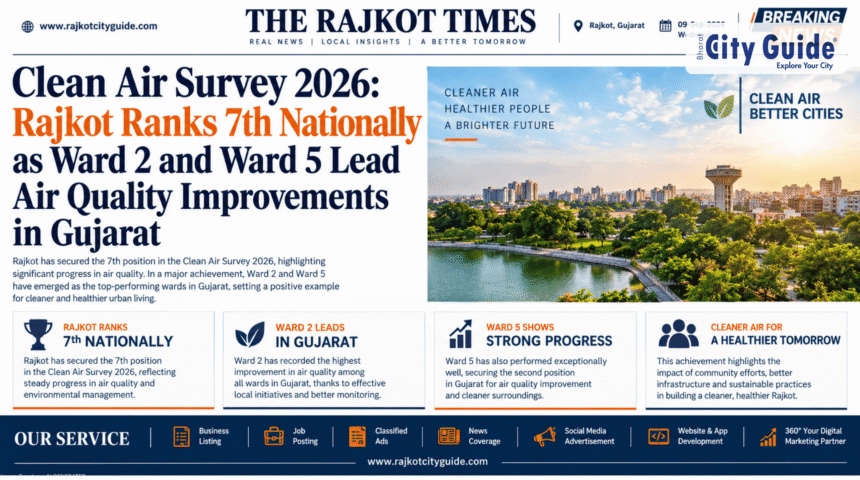
Rajkot has achieved a commendable 7th national rank among Category-I cities (urban areas with a population exceeding 10 lakh), sharing a total score of 187 out of 200 with Thane and Chandigarh. Beyond the citywide success, Rajkot demonstrated remarkable grassroots progress in the newly emphasized ward-level assessments across Gujarat. Ward 2 secured 2nd place and Ward 5 claimed 3rd place statewide, showcasing how micro-level administrative actions directly drive cleaner air and healthier living environments for urban residents.
This impressive leap in the Clean Air Survey 2026 highlights Rajkot’s multi-pronged approach to pollution control, including mechanized road sweeping, paved shoulder construction, electric vehicle (EV) fleet expansion, and strict monitoring of construction dust. This detailed report examines the metrics behind Rajkot’s performance, the administrative policies that fueled the turnaround, and the road ahead for sustaining long-term environmental health.
What is Clean Air Survey 2026?
The Clean Air Survey 2026 is the 5th edition of the annual national assessment framework instituted under India’s National Clean Air Programme (NCAP). Unlike traditional environmental monitoring frameworks that rate cities solely on instant Air Quality Index (AQI) readings, the survey evaluates municipal local bodies based on the execution of action plans designed to curb ambient air pollution.
+--------------------------------------------------------------------------+
|                  CLEAN AIR SURVEY EVALUATION FRAMEWORK                    |
+--------------------------------------------------------------------------+
                                     |
    +--------------------------------+--------------------------------+
    |                                |                                |
    v                                v                                v
[ DUST CONTROL & ROADS ]     [ EMISSIONS & TRANSIT ]      [ WASTE MANAGEMENT ]
- Mechanized sweeping        - EV bus integration         - Legacy waste processing
- Paved shoulders & greening - Industrial stack monitoring- Open burning prohibition
Under NCAP guidelines, 130 non-attainment cities across India are divided into three distinct population tiers:
- Category-I: Cities with a population above 10 lakh (1 million+).
- Category-II: Cities with a population between 3 lakh and 10 lakh.
- Category-III: Cities with a population below 3 lakh.
Evaluation criteria cover key operational domains: control of road dust, management of construction and demolition (C&D) waste, reduction of vehicular emissions, industrial emission monitoring, solid waste management, and public awareness campaigns.
Why This News is Important
The results of the Clean Air Survey 2026 represent a significant milestone for Rajkot’s municipal governance and regional environmental policy:
- Recognition of Governance Efforts: Ranking 7th nationally validates the proactive measures taken by the Rajkot Municipal Corporation (RMC) to curb airborne particulate matter (PM2.5 and PM10).
- Ward-Level Accountability: The recognition of Ward 2 (2nd rank in Gujarat) and Ward 5 (3rd rank in Gujarat) demonstrates that localized environmental management yields tangible results.
- Economic and Health Benefits: Improved air quality reduces upper respiratory illnesses, lowers healthcare expenditure for families, and enhances overall quality of life, making Rajkot an attractive destination for trade and investment.
Background Information
Rajkot, situated in the heart of Gujarat’s Saurashtra region, has undergone rapid industrialization and urban expansion over the past two decades. As an engineering, auto-component, and casting hub, the city faced growing environmental pressure from heavy vehicular traffic, industrial emissions, and airborne road dust.
To address these challenges, the RMC adopted an integrated Clean Air Action Plan under NCAP. The strategy focused on addressing dust resuspension—one of the largest contributors to PM10 levels in dry, semi-arid topographies.
[ Urban Growth & Industrialization ] ---> [ High Road Dust & Vehicle Emissions ]
                                                    |
                                                    v
[ Integrated Clean Air Action Plan ] <--- [ Implementation of NCAP Guidelines ]
              |
              v
[ Mechanized Sweeping, EV Transition, Ward-Level Dust Controls ]
              |
              v
[ 7th National Rank in Clean Air Survey 2026 ]
By introducing anti-smog guns, increasing green belts along major ring roads, paving unpaved roadside shoulders, and transitioning public transportation to electric buses, Rajkot built the framework that led to its success in the Clean Air Survey 2026.
Key Highlights
- National Ranking: Rajkot secured the 7th rank nationwide in Category-I (million-plus population) with a score of 187 out of 200.
- Statewide Ward Honors: In Gujarat’s ward-level evaluation, Rajkot’s Ward 2 claimed 2nd position and Ward 5 secured 3rd position.
- State Performance: Gujarat performed strongly in Category-I, with Surat placing 5th (191 points), Rajkot placing 7th (187 points), Ahmedabad placing 8th (186 points), and Vadodara securing 15th position (179 points).
- Dust Mitigation: High marks were awarded for mechanized sweeping of major arterial corridors and strict dust suppression at construction sites.
- Sustainable Mobility: Expanded e-bus public transit and growing EV charging infrastructure contributed to reduced tailpipe emissions.
Detailed Explanation of the Event
The Central Pollution Control Board (CPCB) released the official results of the Clean Air Survey 2026, assessing 130 cities across India. In the Category-I national list, Uttar Pradesh’s Lucknow took 1st place with 198 points, followed by Madhya Pradesh’s Indore (197 points) and Jabalpur (195 points).
Rajkot delivered a strong performance by scoring 187 points, tying for 7th place alongside Thane and Chandigarh. This achievement puts Rajkot ahead of several major metropolitan centers, reflecting consistent administrative execution.
+--------------------------------------------------------------------------+
|          SWACHH VAYU SURVEKSHAN 2026: CATEGORY-I TOP PERFORMERS          |
+--------------------------------------------------------------------------+
| Rank  | City / Urban Local Body              | Score (out of 200)       |
+-------+--------------------------------------+--------------------------+
| 1     | Lucknow (Uttar Pradesh)              | 198                      |
| 2     | Indore (Madhya Pradesh)              | 197                      |
| 3     | Jabalpur (Madhya Pradesh)            | 195                      |
| 4     | Bhopal (MP) / Agra (UP)              | 192                      |
| 5     | Surat (Gujarat)                      | 191                      |
| 6     | Raipur (Chhattisgarh)                | 189                      |
| 7     | Rajkot (Gujarat) / Thane / Chandigarh| 187                      |
| 8     | Ahmedabad (Gujarat) / Vijayawada     | 186                      |
+--------------------------------------------------------------------------+
A key takeaway from the 2026 survey is the addition of ward-level awards. In Gujarat’s intra-state ward assessments, Rajkot’s Ward 2 and Ward 5 emerged as top performers. Ward 2 took 2nd place statewide, while Ward 5 secured 3rd place.
These wards stood out for maintaining high cleanliness standards, enforcing proper waste segregation, utilizing door-to-door garbage collection, eliminating open waste burning, and planting urban trees along commercial corridors.
Benefits and Importance of Improved Air Quality
The improvements recognized by the Clean Air Survey 2026 provide tangible benefits across social, economic, and environmental sectors:
1. Reduced Public Health Burden
Lower concentrations of PM2.5 and PM10 reduce the incidence of asthma, bronchitis, chronic obstructive pulmonary disease (COPD), and cardiovascular conditions among residents, especially children and senior citizens.
2. Micro-Level Urban Cleanliness
The ward-level assessment model creates healthy competition among local councilors and sanitation teams, leading to better-paved roads, regular sweeping, and improved municipal waste collection.
3. Boosting Green Mobility
The push for cleaner air accelerates the adoption of electric three-wheelers, e-buses, and private electric vehicles, lowering long-term fuel costs and fossil fuel dependence.
4. Urban Beautification and Property Value
Consistent dust suppression, road shoulder paving, and plantation drives enhance city aesthetics, contributing to higher real estate value and greater urban livability.
How It Impacts Different Stakeholders
| Stakeholder Group | Direct Impact & Key Benefits |
| Citizens & Families | Cleaner ambient air, reduced respiratory health risks, and cleaner neighborhood streets. |
| Municipal Workers & Sanitation Staff | Greater public recognition, modern equipment (mechanized sweepers), and safer working conditions. |
| Real Estate & Business Owners | Increased commercial appeal of well-maintained wards like Ward 2 and Ward 5. |
| Urban Planners & Engineers | Clear operational metrics under NCAP to prioritize funding for green infrastructure. |
Expert Insights and Environmental Perspective
Environmental engineers and public policy experts highlight that Rajkot’s achievement in the Clean Air Survey 2026 reflects the value of institutionalizing micro-management.
“The true strength of the Clean Air Survey lies in decentralizing environmental targets. When municipal corporations evaluate air quality management down to individual wards, administrative accountability improves dramatically. Rajkot’s top rankings in Ward 2 and Ward 5 demonstrate that localized dust control, waste management, and greening directly improve citywide air quality metrics.”
Urban planners also emphasize that maintaining these scores requires continuous monitoring. Integrating continuous ambient air quality monitoring stations (CAAQMS) with traffic control centers helps authorities spot pollution spikes early and deploy targeted dust-suppression units.
Challenges and Future Bottlenecks
Despite celebrating its 7th rank national finish, Rajkot faces several ongoing challenges to maintain and improve its standing in future assessments:
- Seasonal Particulate Surges: Semi-arid wind conditions during summer and winter temperature inversions can elevate PM10 levels across Saurashtra.
- Rapid Motorization: As vehicle ownership grows, managing traffic congestion along core commercial rings remains critical to prevent localized emissions spikes.
- Construction Dust Enforcement: Ensuring that private real estate developers consistently follow dust-control practices—such as green netting, water spraying, and covered material transport—requires continuous monitoring.
- Industrial Zone Peripheral Control: Coordinating air pollution controls across industrial clusters on the city’s outskirts demands joint efforts between municipal bodies and the Gujarat Pollution Control Board (GPCB).
Future Outlook
Building on its success in the Clean Air Survey 2026, Rajkot is positioning itself for further environmental upgrades:
- Expanding Mechanized Road Sweeping: Scaling up the fleet of mechanized sweeping vehicles to cover secondary and residential roads across all municipal zones.
- 100% Electrification of City Buses: Accelerating the replacement of diesel buses with zero-emission electric buses across all RMC transit routes.
- Paved Shoulder Coverage: Eliminating exposed soil along major road stretches through paving, cobblestones, and dense green hedges to prevent dust resuspension.
- Enhanced Community Engagement: Expanding ward-level clean air committees to involve local residents directly in monitoring open waste burning and promoting urban forestry.
Frequently Asked Questions (FAQs)
1. What rank did Rajkot achieve in the Clean Air Survey 2026?
Rajkot secured the 7th rank nationally among Category-I cities (population above 10 lakh) with a total score of 187 out of 200, tying with Thane and Chandigarh.
2. Which Rajkot wards performed best in Gujarat’s state-level evaluation?
In the state-level ward evaluation, Rajkot’s Ward 2 secured 2nd place and Ward 5 claimed 3rd place in Gujarat.
3. Which city topped the Clean Air Survey 2026 overall?
Lucknow (Uttar Pradesh) topped the national ranking in Category-I with a score of 198 out of 200, followed by Indore (197) and Jabalpur (195).
4. How are rankings determined in the Clean Air Survey?
Cities are evaluated on operational parameters including road dust management, construction dust control, solid waste processing, vehicular emission reduction, industrial monitoring, and public awareness initiatives under NCAP guidelines.
5. What role did Gujarat cities play in the 2026 rankings?
Gujarat cities performed strongly in Category-I, with Surat taking 5th rank (191 points), Rajkot 7th (187 points), Ahmedabad 8th (186 points), and Vadodara 15th (179 points).
6. Why is ward-level ranking important for urban air quality?
Ward-level rankings bring accountability down to the neighborhood level, encouraging local sanitation teams and councilors to control open burning, maintain road shoulders, and improve daily waste collection.
7. How can residents contribute to maintaining clean air in Rajkot?
Residents can support local air quality by avoiding open waste burning, switching to electric or non-motorized transport, planting trees in residential areas, and reporting dust violations to RMC authorities.
Conclusion
Rajkot’s achievement of 7th rank nationally in the Clean Air Survey 2026, alongside the top state-level performances of Ward 2 and Ward 5, reflects the city’s progress in modern urban governance. Through targeted investments in dust mitigation, electric transit, and systematic waste processing, the Rajkot Municipal Corporation has shown that structured planning yields real environmental results.