Introduction
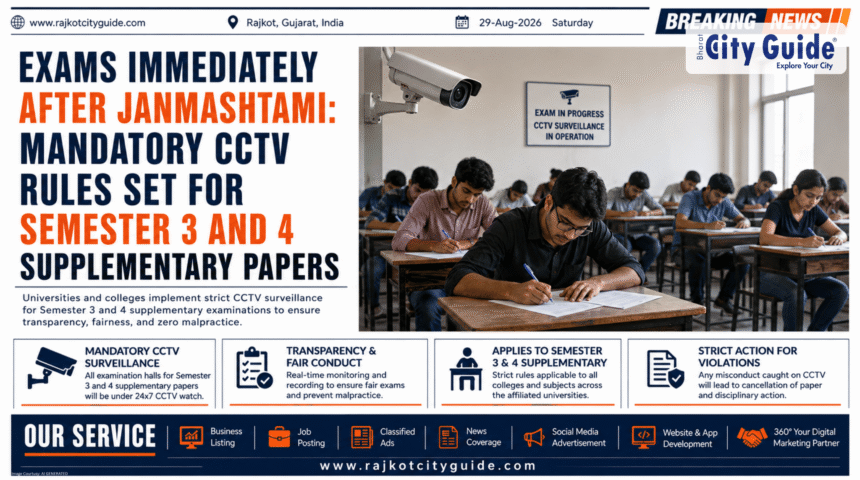
In a significant administrative decision impacting thousands of undergraduate and postgraduate students across Gujarat, Saurashtra University has officially finalized the schedule and compliance guidelines for its upcoming examinations. With Exams Immediately After Janmashtami set to commence on September 8, college administration teams, examination coordinators, and students are stepping up preparations under a strict mandate designed to ensure complete operational transparency and academic integrity.
- Introduction
- What is Exams Immediately After Janmashtami?
- Why This News is Important
- Background Information
- Key Highlights
- Detailed Explanation of the Event
- Benefits, Features, and Importance
- How It Impacts People
- Expert Insights / Industry Perspective
- Challenges and Limitations
- Future Outlook
- Frequently Asked Questions (FAQs)
- Conclusion
The university administration announced that the supplementary examinations for Semester 3 and Semester 4 will begin right after the festive week. However, the most critical element of this announcement goes beyond the schedule itself. To eliminate any possibility of question paper leaks or unauthorized access, Saurashtra University has mandated continuous CCTV recording during the entire paper downloading and printing process across all designated examination centers.
This dual update—combining a post-festival exam timeline with stringent electronic surveillance—highlights a major push toward tech-enabled exam security in state higher education. As students pivot quickly from Janmashtami holiday celebrations back to academic revision, affiliated colleges must ensure their digital infrastructure, surveillance cameras, and high-speed internet connections comply fully with the university’s strict guidelines.
What is Exams Immediately After Janmashtami?
The phrase Exams Immediately After Janmashtami highlights the specific scheduling strategy and administrative protocols enacted by Saurashtra University for its Semester 3 and Semester 4 supplementary tests starting September 8.
Rather than allowing a long gap after the festival season, the university has locked in early September exam dates to maintain the academic calendar, avoid delays in subsequent term cycles, and expedite degree completions.
Key operational components defining this examination drive include:
- Official Start Date: September 8, following the regional Janmashtami festival holidays.
- Academic Scope: Supplementary and remedial examinations for Semester 3 and Semester 4 students across various undergraduate and postgraduate streams.
- Security Protocol: Mandatory live CCTV video recording covering the exact moment question papers are digitally downloaded, decrypted, and printed at exam centers.
- Verification Mandate: College principals and center superintendents must upload verified video footage logs to the university’s central monitoring portal.
- Jurisdiction: Applies across all affiliated colleges in Rajkot, Jamnagar, Morbi, Amreli, Surendranagar, and surrounding districts falling under Saurashtra University’s domain.
Why This News is Important
The announcement of university exams right after a major state festival carries significant academic, administrative, and technological weight:
- Strict Preservation of Academic Timelines: Holding examinations in early September prevents delays in the current academic year, allowing successful candidates to clear backlogs without missing upcoming semester cycles or employment opportunities.
- Zero-Tolerance Policy on Paper Leaks: Standardizing real-time CCTV monitoring during the sensitive paper-downloading window establishes a robust defense against unauthorized paper access, leaks, and malpractice.
- Standardized Administrative Compliance: Affiliated institutions must comply with standardized security rules, ensuring equal exam integrity standards whether a center is located in a major city or a rural district.
- Student Preparation Discipline: Publishing clear exam dates ahead of the festival break helps students manage their time effectively, balancing cultural festivities with structured revision schedules.
Background Information
In recent years, state universities across India have faced ongoing challenges regarding examination security and paper distribution logistics. Traditional paper delivery via physical logistics carried higher operational costs, vulnerability to transit delays, and security risks.
To overcome these vulnerabilities, Saurashtra University implemented an encrypted digital question paper delivery system. Under this system, question papers are transmitted electronically via secure servers shortly before the exam begins, requiring center supervisors to log in, decrypt, and print the exact number of question papers required.
However, digital distribution introduces a crucial security check-point: the downloading and printing phase at the local college level. To eliminate unauthorized access, early decryption, or unauthorized handling in principal offices, the university instituted mandatory CCTV surveillance. By pairing this protocol with the September 8 supplementary timetable for Semester 3 and 4, the university aims to establish a transparent, leak-proof examination framework.
Key Highlights
- Exam Commencement Date: Semester 3 and 4 supplementary exams start on September 8.
- Post-Festival Schedule: Examinations begin right after the Janmashtami holidays.
- Mandatory CCTV Surveillance: Continuous CCTV recording is mandatory during the entire paper downloading, printing, and sealing process.
- Central Control Room Monitoring: The university’s central CCTV control room will actively monitor footage from affiliated exam centers.
- Severe Penalties for Non-Compliance: Centers failing to maintain complete CCTV recordings during paper extraction face heavy administrative fines and potential cancellation of center status.
- Targeted Student Base: Covers repeater and backlog candidates across BA, B.Com, B.Sc, MA, M.Com, M.Sc, and related professional courses.
Detailed Explanation of the Event
The decision to schedule Exams Immediately After Janmashtami starting September 8 was finalized during high-level administrative meetings at Saurashtra University. The controller of examinations emphasized that preserving the academic calendar requires prompt evaluation of supplementary papers, ensuring students receive their corrected marks before regular winter exams begin.
                 [ EXAM SECURITY & TIMELINE FLOW ]
                                 │
  Janmashtami Holiday Period ──► Sept 8: Exams Commence
                                       │
  Encrypted Digital Paper Transfer ──► Mandatory CCTV Download Recording
                                       │
  Live Video Logs Submitted ──► Central University Verification
To maintain complete exam security, the university issued strict instructions to all affiliated college principals:
- Pre-Exam System Checks: Every exam center must verify high-speed internet connections, primary and backup power supplies, printing hardware, and CCTV camera coverage inside the confidential download room.
- Mandatory Video Recording: The camera must clearly capture the computer monitor showing the download timestamp, the printer output area, and the individuals present inside the room.
- Time-Bound Execution: Question paper files will be released on a secure university portal only 30 to 45 minutes before the scheduled exam start time.
- Footage Preservation & Submission: Centers must archive unedited video recordings of the download session and upload or submit the digital proof to the university’s CCTV monitoring section immediately after each paper.
Benefits, Features, and Importance
The table below details the administrative protocols and security benefits of the new examination directives:
| Administrative Aspect | Previous / Traditional Setup | New Post-Janmashtami Protocol | Key Advantage / Benefit |
| Exam Schedule | Irregular, delayed post-holiday dates | Fixed start on September 8 | Timely academic progression & fast result processing. |
| Paper Distribution | Physical transit / Early digital access | Time-bound encrypted download | Eliminates transit delays & physical tampering risks. |
| Download Security | Basic supervisor monitoring | Mandatory continuous CCTV recording | Provides verifiable video evidence of paper integrity. |
| Center Oversight | Periodic physical inspections | Real-time central portal surveillance | Deterrence against local center malpractice. |
| Student Integrity | Variable security across centers | Standardized state-wide security | Fair evaluation environment for all candidates. |
How It Impacts People
For Students and Candidates
Students sitting for Semester 3 and 4 supplementary exams must manage their revision time effectively during the festival week. While Janmashtami is widely celebrated across Gujarat, candidates must stay focused to clear their backlogs. On the positive side, strict CCTV rules ensure that honest students are protected from unfair practices, maintaining the credibility of their degrees.
Students sitting for Semester 3 and 4 supplementary exams must manage their revision time effectively during the festival week. While Janmashtami is widely celebrated across Gujarat, candidates must stay focused to clear their backlogs. On the positive side, strict CCTV rules ensure that honest students are protected from unfair practices, maintaining the credibility of their degrees.
For College Principals and Exam Supervisors
Center administrators face heightened operational accountability. College principals must personally supervise the paper download room while ensuring the CCTV camera functions without interruption. Any technical failure or missing video log could result in formal show-cause notices from the university.
For Parents and Academic Stakeholders
Parents and academic observers benefit from increased trust in the state education system. Transparent security protocols reduce anxieties related to paper leaks, exam cancellations, or re-examination hassles.
Expert Insights / Industry Perspective
Higher education experts and university administrators have praised the integration of digital security and strict video logging into the examination workflow.
Academic analysts point out that paper distribution security has historically been the weakest link in high-stakes university exams. Implementing mandatory CCTV logging during digital decryption effectively secures the paper handling window.
Furthermore, educationists note that while holding exams right after a major cultural festival requires extra discipline from students, maintaining a tight academic timetable is vital. It ensures that supplementary results are declared on time, enabling students to proceed smoothly to their final semesters or enter the workforce without losing a year.
Challenges and Limitations
Despite its clear benefits, the implementation of this exam drive presents a few operational challenges:
- Technical Infrastructure Dependencies: Rural or small-town colleges may face occasional challenges with high-speed internet stability or unexpected power cuts during the paper download window.
- Hardware Maintenance: CCTV cameras must remain fully functional with uninterrupted power backup (UPS/Generators) to avoid gaps in video recording.
- Festival Transition Pressure: Students traveling home to celebrate Janmashtami must plan their return trips carefully to reach their designated examination centers ahead of the September 8 start date.
Future Outlook
The security protocols established for the September 8 supplementary examinations reflect the future direction of university assessments across Gujarat:
- Expanded Digital Security: Building on mandatory CCTV recording during downloads, universities are exploring AI-driven video analytics to automatically flag unauthorized movements inside confidential rooms.
- Faster Result Processing: With digital paper distribution and streamlined supplementary schedules, result processing times are expected to drop from months to weeks.
- Standardized Digital Verification: End-to-end digital tracking—from paper creation to seat allocation and evaluation—will become standard across all undergraduate and postgraduate streams.
Frequently Asked Questions (FAQs)
1. When do the Saurashtra University Semester 3 and 4 supplementary exams begin?
The supplementary examinations for Semester 3 and Semester 4 officially begin on September 8.
2. Why is CCTV recording mandatory during paper downloading?
Mandatory CCTV recording ensures complete transparency, prevents unauthorized access or paper tampering, and provides verifiable proof that question papers were downloaded and printed securely.
3. Which courses are covered under the September 8 exam schedule?
The schedule covers supplementary and backlog candidates across various undergraduate and postgraduate programs, including BA, B.Com, B.Sc, MA, M.Com, and M.Sc.
4. What happens if an exam center fails to record the paper download process?
Exam centers that fail to maintain complete CCTV recordings face administrative penalties, fines, and potential cancellation of their center status by the university.
5. How far in advance are question papers made available to exam centers?
Encrypted question papers are released on the university portal approximately 30 to 45 minutes before the exam starts, requiring live CCTV coverage while downloading and printing.
6. Will regular classes be affected by these supplementary examinations?
Colleges manage schedules to ensure minimal disruption to regular semester classes, using designated exam halls and digital rooms for supplementary paper administration.
7. How can students obtain their detailed exam hall tickets and timetables?
Students can download their hall tickets and subject-wise timetables directly from the official Saurashtra University student portal or collect them from their respective college administrative offices.
Conclusion
The decision to hold Exams Immediately After Janmashtami starting September 8, backed by mandatory CCTV recording during paper downloading, highlights Saurashtra University’s commitment to academic integrity and schedule discipline. By pairing a firm post-festival timetable with high-tech surveillance, the university protects the value of its degrees while ensuring fair testing conditions for every candidate. As students finalize their preparations and colleges double-check their security systems, these measures set a strong standard for secure, transparent higher education assessments across Gujarat.