Introduction
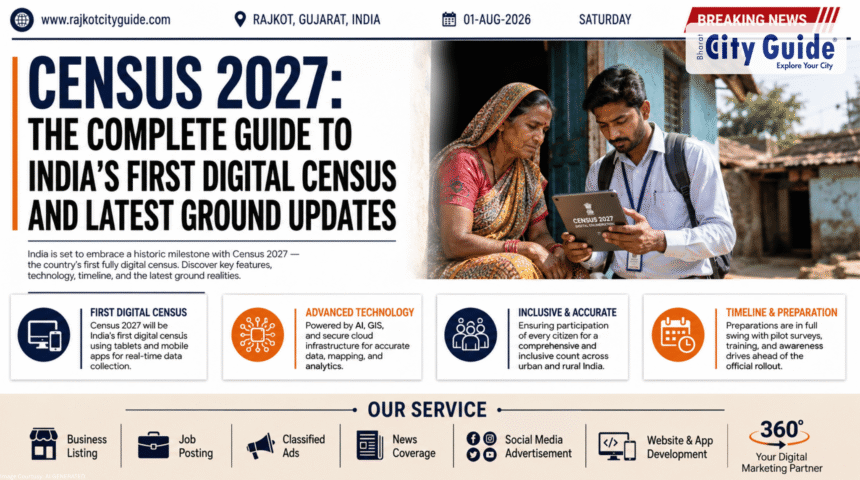
India is embarking on a historic administrative journey with the official rollout of Census 2027. A census is not merely a count of heads; it serves as the foundational bedrock for national planning, resource allocation, and targeted socio-economic policies. As the nation prepares to capture the demographic realities of over 1.4 billion people, the ongoing census 2027 stands out as a historic milestone. For the first time in the history of the country, India is moving away from purely paper-based tracking to deploy a highly advanced, encrypted digital infrastructure.
- Introduction
- What is Census 2027?
- Current Situation and Latest Ground Updates
- Why is This Digital Census Important?
- Key Highlights of Census 2027
- Detailed Explanation of the Two-Phase Census Process
- The 33 Notified Questions: Categorization and Structural Metrics
- Technical Architecture, Software, and Data Security Protocols
- Operational Workflow of the Census Fieldwork
- Advantages of the Digital Census Framework
- Challenges and Implementation Hurdles
- Roadmap and Key Timeline
- Frequently Asked Questions (FAQs)
- Conclusion
The current situation on the ground highlights rapid momentum. In Tripura, the first phase of census 2027—known as the Houselisting and Housing Census (HLO)—is launching tomorrow, Saturday, August 1, 2026. This crucial field operation follows a highly successful two-week window for Self-Enumeration, which concluded on Friday, July 31, 2026. With Tripura setting its machinery in motion across all eight districts, it joins the majority of Indian states and Union Territories that have already wrapped up this initial foundational phase. If you want to understand how this massive digital exercise impacts your household, your data privacy, and the future development of India, this detailed guide provides all the vital details.
What is Census 2027?
The census 2027 is the official, decennial national exercise conducted by the Government of India to enumerate the country’s population, housing conditions, civic infrastructure, and asset distribution. Historically, India’s census operations have been conducted at the start of every decade. Due to unprecedented administrative challenges and delays, the current cycle has been repositioned as the census 2027. This exercise is carried out under the strict legal provisions of the landmark Census Act, 1948, which mandates the collection of citizen details while simultaneously guaranteeing total statutory confidentiality.
The ultimate importance of the census lies in its capacity to shape the future. The data collected acts as a guide for building schools, hospitals, highways, and public distribution systems. Without accurate census numbers, federal and state governments cannot effectively allocate budgetary resources or design welfare schemes. In the context of modern governance, census 2027 represents a massive evolutionary leap. It transitions India into an era of data-driven governance, where real-time statistical processing replaces slow, manual data entry.
Current Situation and Latest Ground Updates
The execution of census 2027 is moving forward in a structured, phased manner across the country. According to official announcements by Ratan Biswas, the Director of Census Operations in Tripura, the state is fully prepared to launch its physical Houselisting and Housing Census tomorrow, August 1, 2026. The initial component of this phase, the Self-Enumeration (SE) process, opened on July 17 and officially concluded on July 31. This online facility allowed citizens to proactively log onto a secure government portal and furnish their household details independently.
In Tripura alone, more than 50,000 families took advantage of the Self-Enumeration portal, showcasing a high degree of digital literacy and public cooperation. To cover the remaining households, an army of over 8,000 specially trained enumerators, systematically backed by field supervisors, will conduct door-to-door physical visits across all eight districts from August 1 to August 30, 2026. The administrative control of this massive exercise has been placed under the direct supervision of the respective District Magistrates (DMs), Collectors, and the Municipal Commissioner of the Agartala Municipal Corporation, all designated as Principal Census Officers. Meanwhile, senior census authorities have confirmed that the second phase—the Population Enumeration—is scheduled to take place nationwide in February 2027.
Why is This Digital Census Important?
The transition to a digital-first framework for census 2027 brings significant structural improvements for both the average citizen and macro-level policymakers. For consumers and households, the introduction of digital tools eliminates the tedious, time-consuming interviews of the past. The ability to complete self-enumeration online provides Indian families with the comfort of submitting data from their own homes, avoiding scheduling conflicts with visiting state officials.
From an industry and governance perspective, the market significance of this digital upgrade is immense. Moving away from manual data entry means that the vast, complex datasets will be processed at unprecedented speeds. Historically, final census reports took years to see public release, which often left policymakers relying on outdated information. With census 2027, data goes directly into secure central servers, reducing human processing errors and drastically cutting down the timeline for generating analytical insights. This ensures that infrastructure spending, market expansions, and corporate investments can align accurately with India’s actual demographic shifts.
Key Highlights of Census 2027
- First Digital Census: Transition from physical registers to a highly secured, custom-built mobile application for field enumerators.
- Hybrid Data Collection: Offers an easy choice between online Self-Enumeration and traditional door-to-door physical verification.
- Zero Document Requirement: Citizens are completely free from the obligation of showing physical identity proofs or official documents to enumerators.
- Rigorous Privacy Protections: Enforced under the Census Act, 1948, featuring 100 percent confidential processing and advanced encryption protocols.
- 33 Notified Questions: A comprehensive framework covering household type, civic amenities, ownership of assets, and structural safety.
- Two-Phase Strategy: Smooth structural split between Houselisting & Housing Census (Phase 1) and Population Enumeration (Phase 2).
- Decentralized Supervision: Monitored directly by District Magistrates and Municipal Commissioners acting as Principal Census Officers.
Detailed Explanation of the Two-Phase Census Process
Phase 1: Houselisting and Housing Census (HLO)
The initial phase focuses on establishing a solid architectural and structural inventory of the nation. Field enumerators note the physical condition of residential structures, wall and roof materials, and overall safety. It gives the state an accurate map of where people reside before counting individuals.
The primary benefit of the HLO phase is that it captures the living standards of the population. From a technical standpoint, this phase relies heavily on the 33 notified questions to catalog housing typologies and utility access. In real-world applications, this allows local municipal bodies to identify high-density areas that lack adequate basic services.
Phase 2: Population Enumeration
Scheduled to take place in February 2027, the second phase shifts the focus from structural assets to human capital. Enumerators will record specific individual parameters for every resident living within the borders of India.
This phase is crucial for capturing the shifting demographic, economic, and social profile of the country. Technical details include capturing exact data points on literacy rates, economic activity, migratory patterns, and fertility metrics. Governments use this information to create targeted educational scholarships, calculate regional employment needs, and adjust the boundaries of political constituencies.
The 33 Notified Questions: Categorization and Structural Metrics
+-----------------------------------------------------------------------+
|                 STRUCTURE OF THE 33 NOTIFIED QUESTIONS                 |
+-----------------------------------------------------------------------+
|  Section 1: Building Characteristics & Construction Materials        |
|  Section 2: Household Composition & Demographics                      |
|  Section 3: Access to Vital Civic Amenities (Water, Power, Sanitation) |
|  Section 4: Household Assets & Digital Connectivity Tools             |
+-----------------------------------------------------------------------+
The survey framework for the first phase of census 2027 relies on a clear, structured list of 33 notified questions. These questions are grouped under four broad operational sections designed to assess the quality of life across Indian households. The first section looks closely at the building characteristics, asking about the main materials used for the roof, walls, and flooring, while establishing whether the structure is permanent or temporary.
The second section gathers basic information on household composition, recording the total number of individuals living together under one roof. The third section measures access to vital civic amenities. Enumerators will check the primary source of drinking water, the availability of electricity, the type of cooking fuel used, and the presence of proper sanitation systems within the premises. The final section catalogs household assets and modern connectivity tools, tracking the ownership of items like bicycles, motor vehicles, televisions, radios, and digital communication devices like smartphones and internet connections.
Technical Architecture, Software, and Data Security Protocols
Mobile Application Infrastructure
The shift toward census 2027 relies on a dedicated, highly optimized mobile application built specifically for Android and iOS enterprise platforms. Enumerators download this government-authorized app onto secure devices to input field details directly. The interface features responsive drop-down menus, automated validation checks, and offline operational capabilities to ensure smooth data entry even in remote rural areas with spotty network coverage.
Advanced Data Encryption Standards
Because this operation collects sensitive personal information, data security is built into every layer of the app. All information collected through the census application is immediately protected using advanced digital encryption protocols. When an enumerator saves a household entry, the data is encrypted both at rest on the device and while moving over the internet to central servers, making it completely unreadable to unauthorized parties.
Legal Privacy Protections under the Census Act
Beyond the technology itself, the privacy of every citizen is protected by law. Under the strict provisions of the Census Act, 1948, all personal records collected during the census are legally classified as confidential. The data cannot be shared with law enforcement, tax authorities, or outside corporate bodies, and it is used only for statistical analysis and national development planning.
Operational Workflow of the Census Fieldwork
[Step 1: Self-Enumeration Portal]
       │
       ▼ (If incomplete or skipped)
[Step 2: Assignment of Trained Enumerator App]
       │
       ▼
[Step 3: Physical Door-to-Door Household Interview]
       │
       ▼
[Step 4: Encrypted Real-Time Upload to Central Government Servers]
       │
       ▼
[Step 5: Quality Review by District Principal Census Officers]
The roll-out of census 2027 follows a strict step-by-step operational workflow designed to prevent any household from being missed. The process begins with the online Self-Enumeration portal, which gives residents an initial window to log in and submit their details. Once this window closes, the system automatically flags all households that did not complete the online forms, creating targeted route maps for the next phase of physical field interviews.
During the second phase, trained enumerators carry out door-to-door visits within their assigned areas. They interview the head of the family or a responsible adult member to fill out the 33 notified questions on their mobile app. As soon as an interview is completed, the encrypted data is uploaded directly to central government servers. If the area lacks cellular service, the app stores the data securely offline and automatically uploads it once a stable internet connection is established. Finally, the data goes through a review process managed by local Principal Census Officers to ensure high quality and accuracy before moving on to final processing.
Advantages of the Digital Census Framework
- Rapid Data Processing: Eliminates the years-long wait for census reports by automating data entry and validation right in the field.
- Enhanced Data Accuracy: Built-in validation checks in the mobile app prevent human entry errors, conflicting responses, and accidental blank fields.
- Environmental Sustainability: Saves thousands of tons of paper by moving away from printing physical ledgers and multi-page forms.
- Public Convenience: The Self-Enumeration portal allows modern, tech-savvy citizens to fill out their household information at their own convenience.
- Reduced Administrative Costs: Lowers long-term government spending on printing, transporting, sorting, and securely storing physical records.
Challenges and Implementation Hurdles
While the transition to a digital census 2027 brings many clear benefits, it also introduces several practical implementation challenges. The most significant hurdle is overcoming the digital divide across India’s diverse geography. While urban centers quickly adopted the online Self-Enumeration portal, many rural areas face persistent challenges like limited smartphone access, low digital literacy, and unreliable mobile networks, placing a heavier burden on the door-to-door physical enumeration teams.
Another major operational challenge involves managing data quality and building public trust. With ongoing public conversations around data privacy, census teams must constantly reassure citizens that their personal information is protected under the Census Act, 1948. Additionally, managing an army of over 8,000 enumerators in smaller states like Tripura—and hundreds of thousands more across larger states—requires massive, ongoing training efforts to prevent software misuse and ensure consistent data collection across the board.
Roadmap and Key Timeline
The rollout of census 2027 follows a strict timeline designed to ensure thorough coverage across every corner of the country. With the initial phase already completed across most Indian states and Union Territories, the current focus is on closing out regional operations. For example, Tripura’s dedicated field operations run from August 1 to August 30, 2026, capturing details for households that skipped the self-enumeration option.
+--------------------------+------------------------------------------------+
| TIMELINE                 | OPERATIONAL PHASE FOCUS                        |
+--------------------------+------------------------------------------------+
| July 17 - July 31, 2026  | Self-Enumeration Online Portal Access (Tripura) |
| August 1 - Aug 30, 2026  | Houselisting & Housing Census Field Operations  |
| September - Dec 2026     | Nationwide Data Consolidation & Validation     |
| February 2027            | National Launch of Population Enumeration      |
+--------------------------+------------------------------------------------+
Once the physical Houselisting and Housing Census wraps up at the end of August, data teams will spend the rest of the year consolidating and validating the structural data collected nationwide. This sets the stage for the highly anticipated second phase in February 2027. During this final phase, the focus shifts to detailed population enumeration, capturing the full demographic, social, and economic metrics of every individual citizen.
Frequently Asked Questions (FAQs)
What is census 2027 and how does it differ from previous exercises?
The census 2027 is the official nationwide counting and socio-economic mapping of India’s population and housing conditions. Unlike all previous exercises that relied on physical paper forms, this census introduces a digital-first approach. Field workers use a dedicated, secure mobile app for real-time data collection, and citizens have the option to self-enumerate online. This update reduces data processing times, minimizes human error, and keeps information secure.
Is it mandatory to show identity proofs like Aadhaar or Voter ID to the census enumerators?
No, citizens are not required to show any identity proof, official documents, or citizenship papers to field workers during census 2027. The exercise relies entirely on voluntary, oral disclosure. When an enumerator visits your home, you simply provide the correct information verbally. The focus is on statistical data collection for national planning, not individual documentation or identity verification.
How does the government ensure that my personal information remains secure during census 2027?
Data privacy is protected by law under the strict provisions of the historic Census Act, 1948. All personal data collected through the mobile app or online portal is encrypted using high-level digital standards. The law ensures that your information stays completely confidential and cannot be used for law enforcement, tax audits, or outside corporate databases. The information is strictly used to create anonymous statistical analyses for development planning.
What happens if I missed the online Self-Enumeration window that closed recently?
If you missed the online Self-Enumeration window, you do not need to worry. The census framework includes a backup plan through door-to-door field operations. Trained government enumerators will visit every household that skipped the online process. In Tripura, these field visits take place between August 1 and August 30, 2026, ensuring that every family is safely and accurately counted.
What kind of questions will be asked during the Houselisting and Housing Census phase?
During the first phase of census 2027, enumerators use a structured questionnaire containing 33 notified questions. These questions focus on your living conditions rather than personal details. They cover the construction materials of your home, the total number of residents, access to core civic amenities like drinking water, electricity, and sanitation, as well as the ownership of standard family assets like vehicles, televisions, and smartphones.
Who is supervising the field operations of census 2027 at the regional level?
To ensure smooth management, operations are overseen by senior local officials. At the regional level, District Magistrates (DMs) and Collectors are appointed as the Principal Census Officers for their respective districts. In urban areas, municipal leaders, such as the Municipal Commissioner of the Agartala Municipal Corporation in Tripura, manage the field operations within their city boundaries.
When will the second phase of the national census take place and what will it cover?
The second phase of census 2027, known as Population Enumeration, is scheduled to launch nationwide in February 2027. While the first phase looks primarily at housing structures and family assets, the second phase focuses on the individual citizens. Enumerators will collect detailed information on demographics, age, education, marital status, economic activities, migration history, and spoken languages to build a complete profile of India’s human capital.
Conclusion
The rollout of census 2027 marks a major turning point in how India manages its national data, moving from slow, paper-based forms to a modern, digital-first system. By combining online Self-Enumeration with comprehensive door-to-door field operations, this updated approach ensures thorough, reliable, and secure coverage of the entire population. The launch of phase one operations in Tripura demonstrates the government’s clear focus on gathering high-quality housing and asset data to guide future infrastructure and welfare programs.
As field enumerators begin their rounds, it is important to remember that this exercise is built on trust and privacy. Protected by the long-standing legal guarantees of the Census Act, 1948, every citizen can share their details with full confidence that their information is encrypted and safe. By participating openly and cooperating with local enumerators, residents play a vital role in helping build a more accurate, data-driven foundation for India’s growth and public policy for years to come.