Introduction
The artificial intelligence industry is evolving at an unprecedented pace, and one company making headlines in 2026 is sakana ai. While many AI companies focus on building increasingly larger language models, Sakana AI is taking a completely different approach. The Japanese AI startup has introduced an innovative platform called Fugu, which leverages multiple AI models working together rather than relying on a single giant model.
- Introduction
- What is Sakana AI?
- The Current AI Industry Landscape
- What is the Fugu Platform?
- Why Fugu is Different from Traditional AI Models
- Sakana AI’s Success in Coding Benchmarks
- The Technology Behind Sakana AI
- Advantages of the Sakana AI Approach
- Potential Use Cases for Fugu
- How Sakana AI Could Change the AI Industry
- Challenges Facing Sakana AI
- Why Investors Are Watching Sakana AI Closely
- Future Outlook for Sakana AI
- Sakana AI vs Traditional AI Models
- Frequently Asked Questions (FAQs)
- Conclusion
This development has attracted significant attention from technology experts, software developers, investors, and AI researchers worldwide. According to the company, Fugu has demonstrated the ability to outperform some leading AI systems on specific coding benchmarks, showcasing the potential of collaborative artificial intelligence.
As the global AI race intensifies, sakana ai is positioning itself as one of the most innovative players in the industry. This article explores Sakana AI, the Fugu platform, its technology, advantages, challenges, market impact, and future prospects.
What is Sakana AI?
Sakana AI is a Japanese artificial intelligence startup focused on developing next-generation AI systems inspired by nature and collective intelligence.
The name “Sakana” means “fish” in Japanese. The company draws inspiration from how schools of fish coordinate their movements efficiently without relying on a single leader. Similarly, Sakana AI aims to create AI systems where multiple specialized models collaborate to solve complex problems.
Unlike traditional AI companies that prioritize building larger language models with billions or trillions of parameters, Sakana AI focuses on creating intelligent systems that combine the strengths of multiple AI agents.
Key Highlights of Sakana AI
- Founded by experienced AI researchers
- Based in Japan
- Focuses on collaborative AI systems
- Inspired by biological intelligence
- Develops multi-agent AI architectures
- Introduced the innovative Fugu platform
- Challenges traditional large-model approaches
This unique philosophy makes sakana ai one of the most interesting companies in the global artificial intelligence ecosystem.
The Current AI Industry Landscape
Before understanding why Sakana AI matters, it is important to understand the current state of artificial intelligence.
For several years, the AI industry has followed a simple strategy:
- Build larger models
- Use more data
- Increase computing power
- Train bigger neural networks
This approach has produced powerful systems capable of:
- Writing content
- Generating code
- Creating images
- Answering questions
- Solving complex tasks
However, larger models come with challenges:
- High computational costs
- Expensive training processes
- Increased energy consumption
- Scaling limitations
- Slower deployment
These limitations have encouraged companies like sakana ai to explore alternative methods.
What is the Fugu Platform?
The biggest recent breakthrough from sakana ai is the launch of its new AI platform called Fugu.
Fugu is designed around a fundamentally different concept from traditional AI systems.
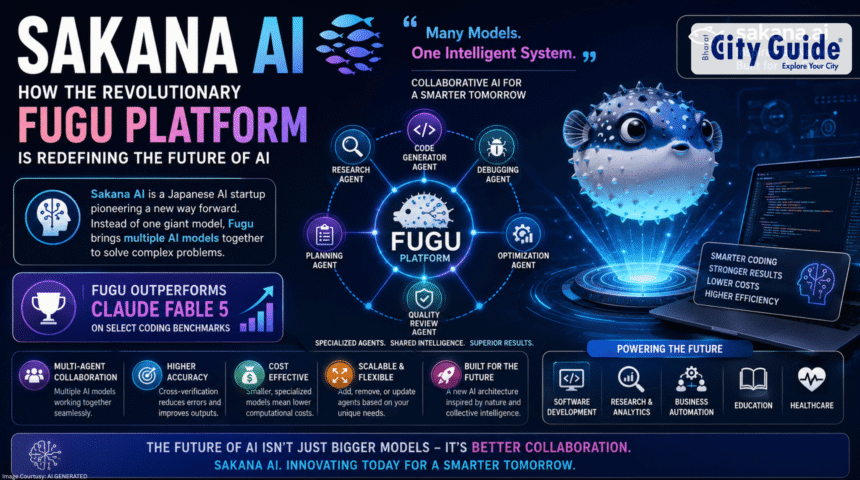
Instead of using one large language model to solve every problem, Fugu coordinates multiple AI models that collaborate through a unified interface.
How Fugu Works
Imagine a team of experts working together on a project:
- One expert handles research.
- Another specializes in coding.
- A third reviews quality.
- A fourth identifies errors.
Fugu applies a similar concept to artificial intelligence.
Multiple specialized AI agents work together to:
- Analyze tasks
- Divide responsibilities
- Generate solutions
- Verify outputs
- Improve final results
This collaborative framework is one of the key innovations introduced by sakana ai.
Why Fugu is Different from Traditional AI Models
Most modern AI platforms rely heavily on a single foundation model.
Examples include:
- Large language models
- Monolithic AI architectures
- Centralized decision-making systems
Fugu takes a completely different route.
Traditional AI Approach
- One model handles everything
- Requires enormous computational resources
- Limited specialization
- Scaling challenges
Fugu’s Collaborative Approach
- Multiple models cooperate
- Specialized expertise
- Better resource utilization
- Improved flexibility
- Enhanced performance on specific tasks
This shift represents a potentially important milestone in AI development.
Sakana AI’s Success in Coding Benchmarks
One of the major reasons sakana ai is attracting global attention is its reported coding performance.
According to the company, Fugu has outperformed Anthropic’s Claude Fable 5 on certain coding benchmarks.
Why Coding Benchmarks Matter
Coding benchmarks evaluate an AI system’s ability to:
- Generate code
- Debug software
- Solve programming challenges
- Understand software architecture
- Optimize algorithms
Strong benchmark performance indicates that an AI system can assist developers more effectively.
Potential Benefits
If Fugu consistently performs well on coding tasks, it could become valuable for:
- Software companies
- Independent developers
- Enterprise technology teams
- Research organizations
This achievement has strengthened the reputation of sakana ai in the AI community.
The Technology Behind Sakana AI
The technology philosophy of sakana ai is inspired by collective intelligence.
Collective Intelligence Concept
Collective intelligence occurs when multiple individuals or agents work together to achieve outcomes superior to what a single individual could accomplish.
Examples in nature include:
- Schools of fish
- Ant colonies
- Bee swarms
- Bird flocks
Sakana AI applies these principles to artificial intelligence.
Core Components
The Fugu platform likely incorporates:
- Multiple language models
- Task coordination systems
- Agent communication frameworks
- Performance evaluation mechanisms
- Dynamic resource allocation
Together, these components create a highly adaptive AI ecosystem.
Advantages of the Sakana AI Approach
The collaborative AI strategy offers several advantages.
Improved Specialization
Different AI agents can focus on specific tasks.
Examples:
- Coding
- Research
- Planning
- Verification
- Problem solving
Better Accuracy
Multiple models can review each other’s outputs, reducing errors.
Greater Flexibility
Organizations can customize the combination of AI agents according to their needs.
Lower Costs
Smaller specialized models may be more cost-efficient than training a single gigantic model.
Scalability
New AI agents can be added without rebuilding the entire system.
These benefits help explain why sakana ai is gaining attention from businesses and researchers.
Potential Use Cases for Fugu
The possibilities for Fugu extend far beyond coding.
Software Development
- Code generation
- Bug detection
- Testing automation
- Documentation creation
Scientific Research
- Data analysis
- Literature review
- Hypothesis generation
Business Operations
- Workflow automation
- Strategic planning
- Market research
Education
- Personalized tutoring
- Curriculum development
- Learning assistance
Healthcare
- Research support
- Medical documentation
- Data processing
As the technology matures, sakana ai could expand into numerous industries.
How Sakana AI Could Change the AI Industry
The launch of Fugu highlights an important debate in artificial intelligence.
Bigger Isn’t Always Better
For years, AI development focused on larger models.
However, larger models create challenges such as:
- Higher costs
- Longer training times
- Increased energy requirements
Collaboration May Be the Future
The success of Fugu suggests that AI collaboration may become an alternative path forward.
Instead of building one super-intelligent model, companies may develop networks of specialized agents.
If successful, sakana ai could influence future AI research and development worldwide.
Challenges Facing Sakana AI
Despite its promising technology, Sakana AI faces several challenges.
Intense Competition
The company competes with major AI firms such as:
- OpenAI
- Anthropic
- Google DeepMind
- Meta
- Microsoft
Market Adoption
Convincing businesses to adopt a new AI architecture may take time.
Reliability
Coordinating multiple AI agents introduces new technical complexities.
Infrastructure Requirements
Managing communication between models requires sophisticated systems.
Scaling Globally
Expanding from a startup into a global AI leader requires significant resources.
These factors will play a major role in determining the long-term success of sakana ai.
Why Investors Are Watching Sakana AI Closely
The AI industry remains one of the fastest-growing technology sectors.
Investors are particularly interested in companies that:
- Introduce breakthrough technologies
- Challenge existing industry assumptions
- Create scalable platforms
- Solve real-world problems
Sakana AI fits many of these criteria.
The launch of Fugu has increased discussions about the company’s future valuation, partnerships, and growth potential.
As AI adoption accelerates globally, innovative startups like sakana ai may attract increasing investor attention.
Future Outlook for Sakana AI
The future appears promising for Sakana AI.
Several trends support the company’s strategy:
Growing Demand for Efficient AI
Organizations increasingly seek cost-effective AI solutions.
Rise of Agent-Based Systems
Multi-agent architectures are becoming a major research focus.
Enterprise AI Adoption
Businesses require specialized AI capabilities rather than generic solutions.
Need for Better Collaboration
Complex tasks often benefit from multiple AI systems working together.
These trends align closely with the vision of sakana ai and the Fugu platform.
Sakana AI vs Traditional AI Models
Sakana AI Approach
- Multi-agent collaboration
- Specialized intelligence
- Flexible architecture
- Nature-inspired design
Traditional Large Models
- Single model architecture
- Massive computational requirements
- Higher operational costs
- Centralized decision-making
The future may not be about choosing one approach over the other. Instead, hybrid systems combining both strategies could emerge as the next generation of artificial intelligence.
Frequently Asked Questions (FAQs)
What is Sakana AI?
Sakana AI is a Japanese artificial intelligence startup focused on developing collaborative multi-agent AI systems inspired by collective intelligence in nature.
What is Fugu?
Fugu is a new AI platform developed by Sakana AI that coordinates multiple AI models through a unified system to solve complex tasks.
Why is Sakana AI gaining attention?
The company has attracted attention because its Fugu platform reportedly outperformed leading AI systems on certain coding benchmarks.
How is Fugu different from traditional AI models?
Unlike traditional systems that rely on one large language model, Fugu uses multiple specialized AI agents working together.
Can Fugu replace large language models?
Not necessarily. Fugu may complement or enhance existing AI systems rather than completely replace them.
What industries could benefit from Sakana AI technology?
Software development, education, healthcare, business automation, scientific research, and enterprise technology could benefit from the platform.
Is Sakana AI a major competitor in the AI industry?
While still a startup, Sakana AI is emerging as an innovative competitor due to its unique approach to collaborative artificial intelligence.
Conclusion
The emergence of sakana ai and its groundbreaking Fugu platform represents one of the most intriguing developments in artificial intelligence in 2026. While much of the industry continues to focus on building increasingly larger AI models, Sakana AI is demonstrating that collaboration among multiple specialized models may offer a powerful alternative.
By drawing inspiration from nature and collective intelligence, the company has introduced a fresh perspective on how AI systems can solve complex problems more efficiently. Early coding benchmark results suggest that this approach has significant potential, particularly in software development and advanced reasoning tasks.
As the AI landscape continues to evolve, sakana ai could become a major influence on future AI architecture, research, and enterprise adoption. Whether Fugu ultimately reshapes the industry or becomes part of a broader multi-agent movement, one thing is clear: the future of artificial intelligence may depend not only on making models bigger but also on making them work together smarter.