Introduction Sandesh
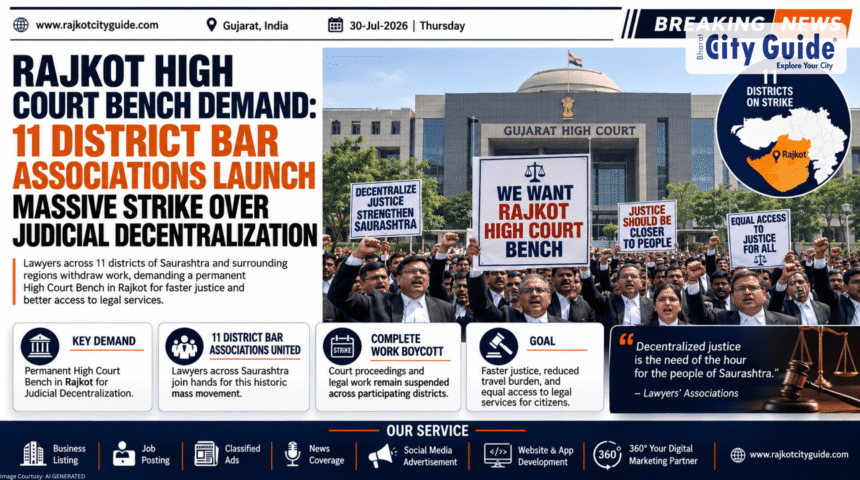
The legal fraternity across Saurashtra and Kutch has once again sounded the battle cry for judicial decentralization, breathing new life into a multi-decade political and legal agitation. In a unified display of professional solidarity, the bar associations of 11 distinct districts officially initiated a widespread strike, collectively completely withdrawing from ordinary court operations. The primary catalyst for this massive escalation is the long-standing Rajkot High Court Bench Demand, a movement that seeks to establish a permanent bench of the Gujarat High Court within the geographic center of the Saurashtra region.
- Introduction Sandesh
- What is the Rajkot High Court Bench Demand? Sandesh
- Why This News is Important
- Background Information: A 43-Year Struggle
- Key Highlights of the Agitation Sandesh
- Detailed Explanation of the Current Event Sandesh
- Importance and Benefits of a Rajkot High Court Bench Sandesh
- How It Impacts Different Sections of Society
- Industry Perspective and Expert Insights Sandesh
- Challenges and Structural Obstacles Sandesh
- Future Outlook
- Frequently Asked Questions (FAQs)
- Conclusion Sandesh
This recent strike highlights deep systemic frustrations within the legal community and the broader citizenry of western Gujarat. Lawyers and judicial activists are raising an essential, hard-to-ignore question: if multiple major states across India can comfortably host more than one high court bench to satisfy regional requirements, why must Gujarat persist with a single centralized high court in Ahmedabad? The geographic spread of Gujarat places extreme travel and financial burdens on individuals residing in distant coastal communities like Dwarka, Porbunder, and Bhuj.
By bringing municipal and district court proceedings to a temporary halt, the legal community aims to force state authorities and the judiciary to take immediate action. This news signals a major shift from localized requests to a structured, regional campaign. For millions of citizens across Saurashtra and Kutch, this is not just an administrative adjustment; it is a vital step toward accessible and affordable justice.
What is the Rajkot High Court Bench Demand? Sandesh
The Rajkot High Court Bench Demand is a socio-legal movement asserting that a permanent bench of the Gujarat High Court should be established in Rajkot, the commercial capital of Saurashtra. The primary High Court of Gujarat is currently located exclusively in Ahmedabad. This centralized model means that every single high court appeal, writ petition, public interest litigation (PIL), and specialized corporate case originating anywhere in Gujarat must be filed and argued in Ahmedabad.
To fully grasp the scope of this demand, one must analyze the geographic and demographic structure of Gujarat. The Saurashtra and Kutch regions encompass a vast land area, including districts like Rajkot, Jamnagar, Devbhumi Dwarka, Porbandar, Junagadh, Amreli, Gir Somnath, Bhavnagar, Botad, Morbi, and Surendranagar, alongside the massive district of Kutch.
The Rajkot High Court Bench Demand argues that establishing a permanent regional bench would resolve the uneven distribution of judicial access. Rajkot is geographically positioned to serve as the ideal host for this expansion, acting as a natural hub connecting the entire peninsula. The demand is based on institutional decentralization, a principle implemented in many other large Indian states to bring justice closer to the public.
Why This News is Important
This news is highly important because it shifts the conversation from a localized civic request to an organized, region-wide legal movement. When 11 separate district bar associations collectively choose to strike, it shows that the discontent is widespread and deeply felt across the legal fraternity.
This escalation significantly affects the daily administration of justice. With thousands of advocates refraining from court appearances, everyday trials, bail applications, property disputes, and civil matters face immediate delays. This disruption affects the state’s legal data, highlighting the heavy reliance of the judicial system on regional advocates.
Furthermore, this movement directly challenges the state government and the high court collegium to review their spatial layout strategies. It raises key constitutional and systemic questions about institutional accessibility, the true cost of litigation for rural populations, and the necessity of structural reforms to ensure that geographic distance does not become a barrier to legal remedies.
Background Information: A 43-Year Struggle
The struggle for a High Court bench in Saurashtra is not a recent development. It has historical roots extending back more than four decades. The agitation formally began around 1983, making this a 43-year-long effort by successive generations of legal professionals in the region.
When the state of Gujarat was carved out of the bilingual Bombay State in 1960, the High Court was established in Ahmedabad. While this choice suited the central and eastern corridors, it overlooked the distinct history of Saurashtra, which had previously functioned as a separate state (Saurashtra State) with its own independent judicial frameworks prior to the reorganization.
+-------------------------------------------------------------+
|              TIMELINE OF JUDICIAL DECENTRALIZATION          |
+-------------------------------------------------------------+
| Year 1960: Gujarat State formed; High Court centralized     |
|            exclusively in Ahmedabad.                        |
+-------------------------------------------------------------+
| Year 1983: Saurashtra legal community initiates the first   |
|            formal agitation for a Rajkot Bench.           |
+-------------------------------------------------------------+
| Mid-1990s: Political promises made during various state     |
|            elections; implementation remains stalled.      |
+-------------------------------------------------------------+
| Year 2026: 11 District Bar Associations organize a mass      |
|            strike, renewing the regional movement.|
+-------------------------------------------------------------+
Over the last 43 years, various committees have evaluated the viability of additional benches across India. The famous Jaswant Singh Commission report laid down specific criteria for establishing circuit and permanent benches of High Courts, emphasizing parameters such as distance from the main seat, nature of terrain, population densities, and regional case load volumes.
Legal historians note that during the chief ministership of Keshubhai Patel in the late 1990s, distinct assurances were made regarding the evaluation of a separate bench for Rajkot. However, despite multiple decades of shifting political administrations, these promises have not materialized, leading to the current widespread protests.
Key Highlights of the Agitation Sandesh
- 11-District Solidarity: The bar associations of 11 districts across Saurashtra and Kutch have fully backed the strike, bringing regional legal work to a temporary halt.
- Decade-Long Grievance: The movement marks 43 years of ongoing struggle, dating back to its origin in 1983.
- High Regional Case Load: Protesting advocates highlight that nearly 40% of the active case load handled by the main Gujarat High Court bench in Ahmedabad originates directly from Saurashtra and Kutch.
- Interstate Comparisons: The agitation draws comparisons to states like Maharashtra, Madhya Pradesh, Rajasthan, and Uttar Pradesh, which successfully run multiple high court benches.
- Coordinated Memorandums: Legal representatives across all participating districts have formally submitted detailed memorandums to District Collectors, Mamlatdars, and judicial officers to escalate their demands to the Chief Justice and state executive leaders.
- Focus on Basic Rights: Proponents emphasize that affordable, local access to the highest state judiciary is a constitutional right under Article 21 and Article 39A of the Indian Constitution.
Detailed Explanation of the Current Event Sandesh
The current round of protests gained momentum following a crucial meeting organized by the Rajkot Bar Association. In this meeting, senior advocates, executive committee members, and representatives from surrounding regions discussed the persistent neglect of Saurashtra’s judicial infrastructure. The assembly concluded that decades of peaceful appeals had yielded little progress, making a collective, structured strike necessary to draw administrative attention.
On the day of the strike, advocates across 11 districts completely abstained from routine court work. They handled only highly urgent matters—such as critical bail hearings or statutory deadlines—to avoid severely affecting vulnerable litigants. In cities like Rajkot, Jamnagar, Morbi, and Amreli, groups of lawyers marched to administrative offices, chanting slogans and presenting formal petitions addressed to the Chief Justice of the Gujarat High Court and the Ministry of Law and Justice.
+---------------------------------------------------------------+
|         PARTICIPATING REGIONAL BAR ASSOCIATIONS               |
+---------------------------------------------------------------+
| 1. Rajkot District Bar       | 7. Gir Somnath District Bar    |
| 2. Jamnagar District Bar     | 8. Bhavnagar District Bar      |
| 3. Junagadh District Bar     | 9. Botad District Bar          |
| 4. Amreli District Bar       | 10. Morbi District Bar         |
| 5. Porbandar District Bar    | 11. Surendranagar District Bar |
| 6. Devbhumi Dwarka Bar       | * Plus Kutch regional blocks   |
+---------------------------------------------------------------+
The core argument driving this protest is the structural comparison with neighboring states. Protesters point out that Maharashtra operates three distinct benches outside Mumbai (Nagpur, Aurangabad, and Goa), Madhya Pradesh splits operations across Jabalpur, Indore, and Gwalior, and Rajasthan splits its judiciary between Jodhpur and Jaipur.
Given that Gujarat’s economic scale, geographical spread, and population density match these states, maintaining a single centralized high court in Ahmedabad is seen as outdated and inefficient.
Importance and Benefits of a Rajkot High Court Bench Sandesh
Establishing a high court bench in Rajkot offers several structural advantages for the region’s judicial environment:
1. Reducing Financial Exploitation of Litigants
Currently, a litigant from a distant area like Okha or Dwarka must travel over 400 kilometers to Ahmedabad for a high court hearing. This involves substantial costs for transport, overnight stays, and higher legal fees in the main metropolitan hub. A bench in Rajkot would significantly lower these expenses for ordinary citizens.
2. Speeding Up Case Resolutions
The Gujarat High Court faces a substantial backlog of pending cases. Setting up a dedicated regional bench would allow for better division of labor, systematic case management, and faster resolutions, helping to clear long-standing backlogs.
3. Alleviating Urban Strain on Ahmedabad
A centralized high court creates massive administrative clusters, drawing hundreds of litigants, police officers, and legal files to Ahmedabad daily. Shifting a portion of this load to Rajkot would ease the infrastructural pressure on the state capital’s legal district.
4. Nurturing Regional Legal Talent Sandesh
A permanent high court bench in Rajkot would allow young, aspiring lawyers from Saurashtra and Kutch to practice constitutional law locally, eliminating the need to relocate to Ahmedabad or New Delhi to advance their careers.
How It Impacts Different Sections of Society
The Common Citizen and Litigant
For the average citizen, the Rajkot High Court Bench Demand represents a direct shift in their access to the legal system. Under the current system, many lower-income individuals choose not to appeal unfair lower court orders simply because they cannot afford the travel and logistical costs associated with the high court in Ahmedabad. A regional bench would make legal recourse a realistic option for them rather than a financial strain.
The Legal Fraternity
For local advocates in Saurashtra, the strike represents both a disruption and an investment in their professional future. While a strike results in a short-term loss of daily fees, the successful establishment of a bench would elevate the region’s entire legal community, bringing high-profile appellate work directly to their home turf.
The Industrialists and Traders
Saurashtra is home to major industrial hubs, including the brass industries of Jamnagar, the ceramic clusters of Morbi, and the engine-parts manufacturing sectors of Rajkot. These industries frequently deal with tax disputes, corporate litigations, and environmental appeals. Having a high court bench closer to these commercial centers would streamline corporate legal operations, saving time and money for businesses.
Industry Perspective and Expert Insights Sandesh
Legal experts and former members of the judiciary acknowledge the validity of the arguments supporting the Rajkot High Court Bench Demand. Many retired judges suggest that decentralizing high courts aligns with the modern judicial goal of making justice accessible to all citizens. They emphasize that physical proximity to a court is a key element of comprehensive legal empowerment.
However, senior legal experts also note that establishing a new bench requires careful planning. It involves more than just selecting a location; it requires building high-tech courtrooms, establishing secure digital record rooms, providing secure residential facilities for judges, and setting up extensive law libraries.
Structural analysts emphasize that the decision must ultimately rest on data, specifically an objective evaluation of the percentage of cases coming from Saurashtra and Kutch to ensure the new infrastructure is fully utilized from day one.
Challenges and Structural Obstacles Sandesh
While the demands are backed by strong regional support, several structural challenges have delayed its implementation:
- The Single-Seat Custom: A significant section of the senior bar in Ahmedabad prefers a unified high court, arguing that decentralization can fragment the legal community and dilute institutional standards.
- Infrastructure Investment: Setting up a fully functional high court bench requires substantial financial investment from the state government to build secure, modern court complexes.
- Judicial Allocation: The Gujarat High Court already operates with vacancies relative to its sanctioned strength. Splitting the existing pool of judges across two locations could complicate court roster management.
- Political Consensus: Deciding the exact jurisdiction of the new bench can spark political debates, as neighboring regions may also voice demands for their own localized benches.
Future Outlook
The momentum behind the Rajkot High Court Bench Demand shows no signs of slowing down. The leadership of the Rajkot Bar Association has indicated that this one-day token strike is just the opening phase of a broader, more persistent campaign. Plans are already underway to form dedicated delegations to meet with the Chief Justice of the Gujarat High Court, the Union Law Minister, and regional Members of Parliament (MPs).
If the state executive and judicial leadership continue to defer the issue, the bar associations may escalate to indefinite strikes or regional rallies. Given the growing focus on leveraging technology in the judiciary—such as virtual courts and e-filing—the future might also see intermediate solutions, like a virtual circuit bench for Rajkot, before a full physical complex is constructed.
Frequently Asked Questions (FAQs)
1. Why are lawyers in Saurashtra demanding a High Court bench in Rajkot?
Lawyers are raising the Rajkot High Court Bench Demand to save litigants from the high travel costs and long distances involved in traveling to the centralized High Court in Ahmedabad.
2. How many districts participated in the recent strike? Sandesh
The bar associations of 11 districts across the Saurashtra and Kutch regions actively joined the strike.
3. How long has this demand been active in Gujarat?
This is a long-standing movement that has been active for 43 years, with the first major regional agitations starting back in 1983.
4. Which other states in India have more than one High Court bench?
States like Maharashtra (benches in Nagpur, Aurangabad, Panaji), Madhya Pradesh (Indore, Gwalior), and Rajasthan (Jaipur) operate multiple benches successfully.
5. What percentage of cases in the Gujarat High Court come from Saurashtra?
According to data shared by the protesting bar associations, nearly 40% of the total case load in the Gujarat High Court originates from the Saurashtra and Kutch regions.
6. Did the strike completely stop all court activities?
No, the strike primarily affected routine legal proceedings. Advocates ensured that urgent matters, such as critical bail applications and strict statutory filings, were maintained to minimize impact on vulnerable litigants.
7. What are the next steps planned by the Bar Association leadership?
The bar leadership plans to send representative delegations to present their case directly to the High Court Chief Justice, state ministers, and local MPs to push for a formal proposal.
Conclusion Sandesh
The renewed push for the Rajkot High Court Bench Demand highlights a clear need for structural updates in Gujarat’s judicial layout. The participation of 11 district bar associations in the strike demonstrates that decentralized judicial access is a priority across the region. For a state driving economic growth through its regional industrial hubs, ensuring accessible, affordable, and timely justice is essential.
Resolving this 43-year-old issue requires balanced discussions between the legal community, the state executive, and the high court leadership. While administrative and logistical challenges exist, the long-term benefits of bringing the state’s highest court closer to the people of Saurashtra and Kutch are substantial. Moving forward, finding a constructive resolution will be crucial to fulfilling the constitutional promise of accessible justice for every citizen.