Introduction
The global agricultural landscape is standing at a critical crossroads. For decades, the widespread dependency on chemical fertilizers, synthetic pesticides, and artificial growth regulators has helped maximize crop yields. However, this high-yield strategy has come at a severe cost to environmental stability, soil biology, and human health. Recognizing the urgent need for a sustainable paradigm shift, a massive farmers’ convention (Mhasammelan) has been organized in Gujarat, dedicated entirely to promoting chemical-free, natural, and organic agricultural production.
- Introduction
- What are Organic Farming Methods?
- Why This Convention Matters
- Background Information: The Chemical Dependency Dilemma
- Key Highlights of the Farmers’ Mega Convention
- Detailed Explanation of the Event: Live Field Demonstrations
- Benefits and Core Features of Organic Practices
- How It Impacts Different Segments of Society
- Expert Insights and Industry Perspective
- Challenges and Limitations of the Organic Transition
- Future Outlook
- Frequently Asked Questions (FAQs)
- Conclusion
The core objective of this prominent gathering is to educate, demonstrate, and inspire agriculturalists to abandon toxic chemical inputs in favor of natural alternatives. Instead of relying purely on theoretical lectures or academic research papers, the convention organizers are implementing a practical approach. Experts are utilizing live field demonstrations to show attendees exactly how to implement successful organic farming methods right in their own local fields.
This major event is incredibly timely and important. Across India, rural economies are facing the dual challenges of deteriorating soil health and exponentially rising input costs. By transitioning toward organic systems, farmers can systematically rebuild soil organic matter, reduce their dependency on expensive corporate chemical inputs, and secure premium market prices for cleaner, healthier produce. This comprehensive guide details the key highlights of the convention, explores the exact scientific mechanisms behind natural inputs, and outlines how these sustainable protocols are being scaled up to reshape the future of agricultural development.
What are Organic Farming Methods?
Organic farming methods refer to an integrated agricultural management system that uses ecological processes, biodiversity, and natural cycles adapted to local conditions, rather than relying on synthetic external inputs. This approach completely eliminates the use of chemical pesticides, artificial weed killers, petroleum-based fertilizers, and genetically modified organisms (GMOs).
Instead of treating the farm as an isolated production unit, natural agricultural techniques treat the soil as a living, dynamic ecosystem. Key practices within this framework include:
- Nutrient Management via Bio-inputs: Utilizing organic manures, composted plant materials, and indigenous biological formulations like Jeevamrut or Bijamrut to nurture essential soil microflora.
- Crop Rotation and Polyculture: Growing different types of crops in sequential seasons or alongside one another to naturally interrupt insect reproductive cycles and balance soil nitrogen levels.
- Biological Pest Management: Deploying botanically derived insect repellents—such as neem kernel extracts, fermented buttermilk solutions, and chili-garlic decoctions—to protect plants without leaving toxic chemical residues on food crops.
Why This Convention Matters
This mega convention serves as a vital bridge between scientific ecological theory and real-world field applications. While the theoretical benefits of sustainable agriculture are widely discussed in policy circles, everyday farmers frequently hesitate to make the transition due to a lack of practical, step-by-step guidance. They worry about initial yield drops, management complications, and pest control failures.
By presenting a live, operational demonstration of zero-chemical cultivation, the convention demystifies the entire conversion process. Seeing firsthand how organic mixtures are brewed, how microbial cultures are cultivated, and how natural crop protection protocols are applied provides smallholder farmers with the confidence required to alter their traditional farming practices. Furthermore, this collective movement addresses critical public health concerns by establishing a clear path toward producing completely poison-free (Zermukt) food supplies for urban consumers.
Background Information: The Chemical Dependency Dilemma
To understand the immense relevance of this agricultural transition, one must examine the legacy of the Green Revolution in India. Introduced in the mid-20th century, the heavy application of chemical fertilizers (such as Urea and Diammonium Phosphate) and chemical insecticides successfully averted food shortages and boosted total output. However, decades of continuous, unmonitored chemical application have led to severe ecological side effects.
Over-fertilization has caused widespread soil acidification and compaction, destroying the natural networks of earthworms and beneficial bacteria that naturally maintain soil aeration and fertility. As a result, the soil’s natural capacity to retain moisture has plummeted, making crops highly vulnerable to even brief drought spells.
Simultaneously, pests have rapidly evolved genetic resistance to standard chemical sprays, forcing farmers to buy increasingly expensive, high-toxicity chemical cocktails every season. This vicious loop has led to a steep inflation in overall input costs, pushing many vulnerable smallholder families into deep economic debt. The movement toward organic alternatives is designed to break this dependency, returning financial autonomy directly to rural producers.
Key Highlights of the Farmers’ Mega Convention
- Live Technical Demonstrations: Practical, on-site creation and application of biological formulations, moving beyond static textbook explanations.
- Focus on Poison-Free Cultivation: A coordinated, state-level campaign to eliminate harmful pesticide residues from the daily human food chain.
- Massive Community Mobilization: Bringing thousands of rural farmers, regional agricultural scientists, and sustainability advocates together under a single, collaborative platform.
- Input Cost Reduction Strategies: Demonstrating clear methods to produce highly effective fertilizers and pest repellents directly on the farm using freely available local materials.
- Soil Health Regeneration Protocols: Showcasing long-term strategies to restore organic carbon content, improve soil structure, and increase moisture retention capacity.
Detailed Explanation of the Event: Live Field Demonstrations
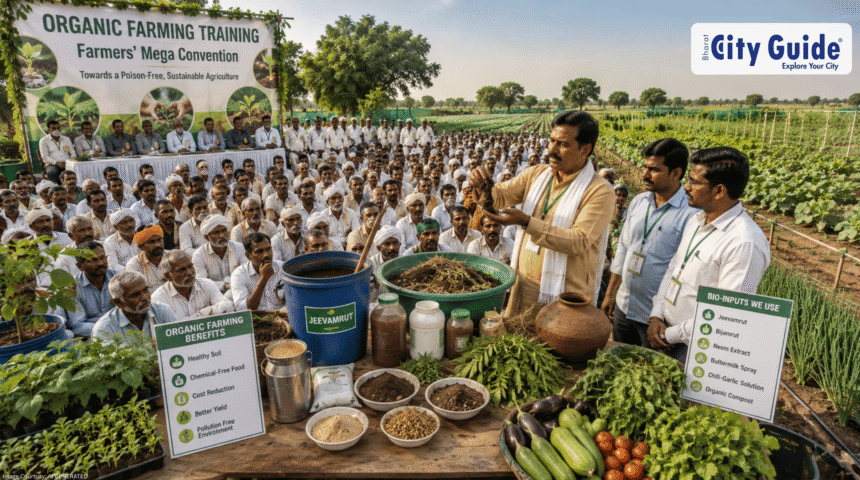
The core feature of the convention is its focus on active, live demonstrations. Instead of relying on passive PowerPoint presentations, the exhibition grounds feature fully operational processing stations where agricultural experts prepare traditional bio-formulations directly in front of the audience.
Farmers observe the exact ratios, mixing steps, and fermentation timelines required to prepare powerful organic treatments. For instance, the live demonstration shows how mixing indigenous cow dung and urine with local pulse flour, jaggery, and undisturbed topsoil creates a highly concentrated microbial solution. When applied to fields, this mixture acts as a powerful bio-catalyst, unlocking fixed soil nutrients and making them easily accessible to crop roots.
Specialized sessions also focus on natural seed treatment techniques. Experts demonstrate how coating seeds with anti-fungal microbial pastes prior to planting protects delicate seedlings from soil-borne pathogens without the use of toxic chemical powders. This visual, hands-on learning environment ensures that attendees can easily replicate these exact processes back on their own family farms.
Benefits and Core Features of Organic Practices
Implementing structured organic farming methods yields multi-dimensional benefits that extend far beyond individual crop fields:
Environmental and Soil Benefits
- Restoration of Soil Biodiversity: Eliminating chemical toxicity allows vital soil organisms, such as mycorrhizal fungi and earthworms, to thrive, establishing a self-sustaining nutrient cycling ecosystem.
- Enhanced Water Conservation: Soil rich in organic matter acts like a sponge. It retains moisture for significantly longer periods, reducing overall irrigation frequency and protecting crops from unexpected rainfall shortages.
- Mitigation of Agricultural Pollution: Stopping the use of synthetic chemicals prevents toxic runoff from entering local groundwater tables, rivers, and village ponds, preserving freshwater ecosystems.
Financial and Operational Advantages
- Drastic Drop in Upfront Costs: Because the necessary biological inputs are manufactured directly on-site using local components, farmers save significant capital previously spent on commercial chemical packages.
- Premium Market Value: As global and domestic consumer awareness grows, organically certified commodities command substantially higher retail prices, boosting net profit margins for rural producers.
How It Impacts Different Segments of Society
1. The Farming Community
For everyday agriculturalists, this event provides a practical blueprint to improve their financial resilience. By shifting away from volatile, market-dependent chemical pricing, they can stabilize their seasonal production expenses and protect their own physical health from the chronic hazards associated with handling toxic chemical sprays.
2. General Consumers and Families
Urban populations stand to benefit immensely from the widespread adoption of these methods. A larger supply of verified organic produce means families gain consistent access to clean, nutrient-dense food options that are completely free from toxic chemical trace elements, lowering long-term healthcare risks.
3. Students and Agricultural Researchers
For young students and research scholars attending the meet, the live setups offer an ideal setting to study applied agroecology. It bridges the gap between academic theory and practical field challenges, inspiring new research into optimizing natural biological crop protection.
Expert Insights and Industry Perspective
Leading agronomy experts and policy researchers consistently point out that natural agricultural models are highly practical and scalable when supported by strong educational infrastructure. Industry analysts highlight that today’s conscious consumers are demanding absolute transparency regarding the origins of their food.
Agricultural economists stress that the successful scaling of organic cultivation relies on establishing simple, localized certification procedures alongside robust regional supply chains. When farmers receive the training necessary to maintain uniform quality standards, organic clusters can easily link up with major retail networks and international export markets, turning sustainable agriculture into a highly lucrative enterprise.
Challenges and Limitations of the Organic Transition
Despite the undeniable advantages, shifting completely away from chemical paradigms presents certain structural challenges that farmers must navigate:
- The Initial Conversion Period: Soils that have been heavily dependent on chemical inputs for decades often require a transition phase of two to three years to rebuild their natural biological activity. During this time, initial crop yields can fluctuate before stabilizing.
- Labor-Intensive Management: Preparing organic formulations, managing biodiversity, and handling mechanical weeding requires more hands-on physical labor and closer daily field monitoring than simply applying synthetic chemical sprays.
- Lack of Widespread Supply Networks: While access to chemical inputs is universal, organized distribution channels for bulk organic raw materials, specialized bio-fertilizers, and dedicated organic processing units are still growing in many rural zones.
Future Outlook
The long-term future of agriculture is undeniably moving toward sustainable, natural systems. Over the coming decade, climate variability and rising resource costs will continue to make chemical-dependent farming increasingly difficult to sustain economically. Events like this major convention in Gujarat are setting the foundation for an organized agricultural transition.
As regional knowledge networks expand, we are likely to see the rise of highly advanced bio-refineries run directly by rural cooperatives. These hubs will produce standardized natural fertilizers and pest repellents at scale. Combined with growing consumer support and favorable state policies, the widespread implementation of organic methodologies will play an indispensable role in safeguarding national food security, regenerating rural ecosystems, and ensuring long-term agricultural prosperity.
Frequently Asked Questions (FAQs)
Q1: What are the main benefits of adopting organic farming methods?
The primary benefits include a significant reduction in seasonal production costs, restoration of long-term soil fertility, improved field water retention, and the elimination of chemical chemical residues from human food supplies.
Q2: How do natural methods control crop pests without chemical sprays?
Natural methods utilize botanical extracts, such as fermented neem, chili, and garlic solutions, alongside strategic crop rotation and the conservation of beneficial predatory insects that naturally control pest populations.
Q3: Will crop yields drop immediately after stopping chemical inputs?
Vast fields that are deeply degraded by decades of chemical use may experience a temporary yield adjustment during the initial conversion phase. However, as soil biology recovers, yields stabilize and become significantly more resilient to climate stresses.
Q4: What role did the live demonstrations play at the convention?
The live demonstrations allowed farmers to see the exact formulations, mixing steps, and fermentation periods required to make bio-inputs, giving them the practical knowledge to replicate the processes on their own farms.
Q5: How does organic cultivation help conserve water?
Organic practices dramatically increase the organic carbon and humus content within the soil. This structural improvement allows the ground to hold water much longer, reducing overall irrigation needs.
Q6: Are organic agricultural products economically viable for smallholder farmers?
Yes. Although they require more hands-on management, the near-zero cost of manufacturing bio-inputs on-site, combined with premium market prices for organic crops, results in higher net profitability.
Conclusion
The massive farmers’ convention in Gujarat underscores an essential truth: the transition to sustainable agriculture is no longer just an alternative choice, but an absolute necessity for long-term survival. By focusing heavily on live, practical demonstrations of organic farming methods, this event successfully demystifies chemical-free farming and equips rural communities with actionable tools to revitalize their lands.
Replacing toxic chemical paradigms with robust, nature-based biological inputs allows agriculturalists to restore soil health, slash input costs, and protect public health. As these ecological frameworks continue to gain momentum among producers and consumers alike, they will pave the way for a highly resilient, prosperous, and poison-free agricultural economy for generations to come.