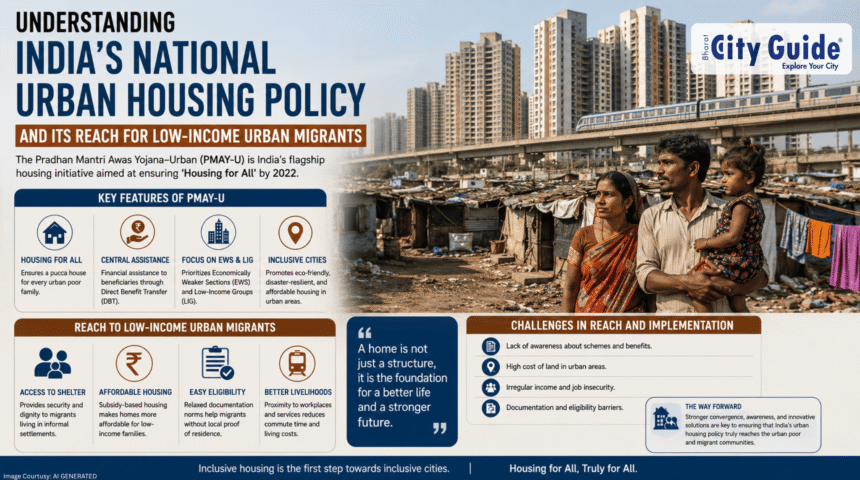
Introduction
India’s rapid urbanization has created both opportunity and challenge. Cities are expanding at an unprecedented pace, attracting millions of people from rural areas in search of better employment, education, and living standards. This large-scale migration has significantly increased the demand for affordable urban housing.
- Introduction
- Key Objective:
- 1. Rapid Urbanization
- 2. Migration Pressure
- 3. Housing Shortage
- 4. Informal Settlements
- Common Occupations:
- 1. Affordable Housing Development
- 2. Rental Housing Frameworks
- 3. Slum Rehabilitation Programs
- 4. Urban Livelihood Integration
- 1. Pradhan Mantri Awas Yojana (Urban)
- 2. Affordable Rental Housing Complexes
- 3. Smart Cities Mission
- 1. High Rental Costs
- 2. Lack of Documentation
- 3. Informal Housing Dependence
- 4. Job-Housing Distance
- 1. Slow Project Execution
- 2. Regional Inequality
- 3. Limited Rental Housing Supply
- 4. Awareness Issues
- Characteristics:
- Policy Response:
- Positive Outcomes:
- Benefits:
- Expected Trends:
- 1. Expand Rental Housing Supply
- 2. Improve Migrant Documentation Access
- 3. Speed Up Project Execution
- 4. Strengthen Urban Infrastructure
- 1. What is India’s urban housing policy?
- 2. Who benefits from it?
- 3. What is the biggest challenge?
- 4. Are migrants eligible for housing schemes?
- 5. What is affordable rental housing?
- 6. What is the role of Smart Cities?
- 7. Is urban housing improving in India?
However, for low-income urban migrants, access to safe, affordable, and dignified housing remains one of the biggest challenges in India’s urban development story.
To address this issue, the government has introduced multiple housing initiatives under its broader urban development framework. These policies aim to ensure that every citizen, regardless of income level, has access to adequate housing in cities.
In this article, we take a deep dive into Understanding India’s National Urban Housing Policy And Its Reach For Low-Income Urban Migrants, examining its objectives, implementation, challenges, and real-world impact.
What is India’s National Urban Housing Policy?
India’s National Urban Housing Policy is a government framework designed to promote affordable housing, reduce homelessness, and improve living conditions in urban areas.
Key Objective:
“To provide affordable and inclusive housing for all urban residents, especially economically weaker sections.”
Why Urban Housing Policy is Important in India
1. Rapid Urbanization
Cities are growing faster than infrastructure development.
2. Migration Pressure
Millions of workers migrate to cities annually.
3. Housing Shortage
Urban areas face a significant shortage of affordable housing units.
4. Informal Settlements
Many migrants live in slums or informal housing.
Who Are Low-Income Urban Migrants?
Low-income urban migrants are individuals or families who:
- Move from rural to urban areas
- Work in informal or low-paying jobs
- Have limited access to formal housing markets
Common Occupations:
- Construction workers
- Domestic helpers
- Street vendors
- Factory laborers
- Gig economy workers
Understanding India’s National Urban Housing Policy And Its Reach For Low-Income Urban Migrants
The policy aims to improve housing accessibility for migrants, but its effectiveness varies across regions.
1. Affordable Housing Development
Government-supported housing schemes aim to:
- Construct low-cost housing units
- Provide subsidies for home ownership
- Encourage public-private partnerships
2. Rental Housing Frameworks
Rental housing is a key focus area for migrants who:
- Do not own property
- Frequently change cities or jobs
3. Slum Rehabilitation Programs
Programs focus on:
- Upgrading slum areas
- Providing basic amenities
- Relocating residents to formal housing
4. Urban Livelihood Integration
Housing policies are linked with:
- Employment opportunities
- Transport access
- Social infrastructure
Major Government Initiatives Supporting Urban Housing
1. Pradhan Mantri Awas Yojana (Urban)
A flagship housing scheme aimed at providing affordable housing to urban residents.
2. Affordable Rental Housing Complexes
Designed specifically for migrant workers near industrial and job hubs.
3. Smart Cities Mission
Focuses on:
- Planned urban development
- Infrastructure improvement
- Housing integration
Challenges Faced by Urban Migrants
1. High Rental Costs
Urban rent is often unaffordable for low-income workers.
2. Lack of Documentation
Many migrants lack:
- Identity proof
- Address proof
- Formal employment records
3. Informal Housing Dependence
Slums and temporary shelters remain common.
4. Job-Housing Distance
Migrants often live far from workplaces.
Implementation Gaps in Housing Policy
1. Slow Project Execution
Delays in construction and delivery.
2. Regional Inequality
Uneven housing development across states.
3. Limited Rental Housing Supply
Rental schemes are still underdeveloped.
4. Awareness Issues
Many migrants are unaware of available schemes.
Urban Slums and Informal Settlements
Characteristics:
- Overcrowded living conditions
- Lack of sanitation
- Limited access to utilities
Policy Response:
- Slum redevelopment projects
- Infrastructure upgrades
- Relocation programs
Role of Public-Private Partnerships (PPP)
PPP models help:
- Increase housing supply
- Improve construction efficiency
- Share financial burden
Migration and Housing Demand Pressure
India’s migration trends significantly impact housing demand in:
- Metro cities
- Industrial hubs
- Emerging urban centres
Role of Affordable Rental Housing
Rental housing is critical because:
- Migrants often do not settle permanently
- Ownership is not feasible for low-income groups
- Flexibility is required for job mobility
Smart City Integration with Housing Policy
Smart cities aim to:
- Integrate housing with transport
- Improve digital infrastructure
- Ensure planned urban expansion
Environmental and Infrastructure Considerations
Urban housing development must address:
- Water supply
- Waste management
- Energy efficiency
- Urban congestion
Social Impact of Housing Policy
Positive Outcomes:
- Improved living conditions
- Better access to services
- Reduced homelessness
Economic Impact
Benefits:
- Construction job creation
- Real estate sector growth
- Urban productivity improvement
Technology in Housing Development
Modern housing projects use:
- GIS mapping
- Digital land records
- Smart construction techniques
Future of Urban Housing in India
Expected Trends:
- Expansion of rental housing
- AI-based urban planning
- Sustainable housing models
- Increased private sector involvement
Key Policy Recommendations
1. Expand Rental Housing Supply
2. Improve Migrant Documentation Access
3. Speed Up Project Execution
4. Strengthen Urban Infrastructure
Importance of Inclusive Urban Growth
Inclusive housing ensures:
- Social equality
- Economic stability
- Sustainable urban development
Frequently Asked Questions (FAQs)
1. What is India’s urban housing policy?
It is a framework to provide affordable housing in cities.
2. Who benefits from it?
Low-income groups and urban migrants.
3. What is the biggest challenge?
Lack of affordable rental housing.
4. Are migrants eligible for housing schemes?
Yes, under specific government programs.
5. What is affordable rental housing?
Low-cost housing for temporary urban workers.
6. What is the role of Smart Cities?
They integrate housing with urban infrastructure.
7. Is urban housing improving in India?
Yes, but challenges remain in execution and scale.
Conclusion
India’s urban transformation is closely linked with its ability to provide safe, affordable, and inclusive housing. For millions of low-income urban migrants, housing is not just a basic need but a foundation for dignity, stability, and opportunity.
The Understanding India’s National Urban Housing Policy And Its Reach For Low-Income Urban Migrants highlights both progress and challenges. While government initiatives have expanded housing availability and improved urban planning, gaps in rental housing, affordability, and implementation still need attention.
As India continues to urbanize, strengthening housing policy will be essential for building equitable, sustainable, and livable cities for all.