Introduction
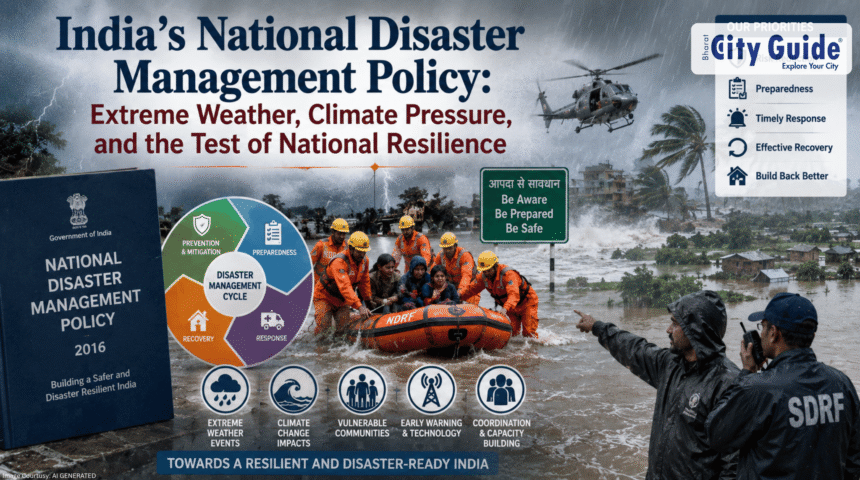
India is increasingly confronting a new era of environmental uncertainty where climate-linked extreme weather events are placing unprecedented pressure on governance systems, infrastructure, public safety, and economic stability. Heatwaves, cyclones, flash floods, droughts, landslides, glacial disruptions, urban flooding, and irregular monsoon behavior are no longer isolated concerns—they are becoming more frequent stress tests for policy execution and disaster preparedness. In this context, India’s National Disaster Management Policy has emerged as one of the country’s most critical institutional frameworks for protecting lives, livelihoods, and infrastructure.
- Introduction
- What is India’s National Disaster Management Policy?
- Why Extreme Weather Is Testing India’s National Disaster Management Policy
- Heatwaves: A Growing Public Health and Governance Crisis
- Floods and Urban Drainage Failures
- Cyclones and Coastal Preparedness
- Droughts, Water Scarcity, and Agricultural Stress
- Himalayan and Mountain Vulnerabilities
- Institutional Strengths of India’s Disaster Framework
- Major Gaps and Execution Challenges
- Technology, Forecasting, and Early Warning Systems
- Climate Change and Policy Evolution
- Public Health Infrastructure During Disasters
- Community Awareness and Citizen Participation
- Economic Costs of Extreme Weather
- Future of India’s National Disaster Management Policy
- Frequently Asked Questions About India’s National Disaster Management Policy
- Conclusion
Originally designed to strengthen prevention, preparedness, mitigation, response, recovery, and resilience, India’s disaster management architecture now faces intensifying challenges from climate variability and large-scale extreme weather patterns. As both urban and rural India experience climate-related disruptions, the effectiveness of disaster governance is increasingly measured not just by emergency response, but by early warning systems, adaptive infrastructure, inter-agency coordination, public communication, and long-term climate resilience.
India’s National Disaster Management Policy is therefore being tested in ways that go beyond traditional disaster response—it is being challenged by the realities of a warming planet, population density, environmental degradation, and rising economic vulnerability.
Understanding how India’s policy performs under these evolving pressures is essential to evaluating the country’s readiness for a future where extreme weather may become a defining governance challenge.
What is India’s National Disaster Management Policy?
India’s National Disaster Management Policy refers to the strategic framework and institutional systems developed to reduce disaster risks, coordinate emergency response, and strengthen resilience across the country.
Core Objectives:
- Disaster prevention
- Risk reduction
- Preparedness
- Early warning
- Emergency response
- Rehabilitation
- Long-term resilience
Key Institutional Backbone:
The disaster governance framework includes national, state, and district-level coordination systems.
In Simple Terms:
It is India’s roadmap for managing natural and human-caused disasters more effectively.
Why Extreme Weather Is Testing India’s National Disaster Management Policy
Major Climate Stressors:
- Heatwaves
- Cyclones
- Flooding
- Droughts
- Landslides
- Urban flooding
- Coastal erosion
Key Reality:
Climate volatility increases both frequency and complexity.
Strategic Concern:
Traditional disaster models may not fully address climate-intensified patterns.
Heatwaves: A Growing Public Health and Governance Crisis
Rising temperatures have become one of India’s most visible extreme weather threats.
Major Risks:
- Heatstroke
- Water stress
- Agricultural disruption
- Worker productivity decline
- Urban health emergencies
Policy Test:
Can public systems provide:
- Early warnings
- Cooling access
- Health advisories
- City planning adaptation?
Bigger Lesson:
Heat resilience is now central to disaster governance.
Floods and Urban Drainage Failures
Common Challenges:
- Monsoon flooding
- Flash floods
- River overflow
- Drainage overload
- Informal settlement vulnerability
Urban Problem:
Rapid urbanization often outpaces drainage planning.
Strategic Concern:
Disaster policy increasingly overlaps with infrastructure governance.
Cyclones and Coastal Preparedness
India’s coastal states regularly face severe cyclone risks.
Progress:
Improved evacuation systems have often reduced casualties.
Continuing Challenges:
- Property destruction
- Livelihood disruption
- Coastal infrastructure damage
Key Strength:
Early warning and evacuation can save lives.
Droughts, Water Scarcity, and Agricultural Stress
Key Impacts:
- Crop failure
- Rural distress
- Water shortages
- Migration pressures
Policy Challenge:
Disaster management must increasingly integrate water security and agricultural adaptation.
Strategic Shift:
Preparedness now includes climate-sensitive development.
Himalayan and Mountain Vulnerabilities
Emerging Risks:
- Landslides
- Glacier-related disruptions
- Flash floods
- Infrastructure fragility
Key Issue:
Ecologically sensitive zones face compounded risk from both development and climate shifts.
Institutional Strengths of India’s Disaster Framework
Major Advantages:
- Established national structures
- Cyclone warning progress
- Disaster response forces
- Multi-level governance
- Growing public awareness
Strategic Value:
Institutional capacity can significantly reduce mortality when effectively deployed.
Major Gaps and Execution Challenges
Persistent Weaknesses:
- Uneven local implementation
- Rural vulnerability
- Infrastructure gaps
- Resource constraints
- Urban planning deficits
- Last-mile communication barriers
Important Reality:
Policy quality and execution quality are not always the same.
Technology, Forecasting, and Early Warning Systems
Important Tools:
- Satellite monitoring
- Mobile alerts
- Weather forecasting
- GIS mapping
- Community warning systems
Benefits:
Better forecasting can improve preparedness.
Key Limitation:
Technology must be accessible and actionable.
Climate Change and Policy Evolution
Strategic Question:
Can disaster policy remain reactive, or must it become adaptive?
Emerging Priorities:
- Climate-resilient infrastructure
- Heat action plans
- Flood-resilient cities
- Water resilience
- Nature-based solutions
Bigger Insight:
Disaster management increasingly intersects with climate policy.
Public Health Infrastructure During Disasters
Critical Areas:
- Emergency medicine
- Heat response
- Disease surveillance
- Safe water
- Shelter systems
Key Lesson:
Public health readiness is disaster readiness.
Community Awareness and Citizen Participation
Why It Matters:
- Local preparedness
- Evacuation compliance
- Resource efficiency
- Reduced panic
Effective Formula:
Awareness + Trust + Infrastructure + Communication
Economic Costs of Extreme Weather
Major Consequences:
- Crop loss
- Infrastructure damage
- Insurance pressure
- Public expenditure
- Employment disruption
National Significance:
Extreme weather can affect long-term development.
Future of India’s National Disaster Management Policy
Strategic Priorities:
- Climate adaptation
- Local resilience
- Smart infrastructure
- Integrated planning
- Stronger district systems
- Data-driven preparedness
Strategic Outlook:
The future may depend on shifting from disaster response to disaster resilience.
Frequently Asked Questions About India’s National Disaster Management Policy
What is the main purpose of the policy?
To reduce disaster risks and improve preparedness.
Why is extreme weather a major challenge?
Climate variability is increasing disaster intensity and unpredictability.
Is India improving cyclone preparedness?
Early warning and evacuation systems have shown progress.
What is the biggest challenge?
Implementation consistency across regions.
Does disaster policy include climate change?
Increasingly, climate adaptation is becoming essential.
Why are cities vulnerable?
Urbanization, drainage gaps, and population density increase risks.
What is the future priority?
Building resilience before disasters occur.
Conclusion
India’s National Disaster Management Policy stands at a critical crossroads as extreme weather events increasingly test the country’s governance systems, public infrastructure, and climate preparedness. While institutional progress in forecasting, evacuation, and response has strengthened certain capacities, the growing scale of climate-linked threats demands deeper transformation.
The future of disaster management in India may depend less on responding after catastrophe and more on building resilient cities, climate-smart agriculture, adaptive public health systems, and proactive infrastructure.
As climate realities intensify, one broader lesson becomes increasingly clear: disaster management is no longer just an emergency function—it is a foundational pillar of national resilience, sustainable development, and human security.