Introduction
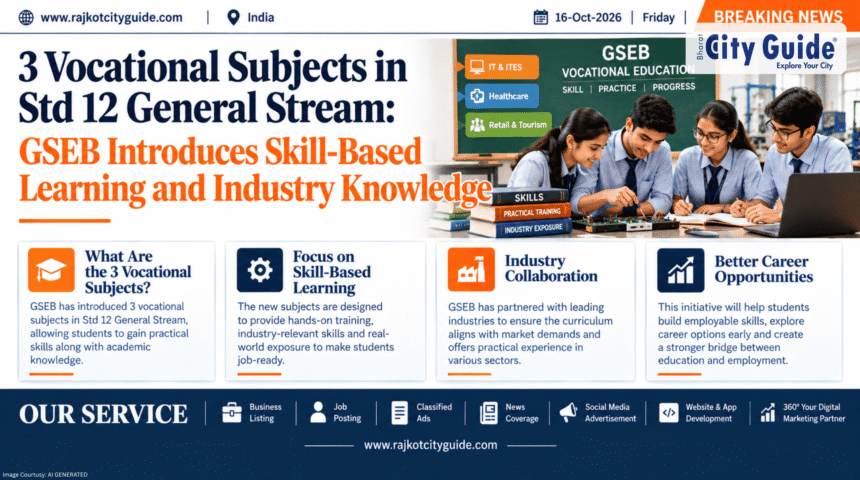
In a transformative educational reform aimed at bridging the gap between theoretical schooling and practical industry requirements, the Gujarat Secondary and Higher Secondary Education Board (GSEB) has formally introduced 3 Vocational Subjects in Std 12 General Stream. To ensure seamless academic preparation across secondary and higher secondary schools, the state education board has already dispatched official question papers, curriculum guidelines, and model sample papers directly to school administrators. This progressive step allows Class 12 General Stream students to gain hands-on technical skills alongside their traditional academic coursework.
- Introduction
- What is 3 Vocational Subjects in Std 12 General Stream?
- Why This News is Important
- Background Information
- Key Highlights
- Detailed Explanation of the Academic Reform
- Benefits and Importance of Vocational Learning
- How It Impacts People
- Expert Insights and Educational Perspective
- Challenges and Implementation Factors
- Frequently Asked Questions (FAQs)
- Conclusion
The decision to incorporate job-oriented skill courses into the standard Higher Secondary Certificate (HSC) curriculum reflects a broader national shift toward vocationalization under the National Education Policy (NEP). For decades, students pursuing the General Stream were primarily restricted to theoretical humanities, arts, and commerce subjects, leaving many unprepared for immediate workforce requirements or specialized technical diploma courses after graduation. By integrating practical skill subjects into the main board examination framework, GSEB is empowering students with real-world industry knowledge early in their academic journey.
This initiative holds significant importance for high school students, educators, and industrial employers across Gujarat. School principals and subject teachers have received standardized sample question papers to familiarize students with the new examination blueprints, marking schemes, and practical evaluation methods. By equipping young learners with career-ready skill sets, the introduction of vocational courses in Class 12 promises to enhance employability, foster youth entrepreneurship, and strengthen regional economic development.
What is 3 Vocational Subjects in Std 12 General Stream?
The initiative introducing 3 Vocational Subjects in Std 12 General Stream refers to the formal integration of skill-based, industry-aligned technical subjects into the regular Class 12 Higher Secondary curriculum governed by the Gujarat Secondary and Higher Secondary Education Board (GSEB). Designed specifically for students enrolled in the Arts and Commerce tracks, these vocational modules replace or supplement traditional elective subjects with practical, career-focused learning disciplines.
The vocational subjects added to the board syllabus focus on high-demand industry sectors, incorporating applied technologies, digital skills, retail management, financial services, healthcare assistance, and information technology applications. The curriculum combines classroom theoretical concepts with mandatory laboratory practicals, hands-on project assignments, and industry-oriented skill assessments.
To ensure that schools, teachers, and students adapt smoothly to this revised academic format, GSEB has released official model question papers and sample test structures. These resources outline the distribution of marks between written theory examinations and practical skill assessments, providing a clear roadmap for classroom teaching and final board exam preparation.
Why This News is Important
The integration of practical vocational training into the senior secondary school curriculum represents a landmark policy shift for Gujarat’s educational ecosystem. First, it addresses the persistent skill mismatch between traditional academic degrees and modern industry expectations. Manufacturing hubs, service industries, digital enterprises, and commercial businesses frequently require entry-level professionals with practical technical knowledge—skills that conventional textbook learning often fails to provide.
Second, this initiative offers vital academic flexibility and alternative career pathways for students who may not wish to pursue traditional multi-year university degree programs. Mastering applied vocational skills in Class 12 allows students to transition smoothly into specialized vocational diplomas, technical training programs, or entry-level industry roles immediately after completing secondary school.
Finally, dispatching standardized sample papers and question blueprints directly to schools ensures equity and clarity across all urban and rural educational institutes. Students studying in remote districts receive the exact same curriculum guidance, practical rubrics, and exam preparation materials as those in major metropolitan centers like Ahmedabad, Rajkot, Surat, and Vadodara.
Background Information
Historically, Indian secondary education maintained a rigid divide between academic streams (Science, Arts, and Commerce) and vocational technical training (such as ITI programs and polytechnic diplomas). Class 12 General Stream students spent the majority of their academic years focusing on theoretical subjects, leaving little room for hands-on application or technical skill building.
Recognizing the need for holistic, flexible learning, the National Education Policy (NEP) recommended integrating vocational education into mainstream school curricula starting from secondary grade levels. The goal is to ensure that at least 50% of school learners receive exposure to vocational skills, cultivating dignity of labor and practical problem-solving abilities.
+-----------------------------------------------------------------------+
|             GSEB VOCATIONAL EDUCATION REFORM AT A GLANCE              |
+--------------------------+--------------------------------------------+
| Governing Body           | Gujarat Board (GSEB)                       |
| Target Class & Stream    | Class 12 (Std 12) General Stream           |
| Core Reform              | Inclusion of 3 Industry Vocational Subjects|
| Curriculum Focus         | Practical Skills & Industry Knowledge      |
| Official Materials Sent  | Sample Papers, Blueprints & Question Banks |
| Key Objective            | Enhance Student Employability & Skill Base |
+--------------------------+--------------------------------------------+
In line with these national directives, the Gujarat Education Department developed specialized vocational syllabi tailored to regional industrial needs. Following successful curriculum piloting and textbook preparation, the board published formal guidelines and sample question papers for Class 12 schools ahead of upcoming board examinations.
Key Highlights
- Board-Level Skill Integration: GSEB officially includes 3 vocational, skill-based subjects in the Class 12 General Stream curriculum.
- Sample Papers Dispatched: Official sample question papers, marking schemes, and exam blueprints distributed to all affiliated higher secondary schools.
- Industry-Oriented Curriculum: Coursework designed to impart practical, real-world knowledge across technology, commerce, and service sectors.
- Balanced Evaluation Structure: Assessment framework divided between written theoretical examinations and hands-on practical evaluations.
- Aligned with NEP Framework: Supports national education directives promoting early vocational exposure and skill-based learning in schools.
- Direct Career Readiness: Prepares students for immediate entry-level technical roles, vocational diplomas, or entrepreneurial ventures after HSC completion.
Detailed Explanation of the Academic Reform
The rollout of the vocational education framework in Class 12 schools across Gujarat follows a structured academic plan managed by GSEB and regional district education offices (DEOs). School principals have received comprehensive instructional kits containing subject syllabi, practical lab guidelines, and model question papers designed by academic subject experts.
Under the new exam pattern, the 3 vocational subjects feature a dual assessment model. Unlike conventional subjects that rely entirely on 100-mark written theory papers, vocational subjects allocate a significant percentage of total marks to practical performance, laboratory work, viva-voce examinations, and project reports.
+-----------------------------------------------------------------------+
|                   VOCATIONAL CURRICULUM ASSESSMENT FLOW               |
+--------------------------+--------------------------------------------+
| Assessment Component     | Evaluation Focus & Practical Application   |
+--------------------------+--------------------------------------------+
| Written Board Theory     | Conceptual understanding & subject fundamentals|
| Practical Lab Work       | Hands-on execution of technical tools & tasks|
| Project & Viva-Voce      | Practical problem-solving & oral defense   |
| Continuous Evaluation    | Classroom assignments & skill portfolio    |
+--------------------------+--------------------------------------------+
The sample papers dispatched to schools clearly demonstrate this balanced question design. Theory papers include objective multiple-choice questions (MCQs), short analytical questions, and scenario-based problem-solving cases. Meanwhile, practical assessments require students to demonstrate real-time technical operations, equipment handling, or software application skills in front of certified external examiners.
Benefits and Importance of Vocational Learning
The formal introduction of skill subjects in Class 12 General Stream offers widespread advantages for students, schools, and industrial sectors:
1. Enhanced Employability and Job Readiness
Gaining practical familiarity with industry tools, digital software, and operational workflows during high school makes students significantly more attractive to potential employers seeking job-ready entry-level personnel.
2. Dignity of Skill and Vocational Confidence
Integrating vocational training into mainstream board exams removes the societal stigma once associated with technical trades, instilling pride and confidence in practical craftsmanship and technical expertise.
3. Fostering Youth Entrepreneurship
Learning practical business operations, digital tools, and service management empowers students to launch independent small businesses, freelance services, or local enterprises upon completing their secondary education.
4. Smooth Progression to Higher Technical Education
Students who complete vocational subjects in Class 12 gain a strong foundational advantage when applying for professional Bachelor of Vocation (B.Voc) degrees, polytechnic diplomas, or specialized technical certifications.
How It Impacts People
This visionary educational policy reform creates a lasting, positive impact across multiple segments of society:
- For High School Students: Expands learning options beyond traditional textbook memorization, offering engaging, hands-on skill courses that match personal career interests.
- For Parents and Families: Provides peace of mind knowing that their children are acquiring practical, career-oriented capabilities that improve employment prospects without requiring expensive private coaching.
- For High School Teachers and Educators: Encourages interactive teaching methodologies, practical lab instruction, and continuous skill assessment rather than purely lecture-based teaching.
- For Industrial Employers and MSMEs: Creates a well-trained, skilled local talent pool equipped with basic technical competencies, reducing onboarding time and training costs for regional businesses.
Expert Insights and Educational Perspective
Education policy experts and industrial leaders strongly praise GSEB’s decision to integrate practical vocational learning into the General Stream. According to senior educational researchers, secondary education must evolve from passive information delivery to active skill acquisition. Introducing structured vocational subjects ensures that students develop logical reasoning, technical adaptability, and practical problem-solving capabilities.
Industrial human resource managers highlight that modern employers value applied competencies over theoretical memorization. Equipping Class 12 students with foundational exposure to technical tools, customer service management, and digital applications prepares them to adapt smoothly to modern corporate environments.
Furthermore, school principals commend the board for proactively distributing sample papers and question blueprints well before board examinations. Providing clear model papers eliminates exam anxiety, allowing teachers to align classroom instruction directly with board evaluation standards.
Challenges and Implementation Factors
While introducing vocational education is a visionary step, ensuring sustainable success across all Gujarat schools requires managing key operational factors:
- Upgrading School Infrastructure and Practical Labs: Equipping secondary schools in rural and semi-urban areas with modern computer labs, technical equipment, and practical training facilities.
- Teacher Training and Skill Faculty Recruitment: Conducting comprehensive professional development workshops for existing teachers and hiring specialized vocational instructors with real industry experience.
- Maintaining Standardized Practical Assessments: Ensuring that practical examinations, internal project grading, and external viva-voce assessments are conducted with complete fairness and transparency across all districts.
- Sustaining Industry Partnerships: Establishing formal collaboration networks between local schools, industrial associations, and vocational training institutes to provide real-world internship exposure for students.
Frequently Asked Questions (FAQs)
What new update has GSEB issued for Std 12 General Stream?
GSEB has formally included 3 vocational skill subjects in the Class 12 General Stream curriculum and dispatched official sample question papers and exam blueprints to schools.
Why were vocational subjects introduced in Class 12 General Stream?
They were introduced to provide students with real-world industry knowledge, practical technical skills, and enhanced job readiness alongside traditional academic studies.
How will vocational subjects be evaluated in board examinations?
Vocational subjects feature a dual evaluation model combining a written theoretical board exam with practical laboratory tests, project assignments, and viva-voce evaluations.
What resources have been sent to schools by the education board?
GSEB has sent official sample question papers, model blueprints, marking schemes, and curriculum guidelines to help teachers and students prepare for board exams.
How does this initiative benefit students pursuing Arts and Commerce streams?
It expands their career options beyond pure theoretical subjects, equipping them with practical technical skills that improve employability, entrepreneurship opportunities, and admission prospects for professional B.Voc degree programs.
Is this reform aligned with the National Education Policy (NEP)?
Yes, incorporating vocational skill education into mainstream secondary school curricula is a central recommendation of the National Education Policy (NEP).
Can students pursue higher education after studying vocational subjects in Class 12?
Absolutely. Students completing Class 12 with vocational subjects can pursue standard university degree courses, professional Bachelor of Vocation (B.Voc) programs, technical diplomas, or direct career pathways.
Conclusion
The formal inclusion of 3 Vocational Subjects in Std 12 General Stream by the Gujarat Secondary and Higher Secondary Education Board marks a monumental step forward in modernizing high school education. By providing practical industry knowledge alongside traditional academic subjects, the board is empowering young learners with the tools required to thrive in a rapidly evolving job market.
Distributing official sample papers and exam blueprints directly to schools guarantees that students and teachers across Gujarat can adapt smoothly to this skill-based evaluation framework.
As secondary schools integrate hands-on practical training into daily learning, Class 12 students will gain the confidence, technical competence, and career clarity needed for future success. This visionary educational reform ensures that Gujarat’s youth step out of secondary school not just with academic diplomas, but with genuine, real-world skills that drive personal growth and national progress.