Introduction̥
In modern mass transportation, passenger safety remains the foundational pillar of operational excellence. Indian Railways, one of the world’s largest rail networks, has been progressively embracing cutting-edge technological frameworks to minimize human error and augment technical competence. In a significant leap forward, the Rajkot Railway Division under Western Railway has achieved a historic technological milestone by indigenously developing and deploying an Artificial Intelligence (AI) powered “Smart RS Valve Simulator”.
- Introduction̥
- What is the Rajkot Railway Division?
- Why This News is Important
- Background Information
- Key Highlights
- Detailed Explanation of the Event
- Benefits and Features of the Simulator
- How It Impacts People
- Expert Insights / Industry Perspective
- Challenges and Limitations
- Future Outlook
- Frequently Asked Questions (FAQs)
- Conclusion
This state-of-the-art simulator is explicitly designed to provide advanced, hyper-realistic operational training to locomotive pilots (loco pilots). The emergence of AI within regional railway divisions signals a profound transition from traditional, manual training modules to responsive, tech-driven training ecosystems. By simulating high-stakes braking scenarios and emergency train operations, the new simulator equips rail crews with unprecedented situational readiness. As rail networks expand rapidly to cater to higher passenger densities and semi-high-speed corridors, local innovations driven by the Rajkot Railway Division establish vital safety standards. This detailed analysis explores the architectural, operational, and practical implications of the Smart RS Valve Simulator, illustrating how indigenous AI solutions are transforming the future of Indian Railways.
What is the Rajkot Railway Division?
The Rajkot Railway Division is a crucial administrative subunit operating under the jurisdiction of the Western Railway zone of Indian Railways. Headquartered in the major industrial and cultural hub of Rajkot, Gujarat, this division manages an extensive network of tracks that connect critical commercial sectors across the Saurashtra region. The division plays a vital role in transporting both essential freight and millions of passengers every year. It serves as a structural backbone for regional connectivity, linking ports, industrial areas, and metropolitan centers. Over the decades, the division has evolved from managing standard legacy rail infrastructure into a proactive laboratory for indigenous technological engineering, ensuring that regional growth seamlessly aligns with national safety objectives.
Why This News is Important
The introduction of the AI-based Smart RS Valve Simulator by the Rajkot Railway Division is highly significant for several key reasons:
- Minimization of Human Error: Braking malfunctions and delayed human reflexes remain critical focus areas in global railway accidents. This technology addresses those specific vulnerabilities directly.
- Pioneering Regional Innovation: The simulator stands out because it was developed indigenously at the divisional level, demonstrating the engineering capabilities present within regional railway technical units.
- Scalable Framework for Indian Railways: This successful deployment offers a replicable model that can be expanded across all 68 railway divisions in India, dramatically shifting how loco pilots are prepared for emergency scenarios nationwide.
Background Information
To fully understand the significance of this development, it is essential to examine the mechanics of railway braking systems and traditional pilot training methodologies. In a conventional diesel or electric locomotive, the RS valve operates as an emergency brake application valve. When a loco pilot encounters an unexpected obstruction, an unaligned track, or a signaling failure, activating the emergency brake causes a rapid reduction in brake pipe pressure. This sudden drop triggers the automatic application of brakes across every coach or wagon attached to the locomotive.
Managing this sudden drop in pressure requires exceptional skill. If a pilot applies the emergency brake incorrectly or fails to read the immediate environmental feedback, it can lead to severe issues. The train might experience wheel slipping, extreme structural jerking, or even derailment due to uneven forces running through the length of the train.
Historically, loco pilots learned how to manage these delicate pneumatic and mechanical systems through theoretical classroom instruction or during supervised operations on live, moving trains. However, practicing high-stakes emergency scenarios on actual tracks carries obvious safety risks and operational costs. While full-scale cab simulators have become more common in recent years, they often focus on general track navigation and basic signaling, rather than the specific, highly detailed pneumatic behaviors of emergency valves. Recognizing this training gap, the Senior Divisional Electrical Engineer (Traction) team at the Rajkot Railway Division initiated a specialized project to build a precise, AI-powered training tool.
Key Highlights
- Indigenous Technology: Completely designed and developed within India by the engineering team of the Rajkot Railway Division.
- AI-Enhanced Diagnostics: The simulator uses built-in artificial intelligence to track every nuance of the pilot’s inputs, analyzing how quickly and effectively they respond to sudden pressure changes.
- Realistic Feedback: The system provides real-world tactile and sensory feedback, closely replicating the exact environment pilots face inside a locomotive cab during an emergency stop.
- Targeted Performance Metrics: The system generates detailed post-training analytics, allowing instructors to evaluate exactly where an individual pilot needs refinement.
- Cost-Effective Implementation: Built utilizing regional resources, saving substantial capital that would otherwise be spent on importing expensive foreign simulator hardware.
Detailed Explanation of the Event
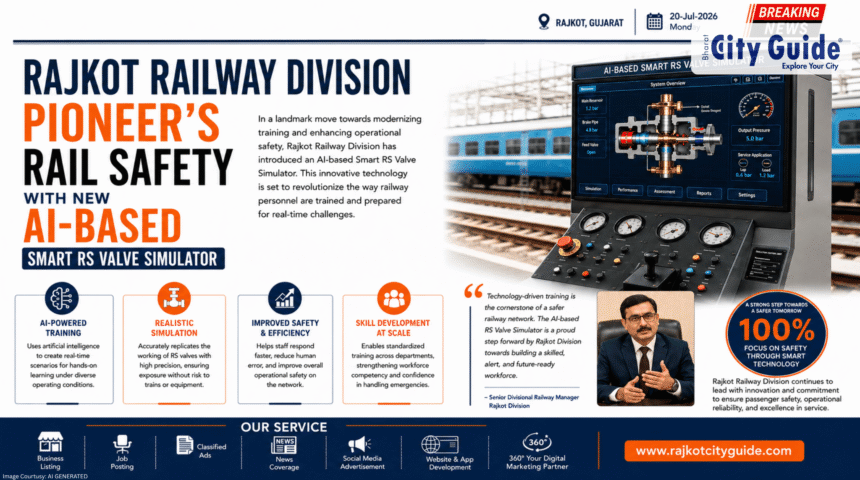
The launch of the Smart RS Valve Simulator represents a major step forward in technical training for Western Railway. Developed under the supervision of the division’s senior traction engineers, the simulator functions as an advanced interactive training bay. It features an authentic physical replica of a locomotive’s desk, complete with standard operational valves, pressure gauges, and control levers.
What sets this system apart is its integrated AI layer. When a trainee pilot operates the RS valve, the system doesn’t just record the action; it evaluates the physics behind the response. The embedded AI tracks variables such as the force applied to the handle, the rate of air pressure discharge, and the pilot’s reaction speed after visual or audible alarms are triggered.
By analyzing this data in real time, the simulator can recreate complex, unpredictable scenarios. For instance, it can simulate an emergency stop during heavy rainfall when tracks are slick, or model how a massive 50-wagon freight train responds compared to a lightweight passenger train. The system gives instructors an objective, data-driven look at a pilot’s habits, highlighting any subtle errors before they can cause real-world issues on the tracks.
Benefits and Features of the Simulator
1. Enhanced Safety Performance
The primary benefit of the simulator is the immediate boost it provides to rail safety. By allowing loco pilots to safely practice high-stakes emergency scenarios repeatedly, it builds strong muscle memory. If a pilot encounters a real-world emergency, their automated response is much more likely to be calm, precise, and correct.
2. Detailed Performance Analytics
Traditional training methods make it difficult to measure exactly how well a pilot manages changing brake pipe pressures. The AI simulator solves this by capturing precise telemetry data. Instructors receive a detailed breakdown of the trainee’s performance, allowing them to provide highly targeted coaching.
3. Reduced Wear and Tear on Rolling Stock
Improper braking techniques can damage equipment, causing flat spots on train wheels and putting excessive stress on couplers. By teaching pilots how to brake smoothly and efficiently, the simulator helps reduce overall maintenance costs and extends the working life of train components.
4. Custom, Adaptable Training Scenarios
The simulator’s software can be easily updated to present pilots with new challenges. Instructors can adjust variables like weather conditions, train weight, and speed on the fly, ensuring that pilots are prepared for a wide variety of unexpected operational environments.
How It Impacts People
For Passengers and Travelers
The most meaningful impact of this technology is the peace of mind it offers to regular passengers. When travelers board a train within the Western Railway network, they can trust that the crew handling their train has been trained using advanced, objective AI tools. This directly translates to smoother rides, fewer sudden jolts, and a much safer travel experience overall.
For Loco Pilots and Rail Crews
Locomotive pilots face immense pressure on the job, carrying responsibility for thousands of lives at any given time. This simulator gives them a safe, stress-free environment to hone their skills and learn from mistakes without real-world consequences. This targeted practice builds deep confidence, reducing job-related anxiety and improving overall career performance.
For the Technical and Engineering Community
For domestic engineers and railway staff, this project stands as a major success story for local innovation. It demonstrates that regional teams can design and deploy high-tech solutions without needing large budgets or relying on imported technology, inspiring further creative problem-solving across the entire organization.
Expert Insights / Industry Perspective
Railway safety experts frequently emphasize that continuous training is the single most effective way to prevent accidents caused by human error. Modern railway research shows that standard classroom instruction simply cannot match the deep learning that happens during hands-on, interactive simulation. Industry professionals note that as trains become faster and heavier, the time a pilot has to react shrinks dramatically. Introducing artificial intelligence into these training systems allows for a highly personalized learning experience, moving away from rigid, one-size-fits-all training programs and tailoring instruction to the specific strengths and weaknesses of each individual pilot.
Challenges and Limitations
While the new simulator brings clear advantages, expanding its use comes with a few natural challenges:
- Integration with Legacy Systems: Blending this advanced simulator data with older, paper-based training records requires careful coordination and administrative updates.
- Hardware Upkeep: Keeping the mechanical valves and highly sensitive AI sensors calibrated across long periods of heavy daily use requires dedicated, consistent maintenance.
- Scaling Production: Transitioning this successful regional prototype into a standardized tool that can be manufactured and distributed to other divisions across India will require structured manufacturing partnerships and additional funding.
Future Outlook
The successful rollout of the Smart RS Valve Simulator by the Rajkot Railway Division marks the beginning of a broader technological shift. Looking ahead, the division is well-positioned to expand this platform by integrating Virtual Reality (VR) headsets, giving pilots a fully immersive, 360-degree view of their operating environment. Furthermore, as Indian Railways continues its nationwide push toward modernization, the data collected by these initial AI systems will likely play a key role in designing future autonomous safety systems and advanced breaking features across the entire national fleet.
Frequently Asked Questions (FAQs)
1. What role does the Rajkot Railway Division play in this new technology?
The Rajkot Railway Division is the core administrative and engineering group that designed, built, and launched the AI-powered Smart RS Valve Simulator locally to improve pilot training.
2. How does the Smart RS Valve Simulator actually work?
The system replicates a real locomotive controls layout, using built-in AI sensors to track a pilot’s reaction times, physical inputs, and braking efficiency during simulated emergency scenarios.
3. Why is training on an RS valve so critical for rail safety?
The RS valve manages the train’s emergency braking system. Operating it incorrectly can lead to severe issues like wheel damage, intense structural jolts, or train derailments.
4. What are the main benefits of using AI in this training?
The AI provides objective, highly accurate data on every trainee, highlighting small operational errors and allowing instructors to customize lessons for each pilot.
5. Does this system replace real, on-track training for pilots?
No, the simulator acts as a powerful preparatory tool, ensuring that pilots develop strong muscle memory and sharp reflexes before they ever begin operating live trains on open tracks.
6. Will this technology be expanded to other parts of Indian Railways?
While currently running as a regional initiative in the Rajkot division, its clear success provides a proven blueprint that can be adopted by other railway divisions across the country.
Conclusion
The deployment of the AI-based Smart RS Valve Simulator by the Rajkot Railway Division marks an important milestone in the modernization of Indian Railways. By using smart technology to improve safety at the ground level, the division has shown how local innovation can solve complex, national-scale engineering challenges. This new training tool gives locomotive pilots the deep confidence and sharp, practiced reflexes needed to handle critical emergency situations smoothly and safely. As the Western Railway network continues to grow and carry more passengers each day, the forward-thinking efforts of the Rajkot Railway Division serve as a premier example of how technology can be used to build a safer, more reliable, and completely modern public transit system.